

/home/kenneth/web/nigeriacommunicationsweek.com.ng/public_html/wp-content/themes/zox-news/parts/post-single.php on line 153
">
Warning: Undefined array key 0 in /home/kenneth/web/nigeriacommunicationsweek.com.ng/public_html/wp-content/themes/zox-news/parts/post-single.php on line 153
Warning: Attempt to read property "cat_name" on null in /home/kenneth/web/nigeriacommunicationsweek.com.ng/public_html/wp-content/themes/zox-news/parts/post-single.php on line 153
Anco Shifts Courier Games to Accommodate Operators

The Association of Nigeria Courier Operators (Anco), has shifted the date of its courier games to the period when operators in the industry will hold their annual general meetings, to ensure that all operators in the industry participate in the games.
Anco in its determination to move the industry to the next stage is fashioning out an array of exercise that will drag stakeholders in the courier and postal business to the streets of Lagos to exercise their body.
The industry which is presently at the verge of monumental reforms will experience relaxation and recreation for the very first time in the industry, as the event is tagged “Jog For Life “.
Siyanbola Oladapo, general secretary of the association who disclosed this to Nigeria CommunicationsWeek last week, said Anco is mobilizing its members for the event which will take place soon.
Oladapo also said that the association is making necessary arrangements like getting clearance from the police and other things to ensure that the event is hitch free.
However, he said that the event, which will be a major get-together for employees of the courier industry will as well provide a platform for members to unwind, recreate and share ideas in a more relaxed and conducive setting.
Furthermore, he said the jogging exercise will help engender the spirit of oneness, promote healthy body and improve productivity level at work.
Oladapo added the event will help to build stronger goodwill for employees of the courier companies and members of their family, who will be very happy to participate and cheer up their fans during the exercise.
Also, he appealed to prospective participants in the jogging exercise to indicate their interest early enough, to enable the association plan ahead and ensure a successful outing.


Warning: Undefined array key 0 in /home/kenneth/web/nigeriacommunicationsweek.com.ng/public_html/wp-content/themes/zox-news/parts/post-single.php on line 493
Warning: Attempt to read property "cat_ID" on null in /home/kenneth/web/nigeriacommunicationsweek.com.ng/public_html/wp-content/themes/zox-news/parts/post-single.php on line 493
General News
MSMEs Paucity of Funds Receives Boost as Senate Backs Bill Seeking to Unlock Cash for them


Businesses across Nigeria, particularly micro, small and medium enterprises (MSMEs), may soon be able to convert unpaid invoices and credit sales into immediate cash without relying on conventional bank loans following the passage of the Factoring, Assignments and Receivables Financing Bill for second reading in the Senate.

The bill, which seeks to establish a legal framework for factoring and receivables financing, is expected to improve access to credit, boost liquidity for businesses and enhance domestic and international trade.
It also seeks to provide legal certainty for the assignment of receivables through factoring, promote transparency, modernise assignment laws and facilitate greater access to credit for businesses across the country.
Leading debate on the bill which was sent from the House of Representatives for concurrence, Senate Leader Opeyemi Bamidele said on Tuesday that the proposed legislation would create an enabling environment for debt factoring to thrive in Nigeria while defining the rights and obligations of creditors, factors and debtors involved in such transactions.
He explained that the bill provides for factoring contracts between sellers and factors and clarifies the legal relationship among parties in receivables financing arrangements.
According to Bamidele, the legislation has already passed all legislative stages in the House of Representatives and has complied with the Senate’s procedural requirements under Order 78(3) of the Senate Standing Orders.
He told lawmakers that the Senate Ad Hoc Committee on Compliance, chaired by Abdul Ningi, had scrutinised and cleared the bill for concurrence.
“The committee confirmed that all procedural requirements for consideration and concurrence by the Senate have been fully met,” he said.
Seconding the bill, Adetokunbo Abiru said the legislation would provide businesses with an alternative source of financing by enabling them to turn credit sales into cash and improve their working capital.
Abiru noted that factoring has become increasingly popular across Africa over the last decade, largely through initiatives supported by the African Export-Import Bank (Afreximbank).
He disclosed that the African factoring market is currently valued at over $50 billion, but Nigeria’s participation remains below one per cent.
According to him, countries such as Egypt and Morocco have benefited significantly from the financing model, adding that Nigeria risks missing out on the growing market without a clear regulatory framework.
“I think that passing this major legislation will help support our micro, small and medium enterprises in terms of converting most of their credit sales into cash without going through the normal borrowing arrangement,” Abiru said.
In his remarks, Ningi also assured lawmakers that the compliance committee had reviewed the bill and found no legal impediments to its passage.
Following a voice vote, the Senate approved the bill for second reading and subsequently referred it to the Committee of the Whole for clause-by-clause consideration.
Telecom
Airtel Nigeria Launches Web Data Calculator to Give Customers Greater Visibility into Data Usage

Airtel Nigeria has launched the Airtel Web Data Calculator, a new digital tool designed to help customers estimate and better understand their internet data consumption based on real-life usage patterns.

The launch comes amid a broader industry effort to improve transparency around data consumption and strengthen customer confidence in mobile broadband services.
It also aligns with ongoing collaboration between telecommunications operators and the Nigerian Communications Commission (NCC) to address customer concerns about data depletion and improve quality of service across the sector.
Recent industry initiatives have included customer education campaigns, daily usage notifications, billing audits, customer engagement forums, and the development of new tools that provide greater visibility into how data is consumed.
Available through Airtel’s website, the calculator enables customers to estimate data usage across common digital activities such as video streaming, social media engagement, voice and video calls, and everyday web browsing. By translating online behaviour into understandable data estimates, the tool empowers customers to make more informed decisions about their data plans and digital habits.
Speaking on the launch, Oladokun Oye, Customer Experience Director, Airtel Nigeria, said the initiative reflects Airtel’s commitment to customer empowerment and service transparency.
“As Nigerians become increasingly dependent on digital services for work, education, entertainment and communication, it is important that customers have clear visibility into how their data is consumed. The Airtel Web Data Calculator was developed to help our customers understand their usage patterns better, make informed choices, and enjoy greater confidence in their digital experience,” he said.
Oye added that customer concerns around data depletion have remained a recurring topic across the telecommunications industry, making transparency a critical component of customer experience.
“We believe that trust grows when customers have access to clear information. This tool is another step in our ongoing efforts to simplify the customer experience, provide greater clarity around data consumption, and support informed decision-making,” he said.
The launch follows a period of intensified engagement between telecom operators, regulators and consumers on data usage awareness. The NCC has consistently emphasized that many instances of perceived rapid data depletion are linked to factors such as high-definition video streaming, automatic application updates, cloud synchronization, background app activity and evolving smartphone capabilities. The regulator has encouraged operators to improve customer education and develop tools that help subscribers better understand their consumption patterns.
Industry data underscores the importance of such initiatives. Nigeria recorded more than 13 million terabytes of internet consumption in 2025, reflecting the country’s accelerating digital transformation and growing dependence on mobile broadband services.
Commenting on the significance of the launch, Dinesh Balsingh, Chief Executive Officer, Airtel Nigeria, said the company remains focused on building a network and customer experience ecosystem anchored on trust, transparency and continuous improvement.
“The future of telecommunications will be defined not only by network investments but also by how effectively operators help customers understand and manage their digital lives. The Airtel Web Data Calculator represents a practical innovation that places more information and control directly in the hands of our customers.”
He noted that Airtel continues to invest heavily in network modernization, customer experience initiatives and digital tools that improve service quality while making telecommunications services easier to understand and use.
“We welcome the industry’s collective focus on transparency and commend the NCC’s continued collaboration with operators to strengthen consumer confidence. As data becomes increasingly central to everyday life, Airtel will continue to develop solutions that make connectivity more accessible, transparent and rewarding for every customer.”
The launch also builds on Airtel Nigeria’s recent customer engagement initiatives, including forums dedicated to helping subscribers better understand data usage, value optimization and service quality. These engagements have brought together customers, regulators and Airtel executives to foster greater awareness and dialogue around digital consumption.
The Airtel Web Data Calculator is now available to customers nationwide and can be accessed via Airtel Nigeria’s website.

By Blaise Udunze
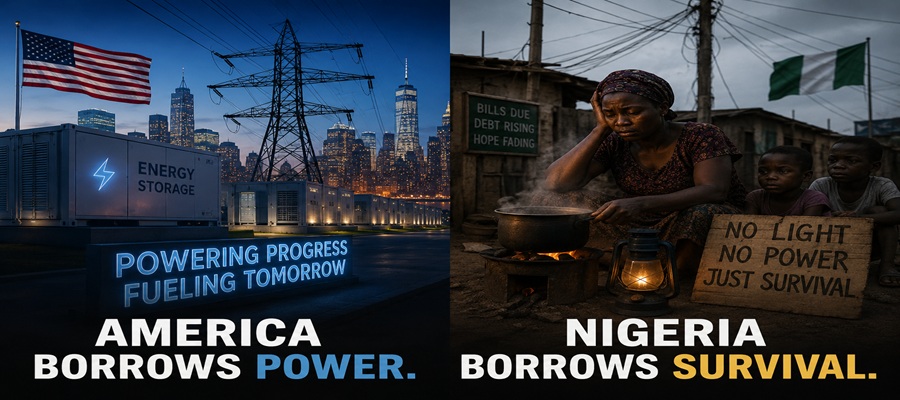
Findings show that the United States owes more than $36 trillion while Nigeria owes over N159.28 trillion, with external debt now standing at approximately $51.8 billion. At a first glance, when comparing the debt profiles of the world’s largest economy and Africa’s largest economy, it may though seem misplaced. America can borrow almost indefinitely because it issues the world’s reserve currency. Nigeria cannot. Yet both countries are confronting a similar worry. This has led to asking, when does debt cease to be a tool for development and become a permanent feature of national survival?

The difference is that while America may be testing the limits of how much debt a superpower can carry, Nigeria is testing how much debt a fragile developing economy can sustain before it begins to mortgage its future.
The latest proposal by the Federal Government to secure another $1.25 billion World Bank facility under the Nigeria Actions for Investment and Jobs Acceleration Programme has once again reignited a debate that refuses to disappear. What appears to be far from the daily lived experience of Nigerians over the years, is having government officials insisting that the loan will support investment, expand access to finance, improve electricity, enhance digital services, and create jobs. According to the claims, these are worthy objectives. But Nigerians have heard similar promises before.
The more important question is no longer whether Nigeria should borrow. Virtually every modern economy borrows. The real question which calls for critical concern, is what exactly Nigeria is borrowing for, and why the benefits of decades of borrowing remain largely invisible in the everyday lives of millions of citizens. This is where the national conversation becomes uncomfortable.
Funny enough over the years, successive governments have justified borrowing as a necessary response to development deficits. Yet despite rising debt levels, many Nigerians struggle to identify corresponding improvements in their lived experiences. This justification has kept many wondering as the roads remain dilapidated, public hospitals are overwhelmed, electricity supply also remains unreliable. Talk of the public education system, this has continued to deteriorate badly and unemployment remains stubbornly high. Inflation has eroded incomes with the cost of cooking gas hitting N2,400 per kg, while businesses struggle under the weight of high operating costs.
If borrowing is supposed to finance development, where is the development? The concern becomes even more urgent when and highly alarming when viewed against the backdrop of Nigeria’s worsening fiscal position. According to the Debt Management Office, public debt has climbed to over N159 trillion. With this outrageous figure, more troubling is the fact that debt servicing now consumes an alarming share of government revenue, which has continued to cripple economic growth and compromising the future. This development caught the attention of the Nigerian Economic Summit Group as it recently noted that Nigeria’s debt-service-to-revenue ratio remains among the highest in the world. In simple and practical terms, this implies that government is spending an increasingly large portion of what it earns paying creditors rather than investing in infrastructure, healthcare, education, security, or economic expansion.
This is the hallmark of a debt trap. The danger is not necessarily that Nigeria will default tomorrow. The danger is that the nation becomes trapped in a vicious cycle where governments borrow to finance deficits, then borrow again to service existing obligations, and then borrow even more to cover the consequences of previous borrowing. That cycle is already becoming visible.
Come to think of it, President Bola Tinubu’s administration has boldly defended borrowing as necessary to support reforms, cushion economic shocks, and stimulate growth. Yet critics have continued to point to the fact that since May 2023, borrowing has accelerated significantly.
According to economic analyst Dele Oye, the current administration has added approximately N65.9 trillion to Nigeria’s debt stock within just two years, a figure that exceeds several multiples of what Nigeria accumulated during its first five decades after independence.
Whether one agrees with the politics surrounding that claim is secondary. The underlying concern remains valid since debt is growing far faster than the visible capacity of the economy to generate sustainable revenue. This is why comparisons with the United States are useful.
America’s debt is enormous, but debt sustainability is not determined by the size of debt alone. It is determined by economic productivity. The United States supports its debt burden through a diversified economy, deep capital markets, technological innovation, globally competitive corporations, advanced research institutions, and an unmatched ability to attract global investment.
Debt is not what sustains America. Productivity does. Unlike Nigeria and by contrast, it continues to rely heavily on crude oil revenues, a narrow tax base, volatile foreign exchange earnings, and a fragile manufacturing sector. The critical difference is that every dollar borrowed by Nigeria therefore carries greater risks than every dollar borrowed by the United States.
When America borrows, it borrows largely in its own currency. When Nigeria borrows externally, it exposes itself to exchange-rate risks that can dramatically increase repayment costs whenever the naira weakens as this call for utmost caution. Every currency depreciation effectively inflates the burden of external obligations. What appears manageable today can become overwhelming tomorrow. This reality makes Nigeria’s current debt trajectory particularly concerning which is but the truth.
The World Bank itself has raised concerns about governance risks and structural weaknesses within Nigeria’s fiscal architecture. Even more troubling are recent revelations indicating that more than N34.5 trillion was reportedly deducted through pre-distribution mechanisms before revenues reached the Federation Account between 2023 and 2025. According to the findings, approximately 41 percent of government revenues were removed as first-line charges before distribution.
Whichever way it is viewed, perhaps as fiscal leakages, weak oversight, or institutional inefficiency, the implications are profound and of critical concern. If we must begin to tell ourselves the factual truth, a nation cannot continue borrowing aggressively while simultaneously failing to maximise the value of revenues it already generates.
This brings us to the central question confronting Nigeria today. The point is, are these loans building future productive capacity, or are they merely financing continuity?
Borrowing can be justified when it funds projects that expand economic output. Investments in power generation, transport infrastructure, agriculture, industrialisation, technology, and education can create long-term growth that eventually pays for the debt itself. In such cases, debt becomes a bridge to prosperity.
But it must be known that borrowing to fund recurrent expenditure, sustain bloated government structures, finance consumption, cover inefficiencies, or service previous debts transforms borrowing into a treadmill. The irony here is that the country runs harder every year but remains trapped in the same place. Unfortunately, much of Nigeria’s fiscal reality increasingly resembles the latter.
The tragedy is that this debt burden is not abstract. It is already affecting ordinary Nigerians. The adverse implication and critical point are that every naira directed toward debt servicing is a naira unavailable for schools, hospitals, security, electricity, or social protection. Every external loan increases future repayment obligations. Every missed opportunity to invest borrowed funds productively transfers today’s policy failures to future generations.
The consequences are visible everywhere. Businesses face prohibitively high borrowing costs. Today in Nigeria, it is no longer news that manufacturers struggle with energy expenses, which rob off adversely on the citizens. The same applies to youth unemployment, which remains widespread. Also, infrastructure deficits persist. Another, critical issue is that states remain heavily dependent on monthly allocations from federal level. With the developments, economic growth remains too weak to significantly improve living standards.
The result is a contradictory in which debt rises while prosperity stagnates. This is perhaps the greatest lesson Nigeria must learn from America’s debt experience.
The debate should not focus exclusively on how much debt a nation carries. The more important progressive question is whether the economy is productive enough to sustain that debt.
What every Nigerians should know is that Nigeria as a country cannot borrow its way to prosperity because it must first strengthen the foundations that generate sustainable growth. With the lingering challenging surrounding the borrowing and the mountain of debts, one key fact is that it cannot rely indefinitely on external creditors while neglecting domestic productivity. Also, it cannot continue to depend on oil revenues while failing to broaden its tax base. Another loosed end that has been a critical matter is that it cannot expect debt-financed development without strong institutions, transparency, accountability and effective project execution.
The solutions are neither mysterious nor impossible. This entails that Nigeria must aggressively expand domestic revenue mobilisation without suffocating businesses and ensure it must digitise tax administration, eliminate leakages, enforce fiscal responsibility laws. Also, it must reduce the cost of governance, strengthen public procurement systems while it ensures that every borrowed naira and kobo is linked to measurable economic outcomes.
Equally important, government must rebuild public trust. The truth is that citizens are more willing to support reforms when they can see tangible results. Some of the developments in the past that have continued to erode public trust are when subsidy savings are announced, people expect better roads, improved healthcare, reliable electricity, and enhanced security. When new loans are obtained, they expect visible projects and measurable returns but the reverse have been the case. Those at the helms of affairs of this country must understand that transparency is not merely good governance; it is an economic necessity. History offers a warning.
In 2006, under the leadership of Olusegun Obasanjo, Nigeria celebrated its exit from the Paris Club debt burden after securing one of Africa’s most significant debt relief achievements. Not too long but for a brief period, the country stood relatively free from the crushing obligations that had constrained development for decades. Two decades later, that achievement appears increasingly distant.
The danger is not simply that Nigeria is borrowing. The danger is that borrowing is becoming normalised as a substitute for difficult reforms.
A nation can borrow to build industries or borrow to pay bills. It can borrow to create future wealth or borrow to postpone present challenges. One path expands prosperity; the other compounds dependency.
America’s debt mountain demonstrates that even wealthy nations are not immune from the consequences of structural borrowing. Nigeria’s debt burden demonstrates how much more dangerous that reality becomes when economic productivity fails to keep pace. Borrowing can buy time. It cannot buy prosperity.
Sooner or later, every nation must generate the economic value necessary to justify the debts it accumulates. Nigeria’s future will depend not on how much it can borrow, but on how effectively it can produce, innovate, industrialise, and grow.
That is the lesson hidden underneath America’s debt mountain. It is also the lesson Nigeria ignores at its own peril.
Blaise, a journalist and PR professional, writes from Lagos and can be reached via: [email protected]

MSMEs Paucity of Funds Receives Boost as Senate Backs Bill Seeking to Unlock Cash for them

Airtel Nigeria Launches Web Data Calculator to Give Customers Greater Visibility into Data Usage

America Borrows Power, Nigeria Borrows Survival

NCC Board Reviews Telecom Sector, Notes Progress in Network Expansion, Consumer Compensation

FG’s $10m Hello.cv Deal Sparks Outrage as Experts Question Snub of .ng Domain

CBN Extends PoS Geo-Fencing Enforcement Deadline to August 2026

FG to Launch Nationwide Free Digital TV Platform June 17

Jumia Nigeria Records Strong Q1 2026 Growth as Technology-Led Strategy Drives Market Expansion

Metro Digital, Nigerian Firm Accuses Multichoice Of Refusal to Obey Court Judgements

NCC Drafts New Rules for Virtual Mobile Operators




 E-Financial3 days ago
BOI Wins Dual Honours @ EMEA Finance Awards for Sustainability and Social Impact Leadership

 E-Financial3 days ago
CBN Imposes N100m Penalty on Dealing Bank Inadequate Processing of Forex Documents

 Telecom3 days ago
Price of Data in Nigerian Mobile among Top Four Cheapest Globally – MTN CEO

 E-Business3 days ago
NITDA Okays NiRA’s Annual, Business Report

 E-Financial3 days ago
Reps Committee Recovers N521m Unremitted VAT from CBN

 Telecom3 days ago
FCCPC Refutes Airtime Market Takeover Claims

 General News3 days ago
SSDC Warns Businesses against Cyber, Election-Related Risks

 E-Business2 days ago
Monnify Processed ₦25 Trillion Worth of Transactions in 2025, Stepping into the Spotlight