

News
Nigerian, Team Mates Win £15,000 at SWIFT Fintech Competition

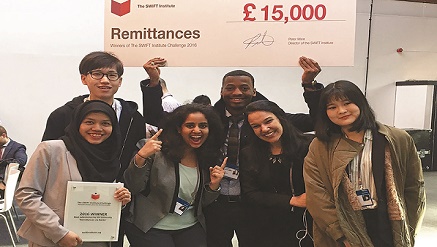
Nigerian Mohammed Dankwambo will share £15,000 with five other university students after their Fintech idea wowed judges at the SWIFT Business Forum London.
The team called HADU from the UK’s Warwick Business School (WBS) beat six other teams – including three more from WBS – in the final to win the inaugural SWIFT Institute Challenge.
Mohammed, of Gombe, Nigeria, and team-mates Fiza Hussain, Sneha Sunkara, Yunjing Li, Yat Hung To and Qotrun Nada Haroen, were presented with the cheque by Harriett Baldwin, Economic Secretary to the Treasury, and they also won a trip to Sibos, the annual financial services event held in Geneva this September by SWIFT (Society for Worldwide Interbank Financial Telecommunication) – the global network that enables financial institutions to send and receive information about financial transactions.
Tasked with identifying a solution to address the challenge of remittances via banks in the UK, HADU presented a solution that focused on using near sound data technology to deliver mobile money and a network of branded high-security buses to do the ‘last mile’ and deliver the cash in Indonesia.
Mohammed said: “We were so excited when we heard our name on stage, even after one day, we still can’t believe it. We are very happy and really looking forward to further develop our idea.”

“This is a great win for WBS and the University that reflects the quality of the research and teaching at Warwick,” said Markos Zachariadis, Assistant Professor of Information Systems Management & Innovation and co-author of The Society for Worldwide Interbank Financial Telecommunication (SWIFT): Cooperative governance for network innovation, standards, and community.
“The SWIFT Institute Challenge has provided a great opportunity for students to work on real issues from the financial industry. Congratulations to all the finalists and to the winning team. We are very proud of the students.
“Our Fintech module at the school is part of our MSc in Information Systems Management & Innovation course and has been going for three years now, with our graduates landing jobs in major financial institutions and already making an impact.
“We will seek to develop more Fintech initiatives in the coming years.”
The 2016 Challenge was open to any UK-based recognised university, or centre of learning, with an interest in banking and asked students for a solution that would enable someone to send money from their UK bank account to an individual in a country where there is little or no banking infrastructure.
Held at the Tobacco Dock in London, each team was given 10 minutes to pitch their idea to the judges who came from across the financial services industry.
They took on teams from King’s College London, Queen Mary University of London and London School of Economics and Politics, with HADU coming out on top.
HADU will have their travel and expenses paid for to attend SWIFT’s annual financial services event, Sibos, and the opportunity to pitch their developed solution at the conference in Switzerland.
Commenting on the Challenge, Ms Baldwin said: “Innovation in payments solves real-world problems and has the ability to change how we, as consumers, interact with our money. That’s why it’s so exciting to see the projects from today’s SWIFT competition teams looking at how we can make remittances easier, cheaper and more efficient for people in the UK and around the world.
“Financial technology plays a vital role in stimulating greater competition, improving access and helping to drive transaction costs down. That’s just one of the many reasons the Government is doing all it can to support the UK’s dynamic Fintech sector.”
Peter Ware, Director at SWIFT Institute, said: “This is the first year for the Challenge, and we have been very impressed by the quality of the submissions and presentations from the UK Universities involved.
“An interest in banking is important but equally, so is an enthusiasm for devising new and cutting-edge ideas that could really make a difference. They all understand important world issues and are able to think outside the barriers that can exist in a corporate mindset.”



A recently released Henley Passport Index 2026, showed that Nigerian citizens can travel to at least 20 destinations outside the African continent where entry is allowed either visa-free, with a visa on arrival (VOA) at no extra cost, or via an e-visa.

This expanded access opens doors for Nigerian travellers to experience countries in the Caribbean, Asia, and beyond with greater ease.
Below is a comprehensive guide to countries outside Africa which Nigerian passport holders can visit without a traditional visa.
Visa-Free Countries outside Africa for Nigerian Passport Holders:
Barbados
Cambodia – Visa on arrival
Comoros Islands – Visa on arrival
Cook Islands
Dominica
Fiji
Haiti
Iran – Visa on arrival
Kiribati
Lebanon
Maldives – Visa on arrival
Micronesia
Montserrat
Niue – Visa on arrival
Palau Islands – Visa on arrival
Samoa – Visa on arrival
St. Kitts and Nevis
Timor-Leste – Visa on arrival
Tuvalu
Vanuatuul


Nigeria and Israel yesterday reaffirmed their commitment to deepening bilateral cooperation in research, technology and innovation as both countries pledged to expand partnerships that will drive entrepreneurship, commercialise research and accelerate economic development.

The commitment was made at the closing ceremony and innovation showcase of the I-FAIR Cohort of the Israel-Nigeria Innovation Fellowship for Aspiring Inventors and Researchers (I-FAIR) in Abuja, where the Ambassador of Israel to Nigeria, Michael Freeman, announced that funding had been secured for the fifth edition of the programme, scheduled to begin in October 2026.
Freeman described I-FAIR as a practical demonstration of the growing partnership between both countries, saying it had enabled Nigerian innovators to develop local solutions to national challenges through Israeli mentorship and expertise.
He said, “This programme has never been about bringing Israeli solutions to Nigeria. It’s been about helping brilliant Nigerian innovators develop Nigerian solutions to Nigerian challenges supported by Israeli experience, mentorship and innovation.”
The envoy noted that the initiative had brought together government, academia, investors, engineers and entrepreneurs to transform innovative ideas into businesses capable of creating jobs and stimulating economic growth.
Announcing the continuation of the programme, he said, “I am so proud to stand here today and announce that we have secured with our partners funding for I-FAIR 5 and I-FAIR 5 will be launching in October 2026.”
Freeman said the relationship between Nigeria and Israel had grown significantly over the past four and a half years through cooperation in innovation, agriculture, healthcare, education, water management and technology.
He expressed confidence that stronger collaboration between both countries would unlock greater opportunities for startups, research institutions and businesses.
According to him, “Israel brings experience and innovation, technology, agriculture, healthcare, cyber security, security and water management. Nigeria brings extraordinary talent, creativity, entrepreneurship and one of the most dynamic young populations anywhere in the world.”
He added, “I have no doubt that the best chapters of the relationship between Israel and Nigeria are still ahead of us.”
The Executive Secretary of the Tertiary Education Trust Fund, Architect Sonny Echono, also reaffirmed TETFund’s commitment to strengthening research and innovation through strategic partnerships with Israel and other stakeholders.
He said the I-FAIR programme aligned with Nigeria’s priorities in food security, agriculture, medicine, technology, clean energy and the circular economy, adding that TETFund would continue supporting initiatives that promote research commercialisation.
Echono stressed that collaboration between government, academia and industry remained critical to translating research findings into products and services.
He said, “It is this critical linkage, especially between science, engineering, technology and innovation, and the productive sector that is critical for translating R&D results and inventions into finished products for socio-economic benefits of our people.”
He disclosed that TETFund was working with partners to establish innovation facilities in about 60 tertiary institutions and had created a student innovation fund that would provide up to ₦50 million to students with commercially viable ideas.
The TETFund boss also announced plans for a National Research Fair later this year, where innovators would showcase products before policymakers, financial institutions and investors to attract funding and commercial partnerships.
Paying tribute to the outgoing Israeli ambassador, Echono described Freeman as a strong bridge between Nigeria and Israel.
He said, “Nigeria is grateful for your service. You have been a strong bridge between our two countries.”
Earlier, Head of Programmes at Innov8 Hub, Tolulope Aina, said sustainable economic development depended on building an innovation ecosystem that transforms ideas into successful businesses.
She noted that Innov8 Hub had supported more than 3,000 innovators, researchers and entrepreneurs, helping them convert research into products, startups and investment-ready ventures.
Aina said, “Nigeria does not suffer from a shortage of brilliant minds, what we need are stronger pathways that help those ideas become products, businesses, and opportunities that improve life.”
She thanked the Embassy of Israel and TETFund for their continued support in strengthening Nigeria’s innovation ecosystem.
According to her, “Building an innovation-driven economy requires collaboration, long-term commitment and shared purpose.”
Chief Judges drawn from countries across the African continent have resolved to collaborate and support measures aimed at ensuring the success of the Africa Continental Free Trade Area (AfCFTA) through an efficient, reliable and predictable dispute resolution system.

They agreed to explore ways to harmonize disputes resolution mechanisms in the continent with a view to making it easier and faster to resolve commercial disputes.
The resolutions formed part of the decisions taken at the third Africa Chief Justices’ Alternative Dispute Resolution (ADR) Summit held in Nairobi, Kenya between June 18 and 19.
According to a statement by the Special Assistant on Media to the Chief Justice of Nigeria (CJN), Justice Kudirat Kekere-Ekun, Mr. Tobi Soniyi, the African judicial leaders were of the view that commercial confidence depends largely on legal certainty.
They emphasised how structured Alternative Disputes Resolution could enhance commercial justice, protect the business environment and support the AfCFTA.
In her contribution, the Chief Justice of Nigeria (CJN), Justice Kudirat Kekere-Ekun urged called on African judiciaries to proactively prepare for emerging challenges to disputes resolution in the continent.
Justice Kekere-Ekun, who served as Co-Chair of the session on “Financial sector disputes, tax certainty and ADR: Building commercial confidence in Africa, noted that AfCFTA represents one of the most ambitious economic integration projects in modern history.
The CJN, who stressed the importance of a proactive Judiciary to the success of AfCFTA, warned that its success would depend, not only on trade protocols, tariff reductions and economic policies, but also on the strength and reliability of the institutions that support commerce.
Justice Kekere-Ekun urged her colleagues to examine how judiciaries in the continent, central banks, tax administrations and ADR institutions could work together to reduce uncertainty, prevent disputes, strengthen investor confidence and support the realization of AfCFTA’s objectives.
She envisaged the growth of intra-African trade to inevitably generate cross-border tax disputes; foreign exchange disputes; banking and payment system disputes; digital commerce disputes; enforcement of arbitral awards; recognition of foreign judgments; and disputes arising from regional supply chains.
The CJN, who said “African Judiciaries must proactively prepare for these emerging realities,” challenged African judicial leaders on the importance of disputes prevention mechanism.
She stated that modern commercial justice must move beyond the traditional focus on disputes resolution after conflicts arise.
“The most successful commercial systems are not those that generate the highest volumes of litigation but those that reduce the need for litigation,” she added.
Justice Kekere-Ekun, who stressed the importance of ADR, cautioned against seeing ADR as merely an alternative procedure.
She said ADR should rather be considered as a strategic tool for reducing transaction costs, preserving commercial relationships, enhancing investor confidence, reducing court congestion, improving ease of doing business and strengthening commercial certainty.
Sharing the Nigerian experiences, Justice Kekere-Ekun cited the recent decision by the Nigerian Supreme Court in the case of EMTS v. AFDIN Ventures Ltd. & Ors. (2026), which reaffirmed important principles of commercial certainty, including respect for arbitration agreements; recognition that consent may be inferred from conduct; judicial restraint from re-litigating arbitral disputes on the merits; and the importance of finality in arbitral awards.
According to her, the decision reinforced Nigeria’s position as an arbitration-supportive jurisdiction.
She identified timely resolution of tax disputes as an important factor in ensuring certainty and recommended Nigerian tax disputes resolution mechanism which she said “offers useful example of institutional reforms that support commercial certainty.”
Justice Kekere-Ekun recommended the Nigeria’s Tax Appeal Tribunal model, which she described as one of Nigeria’s most significant innovations.
According to Mr. Soniyi, Justice Kekere-Ekun’s message to his brother justices is clear: building an African commercial environment in which investors, businesses, regulators and citizens can transact across borders with confidence, secure in the knowledge that their rights will be protected and their obligations fairly enforced.
The summit advanced the goals of the African Chief Justices Alternative Dispute Resolution Forum (ACJADRF) to harmonize jurisprudence and establish common enforcement standards across the continent.
The CJN was, on the last day of the summit, nominated by the Chief Justice of Kenya as the Vice Chairperson of the Africa Chief Justice ADR Forum with effect from August 1, 2026. The nomination was ratified by the forum.

See Verified 20 Countries Nigerian Passport Holders Can Travel Visa-Free

NPC Opens 131 Births, Deaths Registration Centres in Anambra

Lagos Chamber Opposes 21 Percent Pension Contribution, Warns of Job Losses

Subscribers, Telcos Warn FCCPC over Airtime Lending Enforcement

NCC, REA Partner to Cut Telecom Costs with Renewable Energy

NRC, Ponzi Scheme Collapses Resulting Loss of Billions of Naira

EFCC Busts NIS Visa Overstay Racket, Uncovers N700m in an Account

Tokenization, Blockchain Technology will Transform Financial Institutions – IMF

From Scarcity to Scale: What Africa Can Learn from India’s Agricultural Transformation

Spotify partners Afro Nation Portugal to expand African music experience




 Telecom2 days ago
GSMA Supports Abuja Declaration on Meaningful Connectivity for Africa, Joins Partners to Launch ATLAS Umoja

 Telecom2 days ago
Airtel Secures Another 10-year Spectrum Renewal in Nigeria

 Telecom2 days ago
MTN Nigeria Warns Customers Against Fake ‘One Month Free Data’ Promotion

 News2 days ago
Nigeria, Israel Strengthen Research, Technology Collaboration

 E-Business2 days ago
HURIWA, CLO Protests Bill Asking Social Media Firms’ to Open Shops Nigeria

 Broadcasting2 days ago
Glo Sponsored African Voices to Feature Netflix’s “The Polygamist” Stars

 General News2 days ago
Anambra Govt Bans Graduation Ceremonies in Anambra Schools

 E-Financial2 days ago
Moniepoint as a Key Driver in Expanding Financial Access for Businesses in Nigeria