

Telecom
ANALYSIS: SIMs/NINs Directive: Time to Rescue Telecoms Industry

By Vanguard Newspaper
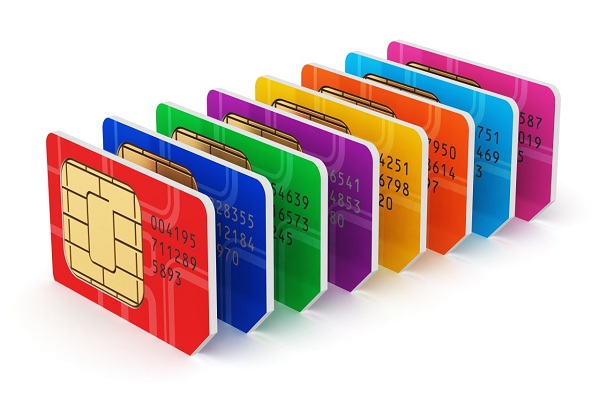
The directive last week by the Ministry of Communications and Digital Economy that the National Identity Number, NIN, has become mandatory for a subscriber to carry a mobile phone is not only a slap on the faces of Nigerians already going through very troubled times but a plain manifestation that arbitrariness is being elevated to the dizzy heights of national policy.
Operators have been given only two weeks to comply and ensure that over 190m subscribers on their networks are properly registered. Or your operating license withdrawn.
We view this as a death sentence for the telecommunications industry, and some experts cautioned last week that a reversal of industry fortunes has been set afoot by an obnoxious official proclamation.
One operator moaned that the regulator wants to wipe out at least more than half of the subscriber base of the industry.
We agree that times are desperate in Nigeria, very desperate. Whole mass of students are spirited away from school and they reappear after a whole week in the den of criminals. Road travel has become a nightmare for the ordinary and the mighty ones. Bandits have taken over the roads and the farms.
Quite unfortunately even for the rich, air travel is beyond the reach of those who used to fly except the hedonists who steal the people’s money for plain pleasure.
According to figures from the National Population Commission, NPC, very bizarre decisions are being taken to rubbish the collective intelligence of a nation and expose the citizenry to ridicule before the international community.
So, using failure in security as pressure point, the ministry under the grip of Dr. Isa Pantami has given a directive capable of destroying the entire communications industry except common sense prevails.
The December 15, 2020, statement signed by Public Affairs Director, Dr. Ikechuckwu Adinde, which affirmed earlier directive for operators to totally suspend registration of new SIMs, stated among others: “Operators to require all their subscribers to provide valid National Identification Number, NIN, to update SIM registration records; The submission of NIN by subscribers to take place within two weeks (from today, December 16, 2020 and end by December 30, 2020).
After the deadline, all SIMs without NINs are to be blocked from the networks.” While conceding the pervasive security challenges, there has been outrage across the land; understandably, by subscribers who feel that apart from the suffering that has worsened more because of COVID-19, a major inconvenience is being added to their burden.
Recall that the country’s economy has gone into recession again and is not expected to recover until late 2021, a development that is forcing more Nigerians to fall into the poverty pit.
Vanguard immediately reached out to a powerful industry source to ask if the directive could be executed in two weeks. The answer was an emphatic NO. We also reached out to a source in the regulatory institution. Is this what should have been done? The answer again was NO. Let’s try to unwrap the intricacies of the unfolding story.
The SIM Card registration regime started in 2011. The exercise was carried out simultaneously by licensed agents of the NCC and the mobile operators. NCC was to warehouse the data. An understanding at the time was that, because of the sensitive nature of personal data, all data will be handed over to the National Identity Management Commission, NIMC, whose responsibility it is to manage the National Identity Database.
Till date the progress recorded in that area opens windows to speculations and recriminations. It is interesting to point out here that NIMC was established in 2007. In all the years of existence, the organisation has succeeded in registering only 43.6m! So what magic wand will it wave to accomplish the act in two weeks?
According to figures gleaned from the NCC website, there were 207,954,737 subscribers on the four mobile networks of MTN, Airtel, GLO and 9Mobile by October 2020. An industry source told Vanguard last week that of this figure, about 120m are unique subscribers, discounting double registration of mobile numbers, while the rest could be used in personal internet modems, sectors like banking, vehicle tracking and other sectors where mobile communications have become very handy. There has to be a way to capture these numbers and this cannot be enforced overnight.
Matching the 120m subscriber figure with their NINs is a nightmare which will rubbish the two-week window. For the journey to start at all, all the companies being licensed by NIMC, one expert explained, will have to source for their equipment and get them certified by NIMC before procurement and purchases can take place. To make any meaningful impact immediately, the industry may need at least 250,000 of those machines which are not manufactured here.
Moreover, the NIMC machines are not what are easily sourced in the open market. They are called the 442 machines because they can take four fingers at a go and take the remaining two fingers once. They are more robust than the SIM Card registration machines which can take only two fingers at a time.
The source told Vanguard that this is a logistics nightmare that can hardly be afforded by some of the companies being recruited by NIMC at the moment.
Industry observers are of the opinion that the President Muhammadu Buhari and the National Assembly should put a leash on the minister before he totally destroys the telecommunications industry.
In attendance at the meeting that had to do purely with the regulation of the industry were the CEOs of NCC, the National Information Development Agency, NITDA, and NIMC.
At least one operator told Vanguard they were never at the meeting; instead the minister is taking all the decisions which he is shoving down their throat, thus increasing the fear that the regulator is increasingly losing direction and hold on the industry.
Strains of helplessness are already showing. “We don’t know why the Executive Vice Chairman, EVC, is unable to call some meetings. We are not able to sit down to negotiate on anything,” the source lamented.
Those who fear the directive may become a dangerous super spreader of the COVID-19 pandemic may have been proven right when, last week, somewhere in Abuja, an eye witness told Vanguard that some youths who had gathered for two days at one registration spot, suddenly started demonstrating on noticing the near futility of the exercise and how some advantaged personalities were bending all the rules to favour a few.
The desperation to register will obviously rubbish the PTF recommendation on social distancing in a season of pandemic. Meanwhile, more trouble looms for the industry.
A knowledgeable industry source told Vanguard that, if not properly managed, the directive could destroy half the base of the industry, stymie revenue and investment, and lead to massive job losses.
But all these could pale into insignificance if the minister ever executes his growing threats that “violations of this directive will be met by stiff sanctions, including the possibility of withdrawal of operating license.”
This is hardly the way to speak to organisations that have invested heavily in your economy.



Association of Licensed Telecom Operators of Nigeria (ALTON), official industry umbrella body and pressure group for major mobile network operators in the country, has faulted claims that foreign direct investments (FDIs) into the sector slumped significantly in quarter one (Q1).

Gbenga Adebayo, Chairman, ALTON
ALTON, said that with N2.13 trillion spent in 2025 on network upgrades and expansion that they would invest an additional N1.86 trillion on network expansion this year.
The body was reacting to the claim by the National Bureau of Statistics (NBS) that FDIs into the sector slumped significantly in quarter one.
The telcos commended the Federal Government for its continued support of the industry, while calling for a more comprehensive framework to track and report investments coming into the sector.
The operators highlighted the importance of accurate data in shaping investor perceptions and guiding policy decisions.
The association noted that while the NBS recently released its Q1 Capital Importation Report, the figures presented do not fully capture the scale of capital deployment within Nigeria’s telecoms industry.
“This disparity between reported foreign capital inflows and actual infrastructure investment highlights a gap in how sectoral capital deployment is currently measured and reported,” the statement read.
ALTON, in the statement, signed by Gbenga Adebayo and Damian Udeh, chairman and publicity secretary, respectively, expressed appreciation to the Federal Government for approving a strategic 50 per cent tariff increase in 2025, describing it as a pivotal intervention that rescued the industry from financial distress.
According to the association, the tariff adjustment restored operational viability, closed critical revenue gaps and enabled operators to reinvest in infrastructure and service quality.
The association emphasised that the policy intervention transformed the sector from a struggling model into a sustainable, growth-focused industry.
“The timely investment enabled operators to transition from financial distress to a sustainable, growth-focused model characterised by significant capital reinvestment,” ALTON stated.
The statement revealed that telecom operators, tower companies, and other players in the sector recorded a total capital expenditure of N2.13 trillion in 2025. For 2026, planned capital expenditure stands at N1.86 trillion, with funds directed towards network infrastructure expansion, technology upgrades, and operational investments critical to maintaining service quality and coverage.
These commitments, ALTON stressed, are fundamental to advancing Nigeria’s digital economy objectives and improving services for millions of subscribers nationwide.
While the NBS report indicated a sharp decline in foreign capital importation into the telecom sector, from $80.78 million in 2025 to just $7.24 million in Q1 2026, ALTON argued that this metric only reflected a portion of the actual investment activity.
The association explained that much of the sector’s capital deployment now comes from domestic sources, including reinvested operational earnings.
These financial mechanisms, ALTON noted, are not fully reflected in conventional foreign capital importation metrics, thereby painting an incomplete picture of the industry’s health.
To address this reporting gap, ALTON proposed a collaborative engagement among the Nigerian Communications Commission (NCC), the NBS, and the Central Bank of Nigeria (CBN).
The goal, according to the association, is to develop a more inclusive and transparent investment-tracking framework that accurately reflects both foreign and domestic capital flows.
ALTON reassured the Nigerian public that telecom operators remain committed to continuous investment in network expansion, modernisation, resilience and service quality improvements.
The association pledged to work closely with regulators and government institutions to ensure that the sector’s contributions to national development are comprehensively documented and appropriately recognised.
With sustained collaboration and government support, ALTON said Nigerians can expect uninterrupted access to digital services that drive economic growth, innovation, financial inclusion, and overall national development.


Princess Emiko
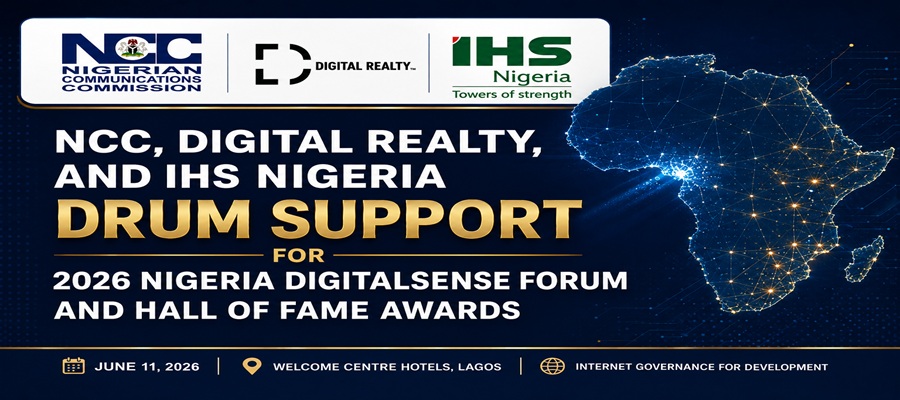
The regulatory and digital infrastructure pillars of Nigeria’s telecommunications ecosystem, led by the Nigerian Communications Commission (NCC), Digital Realty, and IHS Nigeria, have rallied robust support for the upcoming 2026 Nigeria DigitalSENSE Forum (NDSF) on Internet Governance for Development (IG4D) and its prestigious industry awards.

The annual high-level forum is scheduled to hold this Thursday, June 11, 2026, at the prestigious Banquet Hall, Welcome Centre Hotels, Lagos, anchoring its deliberations on the crucial theme: “Sustaining WSIS Vision with Multistakeholder Synergy in Nigeria.”
The Executive Vice Chairman and CEO of the NCC, Dr. Aminu Maida, is set to deliver the Keynote Address, highlighting the regulatory framework required to preserve the World Summit on the Information Society (WSIS) vision through inclusive, multi-stakeholder partnerships.
Joining the regulatory commission in driving this momentum is IHS Nigeria, the nation’s premier digital infrastructure champion boasting a footprint of over 16,000 telecom towers and 15,000km of fiber optic cables across the country. Alongside data center colocation leader Digital Realty, these organizations are heavily backing the forum as part of their commitment to promoting critical national infrastructure and securing Nigeria’s digital possibilities.
Speaking ahead of the event in Lagos, Ogbuefi Remmy Nweke, the Editor-in-Chief of host media organization ITREALMS Media Group, commended the immense institutional support flowing from the public and private sectors.
“Achieving sustainable internet governance and digital trust requires an intentional alignment of regulation and infrastructure,” Nweke remarked. “The active collaboration of the NCC, IHS Nigeria, and Digital Realty ensures that the 2026 forum will move beyond mere dialogue to produce clear, actionable policy recommendations for our digital economy.”
The event will be presided over by Dr. Olusola Teniola (hon), Director, Strategic Business Initiatives, ipNX Nigeria and former President, Association of Telecommunications Companies of Nigeria (ATCON), who will deliver the Chairman’s Opening Speech on the 2026 NDSF blueprint.
Earlier, leading telecommunications, technology, and internet governance stakeholders have thrown their weight behind the 17th milestone edition of the annual Nigeria DigitalSENSE Forum (NDSF) on Internet Governance for Development (IG4D), including ICT infrastructure leader MTN Nigeria; the Association of Licensed Telecoms Operators of Nigeria (ALTON); premier software and DNS infrastructure firm Upperlink Limited; and the Nigeria Internet Registration Association (NiRA), managers of the .NG country code Top Level Domain name.
Media & Event Contact: The Secretariat Nigeria DigitalSENSE Forum (NDSF) / ITREALMS Media Group Banquet Hall, Welcome Centre Hotels, Lagos Website: www.itrealms.com.ng

CBN to Deploy AI in Fight Against Payment Fraud

NDPC, Meta Launch 2-Year M-SIDP after Regulatory Settlement

Report Faults Banks over N91.1 Trillion Sterilised at CBN

Telcos Fault Data of FDI Flow, Claim Investment of N1.86 Trillion on Service Expansion

NRS Accredits Afri Invoice as Access Point Provider to Drive Nigeria’s Mandatory e-invoicing

CBN Extends PoS Geo-Fencing Enforcement Deadline to August 2026

FG to Launch Nationwide Free Digital TV Platform June 17

MTN, Airtel, Glo Under Pressure as FG Demands Better Service Delivery

Jumia Nigeria Records Strong Q1 2026 Growth as Technology-Led Strategy Drives Market Expansion

Metro Digital, Nigerian Firm Accuses Multichoice Of Refusal to Obey Court Judgements




 Telecom2 days ago
Price of Data in Nigerian Mobile among Top Four Cheapest Globally – MTN CEO

 E-Financial2 days ago
BOI Wins Dual Honours @ EMEA Finance Awards for Sustainability and Social Impact Leadership

 E-Business2 days ago
NITDA Okays NiRA’s Annual, Business Report

 E-Financial2 days ago
CBN Imposes N100m Penalty on Dealing Bank Inadequate Processing of Forex Documents

 Telecom2 days ago
NAIFF Returns for 2026, Expands Focus on AI-Powered Storytelling in Africa

 General News1 day ago
SSDC Warns Businesses against Cyber, Election-Related Risks

 Telecom2 days ago
FCCPC Refutes Airtime Market Takeover Claims

 General News2 days ago
Moniepoint DreamDevs Bootcamp Graduates Second Cohort to Strengthen Homegrown Talent Pipeline