

Telecom
As Stakeholders Await New Study on Health Impacts of Telecom Equipment

Telecommunications operators in the country are having long running battle with the National Environmental Standard and Regulatory Enforcement Agency, (Nesrea) over what it terms environmental and health hazard of transmission base stations. The agency had decommissioned two based-stations belonging to MTN Telecommunication Company for non-compliance with the Environmental Impact Assessment Act as well as its regulations on set-back of based-stations from residential areas.
The decommissioning operation, which was jointly led by the Mr. Timothy Okewo, director of administration and finance of Nesrea, and the legal adviser to the agency Barrister Bola Odugbesan, effected the shut-down of the based-station with emergency inscription placed on the two facilities.
The two stations are located at No 27, Asheik Jarma street, Jabi Abuja, and at 2, Oyo street Area 2 Garki all within the centre of the Federal Capital Territory (FCT).
Okewo said the agency’s action was based on complaints of noise pollution, vibration of buildings, environmental degradation resulting from oil spill and effect of the radio-active waves by the residents of the area.
According to the provisions of environmental impact assessment Act, based stations are only allowed to be located 10metres away from the fence of any resident or 12meters away from the building in the case of an unfenced building.
Okeowo who lamented on the negative impact of oil-spillage from the based stations on the environment, regretted that previous complaints by Nesrea has not attracted any remarkable response from the communication firms.
"Most of the telecommunication companies are defaulters of the environmental laws which we are meant to protect" he said.
One wonders the basis of claims of health impact upon which Nesrea is decommissioning and closing down telecommunications operators’ base stations without following due process as recommended by law on such actions.
The agency recently sealed base stations belonging to three telecommunication operators in Ilorin, Kwara State again over non compliance with the Environmental Impact Assessment (EIA) and audit report by the Federal Ministry of Environment. The telecommunication companies affected are MTN, Zain, and Starcomms.
The sealed base stations are located on Police Road, GRA, Ilorin, belonging to MTN, another on Kontagora Road, opposite Taqwa College, belonging to Zain and that of Starcomms behind Tanke LEA Primary School ,Tanke area of the state, were all sealed by the agency.
Nesrea on April 9, 2010 placed a public notice to all telecommunications agencies over its decision to start the sealing of facilities of the operators over their non-compliance with the Environmental Impact Assessment requirement as entailed in the law.
Similar concerns have been expressed by some stakeholders on the impact of both the use of mobile phones and microwave equipment on health of people, although presently there is no scientific proof to these concerns.
Concerns have also been raised about the normal mobile phone, which has the antenna in the handset. In this case, the antenna is very close to the user’s head during normal use of the telephone and there is concern about the level of microwave emissions to which the brain is being exposed.
Telephones that have the antenna mounted elsewhere are of little concern, since exposure levels decrease rapidly with increasing distance from the antenna.
Reports have appeared in the media linking the use of mobile telephones with, among other things, headaches, hot spots in the brain and brain cancer.
Media reports have claimed that up to 70 percent of the microwave emissions from hand-held mobile telephones may be absorbed in the user’s head. This is not supported by the evidence, but nevertheless leads to speculation that hot spots may be created in the user’s brain, thereby raising concerns that the telephones may be a health risk. Other reports have indicated that mobile telephone users suffer localized headaches when they use their telephone. At this stage, it is difficult to evaluate the evidence supporting these reports, since they have not been published.
Against these backdrops that a new decades-long study has just been launched to investigate whether there is a link between the use of mobile phones and long-term health problems such as cancer.
The cohort study on mobile communications (COSMOS) forms part of the Mobile Telecommunications and Health Research (MTHR) Programme. The international study will run for 20-30 years and will follow the health of at least 250,000 participants, aged 18-69 in five European countries.
There are currently over six billion mobile phone devices in use worldwide, with over 70 million in use in the UK, which has a population of 61 million people.
Studies of short term use of mobile phones and health have been reassuring, other than well known associations with risk of motor accidents. However, there are still some uncertainties about the health effects of mobile phone use, since some diseases take many years to develop and so far few people have been using mobile phones for that period of time.
Dr. Mireille Toledano, co-Principal Investigator of the study from the School of Public Health at Imperial College London, said: "For the benefit of current users and for future generations, it is important for us to carry out long-term health monitoring of a large group of mobile phone users so that we can identify if there are any possible health effects from this new and widespread technology that has become so central to our everyday lives."
Professor Paul Elliott, Principal Investigator of the study from the School of Public Health at Imperial College London, said: "Scientists have been looking at the effects of mobile phones on health for several years and so far, reviews of the research have been reassuring with respect to mobile phone use and health problems in the short term. However, as mobile phones have only been in widespread use for a relatively short time, we haven’t been able to carry out long-term studies until now.
"COSMOS aims to fill in important gaps in our knowledge of mobile phones and health. By looking at large numbers of people across Europe over a long period of time, we should be able to build up a valuable picture of whether or not there is any link between mobile phone use and health problems over the long term," added Professor Elliott.
Through four major mobile phone operators, the COSMOS project team from Imperial College London is inviting 2.4 million mobile phone users in the UK to take part in the study.
Participants who agree to take part in the study will complete an on-line questionnaire about their mobile phone use, health and lifestyle. The researchers will monitor participants’ mobile phone use and any health problems they might develop, e.g., cancers and neurological diseases such as Alzheimer’s disease, for at least the next 20 years. They will also analyse whether any changes in the frequency of symptoms, such as headaches and sleep disorders, are related to mobile phone usage.
"Over the past decade, mobile phones have become a normal part of everyday life for the majority of people in Britain. The COSMOS study is the largest research study worldwide investigating mobile phone use and health and is a very important step towards finding out whether there are health implications of using a mobile phone over a long period of time," said Dr Toledano.
Professor Lawrie Challis from the MTHR Programme Management Committee said "We still cannot rule out the possibility that mobile phone use causes cancer. The balance of present evidence does not suggest it does but we need to be sure. The best way of doing this is through a large cohort study such as COSMOS and I am very pleased that the UK is to play an important part in this international endeavour."
The study follows on from successful pilot studies carried out between 2004 and 2008 during the first phase of the MTHR Programme.
Microwaves are but one type of electromagnetic field. One of the ways that these fields are described is by specifying their frequency. The range of frequencies that is useful for telecommunications include microwaves.
Some public concern about mobile telephones is erroneously based on media attention to the possibility of adverse effects from exposure to power-line electromagnetic fields, which have a much lower frequency than the microwaves emitted by mobile telephones. The physical properties and biological effects of these fields are very different from microwaves and it is meaningless to extrapolate the results of those studies to the subject of this Information Bulletin.
Some research has indicated that non-thermal effects resulting from low-level microwave exposure may also occur. However, the existence of these effects and their implications has not been sufficiently established to allow for them in the standard.
The World Health organization (WHO) states that "current scientific evidence that exposure to RF fields, such as those emitted by mobile phones and their base stations, is unlikely to induce or promote cancers".



Association of Licensed Telecom Operators of Nigeria (ALTON), official industry umbrella body and pressure group for major mobile network operators in the country, has faulted claims that foreign direct investments (FDIs) into the sector slumped significantly in quarter one (Q1).

Gbenga Adebayo, Chairman, ALTON
ALTON, said that with N2.13 trillion spent in 2025 on network upgrades and expansion that they would invest an additional N1.86 trillion on network expansion this year.
The body was reacting to the claim by the National Bureau of Statistics (NBS) that FDIs into the sector slumped significantly in quarter one.
The telcos commended the Federal Government for its continued support of the industry, while calling for a more comprehensive framework to track and report investments coming into the sector.
The operators highlighted the importance of accurate data in shaping investor perceptions and guiding policy decisions.
The association noted that while the NBS recently released its Q1 Capital Importation Report, the figures presented do not fully capture the scale of capital deployment within Nigeria’s telecoms industry.
“This disparity between reported foreign capital inflows and actual infrastructure investment highlights a gap in how sectoral capital deployment is currently measured and reported,” the statement read.
ALTON, in the statement, signed by Gbenga Adebayo and Damian Udeh, chairman and publicity secretary, respectively, expressed appreciation to the Federal Government for approving a strategic 50 per cent tariff increase in 2025, describing it as a pivotal intervention that rescued the industry from financial distress.
According to the association, the tariff adjustment restored operational viability, closed critical revenue gaps and enabled operators to reinvest in infrastructure and service quality.
The association emphasised that the policy intervention transformed the sector from a struggling model into a sustainable, growth-focused industry.
“The timely investment enabled operators to transition from financial distress to a sustainable, growth-focused model characterised by significant capital reinvestment,” ALTON stated.
The statement revealed that telecom operators, tower companies, and other players in the sector recorded a total capital expenditure of N2.13 trillion in 2025. For 2026, planned capital expenditure stands at N1.86 trillion, with funds directed towards network infrastructure expansion, technology upgrades, and operational investments critical to maintaining service quality and coverage.
These commitments, ALTON stressed, are fundamental to advancing Nigeria’s digital economy objectives and improving services for millions of subscribers nationwide.
While the NBS report indicated a sharp decline in foreign capital importation into the telecom sector, from $80.78 million in 2025 to just $7.24 million in Q1 2026, ALTON argued that this metric only reflected a portion of the actual investment activity.
The association explained that much of the sector’s capital deployment now comes from domestic sources, including reinvested operational earnings.
These financial mechanisms, ALTON noted, are not fully reflected in conventional foreign capital importation metrics, thereby painting an incomplete picture of the industry’s health.
To address this reporting gap, ALTON proposed a collaborative engagement among the Nigerian Communications Commission (NCC), the NBS, and the Central Bank of Nigeria (CBN).
The goal, according to the association, is to develop a more inclusive and transparent investment-tracking framework that accurately reflects both foreign and domestic capital flows.
ALTON reassured the Nigerian public that telecom operators remain committed to continuous investment in network expansion, modernisation, resilience and service quality improvements.
The association pledged to work closely with regulators and government institutions to ensure that the sector’s contributions to national development are comprehensively documented and appropriately recognised.
With sustained collaboration and government support, ALTON said Nigerians can expect uninterrupted access to digital services that drive economic growth, innovation, financial inclusion, and overall national development.



Princess Emiko
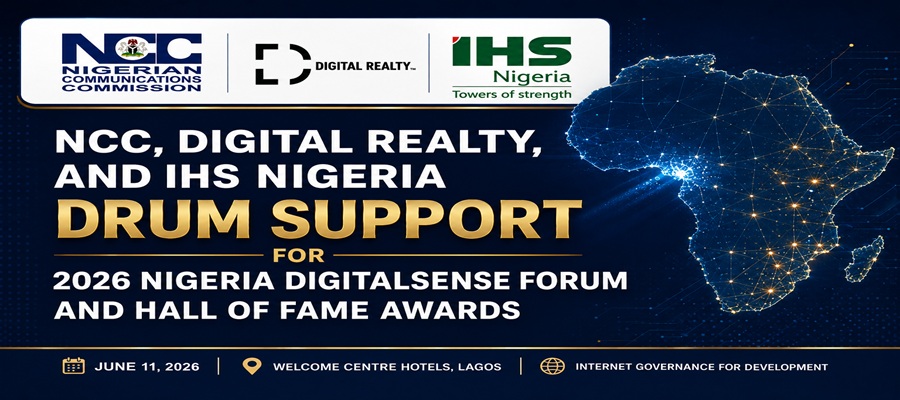
The regulatory and digital infrastructure pillars of Nigeria’s telecommunications ecosystem, led by the Nigerian Communications Commission (NCC), Digital Realty, and IHS Nigeria, have rallied robust support for the upcoming 2026 Nigeria DigitalSENSE Forum (NDSF) on Internet Governance for Development (IG4D) and its prestigious industry awards.

The annual high-level forum is scheduled to hold this Thursday, June 11, 2026, at the prestigious Banquet Hall, Welcome Centre Hotels, Lagos, anchoring its deliberations on the crucial theme: “Sustaining WSIS Vision with Multistakeholder Synergy in Nigeria.”
The Executive Vice Chairman and CEO of the NCC, Dr. Aminu Maida, is set to deliver the Keynote Address, highlighting the regulatory framework required to preserve the World Summit on the Information Society (WSIS) vision through inclusive, multi-stakeholder partnerships.
Joining the regulatory commission in driving this momentum is IHS Nigeria, the nation’s premier digital infrastructure champion boasting a footprint of over 16,000 telecom towers and 15,000km of fiber optic cables across the country. Alongside data center colocation leader Digital Realty, these organizations are heavily backing the forum as part of their commitment to promoting critical national infrastructure and securing Nigeria’s digital possibilities.
Speaking ahead of the event in Lagos, Ogbuefi Remmy Nweke, the Editor-in-Chief of host media organization ITREALMS Media Group, commended the immense institutional support flowing from the public and private sectors.
“Achieving sustainable internet governance and digital trust requires an intentional alignment of regulation and infrastructure,” Nweke remarked. “The active collaboration of the NCC, IHS Nigeria, and Digital Realty ensures that the 2026 forum will move beyond mere dialogue to produce clear, actionable policy recommendations for our digital economy.”
The event will be presided over by Dr. Olusola Teniola (hon), Director, Strategic Business Initiatives, ipNX Nigeria and former President, Association of Telecommunications Companies of Nigeria (ATCON), who will deliver the Chairman’s Opening Speech on the 2026 NDSF blueprint.
Earlier, leading telecommunications, technology, and internet governance stakeholders have thrown their weight behind the 17th milestone edition of the annual Nigeria DigitalSENSE Forum (NDSF) on Internet Governance for Development (IG4D), including ICT infrastructure leader MTN Nigeria; the Association of Licensed Telecoms Operators of Nigeria (ALTON); premier software and DNS infrastructure firm Upperlink Limited; and the Nigeria Internet Registration Association (NiRA), managers of the .NG country code Top Level Domain name.
Media & Event Contact: The Secretariat Nigeria DigitalSENSE Forum (NDSF) / ITREALMS Media Group Banquet Hall, Welcome Centre Hotels, Lagos Website: www.itrealms.com.ng

CBN to Deploy AI in Fight Against Payment Fraud

NDPC, Meta Launch 2-Year M-SIDP after Regulatory Settlement

Report Faults Banks over N91.1 Trillion Sterilised at CBN

Telcos Fault Data of FDI Flow, Claim Investment of N1.86 Trillion on Service Expansion

NRS Accredits Afri Invoice as Access Point Provider to Drive Nigeria’s Mandatory e-invoicing

CBN Extends PoS Geo-Fencing Enforcement Deadline to August 2026

FG to Launch Nationwide Free Digital TV Platform June 17

MTN, Airtel, Glo Under Pressure as FG Demands Better Service Delivery

Jumia Nigeria Records Strong Q1 2026 Growth as Technology-Led Strategy Drives Market Expansion

Metro Digital, Nigerian Firm Accuses Multichoice Of Refusal to Obey Court Judgements




 Telecom1 day ago
Price of Data in Nigerian Mobile among Top Four Cheapest Globally – MTN CEO

 E-Financial1 day ago
BOI Wins Dual Honours @ EMEA Finance Awards for Sustainability and Social Impact Leadership

 E-Business1 day ago
NITDA Okays NiRA’s Annual, Business Report

 E-Financial1 day ago
CBN Imposes N100m Penalty on Dealing Bank Inadequate Processing of Forex Documents

 Telecom1 day ago
NAIFF Returns for 2026, Expands Focus on AI-Powered Storytelling in Africa

 General News1 day ago
SSDC Warns Businesses against Cyber, Election-Related Risks

 General News1 day ago
Moniepoint DreamDevs Bootcamp Graduates Second Cohort to Strengthen Homegrown Talent Pipeline

 Telecom1 day ago
FCCPC Refutes Airtime Market Takeover Claims