

Telecom
Curbing Vandalization, Theft of Telecom Equipment

Vandalization as an act before now was synonymous with the oil and gas sector of the country’s economy, where petroleum pipe lines are vandalized with the aim of siphoning petroleum products from the pipes.
This nefarious act has led to loss of human lives and material wealth over the years especially in recent years when the product has become goldmine. The growth of telecommunications in the country as witnessed in the spread of coverage by Global System for Mobile (GSM) communications saw this ‘bad word’ extending its tentacle to the sector that has been adjudged the fastest in terms of growth in Africa. It started as activities of areas boys who demanded for settlement from telecom operators before they could site their base stations in their areas and has today, grown to menacing proportions.
When last year, Nigeria witnessed its worst quality of service issue in GSM service delivery that led to Nigerian Communications Commission (NCC) slamming blanket ban on MTN and Zain from running promo and directed that they pay compensation to their subscribers; the operators argued that they were not responsible for the poor quality of service attributing it to vandalization and theft of their equipment.
This argument was not acceptable; maybe NCC and National Assembly saw it as an afterthought as such issue was not raised before the hammer fell on them. But, today, the matter that was relegated to the background has turned out to be a subject for discussion by the industry stakeholders.
NCC few weeks ago organized Stakeholders’ Forum to tackle vandalization and theft of telecom infrastructure where it resolved to collaborate with security agencies to address the issue. Engr. Ernest Ndukwe, executive vice chairman, NCC said at the forum that there was need for the commission to revisit the military decree that punished culprits of theft and vandalization of Nitel and government properties with long term imprisonment of 21 years.
This forum has been described by industry stakeholders as timely, when after one year of sanctions, operators are yet to deliver improved quality of service on their networks; and also proved that capacity is not the sole responsibility for poor quality of service.
Impact on operators
MTN Nigeria said it lost N125.2 million worth of equipment to theft and vandalization within 11 months of 2007. According to Mr. Karl Toriola, chief technical officer, MTN, 90 generating sets worth N44 million and 654,214 litres of diesel worth N65,421 million, were stolen within the period.
Others include 35 solenoid worth N2.7 million, 23 air conditioners worth N1.3 million, 47 batteries worth N2.1 million and 120 AVR put at N9.7 million. He added that vandalization of about 300 sites and sabotage of MTN’s transmission infrastructure led to significant downtime last year. These figures may have doubled going by increase activities of these vandals and thieves.
Toriola noted that repeated and multiple cuts to its fibre optic network disrupt service, defeat redundancy and self healing architecture of fibre rings as damage to one microwave tower will often affect several others in line of sight causing widespread transmission outages. "Increasing community agitation and militancy across the six geographical zones with greatest incidence in Lagos, Niger-Delta, South-East also affected our services," he said.
According to him, about 50 sites were rendered inaccessible per day on account of community issues. He added that increasing robbery and banditry hamper the ability to provide reactive maintenance within preferred best practice response times. Zain on the other hand lost 100 generators last year which has doubled as at last month when Mr. Bayo Ligali, chief executive officer of the company disclosed that GSM operators are losing at least two sets of generators to thieves on daily basis. Although Globacom has not disclosed the number of its generators and other equipments lost to vandalism and theft, it is believed that it could still be in the same range with its competitors as they are not operating in a different environment. However, these thieves overpower security guards guiding these base stations with sophisticated weapon to carry out their unscrupulous act.
Nigeria CommunicationsWeek gathered that 3 GSM operators had a total of 11,900 base stations as at the end of July this year. A breakdown of which shows that MTN has 4,200, Glomobile 4,100 and Zain 3,600 with installed 23,800 generators. GSM operators are using generating sets because of the unreliable nature of Nigeria’s public power supply.
Mr. Ligali said that apart from countries where they have witnessed wars and other major conflicts, Nigeria ranks highest among countries that have recorded rampant vandalization of telecommunications equipment in the world.
Options
Nigeria cannot afford to allow few disgruntled elements destroy the growth recorded in an industry she seem to have gotten it right among others in the economy. Against this backdrop, something needs to be done fast to check this ugly trend capable of throwing us back to the dark ages of telecommunications.
Mr. Gbenga Adebayo, chairman, Association of Telecommunications Operators of Nigeria (Alton) suggested that the Federal Government should present a bill to the National Assembly, to advance a law that will stipulate stiffer penalties of up to 10 years imprisonment for apprehended vandals of base stations and other infrastructure like optic fibre cables.
According to Adebayo, Alton was actually at the forefront of the plans to sponsor the bill at the National Assembly, even as he expressed optimism that having been a problem that affects all, the bill would not have much problem being passed into law.
He cited the scenario of the 80s when it was a serious offence punishable by a long stretch of prison sentence, to vandalize Nitel property and wondered why the same protection is not extended to today’s telecom operators who are largely private firms.
He said his association has over time, articulated and packaged submissions to the Federal Government by writing to relevant agencies, ministries and related authorities over what they have been going through in the hands of vandals and thieves who steal and damage facilities, and the need to be given some kind of protection to enable them focus on delivering better quality of service to the subscribers.
"We cannot fold our arms and watch things continue the way they are going," he said.
Adebayo cautioned that with the astronomical growth of telecom subscribers on the networks, government should at least provide those basic things to help the operators in providing quality and seamless services or risk having the networks collapse with inestimable drastic effects on the economy of the country.
Franchising option should be also looked into by operators to address this menace especially in rural areas, just as Zain’s Rural Acquisition Initiative (RAI). Franchising is a method of doing business where a franchisor licenses trademarks to a franchisee in exchange for a recurring payment – usually a percentage of gross profits as well as the annual fees.
Zain’s RAI is targeted at low income consumers in most rural and poorest parts of Nigeria. The telecom franchise programme initiative is designed to involve rural residents in base station management and distribution programme, creating jobs, wealth, and improved products and services availability in the process.
Franchisees selected for the programme are the drivers of the programme as local entrepreneurs and in turn recruit representatives from their locality to sell services and protect local base stations in their areas. They are given necessary technical, marketing, sales and financial support by Zain to help grow their businesses.
Fola Odufuwa, founder of eShekels limited, a pioneer ICT researcher in Sub-Saharan Africa, said franchising has ability to speedily start a new business based on a proven template. It also ensures expansion of operations more rapidly.
According to him, Nigerian entrepreneurs do not really need subsidies but a level playing field, access to capital and fair access to existing networks, adequate profit sharing structure and legal protection for their investments.
Business franchising involves the transfer of the total way of doing business that has been developed by a franchisor (big enterprise) to a franchisee (such as small and medium enterprise).
In the context of telecoms, it means that the service provider transfers to the small entrepreneur, the whole process including technical expertise, training systems, marketing, management methods and relevant information on provision of telecoms services to rural areas for an agreed fee or proportion of profit on the business.
Industry analysts say franchising can to an extent, assist in curbing theft and vandalization of telecomm equipment. For instance, if operators franchise their base stations, products and distribution outlets in a community to an indigene of such community, chances are that such franchisee will provide adequate security for those equipments knowing fully well that he or she has stakes in the business and if anything happens to the equipment, he stands to lose money. More so, his people will see such equipments as belonging to a local and not the major network operator and then be more willing to protect them.



Association of Licensed Telecom Operators of Nigeria (ALTON), official industry umbrella body and pressure group for major mobile network operators in the country, has faulted claims that foreign direct investments (FDIs) into the sector slumped significantly in quarter one (Q1).

Gbenga Adebayo, Chairman, ALTON
ALTON, said that with N2.13 trillion spent in 2025 on network upgrades and expansion that they would invest an additional N1.86 trillion on network expansion this year.
The body was reacting to the claim by the National Bureau of Statistics (NBS) that FDIs into the sector slumped significantly in quarter one.
The telcos commended the Federal Government for its continued support of the industry, while calling for a more comprehensive framework to track and report investments coming into the sector.
The operators highlighted the importance of accurate data in shaping investor perceptions and guiding policy decisions.
The association noted that while the NBS recently released its Q1 Capital Importation Report, the figures presented do not fully capture the scale of capital deployment within Nigeria’s telecoms industry.
“This disparity between reported foreign capital inflows and actual infrastructure investment highlights a gap in how sectoral capital deployment is currently measured and reported,” the statement read.
ALTON, in the statement, signed by Gbenga Adebayo and Damian Udeh, chairman and publicity secretary, respectively, expressed appreciation to the Federal Government for approving a strategic 50 per cent tariff increase in 2025, describing it as a pivotal intervention that rescued the industry from financial distress.
According to the association, the tariff adjustment restored operational viability, closed critical revenue gaps and enabled operators to reinvest in infrastructure and service quality.
The association emphasised that the policy intervention transformed the sector from a struggling model into a sustainable, growth-focused industry.
“The timely investment enabled operators to transition from financial distress to a sustainable, growth-focused model characterised by significant capital reinvestment,” ALTON stated.
The statement revealed that telecom operators, tower companies, and other players in the sector recorded a total capital expenditure of N2.13 trillion in 2025. For 2026, planned capital expenditure stands at N1.86 trillion, with funds directed towards network infrastructure expansion, technology upgrades, and operational investments critical to maintaining service quality and coverage.
These commitments, ALTON stressed, are fundamental to advancing Nigeria’s digital economy objectives and improving services for millions of subscribers nationwide.
While the NBS report indicated a sharp decline in foreign capital importation into the telecom sector, from $80.78 million in 2025 to just $7.24 million in Q1 2026, ALTON argued that this metric only reflected a portion of the actual investment activity.
The association explained that much of the sector’s capital deployment now comes from domestic sources, including reinvested operational earnings.
These financial mechanisms, ALTON noted, are not fully reflected in conventional foreign capital importation metrics, thereby painting an incomplete picture of the industry’s health.
To address this reporting gap, ALTON proposed a collaborative engagement among the Nigerian Communications Commission (NCC), the NBS, and the Central Bank of Nigeria (CBN).
The goal, according to the association, is to develop a more inclusive and transparent investment-tracking framework that accurately reflects both foreign and domestic capital flows.
ALTON reassured the Nigerian public that telecom operators remain committed to continuous investment in network expansion, modernisation, resilience and service quality improvements.
The association pledged to work closely with regulators and government institutions to ensure that the sector’s contributions to national development are comprehensively documented and appropriately recognised.
With sustained collaboration and government support, ALTON said Nigerians can expect uninterrupted access to digital services that drive economic growth, innovation, financial inclusion, and overall national development.



Princess Emiko
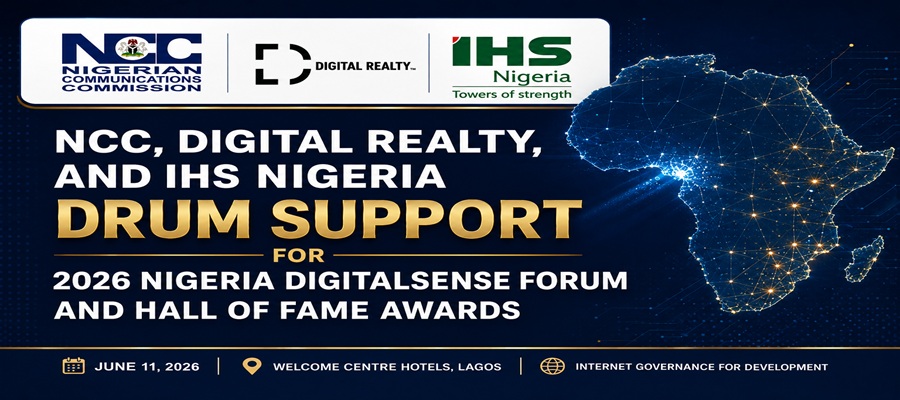
The regulatory and digital infrastructure pillars of Nigeria’s telecommunications ecosystem, led by the Nigerian Communications Commission (NCC), Digital Realty, and IHS Nigeria, have rallied robust support for the upcoming 2026 Nigeria DigitalSENSE Forum (NDSF) on Internet Governance for Development (IG4D) and its prestigious industry awards.

The annual high-level forum is scheduled to hold this Thursday, June 11, 2026, at the prestigious Banquet Hall, Welcome Centre Hotels, Lagos, anchoring its deliberations on the crucial theme: “Sustaining WSIS Vision with Multistakeholder Synergy in Nigeria.”
The Executive Vice Chairman and CEO of the NCC, Dr. Aminu Maida, is set to deliver the Keynote Address, highlighting the regulatory framework required to preserve the World Summit on the Information Society (WSIS) vision through inclusive, multi-stakeholder partnerships.
Joining the regulatory commission in driving this momentum is IHS Nigeria, the nation’s premier digital infrastructure champion boasting a footprint of over 16,000 telecom towers and 15,000km of fiber optic cables across the country. Alongside data center colocation leader Digital Realty, these organizations are heavily backing the forum as part of their commitment to promoting critical national infrastructure and securing Nigeria’s digital possibilities.
Speaking ahead of the event in Lagos, Ogbuefi Remmy Nweke, the Editor-in-Chief of host media organization ITREALMS Media Group, commended the immense institutional support flowing from the public and private sectors.
“Achieving sustainable internet governance and digital trust requires an intentional alignment of regulation and infrastructure,” Nweke remarked. “The active collaboration of the NCC, IHS Nigeria, and Digital Realty ensures that the 2026 forum will move beyond mere dialogue to produce clear, actionable policy recommendations for our digital economy.”
The event will be presided over by Dr. Olusola Teniola (hon), Director, Strategic Business Initiatives, ipNX Nigeria and former President, Association of Telecommunications Companies of Nigeria (ATCON), who will deliver the Chairman’s Opening Speech on the 2026 NDSF blueprint.
Earlier, leading telecommunications, technology, and internet governance stakeholders have thrown their weight behind the 17th milestone edition of the annual Nigeria DigitalSENSE Forum (NDSF) on Internet Governance for Development (IG4D), including ICT infrastructure leader MTN Nigeria; the Association of Licensed Telecoms Operators of Nigeria (ALTON); premier software and DNS infrastructure firm Upperlink Limited; and the Nigeria Internet Registration Association (NiRA), managers of the .NG country code Top Level Domain name.
Media & Event Contact: The Secretariat Nigeria DigitalSENSE Forum (NDSF) / ITREALMS Media Group Banquet Hall, Welcome Centre Hotels, Lagos Website: www.itrealms.com.ng

CBN to Deploy AI in Fight Against Payment Fraud

NDPC, Meta Launch 2-Year M-SIDP after Regulatory Settlement

Report Faults Banks over N91.1 Trillion Sterilised at CBN

Telcos Fault Data of FDI Flow, Claim Investment of N1.86 Trillion on Service Expansion

NRS Accredits Afri Invoice as Access Point Provider to Drive Nigeria’s Mandatory e-invoicing

CBN Extends PoS Geo-Fencing Enforcement Deadline to August 2026

FG to Launch Nationwide Free Digital TV Platform June 17

MTN, Airtel, Glo Under Pressure as FG Demands Better Service Delivery

Jumia Nigeria Records Strong Q1 2026 Growth as Technology-Led Strategy Drives Market Expansion

Metro Digital, Nigerian Firm Accuses Multichoice Of Refusal to Obey Court Judgements




 Telecom2 days ago
Price of Data in Nigerian Mobile among Top Four Cheapest Globally – MTN CEO

 E-Financial2 days ago
BOI Wins Dual Honours @ EMEA Finance Awards for Sustainability and Social Impact Leadership

 E-Business2 days ago
NITDA Okays NiRA’s Annual, Business Report

 E-Financial2 days ago
CBN Imposes N100m Penalty on Dealing Bank Inadequate Processing of Forex Documents

 Telecom2 days ago
NAIFF Returns for 2026, Expands Focus on AI-Powered Storytelling in Africa

 General News1 day ago
SSDC Warns Businesses against Cyber, Election-Related Risks

 General News2 days ago
Moniepoint DreamDevs Bootcamp Graduates Second Cohort to Strengthen Homegrown Talent Pipeline

 Telecom1 day ago
FCCPC Refutes Airtime Market Takeover Claims