

Telecom
Encouraging Local Content in Telecom for Development

The fact that the country’s telecommunications sector has witnessed tremendous growth over the past eight years of its liberalization is no longer celebrating news, but how to sustain and develop the sector is now the paramount concern of stakeholders in the industry.
One likely area of emphasis in a bid to develop as well as sustain the growth is adoption of local content to replace dominant foreign content in the sector. Local content in telecommunications industry is the use or adoption of locally manufactured material and initiatives in the operation processes of telecommunications service delivery. To many, there are little or nothing that local initiatives can contribute in the telecommunications industry going by the capital intensive nature of the business, they cite instance of mobile handsets which are predominately imported and where there are no known initiative of capacity to develop it locally. More so, core network equipment such as intelligent switches and microwave equipments which are sensitive high technological equipment that will take the country decades to come to terms with, let a lone manufacturing them.
But, unknown to these school of thought, that there are other areas where telecommunications operators are spending huge of the country’s hard earned foreign exchange in import that Nigerians can effective play role in substituting with local initiatives.
Among them are billing software, cyber cables, mast, connectors, switches as well as equipment racks.
Local content policies
Local firms are ultimately and probably the most important driver of economic incomes and growth in developing countries. It has been found that local technology is spreading faster in emerging economies than in rich nations, even though the technology gap remains wide. It also found that technological progress has helped raise incomes in the developing world and reduced the share of people living in poverty from 29 percent in 1990 to 18 percent in 2004.
It has long been recognized that investment in science and technology makes a vital contribution to economic growth in terms of higher growth rate of the economy’s productivity under such conditions; the neglect of R&D in developing countries will have serious repercussion on firms’ ability to absorb and evolve new technologies and participate in their development. This may have long-term implication for the developmental efforts of these countries. But two critical questions arise: one, what were the weaknesses that resulted in the poor performance of technology policies in these countries? And two, what measures should be adopted to plug in the loopholes in these policies to make them more effective in the globalize era?
Local content means the development of local skills, technology transfer, use of local manpower and local manufacturing. It has become an increasingly important issue that could support the federal government to upgrade her manpower capacity, with results that benefit the government, private companies, and the Nigeria’s economy. However, the performance of this mission over the past decade has been a mix of successes and failures. Research performed to improve this performance by identifying the characteristics of successful public to private sector technology transfers identified several critical success factors. These include a "transfer culture" in the government laboratory and Nigerianized organization, shared personnel of the federal and local organizations throughout the transfer project life cycle; the local workforce services could be the major source of employment inside Nigeria economies, accounting for over 50 percent of jobs. Local technology services account for a much larger share of total economic output than either manufacturing or agriculture in this country. Home-grown services are the future of this country, as it is the fastest-growing component of the total GDP, particularly low-income Nigeria.
Nigeria, though embarked to the periodic development planning exercise as early as 1964, failed to realize the importance of private sector and market oriented policy in the process of overall development of the country till late eighties and this resulted to several economic distortions.
Since then, the private sector development policy has been reoriented to identifying and removing the barriers for private investments, and creating private sector friendly economic environment so that the private sector would play pivotal role in the economy. Thus shift in the role of the government from active participant to facilitator not only brought positive psychological change in the private sectors, but also added economic dynamism through the active participation of private sectors in all sectors.
Nigeria provides a classic case of a developing country where despite the presence of a wide institutional infrastructure for producing trained manpower, generating new knowledge and providing science and technology (S&T) services, the industry became increasingly dependent on foreign technologies ever since the economy became liberalized under ex-president Obasanjo’s regime.
In the early 1999’s new democratic government initiated a series of market oriented policy reforms to integrate the economy towards globalization and economic growth. A remarkable progress in terms of growth, investment and employment has been achieved. Private sector led growth was the main thrust of the policy reform initiatives taken during the millennium.
In the field of science and technology, Nigeria presents two completely contradictory faces. On the one hand, foreign observers look upon Nigeria as a bottomless container of S&T talent which in due course of time will, along with China, dominates the global scene in the second half of the 21st century. This perception is based on the success Nigeria has registered in the field of information technology in Nigeria and the achievement of African Americans in the United States. The opposite face is registered at Nigeria’s inability to solve problems of infrastructure, namely roads, power, water supply and sanitation and at the poor state of its schools and colleges. In a bid to meet this target, Nigeria joined other countries in jumpstarting the services negotiation in the local content policy implementation. The Collective Services Requests are aimed at promoting this country’s economic growth, particularly in developing economies, by improving productivity, creating jobs and improving the quality and availability of goods, agriculture and services through oil and gas root-up.
Since the country’s own technological capabilities were limited, the dual trade policy placed a continuous pressure on firms for acquiring foreign technologies. To meet the industry demand, the government encouraged the transfer of foreign technology embodied in capital goods and turnkey plants by assigning low protection to the capital goods industry. Highly restrictive policies were adopted towards FDI and technology licensing. Technical agreements were allowed only in the cases where technical assistance was needed to run the turnkey projects. Capital goods imports were given preference over the alternative modes of technology acquisition for two reasons. Light industries required simple and standardized technologies that could easily be transferred through capital goods imports. It was felt that given the training and entrepreneurship of Koreans, it would be easy to assimilate and adapt foreign technologies embodied in capital goods through reverse engineering at the production end. Though the policy led to massive imports of foreign capital goods and owing to low protection retarded the growth of the local capital goods industries, it did facilitate a rapid acquisition of technology during this phase.
Local content in telecommunications is not all about equipments, human resource is another area of local content. This requires telecommunications companies to employ greater number of Nigerians in their work force. However, trained manpower is not readily available in the industry; this is evident in the high rate of pouching in the industry, where skilled personnel move among organizations that pay high.
Engr. Lanre Ajayi, managing director, Pinet Informatics, acknowledged that there is acute shortage of trained human resources in ICT industry. According to him, any policy that requires a company to use local human resource such policy should ensure that there is enough trained human capacity available in the country. He cited instance of problem of poor quality of service in the GSM space, which he attributed lack of skilled manpower as part of the causes.
This could also be explained as responsible for Nigerian Communications Commission conception of the establishment of ICT training institute in the name of Digital Bridge institute to provide the needed skilled manpower requirement to develop the industry.
Dr. Emmanuel Ekuwem, president, Association Telecommunications Companies of Nigeria (Atcon) said that the industry requires an effective policy framework as well as enforcement to encourage local content in telecommunications development. He urged NCC and National Information Technology Development Agency (Nitda) to ensure that policies are formulated to encourage operators in the industry to use locally made equipment where necessary in the sector. This he said would go a long in solving the problem of unemployment and save the country’s foreign exchange that are used in the importation of those goods with local alternatives.
Obstacles to adoption
Nigerian psyche has been steeped in the notion that foreign made products are preferable even when there local alternatives are of higher quality and cheaper. Government officials expected to set example for private sector to follow are also cut in the web of this act as most government officials uses foreign made goods against the locally produce ones. This accounts for lack of vigor required in the enforcement local content policies in the different sectors of the economy.
Liberalization is not an end in itself; however it could enhance the capability of the local content to the asses of capital, technology and knowledge by which the overall objective of economic development could be achieved. Local workforce and home-grown technology as the main actor in the process of liberalization of telecom can inject more capital, acquire new and modern technology, generates additional resources for telecom development. The process of integration possesses various opportunities and challenges and such challenges which are complex as well as need competitiveness have to be dealt with joint effort of the regulatory authorities and local input inside the telecom space through appropriate institutional mechanism.



Association of Licensed Telecom Operators of Nigeria (ALTON), official industry umbrella body and pressure group for major mobile network operators in the country, has faulted claims that foreign direct investments (FDIs) into the sector slumped significantly in quarter one (Q1).

Gbenga Adebayo, Chairman, ALTON
ALTON, said that with N2.13 trillion spent in 2025 on network upgrades and expansion that they would invest an additional N1.86 trillion on network expansion this year.
The body was reacting to the claim by the National Bureau of Statistics (NBS) that FDIs into the sector slumped significantly in quarter one.
The telcos commended the Federal Government for its continued support of the industry, while calling for a more comprehensive framework to track and report investments coming into the sector.
The operators highlighted the importance of accurate data in shaping investor perceptions and guiding policy decisions.
The association noted that while the NBS recently released its Q1 Capital Importation Report, the figures presented do not fully capture the scale of capital deployment within Nigeria’s telecoms industry.
“This disparity between reported foreign capital inflows and actual infrastructure investment highlights a gap in how sectoral capital deployment is currently measured and reported,” the statement read.
ALTON, in the statement, signed by Gbenga Adebayo and Damian Udeh, chairman and publicity secretary, respectively, expressed appreciation to the Federal Government for approving a strategic 50 per cent tariff increase in 2025, describing it as a pivotal intervention that rescued the industry from financial distress.
According to the association, the tariff adjustment restored operational viability, closed critical revenue gaps and enabled operators to reinvest in infrastructure and service quality.
The association emphasised that the policy intervention transformed the sector from a struggling model into a sustainable, growth-focused industry.
“The timely investment enabled operators to transition from financial distress to a sustainable, growth-focused model characterised by significant capital reinvestment,” ALTON stated.
The statement revealed that telecom operators, tower companies, and other players in the sector recorded a total capital expenditure of N2.13 trillion in 2025. For 2026, planned capital expenditure stands at N1.86 trillion, with funds directed towards network infrastructure expansion, technology upgrades, and operational investments critical to maintaining service quality and coverage.
These commitments, ALTON stressed, are fundamental to advancing Nigeria’s digital economy objectives and improving services for millions of subscribers nationwide.
While the NBS report indicated a sharp decline in foreign capital importation into the telecom sector, from $80.78 million in 2025 to just $7.24 million in Q1 2026, ALTON argued that this metric only reflected a portion of the actual investment activity.
The association explained that much of the sector’s capital deployment now comes from domestic sources, including reinvested operational earnings.
These financial mechanisms, ALTON noted, are not fully reflected in conventional foreign capital importation metrics, thereby painting an incomplete picture of the industry’s health.
To address this reporting gap, ALTON proposed a collaborative engagement among the Nigerian Communications Commission (NCC), the NBS, and the Central Bank of Nigeria (CBN).
The goal, according to the association, is to develop a more inclusive and transparent investment-tracking framework that accurately reflects both foreign and domestic capital flows.
ALTON reassured the Nigerian public that telecom operators remain committed to continuous investment in network expansion, modernisation, resilience and service quality improvements.
The association pledged to work closely with regulators and government institutions to ensure that the sector’s contributions to national development are comprehensively documented and appropriately recognised.
With sustained collaboration and government support, ALTON said Nigerians can expect uninterrupted access to digital services that drive economic growth, innovation, financial inclusion, and overall national development.



Princess Emiko
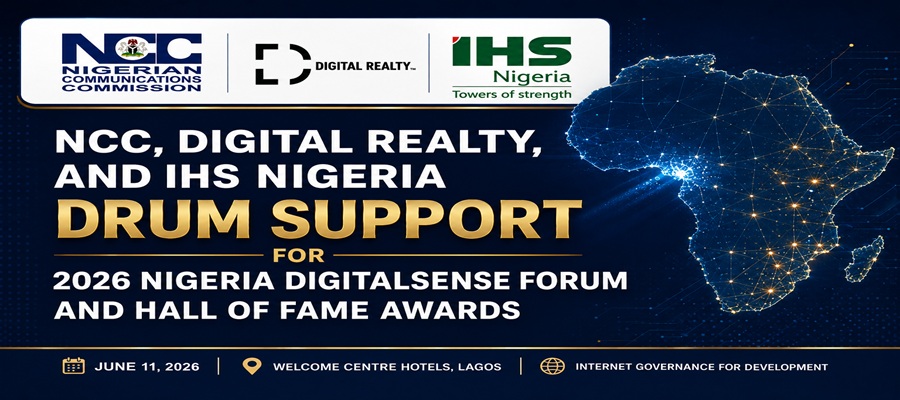
The regulatory and digital infrastructure pillars of Nigeria’s telecommunications ecosystem, led by the Nigerian Communications Commission (NCC), Digital Realty, and IHS Nigeria, have rallied robust support for the upcoming 2026 Nigeria DigitalSENSE Forum (NDSF) on Internet Governance for Development (IG4D) and its prestigious industry awards.

The annual high-level forum is scheduled to hold this Thursday, June 11, 2026, at the prestigious Banquet Hall, Welcome Centre Hotels, Lagos, anchoring its deliberations on the crucial theme: “Sustaining WSIS Vision with Multistakeholder Synergy in Nigeria.”
The Executive Vice Chairman and CEO of the NCC, Dr. Aminu Maida, is set to deliver the Keynote Address, highlighting the regulatory framework required to preserve the World Summit on the Information Society (WSIS) vision through inclusive, multi-stakeholder partnerships.
Joining the regulatory commission in driving this momentum is IHS Nigeria, the nation’s premier digital infrastructure champion boasting a footprint of over 16,000 telecom towers and 15,000km of fiber optic cables across the country. Alongside data center colocation leader Digital Realty, these organizations are heavily backing the forum as part of their commitment to promoting critical national infrastructure and securing Nigeria’s digital possibilities.
Speaking ahead of the event in Lagos, Ogbuefi Remmy Nweke, the Editor-in-Chief of host media organization ITREALMS Media Group, commended the immense institutional support flowing from the public and private sectors.
“Achieving sustainable internet governance and digital trust requires an intentional alignment of regulation and infrastructure,” Nweke remarked. “The active collaboration of the NCC, IHS Nigeria, and Digital Realty ensures that the 2026 forum will move beyond mere dialogue to produce clear, actionable policy recommendations for our digital economy.”
The event will be presided over by Dr. Olusola Teniola (hon), Director, Strategic Business Initiatives, ipNX Nigeria and former President, Association of Telecommunications Companies of Nigeria (ATCON), who will deliver the Chairman’s Opening Speech on the 2026 NDSF blueprint.
Earlier, leading telecommunications, technology, and internet governance stakeholders have thrown their weight behind the 17th milestone edition of the annual Nigeria DigitalSENSE Forum (NDSF) on Internet Governance for Development (IG4D), including ICT infrastructure leader MTN Nigeria; the Association of Licensed Telecoms Operators of Nigeria (ALTON); premier software and DNS infrastructure firm Upperlink Limited; and the Nigeria Internet Registration Association (NiRA), managers of the .NG country code Top Level Domain name.
Media & Event Contact: The Secretariat Nigeria DigitalSENSE Forum (NDSF) / ITREALMS Media Group Banquet Hall, Welcome Centre Hotels, Lagos Website: www.itrealms.com.ng

CBN to Deploy AI in Fight Against Payment Fraud

NDPC, Meta Launch 2-Year M-SIDP after Regulatory Settlement

Report Faults Banks over N91.1 Trillion Sterilised at CBN

Telcos Fault Data of FDI Flow, Claim Investment of N1.86 Trillion on Service Expansion

NRS Accredits Afri Invoice as Access Point Provider to Drive Nigeria’s Mandatory e-invoicing

CBN Extends PoS Geo-Fencing Enforcement Deadline to August 2026

FG to Launch Nationwide Free Digital TV Platform June 17

MTN, Airtel, Glo Under Pressure as FG Demands Better Service Delivery

Jumia Nigeria Records Strong Q1 2026 Growth as Technology-Led Strategy Drives Market Expansion

Metro Digital, Nigerian Firm Accuses Multichoice Of Refusal to Obey Court Judgements




 Telecom1 day ago
Price of Data in Nigerian Mobile among Top Four Cheapest Globally – MTN CEO

 E-Financial1 day ago
BOI Wins Dual Honours @ EMEA Finance Awards for Sustainability and Social Impact Leadership

 E-Business1 day ago
NITDA Okays NiRA’s Annual, Business Report

 E-Financial1 day ago
CBN Imposes N100m Penalty on Dealing Bank Inadequate Processing of Forex Documents

 General News1 day ago
SSDC Warns Businesses against Cyber, Election-Related Risks

 Telecom1 day ago
NAIFF Returns for 2026, Expands Focus on AI-Powered Storytelling in Africa

 General News1 day ago
Moniepoint DreamDevs Bootcamp Graduates Second Cohort to Strengthen Homegrown Talent Pipeline

 Telecom1 day ago
FCCPC Refutes Airtime Market Takeover Claims