

Telecom
Enhancing Mobile Revenue through Advertising

Mobile network operators in the country have concentrated on voice services to generate revenue without looking at other avenues that can lift their revenue without much pressure on their capacity to delivery voice service.
This scenario could be explained by the late entrance of the country into the mobile communications world where much emphasis is laid on voice communications.
Mobile network operators in Nigeria today have the required technology to deliver short message service, video and picture messages. One then wonders why they are not exploring mobile advertising option to enhance their revenue base which invariable could help in driving down voice call tariff.
Mobile Marketing refer to one of two categories of marketing, first, and relatively new, is meant to describe marketing on or with a mobile device, such as a mobile phone this is an example of horizontal telecommunication convergence. Second, and a more traditional definition, is meant to describe marketing in a moving fashion – for example – technology road shows or moving billboards. However, this analysis is concentrating on the first definition of mobile marketing which has to do with using mobile phones as vehicle for advertising.
According to a survey conducted by a mobile marketing provider, approximately 89% of major brands are planning to market their products through text and multimedia mobile messaging by 2008. One-third is planning to spend about 10% of marketing budgets through mobile marketing.
Also, in about 5 years over half of brands are expected to spend between 5% and 25% of their total marketing budget on their mobile marketing. Already, 40% of the firms that responded have implemented this feature for their audiences. Strategy Analytics is forecasting that advertisers will spend $1.4 billion on mobile media this year, with that rising to $14.4 billion in 2011. eMarketer says mobile advert spending reached $1.5 billion last year and will grow to $14 by 2011.
What will and already has given mobile marketing’s attraction are: the ability to reach a specific target audience; information about how the user responded to a marketing message; and proof that a message has been received by the user’s handset.
Nigeria CommunicationsWeek gathered that Nigeria marketing communications is worth over 4 Billion Dollars. Nigerian Marketing Association, Apcon said that the sector became vibrant with the liberalization of telecommunications sector which witness a boost as a result of operators use of the medium to reach their subscribers in one promotion or the other.
The association which is presently using television viewer ship mostly in their advertising campaigns is considering mobile marketing because television viewer ship is declining at a fast rate for some reasons, such as influx of cheap Chinese pirated movies, electricity failures, absence of prime time Tv shows and absence of national Television stations. Radio the association said has its own challenges too and outdoor is location specific.
According to a report by Apcon Mobile is the only meduim with anywhere and anytime advantage with possibilities to accommodate all array of features like video, Multi-media Messaging Service, pictures, Short Message Service , internet and among others. Mobile is more powerful personal meduim than any other. And it is time, that Nigerian Brands exploit the opportunity.Possible Channels
Marketing on a mobile phone has become increasingly popular ever since the rise of SMS (Short Message Service) in the early 2000s in Europe and some parts of Asia when businesses started to collect mobile phone numbers and send off wanted or unwanted content.
Over the past few years SMS has become a legitimate advertising channel in some parts of the world. This is because unlike email over the public internet, the carriers who police their own networks have set guidelines and best practices for the mobile media industry (including mobile advertising). The Interactive Advertising Bureau (IAB) and the Mobile Marketing Association, as well, have established guidelines and are evangelizing the use of the mobile channel for marketers. While this has been fruitful in developed regions such as North America, Western Europe and some other countries, mobile SPAM messages (SMS sent to mobile subscribers without a legitimate and explicit opt-in by the subscriber) remain an issue in many other parts or the world, partly due to the carriers selling their member databases to third parties.
Mobile Marketing via SMS has expanded rapidly in Europe and Asia as a new channel to reach the consumer. SMS initially received negative media coverage in many parts of Europe for being a new form of spam as some advertisers purchased lists and sent unsolicited content to consumer’s phones; however, as guidelines are put in place by the mobile operators, SMS has become the most popular branch of the Mobile Marketing industry with several 100 million advertising SMS sent out every month in Europe alone.
In North America the first cross-carrier SMS shortcode campaign was run by Labatt Brewing Company in 2002. Over the past few years mobile short codes have been increasingly popular as a new channel to communicate to the mobile consumer. Brands have begun to treat the mobile shortcode as a mobile domain name allowing the consumer to text message the brand at an event, in store and off any traditional media.
SMS services typically run off a short code, but sending text messages to an email address is another methodology. Short codes are 5 or 6 digit numbers that have been assigned by all the mobile operators in a given country for the use of brand campaign and other consumer services. The mobile operators vet every application before provisioning and monitor the service to make sure it does not diverge from its original service description.
Besides short codes, inbound SMS is very often based on long numbers (international number format, e.g. +44 7624 805000), which can be used in place of short codes or premium-rated short messages for SMS reception in several applications, such as product promotions and campaigns. Long numbers are internationally available, as well as enabling businesses to have their own number, rather than short codes which are usually shared across a number of brands. Additionally, long numbers are non-premium inbound numbers.
Marketing communications companies in Nigeria lately are using SMS to send advertising content to mobile subscribers evident is during governorship election campaign in Lagos state when one of the candidates used SMS to solicit for votes from Lagosians. Also so few weeks ago an Abuja base estate consultant used the same medium to advertise its property in Abuja.
One key criterion for provisioning is that the consumer opts in to the service. The mobile operators demand a double opt in from the consumer and the ability for the consumer to opt out of the service at any time by sending the word STOP via SMS. These guidelines are established in the MMA Consumer Best Practices Guidelines which are followed by all mobile marketers in the United States.
Mobile Marketing via Bluetooth
The rise of Bluetooth started around 2003 and a few companies in Europe have started establishing successful businesses. Most of these businesses offer "Hotspot-Systems" which consist of some kind of content-management system with a Bluetooth distribution function. This technology has the advantages that it is permission-based, has higher transfer speeds and is also a radio-based technology and can therefore not be billed (i.e. is free of charge). The likely earliest device built for mobile marketing via Bluetooth was the context tag of the AmbieSense project (2001-2004).
Location-based services (LBS) are offered by some cell phone networks as a way to send custom advertising and other information to cell-phone subscribers based on their current location. The cell-phone service provider gets the location from a GPS chip built into the phone, or using radiolocation and trilateration based on the signal-strength of the closest cell-phone towers (for phones without GPS features).
This has started happening in Nigeria, during Celtel rebranding to Zain, the company used Imaging Concept Limited a proximity marketing firm to send to its subscribers pictures of their new brand Zain at all the event locations organized for the rebranding.
Ugo Okoye, managing director of iConcepts Limited, said that introduction of proximity marketing into the mobile marketing industry will no doubt make a big difference in the way brands reach their consumers with tailor-made messages that suit their purpose. According to Okoye, for the first time, brands using proximity marketing technology can ensure that they reach their target audience at a time and place that puts their messages in a direct and relevant context to the consumer’s current activity.
"The ability to communicate with consumers based on their presence in a fixed time and place is one of the great features of proximity advertising technique as it makes it possible to access people at various points with tailor-made offers precisely to suit them," he said.
Although, most operators in emerging markets are primarily focused on meeting rapid subscriber growth by expanding network coverage and capacity, as markets mature and revenue growth declines, operators will broaden their business scope. Mobile advertising could well make a useful contribution to their revenues.


Association of Licensed Telecom Operators of Nigeria (ALTON), official industry umbrella body and pressure group for major mobile network operators in the country, has faulted claims that foreign direct investments (FDIs) into the sector slumped significantly in quarter one (Q1).

Gbenga Adebayo, Chairman, ALTON
ALTON, said that with N2.13 trillion spent in 2025 on network upgrades and expansion that they would invest an additional N1.86 trillion on network expansion this year.
The body was reacting to the claim by the National Bureau of Statistics (NBS) that FDIs into the sector slumped significantly in quarter one.
The telcos commended the Federal Government for its continued support of the industry, while calling for a more comprehensive framework to track and report investments coming into the sector.
The operators highlighted the importance of accurate data in shaping investor perceptions and guiding policy decisions.
The association noted that while the NBS recently released its Q1 Capital Importation Report, the figures presented do not fully capture the scale of capital deployment within Nigeria’s telecoms industry.
“This disparity between reported foreign capital inflows and actual infrastructure investment highlights a gap in how sectoral capital deployment is currently measured and reported,” the statement read.
ALTON, in the statement, signed by Gbenga Adebayo and Damian Udeh, chairman and publicity secretary, respectively, expressed appreciation to the Federal Government for approving a strategic 50 per cent tariff increase in 2025, describing it as a pivotal intervention that rescued the industry from financial distress.
According to the association, the tariff adjustment restored operational viability, closed critical revenue gaps and enabled operators to reinvest in infrastructure and service quality.
The association emphasised that the policy intervention transformed the sector from a struggling model into a sustainable, growth-focused industry.
“The timely investment enabled operators to transition from financial distress to a sustainable, growth-focused model characterised by significant capital reinvestment,” ALTON stated.
The statement revealed that telecom operators, tower companies, and other players in the sector recorded a total capital expenditure of N2.13 trillion in 2025. For 2026, planned capital expenditure stands at N1.86 trillion, with funds directed towards network infrastructure expansion, technology upgrades, and operational investments critical to maintaining service quality and coverage.
These commitments, ALTON stressed, are fundamental to advancing Nigeria’s digital economy objectives and improving services for millions of subscribers nationwide.
While the NBS report indicated a sharp decline in foreign capital importation into the telecom sector, from $80.78 million in 2025 to just $7.24 million in Q1 2026, ALTON argued that this metric only reflected a portion of the actual investment activity.
The association explained that much of the sector’s capital deployment now comes from domestic sources, including reinvested operational earnings.
These financial mechanisms, ALTON noted, are not fully reflected in conventional foreign capital importation metrics, thereby painting an incomplete picture of the industry’s health.
To address this reporting gap, ALTON proposed a collaborative engagement among the Nigerian Communications Commission (NCC), the NBS, and the Central Bank of Nigeria (CBN).
The goal, according to the association, is to develop a more inclusive and transparent investment-tracking framework that accurately reflects both foreign and domestic capital flows.
ALTON reassured the Nigerian public that telecom operators remain committed to continuous investment in network expansion, modernisation, resilience and service quality improvements.
The association pledged to work closely with regulators and government institutions to ensure that the sector’s contributions to national development are comprehensively documented and appropriately recognised.
With sustained collaboration and government support, ALTON said Nigerians can expect uninterrupted access to digital services that drive economic growth, innovation, financial inclusion, and overall national development.



Princess Emiko
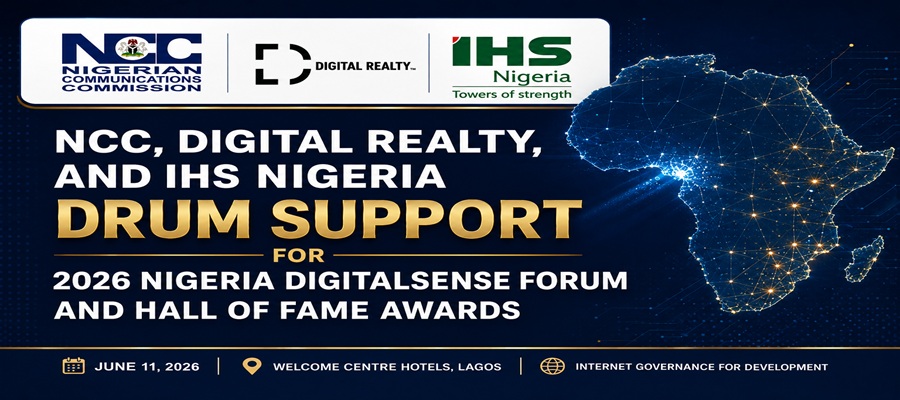
The regulatory and digital infrastructure pillars of Nigeria’s telecommunications ecosystem, led by the Nigerian Communications Commission (NCC), Digital Realty, and IHS Nigeria, have rallied robust support for the upcoming 2026 Nigeria DigitalSENSE Forum (NDSF) on Internet Governance for Development (IG4D) and its prestigious industry awards.

The annual high-level forum is scheduled to hold this Thursday, June 11, 2026, at the prestigious Banquet Hall, Welcome Centre Hotels, Lagos, anchoring its deliberations on the crucial theme: “Sustaining WSIS Vision with Multistakeholder Synergy in Nigeria.”
The Executive Vice Chairman and CEO of the NCC, Dr. Aminu Maida, is set to deliver the Keynote Address, highlighting the regulatory framework required to preserve the World Summit on the Information Society (WSIS) vision through inclusive, multi-stakeholder partnerships.
Joining the regulatory commission in driving this momentum is IHS Nigeria, the nation’s premier digital infrastructure champion boasting a footprint of over 16,000 telecom towers and 15,000km of fiber optic cables across the country. Alongside data center colocation leader Digital Realty, these organizations are heavily backing the forum as part of their commitment to promoting critical national infrastructure and securing Nigeria’s digital possibilities.
Speaking ahead of the event in Lagos, Ogbuefi Remmy Nweke, the Editor-in-Chief of host media organization ITREALMS Media Group, commended the immense institutional support flowing from the public and private sectors.
“Achieving sustainable internet governance and digital trust requires an intentional alignment of regulation and infrastructure,” Nweke remarked. “The active collaboration of the NCC, IHS Nigeria, and Digital Realty ensures that the 2026 forum will move beyond mere dialogue to produce clear, actionable policy recommendations for our digital economy.”
The event will be presided over by Dr. Olusola Teniola (hon), Director, Strategic Business Initiatives, ipNX Nigeria and former President, Association of Telecommunications Companies of Nigeria (ATCON), who will deliver the Chairman’s Opening Speech on the 2026 NDSF blueprint.
Earlier, leading telecommunications, technology, and internet governance stakeholders have thrown their weight behind the 17th milestone edition of the annual Nigeria DigitalSENSE Forum (NDSF) on Internet Governance for Development (IG4D), including ICT infrastructure leader MTN Nigeria; the Association of Licensed Telecoms Operators of Nigeria (ALTON); premier software and DNS infrastructure firm Upperlink Limited; and the Nigeria Internet Registration Association (NiRA), managers of the .NG country code Top Level Domain name.
Media & Event Contact: The Secretariat Nigeria DigitalSENSE Forum (NDSF) / ITREALMS Media Group Banquet Hall, Welcome Centre Hotels, Lagos Website: www.itrealms.com.ng

CBN to Deploy AI in Fight Against Payment Fraud

NDPC, Meta Launch 2-Year M-SIDP after Regulatory Settlement

Report Faults Banks over N91.1 Trillion Sterilised at CBN

Telcos Fault Data of FDI Flow, Claim Investment of N1.86 Trillion on Service Expansion

NRS Accredits Afri Invoice as Access Point Provider to Drive Nigeria’s Mandatory e-invoicing

CBN Extends PoS Geo-Fencing Enforcement Deadline to August 2026

FG to Launch Nationwide Free Digital TV Platform June 17

MTN, Airtel, Glo Under Pressure as FG Demands Better Service Delivery

Jumia Nigeria Records Strong Q1 2026 Growth as Technology-Led Strategy Drives Market Expansion

Metro Digital, Nigerian Firm Accuses Multichoice Of Refusal to Obey Court Judgements




 Telecom1 day ago
Price of Data in Nigerian Mobile among Top Four Cheapest Globally – MTN CEO

 E-Financial1 day ago
BOI Wins Dual Honours @ EMEA Finance Awards for Sustainability and Social Impact Leadership

 E-Business1 day ago
NITDA Okays NiRA’s Annual, Business Report

 E-Financial1 day ago
CBN Imposes N100m Penalty on Dealing Bank Inadequate Processing of Forex Documents

 Telecom1 day ago
NAIFF Returns for 2026, Expands Focus on AI-Powered Storytelling in Africa

 General News1 day ago
SSDC Warns Businesses against Cyber, Election-Related Risks

 General News1 day ago
Moniepoint DreamDevs Bootcamp Graduates Second Cohort to Strengthen Homegrown Talent Pipeline

 Telecom1 day ago
FCCPC Refutes Airtime Market Takeover Claims