

Telecom
Extending Telecoms Connectivity to rural Africa

In spite of tremendous growth in telecommunications service delivery in Africa, greater percentage of rural populace in the region is yet to enjoy telecom access, due mostly because rural areas are not commercially viable.
Governments in Africa have attempted to lure operators in providing service to rural dwellers through incentive such as tax waivers and provision of telecom infrastructure to no avail.
Against this backdrop that a report dealing with the broader issues of rural connectivity in Africa launched last week by the Commonwealth Telecommunications Organisation (CTO). The report reveals that a number of novel and multi-stakeholder partnerships, unique business models and innovative technologies are, for the first time, paving the way to connect many of Africa’s rural communities, on a sustainable, profitable basis.
The report provides evidence that contrary to some assumptions that the private sector can lead the effort to connect Africa’s rural populations, the experiences of industrialized countries like Canada, the Unites States and Australia is that governments have had to lead the effort, but in close collaboration with the private sector and local communities. The report calls for Commonwealth African governments to implement their national ICT policies as part of a wider national development strategy and to make faster in-roads into rural ICT rollout through public private peoples partnerships (PPPPs), with local communities playing a more pivotal role.
The report finds that the key to successful partnerships between the public and private sectors and other ICT stakeholders is to encourage local ownership, thereby nurturing the community’s enthusiasm for effective connectivity and ensuring the sustainability of ICT investments.
The CTO study found that whereas Commonwealth countries such as Malaysia and India have made significant in-roads in rural connectivity, Commonwealth African countries like Sierra Leone and Zambia are lagging behind in rural access, leading to poor and overall slow economic growth. The report finds that although recent years have seen dramatic growth in penetration rates in some African countries, especially through mobile networks, the continent’s aggregate penetration rate is still less than 20 percent.
"For Internet access and use, the figures are well below 5 percent for most of Africa. Over 60 percent of Africa’s population lives in unconnected rural areas and represent an untapped market, holding enormous potential for growth for service providers, equipment manufacturers and the entire telecommunications industry", the report claims.
By way of conclusion the report calls for ICT policy provisions that focus on universal and rural access, in order to affirm the commitment of governments to providing basic ICT services to poor, isolated and marginalized communities . There is also the need for continued incremental and a more methodical process of liberalization and privatization of the telecommunications sector in many African countries, and a variety of regulatory safeguards need to be put in place to foster competition and promote a conducive environment for rural connectivity.
Commenting on the initiative, Dr. Ekwow Spio-Garbrah chief executive officer of CTO said that the evidence they have accumulated in the course of the 9-month study demonstrates that most of Africa’s rural populations could well be connected over the next decade. "This is partly because an unusual confluence of sounder policies, relevant legislation, improving regulatory practices, the establishment of universal access and service agencies and the revenues they have acquired, new technologies and business models, and the availability of funding from a plethora of sources, all make it now possible for most of Africa to be connected wirelessly within the next ten years," he said. According to Spio-Garbrah, who is a former Minister of Communications in Ghana, ‘the pilot project models we have found to work best are where a combination of public institutions and private ICT operators or equipment vendors have found it possible to involve local groups or communities in structuring, ownership or management of the ICT assets, to ensure their more effective use and sustainable operation. We hope that more companies will join the CTO as we move to the second phase of this important initiative to replicate and scale-up a number of selected model projects, so that the benefits of ICTs can be enjoyed by millions more in Africa’. "Connecting the majority of Africans to the Information Super Highway is necessary if African countries are to benefit from the global knowledge revolution," he said.
The project was undertaken under the auspices of the Commonwealth Connects programme, which involves collaboration with a number of Commonwealth agencies, including the Commonwealth Secretariat. It is supported by the International Telecommunication Union, as part of efforts to help unearth market opportunities, enhance technological advancements, as well as accelerate social development and economic growth by connecting rural communities in the 18 Commonwealth African countries.
The first phase of the project was aimed at discovering how telecommunications regulation, policy, legislation, and operational, technological and financial models affect the potential for cost-effective rural connectivity in the 18 African Commonwealth countries. The research compiled similar information on initiatives and best practices of five selected non-African countries such as USA, Canada, Australia, Malaysia and India, countries that have enjoyed greater success in connecting their rural populations. Subsequently the initiative is to devise effective dissemination channels for the report and identify 10 pilot projects for adaptation and replication to form the basis for the second phase of the project.
Can it happen in Nigeria?
Just as the telecom sector in India is fully liberalized and fastest growing so also is Nigeria’s. The question now is why is Nigeria moving at a slow pace? Currently, all the successes recorded in the sector are essentially an urban phenomenon. The four digital mobile operators have concentrated their activities in high density areas. Locations without access are either remote or are relatively poor communities. This has therefore affected some regions more than others.
A Nigerian Communications Commission NCC/World Bank study has looked at the market potential for telecoms services in the country. The study looked at a range of variable including geo-demographic, socio-economic and infrastructure data. It concludes that the entire country is reachable and that a significant market scope exists. The study conducted ranking among states. The most challenging northern states are typically low socio-economically.
They have low revenue potential, poorest infrastructure and highest cost for telecoms development. However, some challenging southern states exist, but are less difficult to serve. These states usually are small in size: have potential to cover cost, and have good chances of returning a profit.
So far, digital mobile licensees have been slow in expanding into rural areas, despite the fact that the NCC requires them to invest part of their income in setting up services in the rural communities. Market assessments suggest that about 22 states will need some form of incentive to attractive mobile operators. The universal Access fund (UAF) operated by the stakeholders (operators, government and donors) is expected to be a vehicle to deliver these incentives.
Over two thirds of Nigeria’s population resides in rural area. Increasingly, poverty in the country is wearing a rural face. From 28.3 percent in 1980 poverty among the rural population grew to 51.4 percent in 1985, has since risen to 69.8 percent.
Little wonder that global consultancies and analysis believe that if only the operators could convert the challenges in rural Nigeria to opportunities, Nigeria would be an exciting story for other countries of the world to emulate.



Association of Licensed Telecom Operators of Nigeria (ALTON), official industry umbrella body and pressure group for major mobile network operators in the country, has faulted claims that foreign direct investments (FDIs) into the sector slumped significantly in quarter one (Q1).

Gbenga Adebayo, Chairman, ALTON
ALTON, said that with N2.13 trillion spent in 2025 on network upgrades and expansion that they would invest an additional N1.86 trillion on network expansion this year.
The body was reacting to the claim by the National Bureau of Statistics (NBS) that FDIs into the sector slumped significantly in quarter one.
The telcos commended the Federal Government for its continued support of the industry, while calling for a more comprehensive framework to track and report investments coming into the sector.
The operators highlighted the importance of accurate data in shaping investor perceptions and guiding policy decisions.
The association noted that while the NBS recently released its Q1 Capital Importation Report, the figures presented do not fully capture the scale of capital deployment within Nigeria’s telecoms industry.
“This disparity between reported foreign capital inflows and actual infrastructure investment highlights a gap in how sectoral capital deployment is currently measured and reported,” the statement read.
ALTON, in the statement, signed by Gbenga Adebayo and Damian Udeh, chairman and publicity secretary, respectively, expressed appreciation to the Federal Government for approving a strategic 50 per cent tariff increase in 2025, describing it as a pivotal intervention that rescued the industry from financial distress.
According to the association, the tariff adjustment restored operational viability, closed critical revenue gaps and enabled operators to reinvest in infrastructure and service quality.
The association emphasised that the policy intervention transformed the sector from a struggling model into a sustainable, growth-focused industry.
“The timely investment enabled operators to transition from financial distress to a sustainable, growth-focused model characterised by significant capital reinvestment,” ALTON stated.
The statement revealed that telecom operators, tower companies, and other players in the sector recorded a total capital expenditure of N2.13 trillion in 2025. For 2026, planned capital expenditure stands at N1.86 trillion, with funds directed towards network infrastructure expansion, technology upgrades, and operational investments critical to maintaining service quality and coverage.
These commitments, ALTON stressed, are fundamental to advancing Nigeria’s digital economy objectives and improving services for millions of subscribers nationwide.
While the NBS report indicated a sharp decline in foreign capital importation into the telecom sector, from $80.78 million in 2025 to just $7.24 million in Q1 2026, ALTON argued that this metric only reflected a portion of the actual investment activity.
The association explained that much of the sector’s capital deployment now comes from domestic sources, including reinvested operational earnings.
These financial mechanisms, ALTON noted, are not fully reflected in conventional foreign capital importation metrics, thereby painting an incomplete picture of the industry’s health.
To address this reporting gap, ALTON proposed a collaborative engagement among the Nigerian Communications Commission (NCC), the NBS, and the Central Bank of Nigeria (CBN).
The goal, according to the association, is to develop a more inclusive and transparent investment-tracking framework that accurately reflects both foreign and domestic capital flows.
ALTON reassured the Nigerian public that telecom operators remain committed to continuous investment in network expansion, modernisation, resilience and service quality improvements.
The association pledged to work closely with regulators and government institutions to ensure that the sector’s contributions to national development are comprehensively documented and appropriately recognised.
With sustained collaboration and government support, ALTON said Nigerians can expect uninterrupted access to digital services that drive economic growth, innovation, financial inclusion, and overall national development.



Princess Emiko
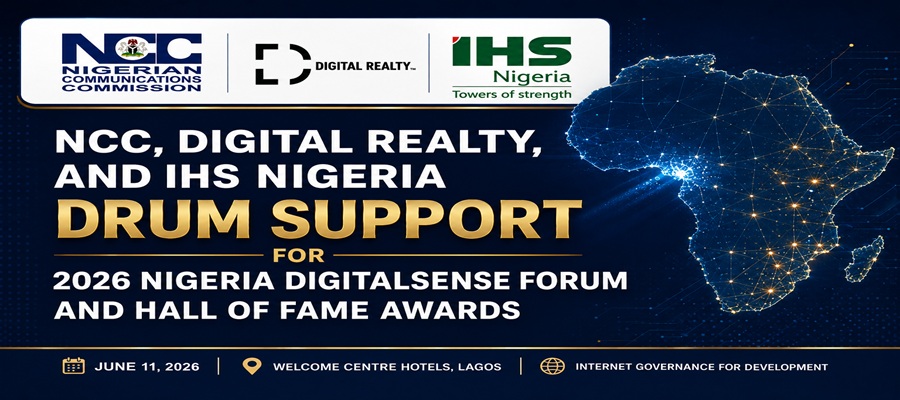
The regulatory and digital infrastructure pillars of Nigeria’s telecommunications ecosystem, led by the Nigerian Communications Commission (NCC), Digital Realty, and IHS Nigeria, have rallied robust support for the upcoming 2026 Nigeria DigitalSENSE Forum (NDSF) on Internet Governance for Development (IG4D) and its prestigious industry awards.

The annual high-level forum is scheduled to hold this Thursday, June 11, 2026, at the prestigious Banquet Hall, Welcome Centre Hotels, Lagos, anchoring its deliberations on the crucial theme: “Sustaining WSIS Vision with Multistakeholder Synergy in Nigeria.”
The Executive Vice Chairman and CEO of the NCC, Dr. Aminu Maida, is set to deliver the Keynote Address, highlighting the regulatory framework required to preserve the World Summit on the Information Society (WSIS) vision through inclusive, multi-stakeholder partnerships.
Joining the regulatory commission in driving this momentum is IHS Nigeria, the nation’s premier digital infrastructure champion boasting a footprint of over 16,000 telecom towers and 15,000km of fiber optic cables across the country. Alongside data center colocation leader Digital Realty, these organizations are heavily backing the forum as part of their commitment to promoting critical national infrastructure and securing Nigeria’s digital possibilities.
Speaking ahead of the event in Lagos, Ogbuefi Remmy Nweke, the Editor-in-Chief of host media organization ITREALMS Media Group, commended the immense institutional support flowing from the public and private sectors.
“Achieving sustainable internet governance and digital trust requires an intentional alignment of regulation and infrastructure,” Nweke remarked. “The active collaboration of the NCC, IHS Nigeria, and Digital Realty ensures that the 2026 forum will move beyond mere dialogue to produce clear, actionable policy recommendations for our digital economy.”
The event will be presided over by Dr. Olusola Teniola (hon), Director, Strategic Business Initiatives, ipNX Nigeria and former President, Association of Telecommunications Companies of Nigeria (ATCON), who will deliver the Chairman’s Opening Speech on the 2026 NDSF blueprint.
Earlier, leading telecommunications, technology, and internet governance stakeholders have thrown their weight behind the 17th milestone edition of the annual Nigeria DigitalSENSE Forum (NDSF) on Internet Governance for Development (IG4D), including ICT infrastructure leader MTN Nigeria; the Association of Licensed Telecoms Operators of Nigeria (ALTON); premier software and DNS infrastructure firm Upperlink Limited; and the Nigeria Internet Registration Association (NiRA), managers of the .NG country code Top Level Domain name.
Media & Event Contact: The Secretariat Nigeria DigitalSENSE Forum (NDSF) / ITREALMS Media Group Banquet Hall, Welcome Centre Hotels, Lagos Website: www.itrealms.com.ng

CBN to Deploy AI in Fight Against Payment Fraud

NDPC, Meta Launch 2-Year M-SIDP after Regulatory Settlement

Report Faults Banks over N91.1 Trillion Sterilised at CBN

Telcos Fault Data of FDI Flow, Claim Investment of N1.86 Trillion on Service Expansion

NRS Accredits Afri Invoice as Access Point Provider to Drive Nigeria’s Mandatory e-invoicing

CBN Extends PoS Geo-Fencing Enforcement Deadline to August 2026

FG to Launch Nationwide Free Digital TV Platform June 17

MTN, Airtel, Glo Under Pressure as FG Demands Better Service Delivery

Jumia Nigeria Records Strong Q1 2026 Growth as Technology-Led Strategy Drives Market Expansion

Metro Digital, Nigerian Firm Accuses Multichoice Of Refusal to Obey Court Judgements




 Telecom2 days ago
Price of Data in Nigerian Mobile among Top Four Cheapest Globally – MTN CEO

 E-Financial2 days ago
BOI Wins Dual Honours @ EMEA Finance Awards for Sustainability and Social Impact Leadership

 E-Financial2 days ago
CBN Imposes N100m Penalty on Dealing Bank Inadequate Processing of Forex Documents

 E-Business2 days ago
NITDA Okays NiRA’s Annual, Business Report

 Telecom2 days ago
NAIFF Returns for 2026, Expands Focus on AI-Powered Storytelling in Africa

 Telecom2 days ago
FCCPC Refutes Airtime Market Takeover Claims

 General News2 days ago
SSDC Warns Businesses against Cyber, Election-Related Risks

 General News2 days ago
Moniepoint DreamDevs Bootcamp Graduates Second Cohort to Strengthen Homegrown Talent Pipeline