

Telecom
NCC Gives Voice to Subscribers with Consumer Advocacy

Telecommunications sector is the only sector of the country’s economy that consumer’s right are protected as well as given opportunity to interfaced with service providers.
It stands on a tripod.
This did not happen spontaneously; it is as a result of regulatory framework initiated by the Nigerian Communications Commission (NCC) led by Ernest Ndukwe.
The consumer wants the services to be of a good quality and affordable. The consumer wants the operator to respond at all times when he or she needs attention, and to provide explanations whenever anything goes wrong. The consumer wants to be protected at all times from being taken advantage of by service providers. Just like consumers of any services, the consumer of telecom services wants to be well treated. The Commission has recognized all these and has put in place special structures to ensure that the needs and desires of the consumer are taken care of. For NCC, the consumer is the main object, the subject and the reason for their being.
Against this backdrop, that the sector has good number of consumer advocacy groups that are active in the industry which the commission is supporting to ensure that interest of consumers are taken care of, such groups include, National Association of Telecommunications Consumers Association (Natcomms), Consumer Right Project, among others.
The Regulatory Process
The Commission has many stakeholders in the regulatory process. These stakeholders include the government, consumers, the operators, the media, and the international community, among few others. The Commission strives to meet the expectations of the many stakeholders.
Government
Government is a very important stakeholder in the job of telecom regulation. The policy and the laws being implemented by the Commission have been prepared and enacted by government for good of society. The Government’s interest in the process is also varied.
Government is interested that services are made available to the Nigerian people in a timely, qualitative and affordable manner, and that activities in the sector are carried out in a legal and orderly manner. Government is also interested in creating an enabling environment that would continue to attract investment in the sector so that her desires for the people are substantially met.
The Commission in all its activities is therefore mindful of the need to protect, preserve and implement actions and programmes that meet the expectations and objectives of government.
The Operators: The operators also belong to a class of stakeholders in the business of telecom regulation. Apart from obtaining their operational licenses, with certain obligations attached to them, the operators also expect certain obligations from government and the regulator. They expect a non partial regulator to protect their huge investments. They want the Commission to ensure that no other entity interferes with their network resources such as frequency spectrum. They expect a regulator that will not be arbitrary in decision making and one that will regulate by the rules as contained in the license agreement and provisions of the laws and regulations.
The Consumer: The Commission does not just theorize about empowering the consumer in industry, it has given practical expressions to this phenomenon through actions, policies and programmes which have venerated, empowered, protected and uplifted him/her in the comity of stakeholders in the industry. Prior to the enactment of the Nigerian Communications Act, 2003, the Commission had in September 2001 established a full fledged department called Consumer Affairs Bureau. The Bureau was charged with PIE mandate – to Protect, Inform and Educate the Nigerian telecoms consumers. This mandate has remained an irrevocable social contract between the Commission and telecoms consumers in our nation. In a bid to protect, inform and educated consumers, the Commission held its maiden Consumer Forum at Flamingo Restaurant in Victoria Island in April 2002 and shortly after in August 2003, launched the monthly Telecoms Consumer Parliament, a novel regulatory initiative that earned the Commission, nay Nigeria, commendations from ITU and ICT professionals and groups across the globe. At the last count, 46 sessions of Telecoms Consumer Parliament has helped in no small measure in creating awareness of the rights of consumers and the obligation s of the service providers in the resolution of their problems and concerns. It has enable operators to clarify issues pertaining to service delivery for the benefit of their subscribers and also to publicly give account of their stewardship to the people. Useful feedbacks have emanated from the programme which culminated in far-reaching regulatory interventions by the Commission.
The Commission has over the years proactively enunciated policies and programmes that served the interest of the consumers through the introduction of price caps within which operators were allowed to charge consumers for services provided in accordance with global best practice, introduced competition in all segments of the telecom services portfolio to ensure that consumers have a wide range of products and services to choose from; and are not held to ransom by any service provider. Based on feedbacks received from consumers at the TCP, the Commission intervened on the issue of charging subscribers for calls made to customer care lines to lay consumers complaints.
In line with the commissions consumer-centric philosophy that it inaugurated an twelve-man Industry Consumer Advisory Forum, (ICAF), headed by Mrs. Ifeyinwa Umenyi the director general of the Consumer Protection Council, to review the general consumer code of practice regulations by the Commission as well as facilitate consumer protection, information and educational programmes.
ICAF will act in advisory capacity, and will make recommendations to the Commission regarding the interests and concerns of the consumer of ICT products and services, the interests and concerns of physically challenged and the elderly, ensure that consumers are protected from unfair practices and facilitate the review of the Consumer Code of Practice Regulations 2007 as well as make recommendations on all issues to the Commission.
The Commission has also defined acceptable quality of service thresholds which operators are expected to meet on the one hand, as well as sanctions in event of failure to meet those thresholds. In order to ensure compliance by operators, regular monitoring by the Commission of the operations of licensees across the length and breath of the country is undertaken.
Periodic reports on these monitoring activities are published on the website of the Commission and in major national newspapers.
To underscore the importance that the Board and management of the Commission attach to improved QoS on the networks, an industry QoS Working Group was set up with members drawn from the public and private sectors of the economy.
In 2007, the Commission caused to be gazetted Consumer Code of Practice Regulation which has become the reference document for both consumers and the operators. Each licensee is required to produce and submit a Code of Practice which has to be reviewed and approved by the Commission. The Code of Practice stipulates Service Level Agreements, the responsibilities and rights of each party, and procedure for resolving disagreements whenever they arise between parties.
Given the diversity of the country coupled with its geographical vastness, the Commission has taken it upon itself to promote and nurture consumerism by identifying and collaborating with reputable Consumer Advocacy Groups to facilitate nation-wide consumer protection and empowerment as a precondition for orderly and sustainable growth and development for the telecoms industry in Nigeria.



Association of Licensed Telecom Operators of Nigeria (ALTON), official industry umbrella body and pressure group for major mobile network operators in the country, has faulted claims that foreign direct investments (FDIs) into the sector slumped significantly in quarter one (Q1).

Gbenga Adebayo, Chairman, ALTON
ALTON, said that with N2.13 trillion spent in 2025 on network upgrades and expansion that they would invest an additional N1.86 trillion on network expansion this year.
The body was reacting to the claim by the National Bureau of Statistics (NBS) that FDIs into the sector slumped significantly in quarter one.
The telcos commended the Federal Government for its continued support of the industry, while calling for a more comprehensive framework to track and report investments coming into the sector.
The operators highlighted the importance of accurate data in shaping investor perceptions and guiding policy decisions.
The association noted that while the NBS recently released its Q1 Capital Importation Report, the figures presented do not fully capture the scale of capital deployment within Nigeria’s telecoms industry.
“This disparity between reported foreign capital inflows and actual infrastructure investment highlights a gap in how sectoral capital deployment is currently measured and reported,” the statement read.
ALTON, in the statement, signed by Gbenga Adebayo and Damian Udeh, chairman and publicity secretary, respectively, expressed appreciation to the Federal Government for approving a strategic 50 per cent tariff increase in 2025, describing it as a pivotal intervention that rescued the industry from financial distress.
According to the association, the tariff adjustment restored operational viability, closed critical revenue gaps and enabled operators to reinvest in infrastructure and service quality.
The association emphasised that the policy intervention transformed the sector from a struggling model into a sustainable, growth-focused industry.
“The timely investment enabled operators to transition from financial distress to a sustainable, growth-focused model characterised by significant capital reinvestment,” ALTON stated.
The statement revealed that telecom operators, tower companies, and other players in the sector recorded a total capital expenditure of N2.13 trillion in 2025. For 2026, planned capital expenditure stands at N1.86 trillion, with funds directed towards network infrastructure expansion, technology upgrades, and operational investments critical to maintaining service quality and coverage.
These commitments, ALTON stressed, are fundamental to advancing Nigeria’s digital economy objectives and improving services for millions of subscribers nationwide.
While the NBS report indicated a sharp decline in foreign capital importation into the telecom sector, from $80.78 million in 2025 to just $7.24 million in Q1 2026, ALTON argued that this metric only reflected a portion of the actual investment activity.
The association explained that much of the sector’s capital deployment now comes from domestic sources, including reinvested operational earnings.
These financial mechanisms, ALTON noted, are not fully reflected in conventional foreign capital importation metrics, thereby painting an incomplete picture of the industry’s health.
To address this reporting gap, ALTON proposed a collaborative engagement among the Nigerian Communications Commission (NCC), the NBS, and the Central Bank of Nigeria (CBN).
The goal, according to the association, is to develop a more inclusive and transparent investment-tracking framework that accurately reflects both foreign and domestic capital flows.
ALTON reassured the Nigerian public that telecom operators remain committed to continuous investment in network expansion, modernisation, resilience and service quality improvements.
The association pledged to work closely with regulators and government institutions to ensure that the sector’s contributions to national development are comprehensively documented and appropriately recognised.
With sustained collaboration and government support, ALTON said Nigerians can expect uninterrupted access to digital services that drive economic growth, innovation, financial inclusion, and overall national development.



Princess Emiko
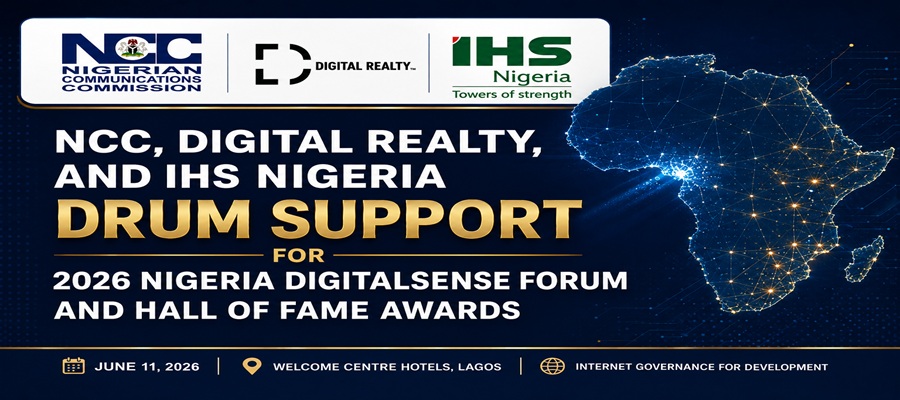
The regulatory and digital infrastructure pillars of Nigeria’s telecommunications ecosystem, led by the Nigerian Communications Commission (NCC), Digital Realty, and IHS Nigeria, have rallied robust support for the upcoming 2026 Nigeria DigitalSENSE Forum (NDSF) on Internet Governance for Development (IG4D) and its prestigious industry awards.

The annual high-level forum is scheduled to hold this Thursday, June 11, 2026, at the prestigious Banquet Hall, Welcome Centre Hotels, Lagos, anchoring its deliberations on the crucial theme: “Sustaining WSIS Vision with Multistakeholder Synergy in Nigeria.”
The Executive Vice Chairman and CEO of the NCC, Dr. Aminu Maida, is set to deliver the Keynote Address, highlighting the regulatory framework required to preserve the World Summit on the Information Society (WSIS) vision through inclusive, multi-stakeholder partnerships.
Joining the regulatory commission in driving this momentum is IHS Nigeria, the nation’s premier digital infrastructure champion boasting a footprint of over 16,000 telecom towers and 15,000km of fiber optic cables across the country. Alongside data center colocation leader Digital Realty, these organizations are heavily backing the forum as part of their commitment to promoting critical national infrastructure and securing Nigeria’s digital possibilities.
Speaking ahead of the event in Lagos, Ogbuefi Remmy Nweke, the Editor-in-Chief of host media organization ITREALMS Media Group, commended the immense institutional support flowing from the public and private sectors.
“Achieving sustainable internet governance and digital trust requires an intentional alignment of regulation and infrastructure,” Nweke remarked. “The active collaboration of the NCC, IHS Nigeria, and Digital Realty ensures that the 2026 forum will move beyond mere dialogue to produce clear, actionable policy recommendations for our digital economy.”
The event will be presided over by Dr. Olusola Teniola (hon), Director, Strategic Business Initiatives, ipNX Nigeria and former President, Association of Telecommunications Companies of Nigeria (ATCON), who will deliver the Chairman’s Opening Speech on the 2026 NDSF blueprint.
Earlier, leading telecommunications, technology, and internet governance stakeholders have thrown their weight behind the 17th milestone edition of the annual Nigeria DigitalSENSE Forum (NDSF) on Internet Governance for Development (IG4D), including ICT infrastructure leader MTN Nigeria; the Association of Licensed Telecoms Operators of Nigeria (ALTON); premier software and DNS infrastructure firm Upperlink Limited; and the Nigeria Internet Registration Association (NiRA), managers of the .NG country code Top Level Domain name.
Media & Event Contact: The Secretariat Nigeria DigitalSENSE Forum (NDSF) / ITREALMS Media Group Banquet Hall, Welcome Centre Hotels, Lagos Website: www.itrealms.com.ng

CBN to Deploy AI in Fight Against Payment Fraud

NDPC, Meta Launch 2-Year M-SIDP after Regulatory Settlement

Report Faults Banks over N91.1 Trillion Sterilised at CBN

Telcos Fault Data of FDI Flow, Claim Investment of N1.86 Trillion on Service Expansion

NRS Accredits Afri Invoice as Access Point Provider to Drive Nigeria’s Mandatory e-invoicing

CBN Extends PoS Geo-Fencing Enforcement Deadline to August 2026

FG to Launch Nationwide Free Digital TV Platform June 17

MTN, Airtel, Glo Under Pressure as FG Demands Better Service Delivery

Jumia Nigeria Records Strong Q1 2026 Growth as Technology-Led Strategy Drives Market Expansion

Metro Digital, Nigerian Firm Accuses Multichoice Of Refusal to Obey Court Judgements




 Telecom1 day ago
Price of Data in Nigerian Mobile among Top Four Cheapest Globally – MTN CEO

 E-Financial1 day ago
BOI Wins Dual Honours @ EMEA Finance Awards for Sustainability and Social Impact Leadership

 E-Business1 day ago
NITDA Okays NiRA’s Annual, Business Report

 E-Financial1 day ago
CBN Imposes N100m Penalty on Dealing Bank Inadequate Processing of Forex Documents

 Telecom1 day ago
NAIFF Returns for 2026, Expands Focus on AI-Powered Storytelling in Africa

 General News1 day ago
SSDC Warns Businesses against Cyber, Election-Related Risks

 General News1 day ago
Moniepoint DreamDevs Bootcamp Graduates Second Cohort to Strengthen Homegrown Talent Pipeline

 Telecom1 day ago
FCCPC Refutes Airtime Market Takeover Claims