

Telecom
NCC’s Spectrum Saga Gets Messier with Fresh Cans of Worms

It is the story of the alleged frequency racketeering at Nigeria Communications Commission (NCC): for every rebuttal by the commission, fresh cans of worms are being opened.
The federal government’s decision to send Dr. Bashir Gwandu, former Nigeria executive commissioner, Technical of the commission packing for whistle blowing may have calmed frayed nerves at the seat of power but it has left many unanswered questions which critics insisted showed the unseriousness of the government to tackle corruption.
The now seemingly unending tale of how NCC allegedly violated the provisions of the NCC Act 2003 with regard to the sale of some frequencies, said to be very scare national resources has got the whole world looking at Nigeria.
That single scandal has reduced the reputation of the NCC built in the days of Dr. Ernest Ndukwe, former executive vice chairman as one of the most transparent and respected institutions worldwide.
As the NCC battles to redeem its image, Yusuf .S. Adamu, a former executive director in Nigeria Telecommunications Limited (Nitel) and former technical adviser to the Minister of Communications from 1999 to 2003 is spilling more beans.
His reaction sent to Nigeria CommunicationsWeek is a must read. it is published verbatim below;
The recent removal of the Nigeria Communication Commission’s Executive Commissioner, Technical, Dr. Bashir Gwandu, from office has stirred a major national debate.
Dr. Gwandu was removed by the President Goodluck Jonathan in relation to a controversial secret and uncompetitive sale of frequency spectrum to some companies at meager amounts.
Dr. Gwandu’s major sins that earned him the removal as a commissioner from the commission on November 26 2012 are three major issues he stood against; one, selling of 450MHz Spectrum to an unlicensed company- OpenSkys ltd reportedly owned by Mr. Emeka Offor and powerful associates wherein they paid only $6 million for a license that should have fetched the nation over $50 million.
Secondly, the waiver granted to MTS- a company that was linked to NCC Chief Executive Officer, Dr Eugene Juwah at the expense of the nation and other Operators, and the third issue, was the selling of a 10MHz slot in the 800MHz spectrum band to a South African company called Smile Nigeria Communications Limited at about euros €13 million only when the exact equivalent spectrums were sold in Germany, Italy and France for €1.153billion, €992million and €891million respectively, and only recently in the UK, a minimum reserve price of the same spectrum was set before going to auction this month for about Sterling £450 million.
All these are allegations that, if not addressed, will cause telecom market disruption and an estimated loss to government of over N53billion in addition to the incapacitation of the voice component of the $470 million police surveillance network, were not disputed to a reasonable degree by the telecom regulator- NCC, to convince any inquisitive Nigerian that no fraud has been committed.
The cost to retune the police network to another Spectrum was estimated for $44 to $200m pushing the sum total of losses to Government to well over N60 billion.
First, no one disputed the fact that Smile Communications has had the said 10MHz Spectrum, and there seemed no dispute about the price of €13million being the price it was sold by NCC and such an amount is less than 1% revenue generated by Germany simply because there was no competitive bid process during the sale by NCC.
Furthermore, the NCC has not denied the fact that both the Telecom Act 2003, as well as the Procurement Act 2007 prescribed transparent competitive process as the main ways for sale or disposal of important Spectrum Assets.
To date, the Minister Mrs. Omobola Johnson who applied for the N1bn waiver and the NCC have not specifically denied that N1.029 billion was approved as waiver, and only for, MTS, a company in which Dr. Juwah the CEO of NCC, In a news article published by a national daily (Thisday) on 14th October 2012, claimed that he was given some ‘sweat shares’.
Dr. Juwah has not claimed divesting or relinquishing those shares in the article, as required by the NCC Act under conflict of Interest.
It is also obvious that the existing shareholders of MTS will benefit from the proposed takeover of MTS by Capcom since it was not going to Capcom for free.
Furthermore, the NCC has neither denied that Open Skys ltd does not have an Operational license of the NCC, which qualifies it for the award of a spectrum; nor has it denied that Open Skys paid only about $6m for the 450MHz Spectrum at the expense of the $470m police network, and two-third of the $6m was paid only after the police notified NCC, through a letter, of its intention to activate the emergency numbers on the $470m system. Interestingly however, the NCC spokesman Mr. Ojobo was quoted by national dailies saying that Gwandu’s claims were investigated by a Committee and found to be “false”.
But, the question that remains is -exactly which part is “false”. Is it that Open Sky is an NCC Licensee, and if so, then, since when, or is it that Open Skys paid much more than $6m for the 450MHz Spectrum, or is it that the 800MHz Spectrum slot was NOT sold to Smile Communications, or was it NOT sold at such a low price of about €13m when others have sold it for over €1.153billion, or that a N1.029billion Waiver was not granted to only MTS, or that MTS was not singled-out for Waiver in a letter purported to be requesting for Waiver for 3 companies, or that the voice part of the New Police surveillance network has been working and which command has started using it, or is NCC suggesting that the police system can work when Open Skys starts transmission on that spectrum.
What has in reality been investigated, and can revelation at a meeting of presidency be regarded as insubordination or leak of official secret, and should Gwandu have kept a secret to higher authorities that enquired.
It was stated in a number of write-ups, which I have cross-checked, that, in the first place, a Regulation, derived from the provisions of Section 123 of Telecom Act 2003, which NCC Spokesman was using in its (NCC’s ) defense, also requires transparent competitive bidding process in line with international best practices under its Sections 2(a,c) and 4, and such was also breached leaving NCC apparently with no defense.
What is clear to many is that no provision in a Regulation derived from the Act can supersede provisions of the Act itself since Regulation is a subsidiary legislation to the Act.
The Provisions in the Nigerian Telecoms Act 2003 and Procurement Act 2007 were clearly breached in the secret sale of the 800MHz and 450MHz Spectrums, in particular, secret non-competitive sale has breached Telecoms Act Sections 1(e), 4(1)(d), 4(2), 33(3) as well as Public Procurement Act 2007: Sections 55(3), 56(3), 57(5,6) that provides for ways of disposing public assets, as in this case, the spectrum.
The sale of the spectrums was carried out by the two EVCs in Sept/Nov 2011 without transparency.
I am aware that, Gwandu as the Commissioner Technical, was one of three signatories to award Forms for Spectrums and he apparently did not sign any of the two awards which suggests that the award was by a clique in the Commission.
Although, the NCC had, in a statement by its Head, Media and Public Relations, Mr. Reuben Muoka, denied some of the allegations, relating to the sale of 450MHz frequency slot belonging to the Nigeria Police to Open Skys the statement has not indicated when the NCC collected the Spectrum from the Police Force that have been using the 450MHz Spectrum even before NCC was created.
The NCC has also offered no defense to the allegations that an approval for its licensee, the NigComsat ltd, does not translate to an approval for an Unlicensed third party –the Open Skys ltd, but that, such an arrangement was all part of a plan to defraud Nigeria of billions.
In his reaction, Mouka explained that the said frequency allocation preceded the present administration of Juwah, who took the mantle of leadership at the Commission in July 2010.
He also claimed then that there was no truth in the allegation of non-transparent sale of frequency spectrum to the South African company Smile Communications ltd. However, if the sale was completed on the September 262011 for Open Skys and November 28t 2011 for Smile, as mentioned by one of the national dailies, when Dr. Juwah was undoubtedly in charge, and also in both cases no one seemed to know the number of bidders who competed for the two important spectrums, then, there are still unanswered questions.
The NCC has not come out to deny completion of the sale in September and November 2011.
But the breach of the laws entered another level when the sack letter of Dr, Gwandu was released by the federal government without following the laid down statutory procedures.
The NCC Act 2003, which currently governs the industry, says before removing any commissioner from office, President must write to him/her personally giving notice of the intention to remove, and reasons for such intent, then, he (the president) must also allow the affected commissioner to respond back to the President (in writing), on the said reasons or allegations made against the Commissioner in the notice, within a time frame of not less than 14 days, and furthermore, the Constitution, which the president swore to defend, in Section 36 also requires the President to grant fair hearing citizens before any punishment.
In the Telecom Act 2003, Section 10 subsection (2), it was stated that prior to the suspension or removal of a Commissioner under subsection (1) of this section, the President shall inform the Commissioner by written notice, as soon as practicable, of his intention to suspend or remove the Commissioner from office and the reasons therefore.
(3)“The affected Commissioner under subsection (1) of this section shall be given a reasonable opportunity to make written submissions to the President within a time period specified in the notice and such time period shall not be less than 14 days from the date of the notice. The affected Commissioner may, within the time period specified in the notice, make a written submission and the President shall consider the submission in making his final decision on the Commissioner’s suspension or removal from office”.
Clearly, if the statutory notice has not been issued by the President, 14 days were not allowed for a written response, and the President neither received, and therefore, nor take into account the Commissioner’s response before making his final decision, then, this could amount to breach of the fundamental right of fair hearing under the Telecom Act and the Constitution.
Also, Section 27 of the Freedom of Information (FOI) Act 2011, demands the protection of the whistleblowers in the country. The Section says; “Notwithstanding anything contained in the Criminal Code, Penal Code, the Official of Secrets Act, or any other enactment, no civil or criminal proceedings shall lie against an officer of any public institution, or against any person acting on behalf of a public institution, and no proceedings shall lie against such persons thereof, for the disclosure in good faith of any information, or any part thereof pursuant to this Act, for any consequences that flow from that disclosure, or for the failure to give any notice required under this Act, if care is taken to give the required notice”.
“(2) Nothing contained in the Criminal Code or Official Secrets Act shall prejudicially affect any public officer who, without authorization, discloses to any person, an information which he reasonably believes to show – (a) a violation of any law, rule or regulation; (b) mismanagement, gross waste of funds, fraud, and abuse Of authority; or (c) a substantial and specific danger to public health or safety notwithstanding that such information was not disclosed pursuant to the provision of this Act”.
By instituting proceedings that prejudicially affected, and forcibly removing Engr Gwandu for exposing fraudulent activities, there is a clear breach of the FOI Act and the Constitution.
It was reported in some of the write-ups that DrGwandu exposed these frauds at a meeting chaired by the Vice President and attended by major stakeholders in government including two Ministers, and through written internal communications written in early August 2012.
It was not that he went to press, and even if Dr. Gwandu was perceived to be whistle blowing, it is no longer an offence in this country to expose illegality based on the provision of the FOI Act.
A copy of Gwandu’s sack letter signed by the Secretary to the Government of the Federation, Senator Anyim Pius Anyim, read: “Please recall the series of allegations levelled against you by the Board of the Nigerian Communications Commission. Recall further that the Honourable Minister of Communications Technology, on behalf of Mr. President, set up a Disciplinary Committee to investigate the allegations.
“I am to inform you that based on the recommendations of the Disciplinary Committee, Mr. President has approved your removal from Office, for gross misconduct, with effect from November 9, 2012.
“I am to note that during the course of the investigations you were invited to appear before the committee to explain why disciplinary action should not be taken against you for gross misconduct. You may recall that you made both verbal and written submissions to the committee, in your defense.
“By this letter, you are to return all the property of the commission in your possession and handover to the Executive Vice Chairman.
As, there was no series of allegations sent to Gwandu from the Board, the Minister, or any Committee, and there appears to be no disciplinary committee as claimed, no written submission to any committee by Gwandu, and no investigation on the issues of Spectrum underselling or, at least, no mention of what has been investigated, and there was no statutory notice of removal from the President, It is clear that Gwandu has now became a first major victim for exercising the right which the Freedom of Information Act granted to him by blowing whistle on some secret fraudulent deals that could deprived the country over fifty billion naira spectrum revenue.
There are few countries where Government will be happy to lose billions in revenue to fraudsters in broad daylight, or will have such objective, especially when such Government had to borrow to finance its budget.
This case has raised many questions in respect of sincerity of government to deal with corruption that bedeviled this nation.
The message this present administration is sending to the global community and other civil society organizations is that fight against corruption is not a priority and is only against those that are far from the corridors of power or perceived to be in opposition. Importantly, competition in the Nigerian telecom market stands to be disrupted as it will be difficult to imagine how companies that pay $280m-$400m for a 2G GSM-Spectrum, others pay $150m-$245m for 3G Spectrum and then a competitor comes along, in the same country, and pays only $17m (€13million) for a better 4G spectrum, using which, deployment cost will be just a fraction of what the higher payers will spend, and yet compete in the same market. This could just be a new dawn for those who have already invested in the market, and for Nigerians who seem to be deprived of billions in day light.
Yusuf .S. Adamu, is a former executive director in NITEL and former technical Adviser to the Minister of Communications (1999-2003)



Association of Licensed Telecom Operators of Nigeria (ALTON), official industry umbrella body and pressure group for major mobile network operators in the country, has faulted claims that foreign direct investments (FDIs) into the sector slumped significantly in quarter one (Q1).

Gbenga Adebayo, Chairman, ALTON
ALTON, said that with N2.13 trillion spent in 2025 on network upgrades and expansion that they would invest an additional N1.86 trillion on network expansion this year.
The body was reacting to the claim by the National Bureau of Statistics (NBS) that FDIs into the sector slumped significantly in quarter one.
The telcos commended the Federal Government for its continued support of the industry, while calling for a more comprehensive framework to track and report investments coming into the sector.
The operators highlighted the importance of accurate data in shaping investor perceptions and guiding policy decisions.
The association noted that while the NBS recently released its Q1 Capital Importation Report, the figures presented do not fully capture the scale of capital deployment within Nigeria’s telecoms industry.
“This disparity between reported foreign capital inflows and actual infrastructure investment highlights a gap in how sectoral capital deployment is currently measured and reported,” the statement read.
ALTON, in the statement, signed by Gbenga Adebayo and Damian Udeh, chairman and publicity secretary, respectively, expressed appreciation to the Federal Government for approving a strategic 50 per cent tariff increase in 2025, describing it as a pivotal intervention that rescued the industry from financial distress.
According to the association, the tariff adjustment restored operational viability, closed critical revenue gaps and enabled operators to reinvest in infrastructure and service quality.
The association emphasised that the policy intervention transformed the sector from a struggling model into a sustainable, growth-focused industry.
“The timely investment enabled operators to transition from financial distress to a sustainable, growth-focused model characterised by significant capital reinvestment,” ALTON stated.
The statement revealed that telecom operators, tower companies, and other players in the sector recorded a total capital expenditure of N2.13 trillion in 2025. For 2026, planned capital expenditure stands at N1.86 trillion, with funds directed towards network infrastructure expansion, technology upgrades, and operational investments critical to maintaining service quality and coverage.
These commitments, ALTON stressed, are fundamental to advancing Nigeria’s digital economy objectives and improving services for millions of subscribers nationwide.
While the NBS report indicated a sharp decline in foreign capital importation into the telecom sector, from $80.78 million in 2025 to just $7.24 million in Q1 2026, ALTON argued that this metric only reflected a portion of the actual investment activity.
The association explained that much of the sector’s capital deployment now comes from domestic sources, including reinvested operational earnings.
These financial mechanisms, ALTON noted, are not fully reflected in conventional foreign capital importation metrics, thereby painting an incomplete picture of the industry’s health.
To address this reporting gap, ALTON proposed a collaborative engagement among the Nigerian Communications Commission (NCC), the NBS, and the Central Bank of Nigeria (CBN).
The goal, according to the association, is to develop a more inclusive and transparent investment-tracking framework that accurately reflects both foreign and domestic capital flows.
ALTON reassured the Nigerian public that telecom operators remain committed to continuous investment in network expansion, modernisation, resilience and service quality improvements.
The association pledged to work closely with regulators and government institutions to ensure that the sector’s contributions to national development are comprehensively documented and appropriately recognised.
With sustained collaboration and government support, ALTON said Nigerians can expect uninterrupted access to digital services that drive economic growth, innovation, financial inclusion, and overall national development.



Princess Emiko
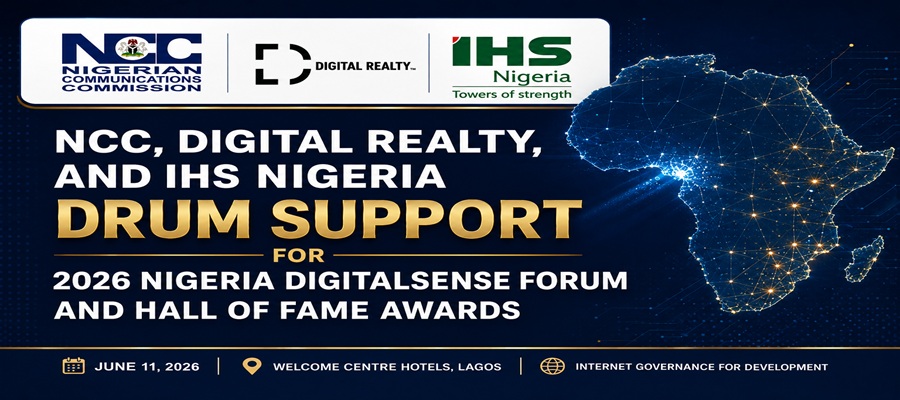
The regulatory and digital infrastructure pillars of Nigeria’s telecommunications ecosystem, led by the Nigerian Communications Commission (NCC), Digital Realty, and IHS Nigeria, have rallied robust support for the upcoming 2026 Nigeria DigitalSENSE Forum (NDSF) on Internet Governance for Development (IG4D) and its prestigious industry awards.

The annual high-level forum is scheduled to hold this Thursday, June 11, 2026, at the prestigious Banquet Hall, Welcome Centre Hotels, Lagos, anchoring its deliberations on the crucial theme: “Sustaining WSIS Vision with Multistakeholder Synergy in Nigeria.”
The Executive Vice Chairman and CEO of the NCC, Dr. Aminu Maida, is set to deliver the Keynote Address, highlighting the regulatory framework required to preserve the World Summit on the Information Society (WSIS) vision through inclusive, multi-stakeholder partnerships.
Joining the regulatory commission in driving this momentum is IHS Nigeria, the nation’s premier digital infrastructure champion boasting a footprint of over 16,000 telecom towers and 15,000km of fiber optic cables across the country. Alongside data center colocation leader Digital Realty, these organizations are heavily backing the forum as part of their commitment to promoting critical national infrastructure and securing Nigeria’s digital possibilities.
Speaking ahead of the event in Lagos, Ogbuefi Remmy Nweke, the Editor-in-Chief of host media organization ITREALMS Media Group, commended the immense institutional support flowing from the public and private sectors.
“Achieving sustainable internet governance and digital trust requires an intentional alignment of regulation and infrastructure,” Nweke remarked. “The active collaboration of the NCC, IHS Nigeria, and Digital Realty ensures that the 2026 forum will move beyond mere dialogue to produce clear, actionable policy recommendations for our digital economy.”
The event will be presided over by Dr. Olusola Teniola (hon), Director, Strategic Business Initiatives, ipNX Nigeria and former President, Association of Telecommunications Companies of Nigeria (ATCON), who will deliver the Chairman’s Opening Speech on the 2026 NDSF blueprint.
Earlier, leading telecommunications, technology, and internet governance stakeholders have thrown their weight behind the 17th milestone edition of the annual Nigeria DigitalSENSE Forum (NDSF) on Internet Governance for Development (IG4D), including ICT infrastructure leader MTN Nigeria; the Association of Licensed Telecoms Operators of Nigeria (ALTON); premier software and DNS infrastructure firm Upperlink Limited; and the Nigeria Internet Registration Association (NiRA), managers of the .NG country code Top Level Domain name.
Media & Event Contact: The Secretariat Nigeria DigitalSENSE Forum (NDSF) / ITREALMS Media Group Banquet Hall, Welcome Centre Hotels, Lagos Website: www.itrealms.com.ng

CBN to Deploy AI in Fight Against Payment Fraud

NDPC, Meta Launch 2-Year M-SIDP after Regulatory Settlement

Report Faults Banks over N91.1 Trillion Sterilised at CBN

Telcos Fault Data of FDI Flow, Claim Investment of N1.86 Trillion on Service Expansion

NRS Accredits Afri Invoice as Access Point Provider to Drive Nigeria’s Mandatory e-invoicing

CBN Extends PoS Geo-Fencing Enforcement Deadline to August 2026

FG to Launch Nationwide Free Digital TV Platform June 17

MTN, Airtel, Glo Under Pressure as FG Demands Better Service Delivery

Jumia Nigeria Records Strong Q1 2026 Growth as Technology-Led Strategy Drives Market Expansion

Metro Digital, Nigerian Firm Accuses Multichoice Of Refusal to Obey Court Judgements




 Telecom2 days ago
Price of Data in Nigerian Mobile among Top Four Cheapest Globally – MTN CEO

 E-Financial2 days ago
BOI Wins Dual Honours @ EMEA Finance Awards for Sustainability and Social Impact Leadership

 E-Business2 days ago
NITDA Okays NiRA’s Annual, Business Report

 E-Financial2 days ago
CBN Imposes N100m Penalty on Dealing Bank Inadequate Processing of Forex Documents

 Telecom2 days ago
NAIFF Returns for 2026, Expands Focus on AI-Powered Storytelling in Africa

 General News1 day ago
SSDC Warns Businesses against Cyber, Election-Related Risks

 General News2 days ago
Moniepoint DreamDevs Bootcamp Graduates Second Cohort to Strengthen Homegrown Talent Pipeline

 Telecom1 day ago
FCCPC Refutes Airtime Market Takeover Claims