

Telecom
Preparing for Expected Broadband Revolution

The growth in telecommunications sector of the country is expected to move from growth level to development where service providers are to consolidate on improved quality of service. Presently, over 80 percent of telephone and internet access in the country are through mobile communications facilitated by satellite and microwave technology. It has been observed by telecom experts that quality of service delivered by operators using the above mentioned technology is affected by atmospheric condition making the technology not suitable for reliable service delivery compared to optic fiber also known as terrestrial infrastructures.
A fibre optic cable is made from a glass or plastic core that carries light surrounded by glass cladding that (due to its lower refractive index) reflects “escaping” light back into the core, resulting in the light being guided along the fibre.
The greatest improvement in access to telephones has had positive impact in virtually all facets of life, including political, social and economic activities, thus resulting in an exponential growth in the subscriber lines due to the widespread of networks across the country.
Currently, the growth and potential earnings accruable from telecommunication services in Nigeria economy is comparable to other markets in the world, and the current rate of network growth across the country is impressive. Quite a number of global technology corporations are extending their operations to Nigeria with a multiplier effect on the economy and international trade between us and other countries of the world and in particular the West African sub region. The result of this is more competitive market environment and high potential for wired line network service providers.
However, it is encouraging to note that despite the current rapid development of telecommunications in Nigeria, there is still a great opportunity for further development as Nigeria being the most popular country in Africa, has an estimated addressable telecommunications market of 120 million subscriber lines, and in view of our landscape, the country remains major market for long distance network operators due to increasing demand for multi service, such as voice, data, broadband internet service, rural telephony access and unified service which provides a biggest prospect for wired line service providers.
Some telecom analysts have argued that due to the mobile nature of Nigerians, and as the demand for mobile services continues to grow, that there will be no room for wired line operators. Experience has shown that in order for predominantly mobile operators to improve on their quality of service they must invest in fibre optic backbone, and in order for them to capture multi service segment of the market, they must invest in last mile terrestrial copper infrastructure: there are two ways around this, one is to begin massive investment in this regard, or to invest and or acquire small and medium sized wired line local loop operators.
As the telecommunications industry evolves, it provides increasing opportunity for wired line networks, as operators are challenged to ensure that every city, towns, villages, hamlets, rivers and creeks in Nigeria are covered with multi services: voice, data, video and broadband internet.
Particularly in the new license regime holders are allowed to provide more than one service under the same license.
Preparing to Move forward
The absence of terrestrial infrastructure in the telecommunications industry is being felt in all service deliveries especially as the industry will soon witness an unprecedented capacity with the landing of two undersea cable Glo 1 which landed last year and MainOne expected to land in few weeks. For instance, in direct-to-home satellite television broadcasting it is a common occurrence for service to be disrupted each time it rains. More so, the hope of offering a broadband internet service cannot be realized with a fibre optic infrastructure. Its absence is responsible for narrow band service rendered in the sector.
It is against this backdrop that telecommunications giant Globacom began its fibre optic ring project across the country. So far, it has completed Abuja to Kano, Minna, Enugu, Owerri among others, even as work on other parts of the country is still ongoing.
Nigeria Telecommunications Limited (Nitel) has fibre optic ring that is not being used probably because it has not found its bearing in the industry with controversies in its privatization process, which resulted in the company’s refusal to lease out the infrastructure to other operators that requested for it to enhance their service delivery to last mile.
This however led to them embarking on similar project. Today, MTN in order to meet the fast growing high- capacity transport and connectivity needs has completed a world-class quality Metropolitan Area Fibre Networks in Ibadan, Kano, Warri and Aba. The implementation supports the rolling out 3G services. This is in addition to 3,885km of fibre optic backbone networks popularly referred to as “Blaze” network. Blaze was implemented in four phase namely: Phase 1&2: Southern and South Eastern rings with a total span of 2,422km Phase 3: Northern ring with a total span of 1,116km Phase 4: Niger Delta (completed in October 2007) with a total span of 347km.
Zain Nigeria is also expected to complete its fibre optic project that spans over 4,000km. All these are geared towards high data rate and wide bandwidth.
Projects of this sort are required by operators to deliver last mile services that are going to be available when the undersea cable infrastructure begins to sale bandwidth to operators at a cheaper cost which is the expected broadband revolution.
Going forward, there will be no longer any difference between mobile service providers or private telephone network operators (PTO) and fixed wireless operators as the technology barrier is removed with the unification of licenses, which in turn is an opportunity for hitherto mobile only operators to harness their network resources and offer bundled application.
However, there is the high risk that smaller ‘legacy’ operators with limited local loop coverage may not have a place in the market, as the bigger players begin to offer services which were mainly offered by smaller local loop operators which is now happening.
In essence, Nigeria will begin to see emergence of mega telecommunication operators that would offer unlimited services to their subscribers, with massive expansion of their network, and enormous benefit for their existing market goodwill, and a significant increase in the demand for multi-service.
A significant impact of this opportunity for the market is to streamline end-of-line service delivery to consumers.
Unification of licenses has finally resulted in genuine unification of services with providers offering attractive discount deals to end-users which will soon be the order of the day in no distant time in telecom landscape.
The market will begin to offer bundled services, as costs are driven down, the competition between wireless and wired line services would continue to grow.
The power of service bundling is becoming manifest, as the market grows and it offers major prospects for wired line service providers.
What this combination means is that the next few years may see wireless ‘only’ providers emerging as largely long distance wholesale carrier providers, and landline telecom companies would remain largely as retail terrestrial and local loop entities.
In many cases, wireless carriers are saddled with high cost of frequency and bandwidth channels, as such ability to offer consumer friendly rates for multi-service at high quality.
Mr. Gbeng Adebayo, Chief Executive Officer, Communications Network Support Services, said wired line Telcos have introduced very proficient retails rates in the market. “The cost per new customer for a typical wired line subscriber is relatively low and with excellent quality of service. In addition, wired line operators are able to offer multi-service such as broadband internet, high speed data communication and video communication at a very affordable rate without compromise on quality of services,” he said.
Most importantly, because of the fixing nature of infrastructure, the wire line Telco has an ongoing long term relationship with their customers; therefore their customer loyalty is much higher than that of mobile operators.
Market research has shown that in the urban areas, a large number of residential consumers have a higher retention of their fixed lines which offers value added services such as the internet and data connection than their mobile lines.
The Internet today is the largest single network in the world and it will continue to remain for a long time to come as well as a major source of income for wired line operators as the mobile operators continue to battle with high bandwidth charges.
The challenges for wired network operators in Nigeria range from the difficulty in infrastructure deployment multiplicity of right of way approval processes, non willingness of operators to co share underground ducts and exchange of dark fibre, as well as willful and unwilful damage to cable network infrastructure.
However, the major advantage lies in the size of the market, the need to grow the national fibre optic transmission backbone and the increasing demand for bundled multi-service: voice, data communications and broadband internet services which today can be delivered at affordable rates and best quality by fixed network operators.
As the industry prepares for broadband revolution orchestrated by both developments in the sector which is moving away from voice services to value added as will as the expected availability of the much needed bandwidth capacity stakeholders in the industry should collectively address issues relating to making broadband services available to end users.


Association of Licensed Telecom Operators of Nigeria (ALTON), official industry umbrella body and pressure group for major mobile network operators in the country, has faulted claims that foreign direct investments (FDIs) into the sector slumped significantly in quarter one (Q1).

Gbenga Adebayo, Chairman, ALTON
ALTON, said that with N2.13 trillion spent in 2025 on network upgrades and expansion that they would invest an additional N1.86 trillion on network expansion this year.
The body was reacting to the claim by the National Bureau of Statistics (NBS) that FDIs into the sector slumped significantly in quarter one.
The telcos commended the Federal Government for its continued support of the industry, while calling for a more comprehensive framework to track and report investments coming into the sector.
The operators highlighted the importance of accurate data in shaping investor perceptions and guiding policy decisions.
The association noted that while the NBS recently released its Q1 Capital Importation Report, the figures presented do not fully capture the scale of capital deployment within Nigeria’s telecoms industry.
“This disparity between reported foreign capital inflows and actual infrastructure investment highlights a gap in how sectoral capital deployment is currently measured and reported,” the statement read.
ALTON, in the statement, signed by Gbenga Adebayo and Damian Udeh, chairman and publicity secretary, respectively, expressed appreciation to the Federal Government for approving a strategic 50 per cent tariff increase in 2025, describing it as a pivotal intervention that rescued the industry from financial distress.
According to the association, the tariff adjustment restored operational viability, closed critical revenue gaps and enabled operators to reinvest in infrastructure and service quality.
The association emphasised that the policy intervention transformed the sector from a struggling model into a sustainable, growth-focused industry.
“The timely investment enabled operators to transition from financial distress to a sustainable, growth-focused model characterised by significant capital reinvestment,” ALTON stated.
The statement revealed that telecom operators, tower companies, and other players in the sector recorded a total capital expenditure of N2.13 trillion in 2025. For 2026, planned capital expenditure stands at N1.86 trillion, with funds directed towards network infrastructure expansion, technology upgrades, and operational investments critical to maintaining service quality and coverage.
These commitments, ALTON stressed, are fundamental to advancing Nigeria’s digital economy objectives and improving services for millions of subscribers nationwide.
While the NBS report indicated a sharp decline in foreign capital importation into the telecom sector, from $80.78 million in 2025 to just $7.24 million in Q1 2026, ALTON argued that this metric only reflected a portion of the actual investment activity.
The association explained that much of the sector’s capital deployment now comes from domestic sources, including reinvested operational earnings.
These financial mechanisms, ALTON noted, are not fully reflected in conventional foreign capital importation metrics, thereby painting an incomplete picture of the industry’s health.
To address this reporting gap, ALTON proposed a collaborative engagement among the Nigerian Communications Commission (NCC), the NBS, and the Central Bank of Nigeria (CBN).
The goal, according to the association, is to develop a more inclusive and transparent investment-tracking framework that accurately reflects both foreign and domestic capital flows.
ALTON reassured the Nigerian public that telecom operators remain committed to continuous investment in network expansion, modernisation, resilience and service quality improvements.
The association pledged to work closely with regulators and government institutions to ensure that the sector’s contributions to national development are comprehensively documented and appropriately recognised.
With sustained collaboration and government support, ALTON said Nigerians can expect uninterrupted access to digital services that drive economic growth, innovation, financial inclusion, and overall national development.



Princess Emiko
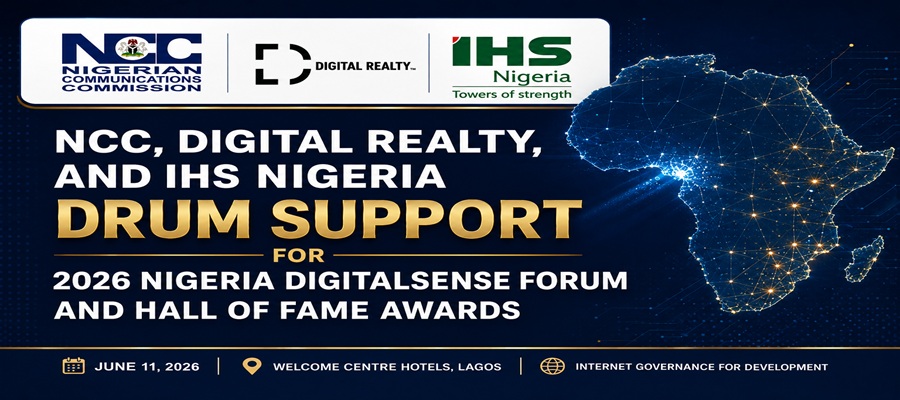
The regulatory and digital infrastructure pillars of Nigeria’s telecommunications ecosystem, led by the Nigerian Communications Commission (NCC), Digital Realty, and IHS Nigeria, have rallied robust support for the upcoming 2026 Nigeria DigitalSENSE Forum (NDSF) on Internet Governance for Development (IG4D) and its prestigious industry awards.

The annual high-level forum is scheduled to hold this Thursday, June 11, 2026, at the prestigious Banquet Hall, Welcome Centre Hotels, Lagos, anchoring its deliberations on the crucial theme: “Sustaining WSIS Vision with Multistakeholder Synergy in Nigeria.”
The Executive Vice Chairman and CEO of the NCC, Dr. Aminu Maida, is set to deliver the Keynote Address, highlighting the regulatory framework required to preserve the World Summit on the Information Society (WSIS) vision through inclusive, multi-stakeholder partnerships.
Joining the regulatory commission in driving this momentum is IHS Nigeria, the nation’s premier digital infrastructure champion boasting a footprint of over 16,000 telecom towers and 15,000km of fiber optic cables across the country. Alongside data center colocation leader Digital Realty, these organizations are heavily backing the forum as part of their commitment to promoting critical national infrastructure and securing Nigeria’s digital possibilities.
Speaking ahead of the event in Lagos, Ogbuefi Remmy Nweke, the Editor-in-Chief of host media organization ITREALMS Media Group, commended the immense institutional support flowing from the public and private sectors.
“Achieving sustainable internet governance and digital trust requires an intentional alignment of regulation and infrastructure,” Nweke remarked. “The active collaboration of the NCC, IHS Nigeria, and Digital Realty ensures that the 2026 forum will move beyond mere dialogue to produce clear, actionable policy recommendations for our digital economy.”
The event will be presided over by Dr. Olusola Teniola (hon), Director, Strategic Business Initiatives, ipNX Nigeria and former President, Association of Telecommunications Companies of Nigeria (ATCON), who will deliver the Chairman’s Opening Speech on the 2026 NDSF blueprint.
Earlier, leading telecommunications, technology, and internet governance stakeholders have thrown their weight behind the 17th milestone edition of the annual Nigeria DigitalSENSE Forum (NDSF) on Internet Governance for Development (IG4D), including ICT infrastructure leader MTN Nigeria; the Association of Licensed Telecoms Operators of Nigeria (ALTON); premier software and DNS infrastructure firm Upperlink Limited; and the Nigeria Internet Registration Association (NiRA), managers of the .NG country code Top Level Domain name.
Media & Event Contact: The Secretariat Nigeria DigitalSENSE Forum (NDSF) / ITREALMS Media Group Banquet Hall, Welcome Centre Hotels, Lagos Website: www.itrealms.com.ng

CBN to Deploy AI in Fight Against Payment Fraud

NDPC, Meta Launch 2-Year M-SIDP after Regulatory Settlement

Report Faults Banks over N91.1 Trillion Sterilised at CBN

Telcos Fault Data of FDI Flow, Claim Investment of N1.86 Trillion on Service Expansion

NRS Accredits Afri Invoice as Access Point Provider to Drive Nigeria’s Mandatory e-invoicing

CBN Extends PoS Geo-Fencing Enforcement Deadline to August 2026

FG to Launch Nationwide Free Digital TV Platform June 17

MTN, Airtel, Glo Under Pressure as FG Demands Better Service Delivery

Jumia Nigeria Records Strong Q1 2026 Growth as Technology-Led Strategy Drives Market Expansion

Metro Digital, Nigerian Firm Accuses Multichoice Of Refusal to Obey Court Judgements




 Telecom1 day ago
Price of Data in Nigerian Mobile among Top Four Cheapest Globally – MTN CEO

 E-Financial1 day ago
BOI Wins Dual Honours @ EMEA Finance Awards for Sustainability and Social Impact Leadership

 E-Business1 day ago
NITDA Okays NiRA’s Annual, Business Report

 E-Financial1 day ago
CBN Imposes N100m Penalty on Dealing Bank Inadequate Processing of Forex Documents

 Telecom1 day ago
NAIFF Returns for 2026, Expands Focus on AI-Powered Storytelling in Africa

 General News1 day ago
SSDC Warns Businesses against Cyber, Election-Related Risks

 General News1 day ago
Moniepoint DreamDevs Bootcamp Graduates Second Cohort to Strengthen Homegrown Talent Pipeline

 Telecom1 day ago
FCCPC Refutes Airtime Market Takeover Claims