

Telecom
Responding Effectively to Telecom Market Dynamics

As telecommunications space of the country’s economy develops, the industry has started witnessing a lot of innovations especially in service delivery geared towards providing efficient and cost effective service. Information and communications have always formed the basis of human existence. This fact has driven human to continuously seek ways to improve the processing of information and the transmission of such information components to one another or real time basis, irrespective of distance.
The explosion in technology which ushered in the information age has become the basis for defining power in the modern world. It is a widely accepted fact that no modern economy can thrive without an integral information technology and telecommunications infrastructure. Consequently, the ability to easily access and share information and stimulate the creation of new ideas is viewed as essential to maintaining a strong economy and enhancing quality a life of every citizen.
Telecommunications networks are now making it possible for developing countries to participate in the world economy in ways that simply were not possible in the past.
Communication tools such as telephony, internet and broadband are increasingly critical to economic success and the citizen’s personal advancement. The internet serves many functions – as virtual community, electorate marketplace, and information source/entertainment center, among others. Through high speed internet, we can create new businesses or facilitate the delivery of basic services such as health and education.
Available data from the international Telecommunications Union has shown that flows of international telephone traffic closely mirror the patterns of international trade. Indeed, variations in telephone traffic can be used as a leading indicator of national economic performance.
In agriculture, easier and faster access to up-to-date market and price information assists farmers and rural-based traders in their businesses. Telecommunications can also deliver better access to information on improved seeds, availability of fertilizers, weather forecasting, post control and other agricultural-related services.
Furthermore, telecommunications plays an important role in politics and governance, by enhancing a government’s ability to provide security for its citizens, protect its borders and more efficiently handle civil emergencies and national disaster. In turn, the citizens gain easier access to government and greater awareness of government programmes and activities.
Traditionally, telecommunications had over the years been regarded as public utility provided by government. However the need to improve services, encourage competition and attract private investment has led to the wave of privatization and sector liberation since the 1980’s. As at the beginning of 2008, nearly all countries in the world have either fully or partially privatized their incumbent operators and opened up the sector market liberalization. In African with 52 countries, this wave of market liberation has also seen Africa transform to an ICT enabled region, though a lot more needs to be done in the area of penetration of internet and broadband. On a global basis, there are about 150 countries that have established independent regulatory agencies (the ITU: Trends report). In many sub-Saharan Africa nations, the sector has also transformed from a monolithic structure in which the PIT is at once the monopoly operator, policy maker and industry regulator to a multi-operator environment regulated by an independent body.
The advances in the last twenty years notwithstanding, in number of countries in Africa, the incumbent operators still retain very strong control of certain segments of the market showing down the growth in those market. These incumbents are quite often, protected unnecessarily, thereby limiting competition, privatization and commercialization
In some cases where the incumbents have been partly privatized, the selected partners could be those with links in government circles who would be in a position to leverage such connections in influencing delays in opening up of the markets to competition.
In few African nations, exclusivity for the incumbents has been known to have been negotiated for upwards of 10 to 15yeas for example in the Fixed Networks and International gateway services. It is advised that where exclusivity still exist for the incumbents, such exclusivity with the aim of introducing competition in all segments of the market – Fixed, Mobile, ISPs, Long Distance, International Gateway Services etc. Exclusivity should only be considered if it is for a number of service providers (at least two) so as to provide choice and encourage optimal investments while ensuring that competition exist.
Nigeria’s telecom revolution
Telecommunications technology presents copious opportunities for the creation of unprecedented wealth for Nigeria. In 2000, Nigeria had only 400,000 connected telephone lines and just 25,000 analogue mobile lines. Total teledensity stood at a paltry 0.4 lines per 100 inhabitants. Connection costs were prohibitively high waiting time for fixed lines ran into years.
Today, owning to several factors including government sector reform policy, the worldwide trend of rapid development in telecommunications and informed technology and the huge potential of the Nigerian market, the story is very different. Since year 2000, NCC has licensed Digital mobile operators, Fixed wireless Access Operators, two Long Distance Operators, Internet Service Providers and a Second National Carrier, thus ensuring competition in all segments of the market.
The activity has increased and promoted rapid deployment of ICT services, resulting in exponential growth in the number of telephone lines. It is instructive to note that while connected lines only grew at an average of 10, 000 lines per annum in the four decades between independence in 1960 and end of 2000, in the last nine years, an average growth rate of 7.5million lines per annum was attained. As at April 2010, Nigeria had attained over 78million connected lines. Total teledensity, which was just 0.4% in 2000 now stands at about 56% by end of April 2010.
Along with this growth in lines has come a boom in private investment in the telecommunications sector. Recognizing the seemingly insatiable appetite of consumers for phone services and the potential of the Nigerian market, investors pumped in over USD 18billion into the sector by end of 2009, increased competition in the market has also pushed down connection fees charged by operators such that connection to a mobile service is virtually free today.
The emergence of digital mobile services has led to improvements in efficiency and productivity, reduction in transaction costs, increased service innovation and better quality of life. Close to 12,000 persons have been directly employed by the mobile operators and an estimated 1,000,000 Nigerians are benefiting from indirect employment generated by the operators, indirect employment has also been created through contract awards to construction firms, research companies and media consultants, in the financial sector, enterprises banks have designed innovative products that leverage the use of mobile phones.
The emergences, has also led to the return of significant numbers of Nigerians from abroad. These are telecom professionals, who have acquired useful international experience and knowledge, and have been attracted, back home to assist in building the country’s communications sector. Moreover, the explosion of mobile services has created a new class of entrepreneurs who might otherwise have been unemployed. There is a nationwide network of dealers, vendors, GSM accessory sellers and the ubiquitous “umbrella stand” operators.
Regulator’s response
The rapid progress made in the telecom industry in the past 10 years in Africa has largely been as a result of the liberalized market, but even in a liberalized environment, government still has a vital role to play in growing the nation’s telecommunications infrastructure and ensuring a competitive environment that will reduce prices and make services more available and affordable. Government best serves the industry through the establishment of strong regulatory institutions. The regulator’s role is to encourage competition, remove barriers to market entry, oversee interconnection of new operators with incumbents, monitor tariffs and quality of service, protect consumer rights and ensure the provision of telephone services for all.
Africa’s immediate requirement for local access to the telephone network is enormous and the required capital and time investment needed to compete is still huge. Market reform has helped to accelerate investment flow into this vital sector, resulting in rapid roll out of networks, but we still require optic fiber highways within and between African nations.
The rapid rate of deployment means faster access to telecommunications facilities and consequently faster pace of national economic development and growth. The Regulator is also today faced with the challenge of keeping pace with technological developments.
According to Ernest Ndukwe, immediate past executive vice chairman, Nigerian Communications Commission (NCC) , “convergence is changing businesses, the players, the equipment and the services we have been accustomed to. In their place new companies, technologies, equipment and services are emerging.
New challenges are also arising from these rapid changes. Therefore, new skill in multi-sector, multi-technology regulations will be needed. Security issues have assumed new dimension, with growing incidence of Cyber crime, identity theft, among others. Laws would therefore need to be upgraded to cover new areas such as electronic transactions, e-commercial and cyber security, and so on”.
Indeed privacy of transaction is constantly being threatened and the same consumers that are to benefit from the new technologies and services will be demanding even more protection from the Regulators.
Telecommunications is an essential infrastructure of the information economy and therefore countries that lack sufficient access to modern telecommunications networks, will find it difficult to be effectively integrated into the global economy.
The role of the regulator is critical to the attainment of the goal of an equitable and socially inclusive information Society.



Association of Licensed Telecom Operators of Nigeria (ALTON), official industry umbrella body and pressure group for major mobile network operators in the country, has faulted claims that foreign direct investments (FDIs) into the sector slumped significantly in quarter one (Q1).

Gbenga Adebayo, Chairman, ALTON
ALTON, said that with N2.13 trillion spent in 2025 on network upgrades and expansion that they would invest an additional N1.86 trillion on network expansion this year.
The body was reacting to the claim by the National Bureau of Statistics (NBS) that FDIs into the sector slumped significantly in quarter one.
The telcos commended the Federal Government for its continued support of the industry, while calling for a more comprehensive framework to track and report investments coming into the sector.
The operators highlighted the importance of accurate data in shaping investor perceptions and guiding policy decisions.
The association noted that while the NBS recently released its Q1 Capital Importation Report, the figures presented do not fully capture the scale of capital deployment within Nigeria’s telecoms industry.
“This disparity between reported foreign capital inflows and actual infrastructure investment highlights a gap in how sectoral capital deployment is currently measured and reported,” the statement read.
ALTON, in the statement, signed by Gbenga Adebayo and Damian Udeh, chairman and publicity secretary, respectively, expressed appreciation to the Federal Government for approving a strategic 50 per cent tariff increase in 2025, describing it as a pivotal intervention that rescued the industry from financial distress.
According to the association, the tariff adjustment restored operational viability, closed critical revenue gaps and enabled operators to reinvest in infrastructure and service quality.
The association emphasised that the policy intervention transformed the sector from a struggling model into a sustainable, growth-focused industry.
“The timely investment enabled operators to transition from financial distress to a sustainable, growth-focused model characterised by significant capital reinvestment,” ALTON stated.
The statement revealed that telecom operators, tower companies, and other players in the sector recorded a total capital expenditure of N2.13 trillion in 2025. For 2026, planned capital expenditure stands at N1.86 trillion, with funds directed towards network infrastructure expansion, technology upgrades, and operational investments critical to maintaining service quality and coverage.
These commitments, ALTON stressed, are fundamental to advancing Nigeria’s digital economy objectives and improving services for millions of subscribers nationwide.
While the NBS report indicated a sharp decline in foreign capital importation into the telecom sector, from $80.78 million in 2025 to just $7.24 million in Q1 2026, ALTON argued that this metric only reflected a portion of the actual investment activity.
The association explained that much of the sector’s capital deployment now comes from domestic sources, including reinvested operational earnings.
These financial mechanisms, ALTON noted, are not fully reflected in conventional foreign capital importation metrics, thereby painting an incomplete picture of the industry’s health.
To address this reporting gap, ALTON proposed a collaborative engagement among the Nigerian Communications Commission (NCC), the NBS, and the Central Bank of Nigeria (CBN).
The goal, according to the association, is to develop a more inclusive and transparent investment-tracking framework that accurately reflects both foreign and domestic capital flows.
ALTON reassured the Nigerian public that telecom operators remain committed to continuous investment in network expansion, modernisation, resilience and service quality improvements.
The association pledged to work closely with regulators and government institutions to ensure that the sector’s contributions to national development are comprehensively documented and appropriately recognised.
With sustained collaboration and government support, ALTON said Nigerians can expect uninterrupted access to digital services that drive economic growth, innovation, financial inclusion, and overall national development.



Princess Emiko
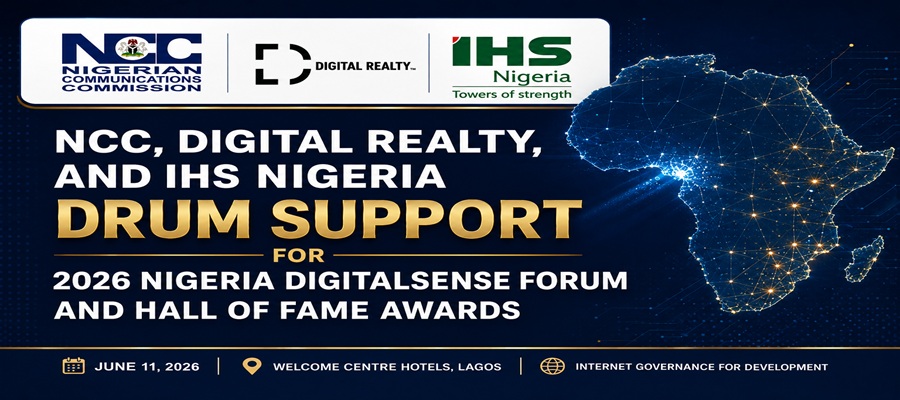
The regulatory and digital infrastructure pillars of Nigeria’s telecommunications ecosystem, led by the Nigerian Communications Commission (NCC), Digital Realty, and IHS Nigeria, have rallied robust support for the upcoming 2026 Nigeria DigitalSENSE Forum (NDSF) on Internet Governance for Development (IG4D) and its prestigious industry awards.

The annual high-level forum is scheduled to hold this Thursday, June 11, 2026, at the prestigious Banquet Hall, Welcome Centre Hotels, Lagos, anchoring its deliberations on the crucial theme: “Sustaining WSIS Vision with Multistakeholder Synergy in Nigeria.”
The Executive Vice Chairman and CEO of the NCC, Dr. Aminu Maida, is set to deliver the Keynote Address, highlighting the regulatory framework required to preserve the World Summit on the Information Society (WSIS) vision through inclusive, multi-stakeholder partnerships.
Joining the regulatory commission in driving this momentum is IHS Nigeria, the nation’s premier digital infrastructure champion boasting a footprint of over 16,000 telecom towers and 15,000km of fiber optic cables across the country. Alongside data center colocation leader Digital Realty, these organizations are heavily backing the forum as part of their commitment to promoting critical national infrastructure and securing Nigeria’s digital possibilities.
Speaking ahead of the event in Lagos, Ogbuefi Remmy Nweke, the Editor-in-Chief of host media organization ITREALMS Media Group, commended the immense institutional support flowing from the public and private sectors.
“Achieving sustainable internet governance and digital trust requires an intentional alignment of regulation and infrastructure,” Nweke remarked. “The active collaboration of the NCC, IHS Nigeria, and Digital Realty ensures that the 2026 forum will move beyond mere dialogue to produce clear, actionable policy recommendations for our digital economy.”
The event will be presided over by Dr. Olusola Teniola (hon), Director, Strategic Business Initiatives, ipNX Nigeria and former President, Association of Telecommunications Companies of Nigeria (ATCON), who will deliver the Chairman’s Opening Speech on the 2026 NDSF blueprint.
Earlier, leading telecommunications, technology, and internet governance stakeholders have thrown their weight behind the 17th milestone edition of the annual Nigeria DigitalSENSE Forum (NDSF) on Internet Governance for Development (IG4D), including ICT infrastructure leader MTN Nigeria; the Association of Licensed Telecoms Operators of Nigeria (ALTON); premier software and DNS infrastructure firm Upperlink Limited; and the Nigeria Internet Registration Association (NiRA), managers of the .NG country code Top Level Domain name.
Media & Event Contact: The Secretariat Nigeria DigitalSENSE Forum (NDSF) / ITREALMS Media Group Banquet Hall, Welcome Centre Hotels, Lagos Website: www.itrealms.com.ng

CBN to Deploy AI in Fight Against Payment Fraud

NDPC, Meta Launch 2-Year M-SIDP after Regulatory Settlement

Report Faults Banks over N91.1 Trillion Sterilised at CBN

Telcos Fault Data of FDI Flow, Claim Investment of N1.86 Trillion on Service Expansion

NRS Accredits Afri Invoice as Access Point Provider to Drive Nigeria’s Mandatory e-invoicing

CBN Extends PoS Geo-Fencing Enforcement Deadline to August 2026

FG to Launch Nationwide Free Digital TV Platform June 17

MTN, Airtel, Glo Under Pressure as FG Demands Better Service Delivery

Jumia Nigeria Records Strong Q1 2026 Growth as Technology-Led Strategy Drives Market Expansion

Metro Digital, Nigerian Firm Accuses Multichoice Of Refusal to Obey Court Judgements




 Telecom2 days ago
Price of Data in Nigerian Mobile among Top Four Cheapest Globally – MTN CEO

 E-Financial2 days ago
BOI Wins Dual Honours @ EMEA Finance Awards for Sustainability and Social Impact Leadership

 E-Business2 days ago
NITDA Okays NiRA’s Annual, Business Report

 E-Financial2 days ago
CBN Imposes N100m Penalty on Dealing Bank Inadequate Processing of Forex Documents

 Telecom2 days ago
NAIFF Returns for 2026, Expands Focus on AI-Powered Storytelling in Africa

 General News1 day ago
SSDC Warns Businesses against Cyber, Election-Related Risks

 Telecom2 days ago
FCCPC Refutes Airtime Market Takeover Claims

 General News2 days ago
Moniepoint DreamDevs Bootcamp Graduates Second Cohort to Strengthen Homegrown Talent Pipeline