

Telecom
Technological Changes and Telecom Access Issues

One major challenge in telecommunications development in countries especially, those referred to as third world is providing telecommunications access to semi urban cities as well as rural areas.
To most operators in these countries, providing access to people living in those areas is not always a priority, basically because they are not commercially viable. Operators of telecommunications services are in the business to make profit and therefore could not afford to spend investors’ money on projects that does not have return on investment such as providing services to rural underserved areas.
In most developing economies, efforts at increasing access to people living in rural but underserved areas are pioneered by government through its agency saddled with the responsibility of regulating the sector. What the authorities does is to grant operators incentives that motivate them to expand their operations to those commercially none viable areas.
Over the years, telecommunications sector like any other sector in the economy are witnessing technological changes each time there is a new technology operators invest money in upgrading its equipment to the new technology.
Unfortunately, most of the new technologies instead of assisting operators in their effort to increase access to less developed areas through making the cost of providing services to such areas cheaper, concentrate more on service efficiency and network capacity to deliver several services.
More so, as these happens it increase cost of acquisition of hardware equipment required to access such service. For instance, when Global System for Mobile communications (GSM) operators upgraded their network from 2.5 Generation to third generation which allows subscribers to use voice, data and video simultaneously, the cost of handset that makes this possible were nowhere near average Nigerian.
Overview of technological changes
Although, Nigeria started late in the business of telecommunications, it has witness some technological upgrade by operators in the industry, all geared towards improvement of service delivery but none that seek to address access concerns to rural areas as well as making such service within the reach of a common man.
The first set of GSM operators that launched services after the industry was liberalized in 2001 used second generation technology to deliver services. Second generation 2G cellular telecom networks were commercially launched on the GSM standard in Finland in 1991. Three primary benefits of 2G networks over their predecessors were that phone conversations were digitally encrypted, 2G systems were significantly more efficient on the spectrum allowing for far greater mobile phone penetration levels; and 2G introduced data services for mobile, starting with SMS text messages.
After 2G was launched, the previous mobile telephone systems were retrospectively dubbed 1G. While radio signals on 1G networks are analog, and on 2G networks are digital, both systems use digital signaling to connect the radio towers (which listen to the handsets) to the rest of the telephone system.
According experts, digital systems were embraced by consumers for several reasons, which included, the lower powered radio signals require less battery power, so phones last much longer between charges, and batteries can be smaller.
The digital voice encoding allowed digital error checking which could increase sound quality by increasing dynamic range and lowering the noise floor.
The lower power emissions helped address health concerns. Going all-digital allowed for the introduction of digital data services, such as SMS and email. With analog systems it was possible to have two or more "cloned" handsets that had the same phone number.
A key digital advantage not often mentioned is that digital cellular calls are much harder to eavesdrop on by use of radio scanners. While the security algorithms used have proved not to be as secure as initially advertised, 2G phones are immensely more private than 1G phones, which have no protection against eavesdropping.
However, its shortcoming includes in less populous areas, the weaker digital signal may not be sufficient to reach a cell tower. This tends to be a particular problem on 2G systems deployed on higher frequencies, but is mostly not a problem on 2G systems deployed on lower frequencies. National regulations differ greatly among countries which dictate where 2G can be deployed.
Analog has a smooth decay curve, digital a jagged steppy one. This can be both an advantage and a disadvantage. Under good conditions, digital will sound better. Under slightly worse conditions, analog will experience static, while digital has occasional dropouts. As conditions worsen, though, digital will start to completely fail, by dropping calls or being unintelligible, while analog slowly gets worse, generally holding a call longer and allowing at least a few words to get through.
While digital calls tend to be free of static and background noise, the lossy compression used by the codecs takes a toll; the range of sound that they convey is reduced. You’ll hear less of the tonality of someone’s voice talking on a digital cellphone, but you will hear it more clearly.
2.5G is a stepping stone between 2G and 3G cellular wireless technologies. The term "second and a half generation" is used to describe 2G-systems that have implemented a packet switched domain in addition to the circuit switched domain. It does not necessarily provide faster services because bundling of timeslots is used for circuit switched data services (HSCSD) as well.
International Mobile Telecommunications-2000 (IMT-2000), better known as 3G or 3rd Generation, is a family of standards for mobile telecommunications defined by the International Telecommunication Union, which includes GSM EDGE, UMTS, and CDMA2000 as well as Dect and WiMax. Services include wide-area wireless voice telephone, video calls, and wireless data, all in a mobile environment. Compared to 2G and 2.5G services, 3G allows simultaneous use of speech and data services and higher data rates (up to 14.0 Mbit/s on the downlink and 5.8 Mbit/s on the uplink with HSPA+). Thus, 3G networks enable network operators to offer users a wider range of more advanced services while achieving greater network capacity through improved spectral efficiency.
4G refers to the fourth generation of cellular wireless standards. It is a successor to 3G and 2G standards, with the aim to provide a wide range of data rates up to ultra-broadband (gigabit-speed) Internet access to mobile as well as stationary users. Although 4G is a broad term that has had several different and more vague definitions, this article uses 4G to refer to IMT Advanced (International Mobile Telecommunications Advanced), as defined by ITU-R.
A 4G cellular system must have target peak data rates of up to approximately 100 Mbit/s for high mobility such as mobile access and up to approximately 1 Gbit/s for low mobility such as nomadic/local wireless access, according to the ITU requirements. Scalable bandwidths up to at least 40 MHz should be provided. A 4G system is expected to provide a comprehensive and secure all-IP based solution where facilities such as IP telephony, ultra-broadband Internet access, gaming services and HDTV streamed multimedia may be provided to users.
LTE Advanced (Long-term-evolution Advanced) is a candidate for IMT-Advanced standard, formally submitted by the 3GPP organization to ITU-T in the fall 2009, and expected to be released in 2011. The target of 3GPP LTE Advanced is to reach and surpass the ITU requirements. LTE Advanced should be compatible with first release LTE equipment, and should share frequency bands with first release LTE.
The Mobile WiMAX (IEEE 802.16e-2005) mobile wireless broadband access (MWBA) standard is sometimes branded 4G, and offers peak data rates of 128 Mbit/s downlink and 56 Mbit/s uplink over 20 MHz wide channels. The IEEE 802.16m evolution of 802.16e is under development, with the objective to fulfill the IMT-Advanced criteria of 1000 Mbit/s for stationary reception and 100 Mbit/s for mobile reception.
UMB (Ultra Mobile Broadband) was the brand name for a discontinued 4G project within the 3GPP2 standardization group to improve the CDMA2000 mobile phone standard for next generation applications and requirements.
Engr. Bayo Banjo, general manager, Disc Communications, said that technological advancement in telecommunications are products of research carried out by especially equipment vendors, and that these vendors invest in research and development with the idea of making profits from the sale of products of such research.
He added that the guiding principle is demand of the product which often time has a global outlook and such would not want to invest in product whose demand is low. He explained that why technological advancements in telecommunications industry are not looking at a way of making equipments for network roll out that will be cheaper and may not require some basic infrastructure is because such equipment vendors are using their home countries which has such infrastructure as basis for producing any product.
He regretted the situation in the country where 60 per cent of telecommunications activities are centred around cities like Lagos, Abuja and Port Harcourt because government has failed in its effort to provide adequate infrastructure such as electric to the citizens there by forcing operators to concentrate in the cities where residents can provide generators to use their telecommunications equipment required to enjoy telecommunications services.
He noted that presently, telecommunications equipments for network roll out are getting cheaper as a result of economic meltdown and emergence of Asian vendors such as Huawei.


Association of Licensed Telecom Operators of Nigeria (ALTON), official industry umbrella body and pressure group for major mobile network operators in the country, has faulted claims that foreign direct investments (FDIs) into the sector slumped significantly in quarter one (Q1).

Gbenga Adebayo, Chairman, ALTON
ALTON, said that with N2.13 trillion spent in 2025 on network upgrades and expansion that they would invest an additional N1.86 trillion on network expansion this year.
The body was reacting to the claim by the National Bureau of Statistics (NBS) that FDIs into the sector slumped significantly in quarter one.
The telcos commended the Federal Government for its continued support of the industry, while calling for a more comprehensive framework to track and report investments coming into the sector.
The operators highlighted the importance of accurate data in shaping investor perceptions and guiding policy decisions.
The association noted that while the NBS recently released its Q1 Capital Importation Report, the figures presented do not fully capture the scale of capital deployment within Nigeria’s telecoms industry.
“This disparity between reported foreign capital inflows and actual infrastructure investment highlights a gap in how sectoral capital deployment is currently measured and reported,” the statement read.
ALTON, in the statement, signed by Gbenga Adebayo and Damian Udeh, chairman and publicity secretary, respectively, expressed appreciation to the Federal Government for approving a strategic 50 per cent tariff increase in 2025, describing it as a pivotal intervention that rescued the industry from financial distress.
According to the association, the tariff adjustment restored operational viability, closed critical revenue gaps and enabled operators to reinvest in infrastructure and service quality.
The association emphasised that the policy intervention transformed the sector from a struggling model into a sustainable, growth-focused industry.
“The timely investment enabled operators to transition from financial distress to a sustainable, growth-focused model characterised by significant capital reinvestment,” ALTON stated.
The statement revealed that telecom operators, tower companies, and other players in the sector recorded a total capital expenditure of N2.13 trillion in 2025. For 2026, planned capital expenditure stands at N1.86 trillion, with funds directed towards network infrastructure expansion, technology upgrades, and operational investments critical to maintaining service quality and coverage.
These commitments, ALTON stressed, are fundamental to advancing Nigeria’s digital economy objectives and improving services for millions of subscribers nationwide.
While the NBS report indicated a sharp decline in foreign capital importation into the telecom sector, from $80.78 million in 2025 to just $7.24 million in Q1 2026, ALTON argued that this metric only reflected a portion of the actual investment activity.
The association explained that much of the sector’s capital deployment now comes from domestic sources, including reinvested operational earnings.
These financial mechanisms, ALTON noted, are not fully reflected in conventional foreign capital importation metrics, thereby painting an incomplete picture of the industry’s health.
To address this reporting gap, ALTON proposed a collaborative engagement among the Nigerian Communications Commission (NCC), the NBS, and the Central Bank of Nigeria (CBN).
The goal, according to the association, is to develop a more inclusive and transparent investment-tracking framework that accurately reflects both foreign and domestic capital flows.
ALTON reassured the Nigerian public that telecom operators remain committed to continuous investment in network expansion, modernisation, resilience and service quality improvements.
The association pledged to work closely with regulators and government institutions to ensure that the sector’s contributions to national development are comprehensively documented and appropriately recognised.
With sustained collaboration and government support, ALTON said Nigerians can expect uninterrupted access to digital services that drive economic growth, innovation, financial inclusion, and overall national development.



Princess Emiko
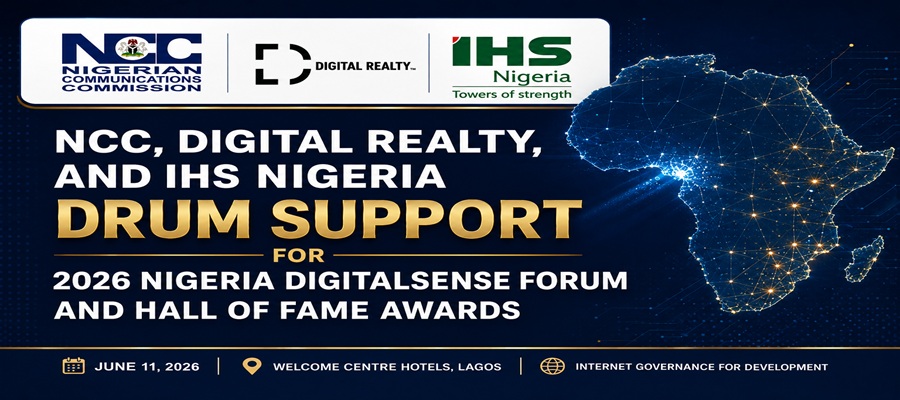
The regulatory and digital infrastructure pillars of Nigeria’s telecommunications ecosystem, led by the Nigerian Communications Commission (NCC), Digital Realty, and IHS Nigeria, have rallied robust support for the upcoming 2026 Nigeria DigitalSENSE Forum (NDSF) on Internet Governance for Development (IG4D) and its prestigious industry awards.

The annual high-level forum is scheduled to hold this Thursday, June 11, 2026, at the prestigious Banquet Hall, Welcome Centre Hotels, Lagos, anchoring its deliberations on the crucial theme: “Sustaining WSIS Vision with Multistakeholder Synergy in Nigeria.”
The Executive Vice Chairman and CEO of the NCC, Dr. Aminu Maida, is set to deliver the Keynote Address, highlighting the regulatory framework required to preserve the World Summit on the Information Society (WSIS) vision through inclusive, multi-stakeholder partnerships.
Joining the regulatory commission in driving this momentum is IHS Nigeria, the nation’s premier digital infrastructure champion boasting a footprint of over 16,000 telecom towers and 15,000km of fiber optic cables across the country. Alongside data center colocation leader Digital Realty, these organizations are heavily backing the forum as part of their commitment to promoting critical national infrastructure and securing Nigeria’s digital possibilities.
Speaking ahead of the event in Lagos, Ogbuefi Remmy Nweke, the Editor-in-Chief of host media organization ITREALMS Media Group, commended the immense institutional support flowing from the public and private sectors.
“Achieving sustainable internet governance and digital trust requires an intentional alignment of regulation and infrastructure,” Nweke remarked. “The active collaboration of the NCC, IHS Nigeria, and Digital Realty ensures that the 2026 forum will move beyond mere dialogue to produce clear, actionable policy recommendations for our digital economy.”
The event will be presided over by Dr. Olusola Teniola (hon), Director, Strategic Business Initiatives, ipNX Nigeria and former President, Association of Telecommunications Companies of Nigeria (ATCON), who will deliver the Chairman’s Opening Speech on the 2026 NDSF blueprint.
Earlier, leading telecommunications, technology, and internet governance stakeholders have thrown their weight behind the 17th milestone edition of the annual Nigeria DigitalSENSE Forum (NDSF) on Internet Governance for Development (IG4D), including ICT infrastructure leader MTN Nigeria; the Association of Licensed Telecoms Operators of Nigeria (ALTON); premier software and DNS infrastructure firm Upperlink Limited; and the Nigeria Internet Registration Association (NiRA), managers of the .NG country code Top Level Domain name.
Media & Event Contact: The Secretariat Nigeria DigitalSENSE Forum (NDSF) / ITREALMS Media Group Banquet Hall, Welcome Centre Hotels, Lagos Website: www.itrealms.com.ng

CBN to Deploy AI in Fight Against Payment Fraud

NDPC, Meta Launch 2-Year M-SIDP after Regulatory Settlement

Report Faults Banks over N91.1 Trillion Sterilised at CBN

Telcos Fault Data of FDI Flow, Claim Investment of N1.86 Trillion on Service Expansion

NRS Accredits Afri Invoice as Access Point Provider to Drive Nigeria’s Mandatory e-invoicing

FG to Launch Nationwide Free Digital TV Platform June 17

CBN Extends PoS Geo-Fencing Enforcement Deadline to August 2026

MTN, Airtel, Glo Under Pressure as FG Demands Better Service Delivery

Jumia Nigeria Records Strong Q1 2026 Growth as Technology-Led Strategy Drives Market Expansion

Metro Digital, Nigerian Firm Accuses Multichoice Of Refusal to Obey Court Judgements




 Telecom1 day ago
Price of Data in Nigerian Mobile among Top Four Cheapest Globally – MTN CEO

 E-Financial1 day ago
BOI Wins Dual Honours @ EMEA Finance Awards for Sustainability and Social Impact Leadership

 E-Business1 day ago
NITDA Okays NiRA’s Annual, Business Report

 E-Financial1 day ago
CBN Imposes N100m Penalty on Dealing Bank Inadequate Processing of Forex Documents

 Telecom1 day ago
NAIFF Returns for 2026, Expands Focus on AI-Powered Storytelling in Africa

 General News1 day ago
SSDC Warns Businesses against Cyber, Election-Related Risks

 General News1 day ago
Moniepoint DreamDevs Bootcamp Graduates Second Cohort to Strengthen Homegrown Talent Pipeline

 Telecom1 day ago
FCCPC Refutes Airtime Market Takeover Claims