

Telecom
Telecom: Great Expectations in 2009

Telecommunications sector remains the pivot of an information society, where businesses and services are delivered via Information and Communications Technology.
The year 2008 was a mix given for telecommunications sector of the economy; it witnessed a lot of activities for growth as well as challenges.
There where issues of poor quality of services by Global System for Mobile communications (GSM), new entrances and missing of Nigeria Communications Satellite (NigComSat-1). Also within this period, Nigeria overtook South Africa by becoming the country with the largest number of connected lines in Africa within the first quarter of 2008. Within the year, telecommunication penetration reached up to 85 percent in Nigeria. By the end of October 2008, Nigeria had attained about 59 million lines, (57.6 million of which are digital mobile lines), and the teledensity figures soared from the 0.4 lines per 100 inhabitants recorded in 1999, to 42 lines per 100 inhabitants by the end of October 2008, according to NCC.
For the regulator the Nigerian Communications Commission (NCC) the year 2008 is top, being a year with highest number of active telephone lines, almost 60 million as at December. The regulators spent majority part of the year addressing quality of service issue by the network operators. Issuing several warnings to GSM operators as well as sanctioned some of them to pay compensation to their subscribers for providing below standard services.
The Commission blamed poor quality of service delivery by operators on network congestion explaining that some of the operator does not have enough capacity to connect the number of subscriber they admit to their network. This led to ban on some of them from carrying out promotions geared towards attract new subscriber to their network.
However, operators lay claim to erratic power supply and vandalization of their equipment as being responsible for their inability to deliver quality of service. Operators experienced highest incident of theft of power generating set as the three major operators in the GSM space was losing an average of four generating sets every week; there were also an increased record of cut on transmission cable by both vandals and government contractors working on roads.
However, many observers believed that the regulator was too soft for the operators as they failed to enforce strict measures that will bring a lasting solution to the problem within the period.
Operators in review
This space also saw in 2008 the rollout of service by the fourth operators Etisalat in some major cities. It would be recalled that Etisalat acquired 60 percent of Mubadala license in the country. Etisalat came at the time GSM service was bedeviled with quality of service issue, which observers said will be an advantage if they able to deliver a better service quality than its counterparts.
For Globacom, the year 2008 is prosperous, the company has move from a local operator to secured operating licenses in two West African Countries- Republic of Benin and Ghana. The company also celebrated 20 million subscriber base on its Nigerian network as it marked 5 years anniversary, although the Glo network needs serious expansion to accommodate the growing number of new subscribers. The telecommunications giant has last year completed and launched over 80 per cent of its fibre optic ring across the country and is planning to complete its submarine cable project this year.
Last year was not such a good time for MTN as it battled with expansion of its network to provide enough capacity to convince NCC to lift the ban on the company from running promos. Although, it achieved this but, it really was a major set back for the company in its bid as a leading telecom solution provider. In spite of all these, MTN managed to launch its 3.5G service commercially and introduced ‘One World network’ a cross border service that allows MTN subscriber to make, receive call as well as recharge their phone in three West African countries, that include Nigeria, Cameroom and Ghana.
Like MTN, Zain was under the ban and sanction by NCC as a result of capacity issues, which prevented the network operator from engaging in a significant activity in the past year. However, a remarkable thing that happened in the network is the re-branding from Celtel to Zain. The re-branding is described as a unification re-branding which saw all the company’s operation in both Africa and Middle East operating as a single brand against what it used to be.
In a similar vein, Reliance Telecommunications (Reltel) having successfully completed its private placement offer, re-branded to Zoom Mobile at the instance of its new equity holders.
Mtel remain sealed within the year despite promises by the federal government and the new management of the Nigerians Telecommunications Limited (Nitel) controlled by Transcorp, to revive the company within 100 days after it took over. Mtel workers engage in many protests of unpaid salaries and allowances, while the subscriber base of the network dropped to less then 10,000 subscribers nationwide.
The year 2008 could be described as Code Division Multiple Access (CDMA) year, as operators of this technology witnessed unprecedented growth. Operators such as, Zoom, Multilink and Starcomms recorded significant growth in the number subscribers on their network, as the dual of Multi-Links Telkom and Starcomms hits 2million subscribers each. Industry watchers attributed the growth in subscriber base of CDMA operators to challenge of poor quality service experienced last year by GSM operators, most promotions in the industry was run by CDMA service providers which accounted for the growth.
More so, Visafone which unveiled its brand and services on February 22, 2008 became the first telecoms company in Nigeria to roll out commercial operations in 12 states and over 40 cities from day one. It has since spread its coverage areas to 17 states and over 150 cities and recorded an unprecedented 1 million subscribers in less than 6 months of operations.
The company has also unveiled a new and innovative product that extends its value added services to its subscribers. The product, called the RC Data Pay, allows data users (internet subscribers) on the Visafone network to recharge or pay for internet subscriptions through their handsets, using recharge cards.
Expectations of 2009
The importance of telecommunications in the economic advancement of the country has placed much burden on the service providers in the sector. Virtually, every sector of the economy rely on one service or the other of telecommunications providers, for instance Automated Teller Machine (ATM) that enable bank account holders to make withdrawal through the machine at anytime of the day is powered by telecommunications solution.
Subscribers of telecommunications services and solution expect in this New Year a significant improvement in service availability up to 95 per cent, and quick resolution of downtime as well as improved customer enlightenment.
Mr. Deolu Ogunbanjo, president, National Association of Telecommunications Subscribers of Nigeria (Natcomms) described the out gone year as being characterized by poor quality of service in spite of efforts by Nigerian Communications Commission (NCC) to address it. He noted that last year was slightly better compared to 2007 especially during the festive period as greater percentage of short message service was delivered on time.
He explained that communications is a two way thing where both caller and receiver need to hear each order for it to be completed, but decried a situation that is prevalence in the industry especially with Global System for Mobile communications (GSM) operators where one makes call and will not hear response from the receiver and the customer is charged for a problem he knows nothing about even as no service was rendered.
Subscribers according to him, expect in 2009 better quality of from telecommunications operators even as they argued NCC to do more in addressing congestion issue in the sector.
Ogunbanjo also decried a system where NCC kept allocating trenches to operators without them exhausting the number range. He added that each trench consists of 10 million numbers, and with almost 60 million subscribers it is expected that each of the three major GSM operators should have two trenches each. But, regretted that a situation where some operators presently have four number trenches which ordinarily such operator should have about 30 million subscribers, which is not the case.
He commended the new entrant into the GSM space Etisalat, for introducing innovative services such as caller notification when the subscriber phone is switch off, and advised other operators to introduce that service.
Natcomms president, also expressed his association’s readiness to challenge Association of Licensed Telecommunications Operators of Nigeria (Alton) in court if it goes ahead in this New Year to implement indiscriminant hike in tariff based on unfriendly operational environment. He lamented the high cost of intra and inter network text message, which according to him operators have refused to heed the call by both NCC and subscriber to reduce it from N15 for inter network SMS to N5 as is the case in other developing countries.
On the operators stand point, Engr. Gbenga Adebayo, chairman, Association Licensed Telecommunications Operators of Nigeria (Alton), described 2008 as a more challenging year for operators as issues of quality of service impacted on operators.
He explained the impact as a result of energy crisis, damage of operator’s infrastructure, capacity issues and inadequate national data for planning.
According to him, operators did not get any help from government through improvement in power supply, damage of operator’s infrastructure which continued unabated and absence of national data.
He noted that operators dealt with the issue of capacity as they impact of network expansion work embarked upon by operator paid off with stable network experienced during the festive period.
He stressed the need for government to ensure that it live up to its responsibility of providing stable power supply and security of operator’s equipment, as there is no miracle that can be done to improve quality of service if the energy issue is not addressed.
He however, expressed hope that with the current engagement between operators and relevant agencies of government on the best way to address the challenges, quality of service will tremendously improve this year, otherwise there is no guarantee that the stable network being experience will last forever.



Association of Licensed Telecom Operators of Nigeria (ALTON), official industry umbrella body and pressure group for major mobile network operators in the country, has faulted claims that foreign direct investments (FDIs) into the sector slumped significantly in quarter one (Q1).

Gbenga Adebayo, Chairman, ALTON
ALTON, said that with N2.13 trillion spent in 2025 on network upgrades and expansion that they would invest an additional N1.86 trillion on network expansion this year.
The body was reacting to the claim by the National Bureau of Statistics (NBS) that FDIs into the sector slumped significantly in quarter one.
The telcos commended the Federal Government for its continued support of the industry, while calling for a more comprehensive framework to track and report investments coming into the sector.
The operators highlighted the importance of accurate data in shaping investor perceptions and guiding policy decisions.
The association noted that while the NBS recently released its Q1 Capital Importation Report, the figures presented do not fully capture the scale of capital deployment within Nigeria’s telecoms industry.
“This disparity between reported foreign capital inflows and actual infrastructure investment highlights a gap in how sectoral capital deployment is currently measured and reported,” the statement read.
ALTON, in the statement, signed by Gbenga Adebayo and Damian Udeh, chairman and publicity secretary, respectively, expressed appreciation to the Federal Government for approving a strategic 50 per cent tariff increase in 2025, describing it as a pivotal intervention that rescued the industry from financial distress.
According to the association, the tariff adjustment restored operational viability, closed critical revenue gaps and enabled operators to reinvest in infrastructure and service quality.
The association emphasised that the policy intervention transformed the sector from a struggling model into a sustainable, growth-focused industry.
“The timely investment enabled operators to transition from financial distress to a sustainable, growth-focused model characterised by significant capital reinvestment,” ALTON stated.
The statement revealed that telecom operators, tower companies, and other players in the sector recorded a total capital expenditure of N2.13 trillion in 2025. For 2026, planned capital expenditure stands at N1.86 trillion, with funds directed towards network infrastructure expansion, technology upgrades, and operational investments critical to maintaining service quality and coverage.
These commitments, ALTON stressed, are fundamental to advancing Nigeria’s digital economy objectives and improving services for millions of subscribers nationwide.
While the NBS report indicated a sharp decline in foreign capital importation into the telecom sector, from $80.78 million in 2025 to just $7.24 million in Q1 2026, ALTON argued that this metric only reflected a portion of the actual investment activity.
The association explained that much of the sector’s capital deployment now comes from domestic sources, including reinvested operational earnings.
These financial mechanisms, ALTON noted, are not fully reflected in conventional foreign capital importation metrics, thereby painting an incomplete picture of the industry’s health.
To address this reporting gap, ALTON proposed a collaborative engagement among the Nigerian Communications Commission (NCC), the NBS, and the Central Bank of Nigeria (CBN).
The goal, according to the association, is to develop a more inclusive and transparent investment-tracking framework that accurately reflects both foreign and domestic capital flows.
ALTON reassured the Nigerian public that telecom operators remain committed to continuous investment in network expansion, modernisation, resilience and service quality improvements.
The association pledged to work closely with regulators and government institutions to ensure that the sector’s contributions to national development are comprehensively documented and appropriately recognised.
With sustained collaboration and government support, ALTON said Nigerians can expect uninterrupted access to digital services that drive economic growth, innovation, financial inclusion, and overall national development.



Princess Emiko
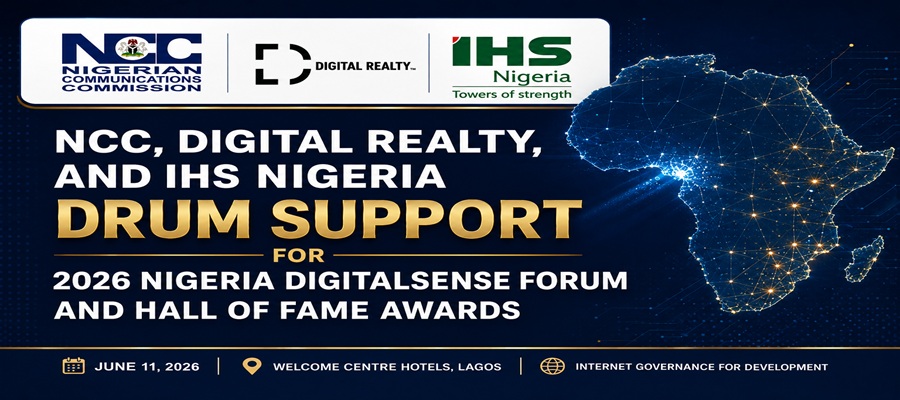
The regulatory and digital infrastructure pillars of Nigeria’s telecommunications ecosystem, led by the Nigerian Communications Commission (NCC), Digital Realty, and IHS Nigeria, have rallied robust support for the upcoming 2026 Nigeria DigitalSENSE Forum (NDSF) on Internet Governance for Development (IG4D) and its prestigious industry awards.

The annual high-level forum is scheduled to hold this Thursday, June 11, 2026, at the prestigious Banquet Hall, Welcome Centre Hotels, Lagos, anchoring its deliberations on the crucial theme: “Sustaining WSIS Vision with Multistakeholder Synergy in Nigeria.”
The Executive Vice Chairman and CEO of the NCC, Dr. Aminu Maida, is set to deliver the Keynote Address, highlighting the regulatory framework required to preserve the World Summit on the Information Society (WSIS) vision through inclusive, multi-stakeholder partnerships.
Joining the regulatory commission in driving this momentum is IHS Nigeria, the nation’s premier digital infrastructure champion boasting a footprint of over 16,000 telecom towers and 15,000km of fiber optic cables across the country. Alongside data center colocation leader Digital Realty, these organizations are heavily backing the forum as part of their commitment to promoting critical national infrastructure and securing Nigeria’s digital possibilities.
Speaking ahead of the event in Lagos, Ogbuefi Remmy Nweke, the Editor-in-Chief of host media organization ITREALMS Media Group, commended the immense institutional support flowing from the public and private sectors.
“Achieving sustainable internet governance and digital trust requires an intentional alignment of regulation and infrastructure,” Nweke remarked. “The active collaboration of the NCC, IHS Nigeria, and Digital Realty ensures that the 2026 forum will move beyond mere dialogue to produce clear, actionable policy recommendations for our digital economy.”
The event will be presided over by Dr. Olusola Teniola (hon), Director, Strategic Business Initiatives, ipNX Nigeria and former President, Association of Telecommunications Companies of Nigeria (ATCON), who will deliver the Chairman’s Opening Speech on the 2026 NDSF blueprint.
Earlier, leading telecommunications, technology, and internet governance stakeholders have thrown their weight behind the 17th milestone edition of the annual Nigeria DigitalSENSE Forum (NDSF) on Internet Governance for Development (IG4D), including ICT infrastructure leader MTN Nigeria; the Association of Licensed Telecoms Operators of Nigeria (ALTON); premier software and DNS infrastructure firm Upperlink Limited; and the Nigeria Internet Registration Association (NiRA), managers of the .NG country code Top Level Domain name.
Media & Event Contact: The Secretariat Nigeria DigitalSENSE Forum (NDSF) / ITREALMS Media Group Banquet Hall, Welcome Centre Hotels, Lagos Website: www.itrealms.com.ng

CBN to Deploy AI in Fight Against Payment Fraud

NDPC, Meta Launch 2-Year M-SIDP after Regulatory Settlement

Report Faults Banks over N91.1 Trillion Sterilised at CBN

Telcos Fault Data of FDI Flow, Claim Investment of N1.86 Trillion on Service Expansion

NRS Accredits Afri Invoice as Access Point Provider to Drive Nigeria’s Mandatory e-invoicing

CBN Extends PoS Geo-Fencing Enforcement Deadline to August 2026

FG to Launch Nationwide Free Digital TV Platform June 17

MTN, Airtel, Glo Under Pressure as FG Demands Better Service Delivery

Jumia Nigeria Records Strong Q1 2026 Growth as Technology-Led Strategy Drives Market Expansion

Metro Digital, Nigerian Firm Accuses Multichoice Of Refusal to Obey Court Judgements




 Telecom1 day ago
Price of Data in Nigerian Mobile among Top Four Cheapest Globally – MTN CEO

 E-Financial1 day ago
BOI Wins Dual Honours @ EMEA Finance Awards for Sustainability and Social Impact Leadership

 E-Business1 day ago
NITDA Okays NiRA’s Annual, Business Report

 E-Financial1 day ago
CBN Imposes N100m Penalty on Dealing Bank Inadequate Processing of Forex Documents

 General News1 day ago
SSDC Warns Businesses against Cyber, Election-Related Risks

 Telecom1 day ago
NAIFF Returns for 2026, Expands Focus on AI-Powered Storytelling in Africa

 General News1 day ago
Moniepoint DreamDevs Bootcamp Graduates Second Cohort to Strengthen Homegrown Talent Pipeline

 Telecom1 day ago
FCCPC Refutes Airtime Market Takeover Claims