

General News
50% of SMEs in Nigeria were Unable to Provide Consistent income to Workers – New Small Firm Diaries Research

Financial Access Initiative (FAI) research center of New York University (NYU) together with the Nigerian National Bureau of Statistics (NBS) this week released the results of the Nigeria Small Firm Diaries (SFD) study. Supported by the Mastercard Center for Inclusive Growth (CFIG), the Bill & Melinda Gates Foundation (BMGF), and the Argidius Foundation, the global research project provides insight into the financial lives of small businesses in seven countries across Latin America, Sub-Saharan Africa and Asia.

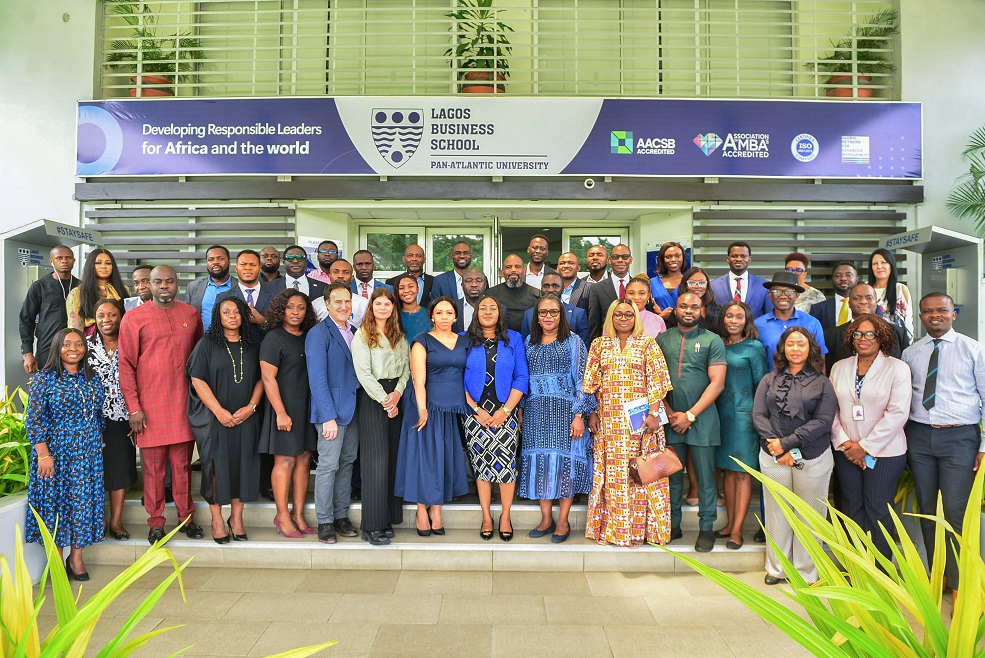
Participants at the Small Firm Diaries Nigeria Research report launch at the Lagos Business School on Tuesday, 25th July 2023.
Results from the Nigeria study
In Nigeria, the study collected data from 161 small businesses in urban, suburban, or semi-rural areas surrounding three locations: Enugu, Kaduna, and Lagos, between August 2021 and August 2022. The study was focused on three industries—light manufacturing, agri-processing, and services—which all play a key role in Nigeria’s economic growth and development.
The study found that the Nigerian firms earn less than firms in the other countries studied. Half of the firms earned less than NGN 223,250 in monthly revenue (PPP USD 1,547) 1 . About half (46%) of the Nigerian firms reported holding a loan of any kind, most of these from informal sources, including suppliers, friends, and family. The research also concentrated on the welfare of employees in small firms, finding that the firms were not able to provide consistent income to workers.
Insights from the research illuminate how small businesses in Nigeria are faring when it comes to: 1 World Bank PPP Rates, NGN/PPP = 152.57
Volatility: The Nigerian small firms, like those in the other countries studied, experience volatile earnings: both revenue and expenses fluctuate from month-to-month.
Desire for growth and stability: When asked about their vision for their business, a large group of Nigerian firms (44%) said they wanted to both grow and gain stability. This population aspires to grow, but does not want to take on the additional risk (they already face a great deal of risk—for instance: fluctuations in demand, rising input prices, supply chain delays, employee issues) that is necessary for rapid growth. They want step-by-step growth that helps reduce volatility and risk.
Financial inclusion: Compared with other countries in the study, Nigerian firms have high rates of bank account ownership: 97% of small firm owners in Nigeria have bank accounts for business—more than in Kenya (79%), Colombia (70%), or Indonesia (65%). However, usage of accounts is less comprehensive, with only 20% of Nigerian firms moving more than three quarters of their transactions through bank accounts. Cash is still the dominant mode of transaction for this segment.
Digital financial services: Nigerian small firm owners use technology — three-quarters use either a smartphone or computer, or both for their business — as well as digital financial services, particularly debit cards, mobile banking, and ATMs. However, they use mobile wallets for business purposes at very low rates.
Credit gaps: Data from the study shows that working capital and liquidity are bigger needs to small firms than investment capital. Despite access to finance being a major barrier to firm owners’ vision for success, more than 40% of firm owners in Nigeria say they “rarely” or “never” need a loan, indicating that products in the market are not accessible or don’t meet their needs. Firms closely match revenues and expenses on a month-to-month basis, which also helps confirm that they lack working capital for day-to-day liquidity needs. Firms rarely take on any operating risk or expansion/growth opportunities that could result in negative monthly cash flow.
Job security: Employment at small firms is precarious. The number of jobs in a firm changes from month to month, and the individuals filling those jobs change frequently. Employee pay varies considerably even during the months they are working at a small firm. Only one-fifth of the small firm employees received their salaries continuously through the study; more than half of employees worked at the same firm for fewer than half of the months studied.
Employee welfare: Some 63% of employees in Nigeria reported difficulties with finances indicative of low-income status, including 51% who reported that a child in their household had not eaten enough in the past week. Both of these figures were higher in Nigeria compared to global sample averages.
In general, the study concluded that stability and growth is a priority for the entrepreneurs who participated in the year-long study. According to the research, these firms face high volatility in income and expenses. They cited “access to finance,” followed by “rising supply costs” as major barriers to achieving their vision of growth and stability.
About the Small Firm Diaries study
The Small Firm Diaries is a global research project conducted between 2021 and 2023 in seven countries: Kenya, Nigeria, Uganda, Ethiopia, Indonesia, Fiji and Colombia. The study aims to improve the understanding of how small businesses can overcome the barriers they face to prosper in the modern economy and contribute to reducing poverty.
In each country, a team of field researchers visited a sample of small business owners in low-income neighborhoods weekly for one full year to collect quantitative and qualitative data on their financial flows. This information sheds light on the economic decision-making, strategies, and constraints of small businesses as they navigate the effects of changes in local and global markets.
The Financial Access Initiative (FAI) research center of New York University, together with partners at the National Bureau of Statistics and the Lagos Business School, anticipate that study results will inform the design of future development policies, financial services and tools to help small businesses and their employees in Nigeria to prosper.
“As the premier agency for the collection, publication, and dissemination of official statistics on Nigeria, NBS was proud to collaborate with the international research team for the Small Firm Diaries project. This study is unique in Nigeria—it is the first large-scale project to gather high-frequency data from businesses of this size—and will allow policymakers to better understand and address the challenges facing these businesses,” said Statistician General Adeyemi Adeniran of the National Bureau of Statistics.
“At the Lagos Business School, we develop the next generation of business owners in Nigeria and Africa. This kind of data, which shines a light on the volatility facing small businesses and their working capital needs, is what we need to inform both government and private sector players who seek to develop policies, products, and services that reduce inequality and increase financial security amongst financially underserved communities,’ said Olayinka David-West, Associate Dean and Professor of Information Systems at the Lagos Business School.
“Small businesses have proved their resiliency in recent years, but still face many pressures to remain profitable. In our work to empower them across the globe as drivers of economic activity and growth, research like this is incredibly insightful. Knowing precisely what challenges small business owners are facing and how they see the future allows us to provide better and more tailored support, and ultimately, better and more meaningful outcomes. We’re proud to support this research, and we hope it can serve as a resource to small business support organizations in the public, private, and social sectors,” said Tania Kruger, Vice President and Head of SME Product & Commercialization, EEMEA at Mastercard.
“MSMEs are by far the biggest employer in low and middle-income economies. Despite decades of statistical research, fundamental questions remain about why some grow, and some stagnate. Our aim with this study has been to try to understand small firms from the bottom-up, by listening closely to how entrepreneurs and workers make choices on their own terms,” said Jonathan Morduch, Executive Director of the Financial Access Initiative and Professor of Public Policy and Economics at New York University.
“We hope the findings from the Small Firm Diaries will be used by others in their own research and initiatives to address the challenges facing small businesses in low- and middle-income communities in Nigeria, and around the world,” said Michelle Kempis, Associate Director of the Financial Access Initiative at New York University.
Uses and application of the study
The reports presented today—the Nigeria Country Data Overview and the Financial Services Report—will be followed by additional analysis and publications in the coming months. The research team will continue to analyze data and publish reports on the Nigerian small firms, including adding further global comparisons, as they seek to collaborate with partners in the public and private sectors to benefit small businesses in Nigeria.
The study aims to guide the policies and practices of a wide variety of players and stakeholders, and study results enable companies and governments to design or improve products and programs that increase the capacity and productivity of small businesses. It will also enable organizations to design financial services products, including digital financial services, that better meet the liquidity and investment needs of small businesses so that they can expand their businesses in terms of income, productivity, employment, and wages paid.



The Nigerians in Diaspora Commission (NiDCOM) has sought to harness the innovation and expertise of Nigerians across the globe with the launch of the Connected Diaspora x DOWA Start-Up Challenge and the Connected Diaspora Flagship Event 2025.

Speaking at a news conference in Lagos, Abike Dabiri-Erewa, Chairman/CEO of NiDCOM, described the initiatives as timely and transformative, noting that they are strategically designed to tap into the creativity, enterprise and professional strength of Nigerians in the diaspora.
She said the Start-Up Challenge, themed “Building, Breaking and Believing in Nigeria,” aims to energise innovators abroad by promoting knowledge transfer, enterprise development and strategic investment to support Nigeria’s rapidly expanding economy.
According to a statement by NiDCOM, the challenge, which offers cash prizes of up to ₦1 million, is targeted at spotlighting exceptional ideas and supporting impactful ventures created by Nigerians living overseas.
According to Dabiri-Erewa, the initiative aligns with the Federal Government’s overarching goal of engaging the diaspora community as key partners in national progress.
She further announced that the Connected Diaspora Flagship Event will take place on December 19, 2025, in Lagos, and will bring together entrepreneurs, policymakers, investors, technology leaders and strategic partners for critical discussions on Nigeria’s future.
Kadiri Hamzat, Deputy Governor of Lagos State, will serve as the Special Guest of Honour and is expected to speak on the importance of collaboration between government and the diaspora in accelerating development.
NiDCOM also revealed that notable contributors from the global diaspora community and Nigeria’s entrepreneurship ecosystem will enrich the sessions and help shape new pathways for meaningful engagement.
Dabiri-Erewa said their support remains invaluable in driving the success of the initiative. She emphasized that their continued collaboration helps unlock the potential of Nigeria’s global talent pool and fosters sustainable economic growth.
The Commission called on stakeholders across both the public and private sectors to support the initiative, stressing that the opportunities for innovation, collaboration and nation-building are immense.
NiDCOM urged young Nigerians and diaspora returnees to participate actively in the Start-Up Challenge, reminding them that entries close on December 12, 2025.
The December event will also feature a Diaspora Talent Career and Internship Fair, aimed at connecting diaspora returnees with internship opportunities offered by DOWA partner organisations.
NiDCOM said the fair will further strengthen talent exchange and deepen the country’s development capacity.
The programme timeline includes the opening of applications for the Start-Up Challenge from November 18 to December 12, followed by public voting on Instagram from December 13 to 17.
The winner will be announced on December 18, ahead of the final presentation at the JK Randle Centre in Lagos on December 19.
NiDCOM encouraged interested participants to follow the provided registration details and take advantage of the platform created to connect, innovate and contribute to national advancement.

Indigenous printing company, PromoPrint Ventures Ltd, celebrated 25 years of operations in the country on Tuesday 2nd December, at an event held at the Lagos Motor Boat Club in Lagos.

The evening saw business executives, clients and stakeholders in the printing space gathered to attest to the dexterity and Nigerian resilience demonstrated by Mrs. Patricia Ojora, the Founder and Chief Executive of the company in sustaining the growth of PromoPrint over the last 25 years.
Amongst many things on display that evening were PromoPrints very first t-shirt printed in the year 2000. Guests also cheerfully adorned custom-made patterns done by Promoprint on our indigenous cotton fabric (Funtau).
In her opening remarks, Mrs. Patricia Ojora recalled the past 25 years of operation in Nigeria at the helm of PromoPrint. While not easy, she says:
“We’ve been able to do it and we enjoy it. There’s nothing better than creation. To create something from nothing and do it so well, it’s a passion for me. It’s something that I really, value. I’m a great supporter of Nigeria, so I believe that we should be able to do things well in Nigeria. We don’t need to always import, that’s why we’re doing this today, to be able to collaborate with people. Most of the people here are people we’ve collaborated with and have worked hard to build Nigeria back up”.
She recounts how she was able to change the narrative of many Nigerians that were printing outside of the country who are now printing with PromoPrint Ventures. “People used to print outside the country because they didn’t trust the quality that was here in Nigeria,” Patricia explains with an understanding that “we can produce good quality here within Nigeria.”
The company is a one-stop shop for all things printing with all operations happening in-house, from the expertise of crafting graphics and garment production to the t-shirts, roller banners, corporate gifts and more being rolled out on a daily basis. “What we are selling is peace of mind in a chaotic place.” Patricia says, with nearly three decades of successful operations and collaboration under her belt.
Significantly, she makes sure the company remains primed for the future, using AI and the like to remain progressive in strategy and implementation. Patricia proudly states, “Our automated printing carousel can churn out 10,000 tees a day if needed and our many corporate clients can attest to this.”
In attendance was Atedo Peterside (CON), Founder, Stanbic IBTC Bank Plc, one of many guests in the room who spoke to PromoPrints impact. “There’s something about longevity,” he shares with the crowd, “If you’ve kept the business going for 10 years, I always tell people, it means you’re doing something right. If you get it going for 20 years, you’re doing something very correct. Patricia must be doing something phenomenally right and it’s my sincere hope that she keeps it going, keep building, keep innovating.”
“Patricia can create almost everything,” Peterside remarks, “she has the courage, audacity and the commitment.”
Mrs. Ibukun Awosika, Nigerian businesswoman and the first female Chairperson of First Bank of Nigeria, contextualises the tenacity of Patricia’s efforts rather well. She reminds the room that “when you think of how many big multinationals who have so much that protects them, who have a lot of support systems internationally and locally, who gave up on Nigerian manufacturing, then you have to go back and think about those of us like Patricia.”
Even after 25 years, Nigeria remains in need of more Entrepreneurs, particularly those like Patricia, to boost the SME and manufacturing industry in the country despite the odds. “She didn’t give up,” Awosika says in admiration.
“What is key is that, when we celebrate the likes of Patricia and her company, we know without a doubt that it’s not just because they want to have a celebration. It’s because, in truth, the Nigerian entrepreneur is a star, and even more so, the Nigerian manufacturer.” Awosika concludes.
So, we celebrate Mrs. Ojora and her PPV entire team, and all that has gone into 25 years of hard work, commitment, creativity, we also recognise the passion that does not allow you to give up on the vision, the commitment to not only creating jobs for other Nigerians but creating value within Nigeria. The commitment to innovating a solution for every challenge and every situation. Indeed, it was a worthy celebration.

Mr. Lanre Basamta, Chief Executive Officer and Co-Founder of Optimus AI LABS, has unveiled a suite of artificial intelligence innovations poised to transform Nigeria’s financial services industry, aligning with recent Central Bank of Nigeria (CBN) directives on consumer protection and fraud prevention.

Mr. Lanre Basamta, Chief Executive Officer and Co-Founder of Optimus AI LABS
Basamta, speaking at a media parley in Lagos, said the company’s flagship product, Omnis, is redefining customer engagement in banking by serving as a virtual assistant embedded within mobile applications.
According to him, the platform is capable of analyzing customer behavior to recommend tailored financial products, effectively functioning as a “digital salesperson” that boosts bank revenues while enhancing customer experience.
He noted that Optimus AI LABS, which began as a modest startup targeting small businesses such as schools, has now identified greater opportunities in serving banks, fintechs, and microfinance institutions.
“The financial sector presents the biggest opportunity for AI to deliver value at scale,” Basamta said.
In response to rising fraud concerns and new CBN regulations mandating resolution of fraud cases within 14 days, Basamta highlighted the company’s AI-powered support platform designed to address customer frustrations over delayed assistance.
The system, he explained, interacts naturally with users, resolves issues promptly, and escalates unresolved cases, thereby strengthening compliance and improving customer satisfaction.
Basamta also recounted the firm’s global expansion, citing its work with Canadian clients, including the development of a dental learning environment for a major dental group.
He said this international footprint demonstrates Nigeria’s capacity to compete globally through homegrown innovation.
Reflecting on the company’s relocation into office space formerly occupied by KUDA, a fast-rising Nigerian fintech, Basamta expressed optimism that Optimus AI LABS is on a similar trajectory toward scaling into a major industry player.
He emphasized that the company’s growth would contribute not only to technological advancement but also to national development.
Basamta concluded by appreciating partners and stakeholders, stressing that “big things can emerge from small beginnings when powered by AI’s transformative capabilities.”

FG, SEC, NGX Group Agree on Capital Gains Tax Reform

Airtel Africa Foundation Celebrates International Volunteer Day, Honours Employee Volunteers

Report Reveals Half of 2025’s Compromised Passwords were Already Leaked

EFCC Arik Case: Witness Testifies on Receiver Manager Nominee’s Role in NG Eagle Shareholding

Nigeria Dominates 2025 TikTok Sub-Saharan Africa Awards with Six Wins

Kaspersky Introduces Cyber Pathways to Support Career Development in Cybersecurity

NITDA DG Tasks Youths to Drive Africa’s Digital Transformation

Firm Urges Organizations to Check Protection of their Websites Amid Search Engine Optimisation Attack Schemes

Hackers Breach Phones of Dangote and Otedola, Demand Ransom

FCCPC Sets Deadline for Digital Lending Regulatory Compliance




 Telecom1 day ago
Nigeria Lacks AI-Ready Data Centres, Trails in Capacity – Nnamani

 E-Financial1 day ago
CAC to Shut Down Unregistered PoS Operators by January 2026

 Telecom1 day ago
Anambra Leads Southeast in Digital Governance Under Soludo’s ICT Agenda

 General News1 day ago
NiDCOM Launches Diaspora Startup Challenge to Boost Nigerian Talent

 General News1 day ago
Optimus AI LABS CEO Showcases AI Breakthroughs in Nigeria’s Financial Sector

 News1 day ago
Lagos Launches Tele-Vet, Nigeria’s First Veterinary Call Centre

 General News1 day ago
PromoPrint Rekindles Nigerian Resilience @ 25th Anniversary
 Telecom6 hours ago
Nigeria Dominates 2025 TikTok Sub-Saharan Africa Awards with Six Wins