

Telecom
NCC Assures Underserved Communities of Ubiquitous Broadband Penetration

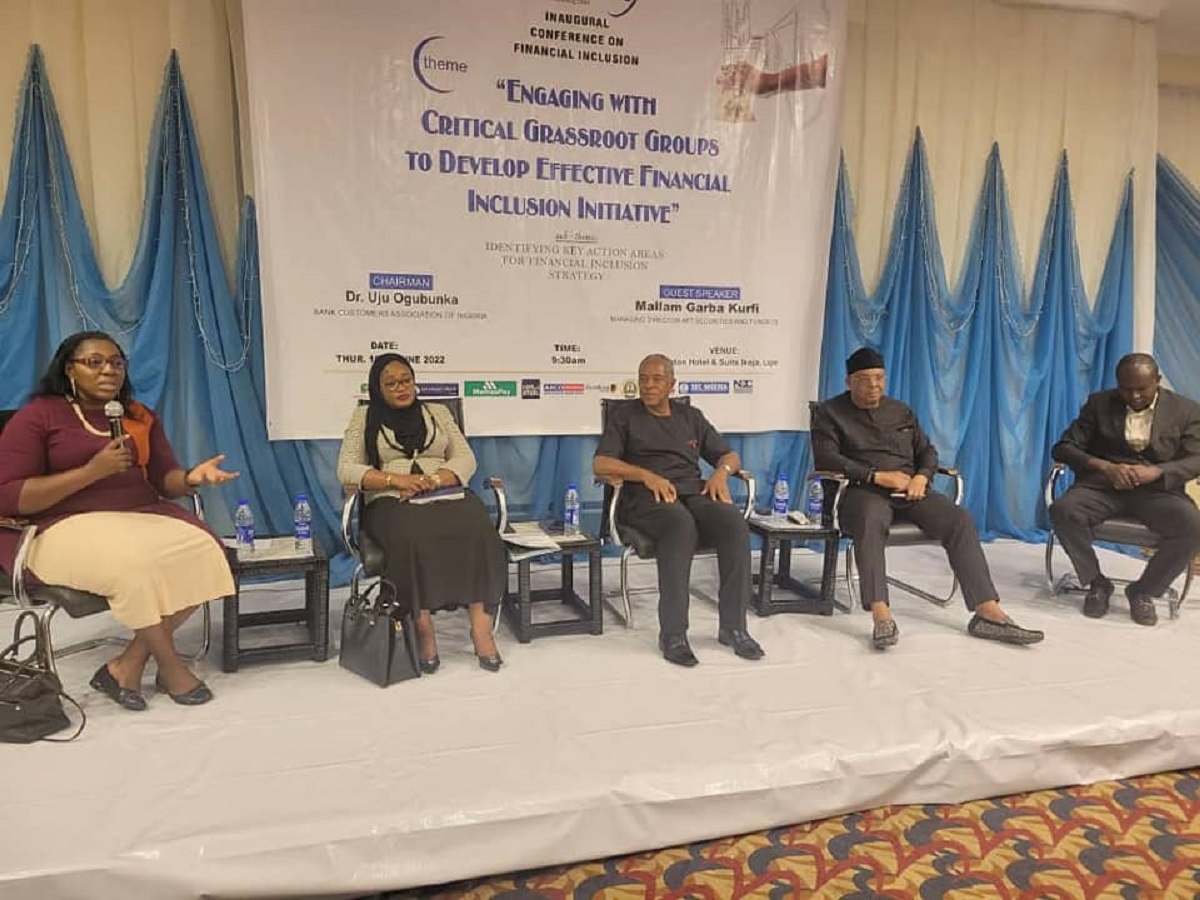

L-R: Freda Bruce-Bennet, Deputy Director, Digital Economy Department, Nigerian Communications Commission (NCC) ; Sa’adatu Faruk, Head, Financial Inclusion Division, Market Development Department, Security Exchange Commission (SEC); Dr.Uju Ogunbunka, Chairman , Bank Customers Association of Nigeria;Rasaaq Salami ,Deputy Director, Corporate Communications & Market Development , National Insurance Commission (NAICOM); Yinka Issac representing David Anyaele , Executive Director Centre for Citizens with Disabilities (CCD), during the panel deliberation at the inaugural conference on financial inclusion in Lagos



Nigerian Communications Commission (NCC) and the Enugu State Government have signed an agreement for the operational lease of the NCC Digital Industrial Park and NCC Learning Centre in Enugu.

The agreement was witnessed by Dr Aminu Maida, Executive Vice Chairman and Chief Executive Officer of the NCC, alongside members of the Commission’s Board and Management.
The development is expected to strengthen digital innovation, skills development and technology-driven opportunities in the state.
As part of the engagement, the NCC delegation also visited the Enugu Smart School Initiative, where technology is being integrated into teaching and learning.
The initiative is aimed at equipping young Nigerians with relevant digital skills and preparing them for future opportunities in an increasingly technology-driven economy.

The NCC said it remained committed to supporting initiatives that expand digital inclusion, strengthen innovation and develop the talent required to drive Nigeria’s digital transformation.
The Commission said partnerships with state governments and other stakeholders were critical to creating an enabling environment for digital skills development and technology adoption across the country.


Nigerian Communications Commission (NCC) has directed telecommunications operators to make dedicated budgetary provisions for cybersecurity as part of efforts to strengthen the resilience of Nigeria’s communications infrastructure against the growing wave of cyber threats.

The directive forms part of the Commission’s Cyber Resilience Framework for the Nigerian Communications Sector (CRF-NCS), which introduces new governance, risk management and operational requirements aimed at safeguarding the country’s critical telecommunications infrastructure from increasingly sophisticated cyberattacks.
Under the framework, all licensed telecom operators are expected to establish formal cybersecurity governance structures, dedicate adequate financial resources to cyber resilience programmes, and integrate cybersecurity into their enterprise-wide risk management processes.
The Commission said operators must ensure cybersecurity investments are no longer treated as optional operational expenses but as strategic business priorities necessary to protect network infrastructure, customer information and the country’s digital economy.
According to the NCC, licensees are expected to allocate sufficient budgets to support cyber risk assessments, security technologies, staff training, incident response capabilities, continuous monitoring and compliance with regulatory requirements.
The framework also requires operators to designate senior executives responsible for cybersecurity oversight.
At the same time, boards of directors are expected to provide strategic direction and ensure adequate funding for cyber resilience initiatives.
Speaking on the need for a stronger cybersecurity regime during the unveiling of the framework, Abraham Oshadami, executive commissioner, Technical Services, NCC, said, “Given the increasing digitalisation of services, the rapid growth of data exchange, and the sophisticated nature of modern cyber threats, the need for a robust, adaptive and inclusive cybersecurity framework has become more urgent.”
He added, “Both state and non-state actors are targeting essential sectors—including ours—through coordinated cyber and physical attacks. These attacks frequently target control systems and data integrity, underscoring the critical risks posed to operational technology (OT), especially in our sector.”
“As cyber threats evolve, they endanger not only system performance but also human safety, amplifying the severity and consequences of disruptions to vital communications infrastructure. Cybersecurity now encompasses human safety and must address the real risk to people’s lives when a system is attacked or compromised.”
The Commission further stated that operators are required to develop comprehensive cybersecurity implementation plans, conduct periodic risk assessments, establish business continuity and disaster recovery procedures, and regularly test their cyber defence capabilities.
In addition, the framework makes cyber incident reporting compulsory. Licensees must inform the NCC’s CSIRT of any major cybersecurity breach within four hours of discovery, and provide a thorough post-incident analysis after mitigation is complete.


Digital solution provider, Globacom has recorded the highest Internet subscriber growth among Nigeria’s major telecom companies for the month of May.

Data from the Nigerian Communications Commission, NCC, Nigeria’s total Internet users increased to 157 million in May, up from 154.3 million in April. That is a growth of 2.67 million users in one month.
Globacom led the market by adding about 1.2 million new Internet subscribers. This means Glo was responsible for almost half of all new Internet users in May.
The company’s subscriber base grew from 15.5 million in April to 16.8 million in May. Airtel came second with 1.07 million new users, moving from 54.8 million to 55.8 million. MTN added 382,894 users to reach 83.5 million.
T2 Mobile, formerly 9mobile, recorded no growth for the second month in a row. Its subscriber base remained at 802,534. This is despite its roaming agreement with MTN, which was approved almost a year ago to help T2 customers use MTN’s network in areas with poor coverage.
Industry experts say Glo’s strong growth is due to its ongoing network upgrade. Since last year, the company has been building new base stations, expanding its fibre network, and adding thousands of new 4G sites across cities and rural areas.
The upgrades have improved voice and data quality for customers, while Globacom remain committed to providing better network experience and affordable Internet services to more Nigerians.

World Bank Debars United Aviation Services, Owner over Fraudulent Activities

NITDA Introduces Cloud Certification Boost Data Localisation Compliance

Enugu State Approves Land for ITF’s Digital Fabrication Centre

BOI Opens N250Bn Bond Offer to Fund Businesses

Guinness Rewards Consumers with ₦17 Million in First Week of ‘Open for More’ Promo Draw

From Scarcity to Scale: What Africa Can Learn from India’s Agricultural Transformation

BON Establishes Six Ad Hoc Committees to Modernize Broadcasting

EFCC Busts NIS Visa Overstay Racket, Uncovers N700m in an Account

Fact-Check: Elon Musk’s “Tesla Pi Phone” is Internet Rumor

NBC Tasks Broadcasting Stations over 2028 DSO Global Deadline




 E-Financial2 days ago
Access Holdings Deepens Sustainable Finance Impact, Expanding Green Assets to ₦92.14 Billion

 News2 days ago
Ogbaga, Abuja Lawyer to Sue Telcos, DStv over Alleged Unfair Practices

 Telecom2 days ago
MTN Moves Closer to Full IHS Takeover

 Telecom2 days ago
Airtel Nigeria Unveils Hundreds of Retail Shops in Wide Expansion of Customer Touch Points

 E-Financial2 days ago
NAICOM Revokes Nigeria Reinsurance’s Licence over Failure to Meet MCR

 News2 days ago
NAICOM Issues New Licences to 43 Recapitalized Insurers

 E-Financial2 days ago
SEC Begins Full e-Registration for Capital Market Services

 E-Financial2 days ago
TeamApt, Awabah Partner to Bring Micro-Pension Contributions to POS Terminals Nationwide