

E-Financial
PatrickGold Microfinance Bank Launches Digital Banking Platform


One of the fastest growing financial institutions in Nigeria, PatrickGold Micro Finance Bank, has launched a digital banking platform, GetriPay, to promote the ease of financial transactions for its customers.

GetriPay, launched alongside GetriSave, promised a big boost in ease of fund transfer, bills payment, loan accessibility, savings and transaction rewards.
In a statement on Tuesday, the Chairman of the bank, Olutosin Bamiduro, said customers who downloaded GetriPay on Google Play and Apple Store would use same login details for GetriSave to experience the best of banking with unique speed.
“For the record, we are here to revolutionise digital banking with amazing rewards for our customers and we will prove this to Nigerians.
“On GetriPay, our customers have numerous benefits which include instant sign-up bonus, charge-free cable subscription payment, whooping cash-back on every airtime purchase and free physical ATM cards with no withdrawal charge on all Zenith Bank ATMs and three free withdrawals on other banks’ ATM.”
“Customers would also enjoy 15 free transfers monthly to any Nigerian bank alongside free fund transfers from accumulated points.
“With GetriSave, anyone can achieve their saving goals and earn up to 13 per cent interest with our different packages. We also give loyalty rewards on savings every 30 days,” Bamiduro said.
Licensed by the Central Bank of Nigeria with deposits insured by the Nigeria Deposit Insurance Corporation, PatrickGold Micro Finance Bank’s partners include: Nigeria Inter-Bank Settlement System Plc, Interswitch, Zenith Bank, Flutterwave, among others.


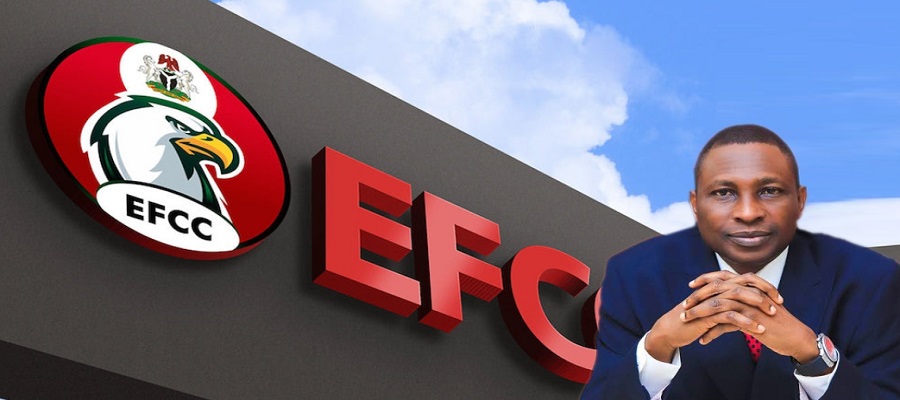
Ola Olukoyede, executive chairman, Economic and Financial Crimes Commission (EFCC), has cautioned Nigerian banks against granting loans without credible collateral, warning that such practices often lead to insider abuse and non-performing loans.

Olukoyede issued the warning recently when he received Mufutau Olawale Abiola, chief audit executive, First Bank Plc, who led a delegation on a courtesy visit to the Lagos Zonal Directorate 2 of the Commission in Ikoyi.
Speaking through Bawa Usman Kaltungo, acting zonal director, Lagos Zonal Directorate 2, Ikoyi, Olukoyede expressed grave concerns over how banks in the country grant loans, noting that loans backed only by personal guarantees, including those of top executives, are inadequate and put depositors’ funds at risk.
He said: “We have issues with banks’ mode of giving loans. The process often shows insider abuse.”
While emphasizing that banks should desist from issuing loans without visible or credible collateral, he added that “Top-down loans are not secured. You cannot give a loan based solely on the personal guarantee of the Chief Executive.
This is not security. Banks must not issue loans without verifiable collateral. If there is proper collateral for loans obtained by bank customers, this will reduce the rate of non-performing loans.”
He further warned that a bank is only a custodian, and that giving loans without adequate collateral “amounts to tampering with depositors’ funds.”
He also urged banks to implement measures, including thorough due diligence on its customers, to prevent loan defaults.
According to him, “Even in situations where you outsource due diligence, there must be a clause of liability,” he said.
Reaffirming the Commission’s commitment to continued cooperation with the bank in tackling financial crimes, he urged the bank to release its staff promptly when invited during investigations of alleged financial crimes.
“When we invite your staff, especially where insider connivance is suspected, you must release them so we can jointly fight economic and financial crimes. We must work together to stay ahead of criminals. Let me add that where money is, that is where people’s hearts are. Most of the time, we escalate issues to foreign security agencies as may be necessary,” he added.
Earlier, Abiola expressed gratitude to the EFCC leadership for the engagement, noting that the visit was intended to strengthen the existing collaboration between the bank and the Commission.
While urging the EFCC to expedite investigations into cases involving its staff and others, Abiola also disclosed that a designated team in his bank handles requests from the EFCC.

More than one million online banking accounts were compromised by infostealers last year, as financial cyberthreats shifted toward credential theft and data reuse.

Pic credit…cybelangel.com
Attackers are moving away from traditional PC banking malware and increasingly relying on social engineering and dark web marketplaces, while mobile financial malware continues to grow.
Detailed information on current financial cyberthreat trends is available in Kaspersky’s new report.
These digital “pickpockets” often exfiltrate data and remove themselves within seconds, making them difficult to detect.
They are a primary source of initial access for ransomware and identity theft
Traditional financial phishing has not gone away. Pages that mimicked e-shops dominated the financial phishing landscape (48.5% in 2025, up 10.3% from 2024), followed by banks (26.1% in 2025, down by 16.5% from 2024) and payment systems (25.5% in 2025, up by 6.2% from 2024). The decline in bank phishing may suggest that these services are becoming increasingly difficult to successfully impersonate, and fraudsters are turning to easier ways to access users’ finances.
Attackers are adapting campaigns to regional digital habits. In the Middle East, financial phishing is overwhelmingly concentrated on e-commerce (85.8%), indicating a heavy reliance on online retail lures, whereas in Africa bank-related phishing leads (53.75%), which may indicate that user account security there is still insufficient. Latin America shows a more balanced distribution but with a higher share of e-commerce and bank targeting, while APAC and Europe display a more even spread across all three categories, pointing to diversified attack strategies.
In 2025, the decline in users affected by financial PC malware continued as users increasingly rely on mobile devices to manage their finances. Contrary to PC banking malware, mobile banker attacks grew by 1.5 times in 2025 compared to the previous year.
Complementing traditional financial malware, infostealers played a significant role in enabling financial crime both on PCs and mobile devices by harvesting login credentials, cookies, bank card numbers, crypto wallet seed phrases, and autofill data from browsers and applications, which attackers then used for account takeovers or direct banking fraud. Kaspersky data pointed to a surge in infostealer detections (up by 59% globally, 53% in Africa and 26% in the Middle East, on PCs from 2024 to 2025), fueling credential-based attacks.
According to Kaspersky Digital Footprint Intelligence (DFI), in 2025 over one million online banking accounts served by the world’s 100 largest banks fell victim to infostealers: credentials for these accounts were being freely shared on the dark web. The countries with the highest median number of compromised accounts per bank were India, Spain, and Brazil.
74% of payment cards that were compromised by infostealer malware, published on dark web resources and identified by Kaspersky DFI team in 2025, remained valid as of March 2026. This means that attackers could still use cards that had been stolen months or even years prior.
“The dark web has become a central hub for financial cybercrime. Stolen credentials and bank cards that have been harvested by infostealers are aggregated, repackaged, and sold there, while phishing kits targeted at users of financial products are offered as ready-to-use services.
This creates a self-sustaining ecosystem where data theft and fraud operations reinforce each other, making attacks scalable and easy to carry out by fraudsters with minimal experience. Breaking this cycle requires proactive threat intelligence on the part of organisations, and increased awareness and scrutiny from individual users,” comments Polina Tretyak, Kaspersky Digital Footprint Intelligence analyst.


By Lukman Otunuga, Head of Market Research, FXTM.
The Naira is the second best performing African currency against the dollar year-to-date, only surpassed by the Zambian Kwacha.

Lukman Otunuga
Its stability through conflict-induced volatility is commendable, but such has come at a heavy cost. Nigeria’s foreign-exchange reserves have fallen for 16 consecutive days through April 8 – falling to its lowest since mid-Feb to $48.94 billion. The CBN followed its pledge to defend in the local currency in March as deepening geopolitical risk punished emerging market assets.
On the data front, it’s a big week for Nigeria due to the incoming inflation report for March.
Nigeria’s CPI is expected to have eased to 13.4% yoy from the 15.1% in February. Persistent signs of easing inflationary pressures may encourage the CBN to cut rates in an environment where other central banks are considering hiking to tame conflict-induced inflation.
Over the weekend, US-Iran peace talks concluded without a resolution.
Despite a marathon 21 hours of negotiations, both sides were unable to agree on key issues, including Iran’s nuclear program and its control of the Strait of Hormuz.
Hours after Trump threatened to block the Strait of Hormuz from Monday 10 am ET.
This fresh uncertainty was reflected across markets this morning, with risk aversion affecting equities, while oil benchmarks surged amid rising geopolitical risk premiums.
Given how Iran has rejected US restrictions on shipping and threatened Gulf ports, sentiment remains fragile and highly sensitive with markets on high alert.
It’s worth noting that the Strait of Hormuz has been effectively closed since late February, raising the risk of inflation and growth shocks that threaten the global economy.
In the commodity space, oil benchmarks surged as the US vowed to blockade all vessels passing through the Strait of Hormuz. Brent rallied as much as 9% to roughly 104$ a barrel as supply shock fears returned with a vengeance. Deepening conflict may keep oil prices elevated, with triple digits potentially becoming a new normal amid extreme supply tightness.
Gold initially declined on rising inflation concerns as oil prices surged. Despite prices jumping back above $4700 bears remain in control amid rising inflationary risks. Given how expectations have basically diminished over lower rates in 2026, gold is likely to remain on the backfoot with a stronger dollar keep bears in the game. Key levels of interest can be found $4825, $4700 and $4600.

EFCC Warns Banks against Loans without Credible Collateral

Nigeria Needs Some 480,000 Local DPOs for Data Protection

Air Traffic Controllers Raise Safety Concerns over Failing Systems, Worsening Welfare

AfDB Grants Project BRIDGE $200m Facility for Nationwide Internet Access

Qualcomm Unveils Startup Selection for Qualcomm Make in Africa 2026

Spotify’s Loud & Clear Report Reveals Over ₦60Bn Revenue for Nigerian Artists in 2025

Kuda MFB Increases Kuda for Her Business Grants to ₦10 Million

Canal+ to Cut Jobs as Part Sweeping Restructuring

Nigeria tops global rankings for USDT, USDC ownership

NBC Boss Urges Content Ceators to Participate in DSO




 Telecom2 days ago
Digital Realty, IXPN Expand Peering Network with New Internet Exchange Point of Presence in Nigeria

 General News2 days ago
Teenager Hacks Celebrities Whatsapps, Sells Adult Content in Delta

 Telecom2 days ago
SpaceX Hints at Home‑Built Chip Module for Starlink Mobile

 Telecom2 days ago
Elon Musk Accuses South Africa of Racism over Starlink Licence Block

 E-Financial2 days ago
Lawyers Sue CBN over One-Time BVN Phone Number Change

 News2 days ago
Meta Files Appeal over $25,000 Damages Awarded to Falana

 E-Business2 days ago
FG Unveils ePharmacy Platform to Regulate Digital Pharmaceutical Services

 General News2 days ago
SERAP Asks Tinubu to Probe Alleged N2.9Bn Fraud In NIGCOMSAT, NNRA