

E-Financial
Stakeholders Converge at the Maiden International Financial Inclusion Conference, Lead Conversations on Financial Inclusion

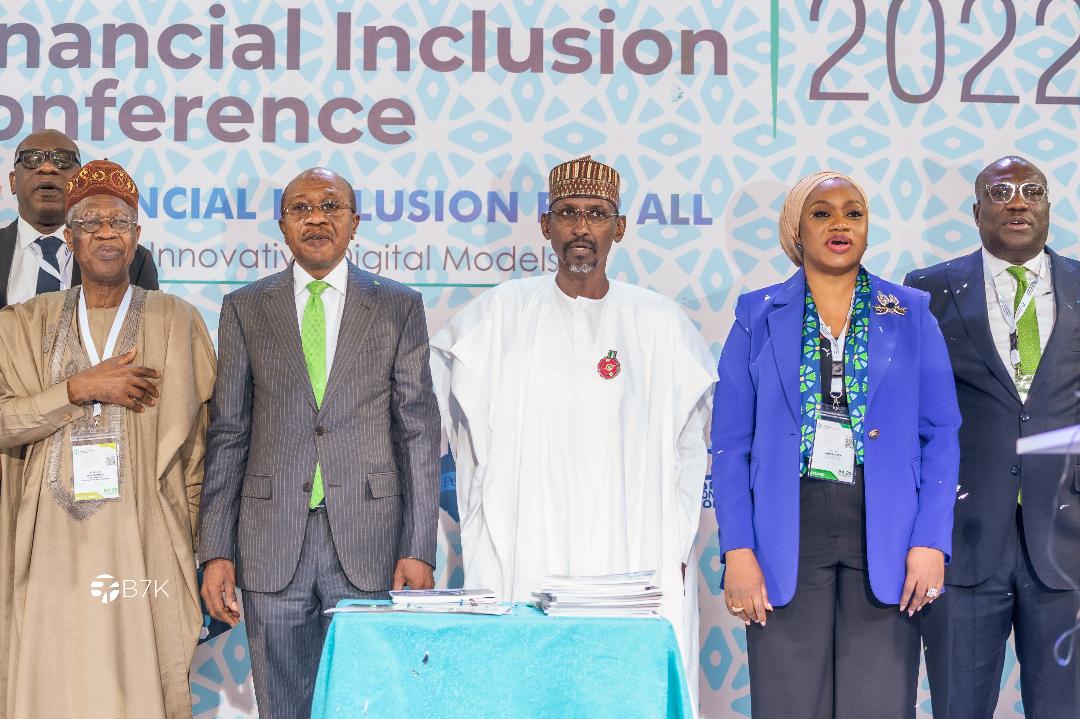
Nigeria, on 24th and 25th November 2022 hosted the largest convening of the global Financial Inclusion ecosystem since the launch of its National Financial Inclusion Strategy in 2012.

L-R: Lai Mohammed CON, Minister of Information and Culture; Godwin Emefiele, Governor of the Central Bank of Nigeria; Alhaji Mohammed Musa Bello CON, Minister of the Federal Capital Territory, Nigeria and Aishah N. Ahmad, CFA– Deputy Governor, Central Bank of Nigeria and Philip Yila Yusuf, Director, Development Finance Department, Central Bank of Nigeria at the maiden edition of the International Financial Inclusion Conference 2022, which was held at Transcorp Hilton hotel Abuja on Thursday, November 24th, 2022.
The 2022 International Financial Inclusion Conference organized by the Central Bank of Nigeria (CBN) and its partners within the financial inclusion governance committees themed: “Financial Inclusion for all: Scaling Innovative Digital Models” had in attendance over 5000 participants from at least 78 countries around the world.
Among the major dignitaries in attendance were His Excellency, President Muhammadu Buhari (GCFR), who was represented by the Honorable Minister of the Federal Capital Territory, Mallam Mohammad Musa Bello (CON); United Nations Secretary-General Special Advocate (UNSGSA) on Inclusive Finance, Queen Maxima of the Netherlands; Secretary to the Government of the Federation, Mr. Boss Mustapha; the Honorable Minister for Communication and Digital Economy, Professor Isa Pantami; the Honorable Minister of Women Affairs, Dame Pauline Tallen; the Honorable Minister for Information and Culture, Mr. Lai Mohammed; the Governor of the CBN, Mr Godwin Emefiele, and Dr Kayode Fayemi, former Chairman of the Nigerian Governors Forum and former Governor of Ekiti State.
Also in attendance were financial sector regulators such as the Chairman of the Securities and Exchange Commission, Mr. Femi Lijadu; Managing Director of the NDIC, Mr Hassan Bello; the Commissioner of NAICOM, Mr Sunday Thomas; Board Members of the Central Bank of Nigeria, and the Chief Executive Officer of Brittania-U Nigeria Limited, Mr. Uju Ifejika, amongst others.
During the conference, attendees witnessed the launch of 7 key policies and products that would enable the achievement of 95% Financial Inclusion in Nigeria by 2024 such as the revised National Financial Inclusion Strategy (3.0), the Strategy for Leveraging Agent Networks for Women’s Financial Inclusion, the National Fintech Strategy, the Payment System Vision (PSV) 2025, the Nigeria Financial Services Maps, the CBN Regulatory Sandbox and a Fintech Bridge between the Central Bank of Nigeria and the Central Bank of Egypt.
Giving a keynote address during the conference, the Governor Central Bank of Nigeria – Mr. Godwin Emefiele who chairs the National Financial Inclusion Steering Committee pointed to CBN’s long-standing effort to achieve the financial inclusion targets through creating enabling environments and providing supports.

He said, “From 2012 to date, over 59 policies and initiatives have been implemented by stakeholders to achieve the objectives of financial inclusion.
“These policies and initiatives cut across the banking sector, the insurance sector, the capital market sector and the institutions responsible for infrastructural development for financial inclusion in Nigeria.
“We have prioritized financial inclusion through our invention for over four million smallholder farmers and SMEs creating over two million jobs. By the end of 2024, we aim to be at 95% rate of financial inclusion in Nigeria”.
The Deputy Governor, Financial System Stability, CBN, Mrs. Aishah N. Ahmad, CFA in her welcome remarks highlighted that the conference was holding at a critical time in Nigeria’s Financial Inclusion journey. “Nigeria is indeed at an important tipping point for financial inclusion.
“At no time has there been a prevalence of an enabling regulatory environment, proliferation of digital technology, innovation and collaborative platforms between the public and private sector – all strategic levers required to scale financial inclusion in Nigeria”. In her engaging plenary session, she also stressed the role of policy making in advancing Financial Inclusion in Nigeria.
In a special keynote address by the United Nations Secretary-General Special Advocate (UNSGSA) on Inclusive Finance – Her Majesty Queen Maxima of the Netherlands highlighted the role to be played by the new National Financial Inclusion Strategy in providing a genuine chance for improving livelihoods, such as strategies leveraging the National Insurance Number, Bank Verification Number amongst other policies
The conference featured nine plenary sessions including Scaling Digital Models for the Last Mile, Catalyzing Global Partnerships for Financial Inclusion, Country Experiences, Expert Dialogue on Women’s Financial Inclusion, Fostering Partnerships for Inclusive growth amongst others. Four breakout sessions focused on Digital Infrastructure, Data Privacy & Consumer Protection, Deepening Digital Financial Services and Strategies for reaching Youth & Rural Areas.
Speakers cut across global policy makers and business leaders including Dr Alfred Hannig, Executive Director AFI, Ambassador Chad Blackman, Special Adviser to the DG ILO, Mrs Elsie Addo- Awadzi, Deputy Governor, Bank of Ghana, Mr Folashodun Shonubi, Deputy Governor Operations, CBN, Mr Herbert Wigwe, Managing Director, Access Corporation and Professor Olayinka David-West of Lagos Business School, etc
The IFIC 2022 conference agenda included the first Financial Inclusion Awards Dinner themed ‘Celebrating Champions of Inclusion’. Nine (9) deserving institutions and one individual were recognized for their contributions to advancing financial inclusion in Nigeria through a rigorous nomination and selection process superintended by Price WaterHouse Coopers (PWC).
The winners included Enhancing Financial Innovation and Access (EFINA) who won the Financial Inclusion Innovation Award and Access Bank and Jaiz Bank who won the national women’s financial inclusion award and the inclusive bank of the year award respectively. TeamApt, Remita, Interswitch, E transact, Lapo MFB and Ms Modupe Ladipo also took away awards.
The conference also showcased 20 fintech and start up companies at its Innovation Labs exhibition focusing on various solutions targeted at facilitating payments, digitizing informal financial services platforms and bridging the financial inclusion gap.


PalmPay, one of Africa’s leading digital financial services companies, is considering a listing on the Hong Kong Stock Exchange after attaining a valuation of more than one billion dollars, according to a Bloomberg report.

PalmPay
The report, citing sources familiar with the matter, said the fintech company was also seeking to raise between 150 million dollars and 200 million dollars in fresh funding ahead of a potential Initial Public Offering (IPO).
According to the sources, the additional capital is expected to support PalmPay’s next phase of expansion across Africa and selected Asian markets.
If completed, the IPO would rank among the most significant public market debuts by an African fintech company and could encourage other technology firms on the continent to explore listings beyond the traditional financial centres of London and New York.
Founded in 2019, PalmPay has emerged as one of Africa’s fastest-growing consumer fintech platforms, providing digital payments, money transfers, savings, lending and merchant payment solutions.
The company has established its strongest market presence in Nigeria while expanding operations into Ghana, Tanzania and Bangladesh as part of its international growth strategy.
PalmPay says it currently serves more than 35 million registered users and supports over one million businesses and merchants, processing millions of transactions daily.
Its rapid growth has positioned it among Africa’s leading fintech firms, alongside companies such as Flutterwave, Moniepoint, OPay, Wave and Onafriq.
Unlike many technology startups that have prioritised rapid customer acquisition over profitability, PalmPay reportedly achieved profitability in 2025, a development analysts say could enhance investor confidence as the company prepares for another fundraising round and an eventual stock market listing.
The report noted that Hong Kong could offer strategic advantages for PalmPay due to its strong commercial ties with Asian investors and the company’s growing presence in emerging Asian markets.
PalmPay’s early investors include Transsion Holdings, the maker of the Tecno, Infinix and itel smartphone brands, as well as investors linked to NetEase and MediaTek.
Industry analysts believe these long-standing relationships could make Hong Kong a natural destination for PalmPay’s public listing while broadening access to investors already familiar with its business model.
The company’s IPO plans come as venture capital investment in African startups has slowed considerably since the record funding years of 2021 and 2022, prompting many technology firms to focus on profitability, stronger balance sheets and sustainable long-term growth.
Against that backdrop, PalmPay’s proposed fundraising and listing are expected to serve as an important test of international investor appetite for profitable African fintech companies.
The company’s valuation also underscores the resilience of Africa’s digital payments sector, driven by rising smartphone adoption, expanding internet access and increasing demand for cashless transactions across the continent.
Although PalmPay has yet to make a final decision on either the fundraising or the IPO timetable, the reported preparations indicate that the company is positioning itself for its next phase of growth.
Industry observers say a successful Hong Kong listing could provide fresh momentum for Africa’s technology sector and create an alternative pathway for high-growth startups seeking access to global capital markets.

Hackers have hit the database of Zenith Bank, one of Nigeria’s largest financial institutions, stealing customers’ information.
Zenith confirmed the attack in an email to customers on Tuesday.
The bank said the hackers accessed limited customer information, “including email addresses and phone numbers, during a cyberattack that forms part of a broader global attack on organisations across different sectors”.
The lender stressed that the incident involved only limited customer information, adding that its banking services and digital channels remain secure and fully operational.
The bank said it is investigating the attack, noting that its incident response protocols and other cybersecurity measures were immediately activated after the breach was discovered.
“As a precaution, we encourage our customers to remain vigilant against phishing emails, text messages, or phone calls, and to never disclose their password, PIN, One-Time Password (OTP), or other security credentials to anyone,” the bank said.
Zenith Bank said it remains committed to protecting customers’ information and thanked them for their continued trust, adding that investigations into the incident are ongoing.
In August 2024, Guaranty Trust Bank (GTB) reported experiencing a similar incident.
The commercial bank said there were attempts to compromise its website domain, but customers’ data was not affected.
The latest attack comes months after the Central Bank of Nigeria (CBN) warned the public of cyber hack attempts to gain access to personal accounts of Nigerians.
The CBN said the hackers were circulating fraudulent messages and emails falsely claiming to originate from the bank.
According to the financial regulator, there were misleading messages circulating, designed to deceive Nigerians and compromise their personal information.
The regulator said the fake communications, which include emails and online messages, often prompt recipients to click suspicious links while spreading false claims about the bank’s leadership, licensing activities, and policy decisions.


Nigerians lost N25.85 billion to digital payment fraud in 2025, according to Central Bank of Nigeria (CBN).

Though the figure represents a significant decline from the N52.26 billion recorded in 2024, CBN, said the losses remained substantial for payment service providers (PSPs).
According to the report, although the value of digital payment fraud declined significantly year-on-year, when compared to the N52.26 billion recorded in the previous year, the losses remained substantial for Payment Service Providers (PSPs), underscoring the need for stronger fraud prevention measures across the industry.
In the report, the CBN, also identified systemic risks, cyber threats, the dominance of a few systemically important payment service providers, and the activities of unlicensed payment companies as major concerns confronting the financial sector.
According to the report, although the value of digital payment fraud declined significantly year-on-year, the losses remained substantial for Payment Service Providers (PSPs), underscoring the need for stronger fraud prevention measures across the industry.
“Digital payment fraud in Nigeria stood at N25.85 billion in 2025,” the apex bank said.
It noted that while this represented a considerable improvement from the N52.26 billion lost in 2024, the amount remained significant.
“Though this was lower than N52.26 billion in the preceding year, it represented a substantial loss for PSPs,” the report stated.
The CBN attributed the reduction in fraud losses to enhanced security measures implemented across the financial sector.
It said, “The lower losses in 2025 reflected improvements in monitoring, BVN-NIN integration, and tighter controls.”
Beyond fraud, the report warned that Nigeria’s rapidly expanding digital payments landscape faces increasing systemic vulnerabilities as banks and fintech companies become more interconnected through shared payment infrastructure.
According to the report, a major operational failure involving a single payment service provider could quickly spread across the financial system because of the growing dependence on integrated payment platforms.
The CBN observed that despite ongoing efforts to strengthen payment system integration, interoperability remains a significant challenge.
It disclosed that about half of fintech stakeholders continued to express dissatisfaction with the current level of system-wide interoperability.
The report stated that “about 50.00 per cent of fintech stakeholders continued to rate system-wide interoperability as poor, primarily due to the lack of universal APIs and data-sharing standards.”
The apex bank also expressed concern over the concentration of payment activities among a few Systemically Important Payment Service (SIPS) providers, warning that operational failures involving any of them could have widespread consequences.
It explained that the failure of such providers could trigger a “domino effect”, where insolvency or operational glitches in one payment service provider spread rapidly to others, disrupting the smooth functioning of the financial system.
Cybersecurity also featured prominently among the risks identified in the report.
The CBN warned that payment service providers remain vulnerable to ransomware attacks, data breaches and credential theft, noting that cybercriminals are becoming increasingly sophisticated in targeting financial institutions.
According to the report, “Banking and fintech institutions remained prime targets for ransomware, data leaks, and credential theft.”
It added that, “Cyber threats in Nigeria are no longer random cybercrimes, but increasingly targeted, organised, and identity-driven campaigns.”
The report further cautioned Nigerians against transacting with unlicensed payment companies, stressing that such entities operate outside regulatory oversight and expose users to significant financial risks.
It warned that customers using unlicensed PSPs are not protected by existing regulatory safeguards and that such operators could facilitate illicit financial activities.
“Users of unlicensed PSPs are not covered by regulatory protection that comes with effective oversight and supervision,” the CBN said.
It further warned that, “Unlicenced payment companies are gateways for money laundering which could undermine regulatory efforts and corrode public trust.”
The report underscores the growing importance of strengthening fraud detection systems, improving payment infrastructure interoperability, enhancing cybersecurity resilience, and intensifying regulatory oversight as Nigeria continues to expand its digital payments ecosystem.

Dimension Data to Channel Funds to Support Nigerian Fibre Expansion

FG Commences 90,000km Fibre Optic Rollout within Weeks

Kaspersky Reveals a New Malicious Framework Targeting Cryptocurrency Users with the Use of OkoSpyware

Nigeria CommunicationsWeek Retracts Story on Pan African Towers Litigation

PalmPay Targets Hong Kong IPO after $1Bn Valuation

NRC, Ponzi Scheme Collapses Resulting Loss of Billions of Naira

From Scarcity to Scale: What Africa Can Learn from India’s Agricultural Transformation

EFCC Busts NIS Visa Overstay Racket, Uncovers N700m in an Account

BON Establishes Six Ad Hoc Committees to Modernize Broadcasting

NELFUND Investigates 34 Universities Over Students’ Missing Tuition Refunds




 News3 days ago
Atte, Nigerian Develops AI Algorithm for Hair Transplants

 News3 days ago
FG to Abolish Subsidies in Power Sector in 2027 – Minister

 E-Financial3 days ago
FCT Court Awards Ex-Customers N15m against Stanbic IBTC over Data Privacy Breach

 E-Financial3 days ago
CBN Exposes over 13,000 BVNs Tied to Fraud as Banks Tighten Security

 Telecom3 days ago
Starbase Technologies Introduces Yolly, a Reward-Based Social Entertainment Platform

 General News3 days ago
Dare Tackles Onaiyekan over Criticism of Tinubu, Says Economic is Working

 General News3 days ago
SERAP Asks Tinubu to Probe Alleged N6.79Bn Missing Police Funds, Firearms

 E-Business2 days ago
Kaspersky Identifies Cyberespionage as a Growing Threat Across Africa, Others