

News
Buhari Launches “EYEMARK” Project Monitoring Mobile App

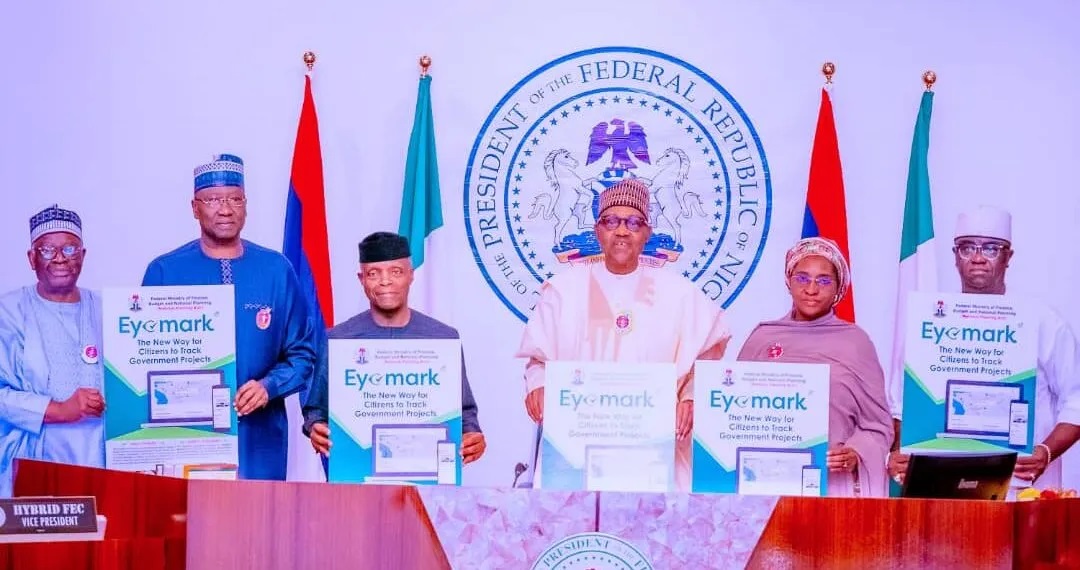
President Muhammadu Buhari, on Wednesday, before the commencement of the Federal Executive Council meeting, launched the National Monitoring and Evaluation platform, EYEMARK, for citizens to adequately and closely monitor projects executed by government.

He launched the project monitoring website (www.eyemark.ng) with its accompanying mobile app at the council chambers of the Presidential Villa, Abuja.
According to the President, the federal government can no longer depend on its handful of Monitoring and Evaluation teams to oversee the vast number of infrastructure projects spread nationwide.
According to him, it only makes sense to set up suitable channels for citizen scrutiny given that his administration has invested more in infrastructure projects than any previous government before it.
This, he said, will close the existing gaps and promote citizens’ participation in governance.

The President also blamed poor implementation of infrastructure projects across the country on corruption.
Buhari said with EYEMARK, “the status of projects, total amount appropriated and dispensed so far are now available in the public space.”
He urged Ministries, Departments and Agencies (MDAs) to cooperate with the coordinating ministry, Ministry of Finance, Budget and National Planning to avail th required information to be captured on the platform.
Earlier in his address, the Minister of State, Budget and National Planning, Clem Agba, explained that the EYEMARK will empower citizens and Civil Society Organisations to monitor capital projects realtime to promote accountability.
Agba pointed out that the platform makes use of a sizable network of citizens who can keep an eye on initiatives in their communities, warning however, that relying on the public comes with the risk of misinformation. He therefore, added that EYEMARK has been equipped with spatial technology to track images and to ascertain their origins.
“If a user is in Kaduna, we can determine the authenticity of the reviews. And we can know if the image was uploaded from the location the user claimed it was sent from,” he explained.
The Minister also revealed that the website and its accompanying app was developed by Nigerians of the average age of 24, with inputs from stakeholders and industry experts.
The council before going into closed door meeting, observed a minute silence for late Demola Seriki, who was a former Minister of Agriculture and Water Resoursces under the Umaru Yar’Adua administration.
Before his death on December 15, Seriki, 63, was Nigeria’s Ambassador to Spain.
In attendance were Vice President Yemi Osinbajo, Secretary to the Goverment of the Federation, Boss Mustapha, Chief of Staff to the President, Prof. Ibrahim Gambari, and Head of Civil Service of the Federation, Dr Folashade Yemi-Esan.
Also physically attending the meeting are Ministers of Finance, budget and national planning, Dr Zainab Ahmed; Works and Housing Babatunde Fashola; Attorney-General of the Federation and Minister of Justice, Abubakar Malami; Information and Culture, Lai Mohammed; Aviation, Hadi Sirika; Sports and Youth Development, Sunday Dare; Science and Technology, Olorunimbe Mamora; Police Affairs, Maigari Dingiyadi.
Others are Minister of States for Budget and National Planning, Clem Agba; Environment Sharon Ikeazor and Petroleum Resources, Timipre Sylva.
Joining virtually are the Ministers of Education Adamu Adamu; Communications and Digital Eonomy, Isa Pantami; Defence, Bashir Magashi; Mines and Steel Development, Olamilekan Adegbite; and his state counterpart Sen. Gbemisola Saraki; Humanitarian Affairs Disaster Management, Social Development, Sadiya Farouq; Foreign Affairs, Geoffrey Onyeama; Industry, Trade and Investment (State) Maryam Katagum.



Accelerating artificial intelligence (AI) adoption could increase Africa’s GDP by up to 4% over the next decade, according to the International Monetary Fund (IMF).

In a report released on Tuesday, titled Africa Can Grow Faster With AI—If It Moves Now, economists from the IMF’s Africa Department say current levels of AI adoption and utilisation are expected to contribute just 0.2% to the region’s GDP over the next 10 years.
However, the report says stronger adoption, supported by the right infrastructure and policies, could raise the economic impact to about 4% by extending AI beyond today’s digitally connected firms.
Martin Schindler and other IMF economists say: “AI adoption in sub-Saharan Africa currently lags well behind every other region. If richer economies race ahead while African firms and governments lag, the productivity gap between the region and the rest of the world will only widen.”
Early signs of AI adoption are emerging across Africa, with countries including Zimbabwe, Kenya, Egypt and Nigeria developing AI strategies.
Telecommunications operators, including Vodacom, Econet, Africell and MTN, are also integrating AI into their operations and networks.
Other examples include chatbots supporting teaching and learning in Nigeria and the South African Revenue Service’s use of data analytics for targeted tax audits.
However, the IMF says AI adoption must extend beyond these early use cases to deliver meaningful economic benefits.
“For the region, AI’s main promise is not about replacing office workers, but boosting productivity across the economy—helping informal firms manage inventory, enabling farmers to increase yields, and supporting mid-sized firms to transition to formality and export readiness,” the report reads.
The IMF is urging governments to prioritise investment in reliable electricity, affordable broadband, data infrastructure and digital skills to support wider AI adoption.
Many African countries, including Zimbabwe, Kenya, Ghana, Nigeria and Cameroon, continue to face electricity shortages, while broadband services remain costly and coverage is uneven.
The Fund believes stronger investment in power, connectivity, regional data infrastructure and digital skills would help unlock AI’s economic potential.


National Population Commission (NPC) has commenced the nationwide digital registration of births and deaths under the Electronic Civil Registration and Vital Statistics (E-CRVS) system to strengthen legal identity management and improve demographic data.

Speaking at a press briefing in Lokoja on Tuesday, Mr Afolabi Yori, federal commissioner representing Kogi, said the initiative became operational nationwide on July 1, through the VitalReg platform.
Yori described the development as a landmark in Nigeria’s civil registration system, noting that it would modernise birth and death registration through a technology-driven platform that meets international standards.
He said the digital platform would improve service delivery, strengthen data integrity and ensure that every birth and death occurring in Nigeria was accurately documented and securely stored.
According to him, civil registration is more than an administrative process, as it provides reliable statistics that support public policy formulation, resource allocation and national development planning.
“Nigeria records an estimated five million births annually, yet millions of births and deaths remain unregistered.
“Birth registration coverage currently stands at about 57 per cent nationwide, while death registration remains below 20 per cent,” he said.
The commissioner said that the commission had established 4,011 functional registration centres across the country’s 774 local government areas and was working to expand the number to about 8,000.
He added that the commission was strengthening collaboration with stakeholders to improve the capacity of registration personnel and ensure prompt documentation of vital events through the VitalReg platform.
Yori said the platform would provide faster registration services, 24-hour online access, digital certificate issuance where applicable, and reduce paperwork, waiting time and unnecessary travel.
He disclosed that the platform was being operated under a Public-Private Partnership with Barnks-forte Technologies Ltd. as the commission’s technical partner to ensure system availability, cybersecurity and continuous technological improvement.
He called on parents, healthcare institutions, traditional and religious leaders, civil society organisations, development partners and the media to support the initiative by encouraging the prompt registration of births and deaths.
Earlier, Samuel Omonakpeme, director in Kogi, NPC State, described the commencement of the digital registration system as another milestone in efforts to strengthen Nigeria’s Civil Registration and Vital Statistics system.
Omonakpeme stated that the initiative aligns with the Federal Government’s digital transformation agenda and the Sustainable Development Goals, particularly Goal 16.9, which seeks to provide legal identity for all.
He appreciated the Federal Government, the leadership of the commission, UNICEF and other development partners for supporting the implementation of the initiative.
The state director also urged parents, guardians, health institutions, community leaders, religious organisations and the media to mobilise public support for the timely registration of all births and deaths.
The News Agency of Nigeria (NAN) reported that ICT personnel of the commission, led by Ehimoni Kolawole, conducted a live demonstration of the digital birth registration process using the VitalReg platform.
The demonstration showed that the registration process captures the biodata of both parents, while at least one parent must possess a valid National Identification Number (NIN) to complete the registration of a newborn.
Yola Electricity Distribution Company (YEDC) has alerted its customers to a fraudulent message circulating on social media, falsely claiming that electricity consumers can receive an additional 20 per cent bonus units when recharging their prepaid meters through unofficial channels.

In a statement issued by the company’s management on Monday, YEDC described the claim as false and urged customers to disregard the misleading information, stressing that it did not originate from the company.
According to the statement, YEDC does not offer bonus electricity units through individuals, agents, personal bank accounts, phone numbers, or social media contacts.
The company advised customers to purchase electricity tokens only through approved cashless payment platforms, including the YEDC Pay App, OPay, Interswitch, and other authorised vending channels, or to visit the nearest YEDC office for assistance.
YEDC also cautioned customers against sharing their meter details or personal information, or making payments to unauthorised persons claiming to represent the company.
The company further urged customers to rely exclusively on information disseminated through its official communication channels to avoid falling victim to fraud.
The management thanked customers for their continued cooperation and reaffirmed its commitment to serving them.

NDIC Begins Payment to Depositors of 46 Failed Microfinance Banks

Telcos Seek Clear Regulatory Framework on Airtime Credit Services

FG Says Rumours, Fear, Can Crash Banks

MTN Warns Customers against Fake Promo

EU Debunks Fake Compensation Scheme Targeting West African Bank Customers

NRC, Ponzi Scheme Collapses Resulting Loss of Billions of Naira

NASENI Moves to Digitize CCB’s 5m Assets Declaration and Operations

Lebara Nigeria Launches Lebara Play, Africa’s First Telecom-Owned Micro-Drama Platform

Tokenization, Blockchain Technology will Transform Financial Institutions – IMF

EFCC Busts NIS Visa Overstay Racket, Uncovers N700m in an Account




 News3 days ago
YEDC Warns Customers, Says 20 Percent Electricity Bonus is Scam

 News3 days ago
PFIPC Probe: Dollar, Pounds Accounts of Fake Agency Inactive – CBN

 Broadcasting3 days ago
NBC, INEC, Plan Joint Broadcast Monitoring Framework ahead of 2027 Elections

 News3 days ago
STEM Africa Fest to Nurture Nigeria’s Future Innovators

 E-Financial3 days ago
No Going Back on July 31 Deadline for Insurance Firms’ Recapitalisation – NAICOM

 E-Business3 days ago
Jumia Nigeria Expands Flexible Payment Options with Klump Partnership

 E-Business3 days ago
Lagos Unveils N10m Single-digit Loan Scheme for MSMEs

 E-Financial3 days ago
Court Affirms FCCPC’s Power to Regulate Digital Lending