

Telecom
Global Internet Traffic Up as Video Dominates


Global internet traffic was up 23% in 2022, driven by an upsurge in streaming video usage and growth in traffic across app categories.

This is according to Sandvine’s 2023 “Global Internet Phenomena Report”, which provides details of the latest global app usage and internet traffic trends.
Sandvine indicates the report’s analysis is based on data from 177 service providers, representing nearly 300 million subscribers. It covers regions across the globe, namely the Americas, Asia Pacific, Europe, Middle East and Africa.
According to the report, Netflix, Microsoft, Alphabet (Google), Meta, Amazon and Apple are the biggest generators of internet traffic, producing nearly half of all internet traffic during the period under review. The big six firms generated nearly 48% of growing internet traffic in the first half of 2022, it reveals.
While the companies generate a substantial amount of overall internet traffic, Sandvine notes there’s a 9% decline in terms of their percentage contribution to total internet volume.
“This means their traffic is now couched amid an expanding number of app categories and greater number of apps, which are producing more data overall. This is contributing to the 23% increase in overall traffic volume we saw in our H12022 data.”
“Following the historic COVID-driven internet traffic surges of 2020 and 2021, the ‘new normal’ in application usage and volumes seems to be here to stay,” says Sandvine chief solutions officer Samir Marwaha.
“The rapid acceleration of digitisation led to an enhanced reliance on applications and a rapid evolution toward more sophisticated apps that fuse together multiple functions and features.”
In the report, Sandvine indicates the streaming and short-form video trend has become a catalyst for internet traffic growth.
Video from not only the big tech companies, but also up-and-comers like TikTok and Disney+, is contributing a sizable volume of traffic, it reveals.
Based on the analysis, video now accounts for 65% of all internet traffic. “Demand for video content is soaring, so most platforms are embedding and spreading video within apps to increase views and engagement.
“Our data shows in the first half of 2022, video accounted for a hefty 65.93% of total volume over the internet. That’s a 24% increase over H12021.”
Marwaha adds: “Video is almost to the point where it can no longer be considered a standalone category, as it’s now integral to conferencing, gaming, social networking, messaging, and virtually all apps that want to drive interactions and engagement.”
Looking at the rise of apps, Sandvine indicates there has been an increase in the number of apps, adding that apps have become more intricate.
It says this is leading to the demise of the web browser, as everything is becoming a web app, containing multiple web pages, feeds and functions – all within a single app.
“Within one app, you might have video, voice, chat and gaming content all in the same flow. For example, Uber is not a single app but rather a series of apps, such as Uber, Uber Eats, Uber Freight, Uber Same-Day Package Delivery, Google Maps, third-party geolocation services, GPS tracking and payment services.”
In addition, the report shows smartphone usage is reshaping app usage and internet traffic around the world.
“We see that time spent on mobile apps has grown from about three hours pre-pandemic, to a global average of about five hours per day, currently. People used their mobiles for things they had not previously used them for: viewing longer videos, video conferencing, file sharing, remote learning, delivery apps (groceries, goods, etc), gaming and more.
“In 1H2022, with people on the go again, some COVID-19 habits linger on, with video-watching and uploading content growing as people leave their homes and do more on the move. Video traffic now accounts for 67.60% of volume.”



OpenAI, the developer of ChatGPT, is reportedly in discussions to offer the U.S. government a five per cent equity stake in the company as part of efforts to address growing political and regulatory scrutiny surrounding artificial intelligence (AI).

According to a report by the Financial Times, the proposal is still at an early stage and would see other leading American AI companies consider similar arrangements to allow the public to benefit from the industry’s rapid growth.
OpenAI Chief Executive Officer, Sam Altman, was quoted as saying that public ownership would enable citizens to share in the economic benefits generated by AI while helping to build public trust in the technology.
Based on OpenAI’s March funding round, which valued the company at about 852 billion dollars, a five per cent stake would be worth approximately 42.6 billion dollars.
The report said the proposal comes amid increasing concerns over AI’s impact on jobs, national security and the concentration of wealth within a handful of technology companies.
Last month, U.S. President Donald Trump said his administration was exploring ways to ensure Americans benefit directly from the country’s leadership in artificial intelligence, including the possibility of government equity stakes in AI companies.
Under the reported proposal, OpenAI executives suggested that major AI firms could allocate five per cent of their equity to a public investment vehicle modelled after the Alaska Permanent Fund, which invests state oil revenues and distributes returns for public benefit.
The discussions are also taking place as OpenAI and rival AI company Anthropic prepare for potential stock market listings that would allow public investment in their businesses.
According to the report, implementation of such an arrangement could require approval by the U.S. Congress, while it remains unclear whether other AI companies would support the proposal.
OpenAI had previously advocated the creation of a “public wealth fund” that would give every citizen a stake in AI-driven economic growth, regardless of whether they participate in financial markets.
The proposal comes as the Trump administration intensifies oversight of advanced AI technologies while promoting U.S. leadership in the rapidly expanding sector.
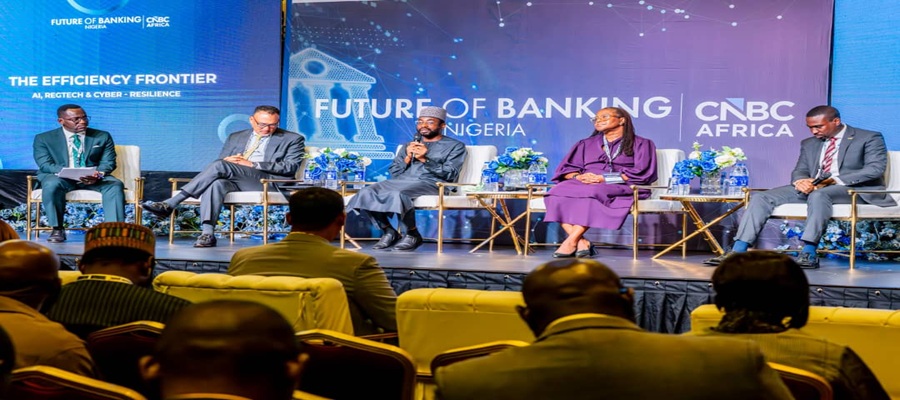
Kashifu Inuwa, director general of the National Information Technology Development Agency (NITDA), has said the next phase of growth for Nigeria’s banking sector will be driven less by capital accumulation and more by the ability of financial institutions to build digital trust through artificial intelligence (AI), regulatory technology (RegTech) and cyber resilience.

From left: Wole Famurewa, Ayotunde Coker, Managing Director, Rack Centre; the Director General of the National Information Technology Development Agency (NITDA), Kashifu Inuwa; Prof. Olayinka David West of Lagos Business School; and Femi Osinubi, Africa Advisory Leader, PwC, during the panel session, “The Efficiency Frontier – AI, RegTech and Cyber Resilience,” at the Future of Banking Nigeria Summit organised by CNBC Africa in Lagos.
Speaking during a panel session titled “The Efficiency Frontier – AI, RegTech and Cyber Resilience” at the Future of Banking Nigeria Summit organised by CNBC Africa in Lagos, Inuwa argued that while Nigeria’s banking industry has successfully weathered major reforms over the past two decades, the emerging threats confronting the sector require a different approach.
He noted that the industry has repeatedly demonstrated resilience through landmark milestones such as the 2005 banking consolidation, the 2009 banking reforms and the ongoing recapitalisation exercise. According to him, the priority has now shifted from simply raising capital to ensuring that such capital is protected and sustained in an increasingly digital economy.
“Today’s question is no longer whether we can raise capital, but whether we can protect, preserve and grow that capital in the digital era. Trust has become the foundation of modern banking, and that trust must be built on resilient digital infrastructure and effective regulation,” he said.
Inuwa observed that digital channels have become the primary point of interaction between banks and customers, making technology resilience, cybersecurity and uninterrupted service delivery essential to maintaining public confidence in the financial system.
He described artificial intelligence as a strategic tool capable of transforming banking operations by improving productivity, strengthening decision-making, boosting revenue and delivering personalised financial services that reflect the expectations of digitally connected customers.
The DG also highlighted the growing importance of regulatory technology, saying its adoption can simplify compliance, lower operational costs, improve transparency and strengthen governance across financial institutions.
According to him, effective regulation must evolve alongside innovation. He explained that NITDA combines formal regulatory instruments with collaborative, innovation-friendly approaches that allow emerging technologies to develop while regulators establish appropriate standards and safeguards.
“Technology evolves much faster than traditional regulation. Regulators must work closely with innovators to create enabling frameworks that encourage innovation while protecting consumers and maintaining market confidence,” he said.
Using Nigeria’s thriving fintech ecosystem as an example, Inuwa said technology has fundamentally changed the delivery of financial services by enabling customers to open accounts, access banking products and carry out transactions remotely without visiting physical branches.
He further called for closer collaboration among regulators to improve access to finance for Small and Medium-sized Enterprises (SMEs). He explained that AI-powered credit assessment and digital financial management tools can help financial institutions better understand business performance, reduce lending risks and expand credit to underserved enterprises.
On responsible AI adoption, Inuwa disclosed that NITDA’s National Artificial Intelligence Strategy provides a framework for deploying AI across critical sectors in partnership with sector regulators, including the Central Bank of Nigeria (CBN) for financial services.
He added that the Agency is also developing National Standards for Sovereign Cloud infrastructure and data classification to strengthen Nigeria’s digital sovereignty and ensure that sensitive national and financial data remain adequately protected.
Inuwa concluded that deeper collaboration among regulators, technology innovators and financial institutions will be critical to building a secure, resilient and globally competitive financial ecosystem that supports sustainable economic growth.

Indian government has asked Meta Platforms to suspend the rollout of WhatsApp’s proposed username feature in the country over fears that it could fuel online fraud, impersonation and phishing attacks.

The directive, issued by the Ministry of Electronics and Information Technology (MeitY), comes days after WhatsApp announced plans to introduce usernames globally, allowing users to connect without sharing their phone numbers in a move aimed at enhancing privacy.
India, WhatsApp’s largest market with more than 500 million users, expressed concern that the feature could make it easier for cybercriminals to impersonate individuals and organisations, particularly among users with limited digital literacy.
According to media reports, the ministry, in a letter to Meta, warned that the feature could increase incidents of online fraud, phishing, digital arrest scams and identity theft.
A senior government official was quoted as saying that malicious actors could claim usernames resembling those of legitimate individuals and use them to deceive unsuspecting users.
The ministry has reportedly asked Meta not to launch the feature in India until consultations with the government are concluded and the company provides satisfactory explanations on the safeguards built into the system. Authorities have also asked WhatsApp to respond to the concerns within three days.
Responding to the concerns, Meta said the username feature had not yet gone live in India and stressed that multiple security measures had been incorporated to prevent abuse.
The company said usernames for high-profile public figures and verified organisations had already been reserved to prevent impersonation.
Meta added that users would still require a phone number to register for WhatsApp and that the platform had introduced several layers of protection, including limits on messaging unknown users, restrictions on repeated attempts to guess usernames, and systems to detect and remove impersonation and scam-related activities.
The latest development comes as India intensifies efforts to combat cybercrime amid a sharp rise in digital fraud cases across the country.
Government data indicate that financial losses from cyber fraud have risen significantly in recent years, prompting closer scrutiny of digital platforms and their security features.

Court Declares Keystone Bank Staff Wanted over Alleged N35m Fraud

IMF Raises Concerns over N8.83 Trillion Unreported Spending in Nigeria’s Budgets

NOTAP to Commercialise University Research, Expands Patent Drive

FG Unveils Digital Postcode System for MDAs

BoI, NBCC Sign MoU to Deepen Bilateral Trade, Industrial Growth and Investment

Mobile Internet Gender Gap Widest in Africa – GSMA

London Strengthens Global Investment Ties with Africa @ First Ever London-Africa Business Summit

FG Targets Alleged N3tn Capital Flight, Opens Airtime Credit Market to Nigerian Fintechs

Japan, UNESCO Boost Digital Learning in 15 CoEs with Donation of ICT Equipment

Nigeria Launches FreeTV Nationwide




 News3 days ago
Verve Strengthens Global Acceptance Across Leading Digital Platforms

 News3 days ago
Army Says Terrorists Now Recruiting, Raising Funds Online

 Telecom3 days ago
Lebara Nigeria Becomes Member of GSMA Network

 E-Business3 days ago
Kaspersky Warns of The Gentlemen Ransomware Group Expanding Operations with New Malware

 Telecom3 days ago
Airtel Nigeria Deepens Focus on Data Usage Transparency @ Customer Forum

 Telecom2 days ago
MTN Foundation, Microsoft Empower Nigerian Educators with AI Integration Skills

 Telecom3 days ago
Vitel Wireless Warns Public, Says it Not Running any Investment Scheme

 E-Financial3 days ago
Bank of Industry Appoints Kuramo Capital as Manager of Dice Fund of Funds