

News
Ekeh, Nigerian Tech Visionary Donates Modern Tech Centres to IMSU, St. Augustine University


Leo Stan Ekeh, who is on Forbes Best of Africa leading Tech Icon and chairman of Zinox Group, Africa’s largest ICT conglomerate, has donated a state-of-the-art training centre to Imo State University (IMSU), Owerri and St. Augustine University Epe, lagos state.

The philanthropist has been on a mission to empower future generations.
Both centres named the Leo Stan Ekeh Foundation (LSEF) Centre, was unveiled on Thursday, April 4, at a grand ceremony held at the respective institutions.
The two events were graced by their respective Vice Chancellors, DVCs, Senate and Council Members and very esteemed academics of the respective institutions.
The LSEF Centre at Imo State University is poised to offer a range of training programs tailored to meet the evolving needs of today’s workforce.
These programs include the Finishing School, Entrepreneurship Boost Training, and specialized courses in Technology and Artificial Intelligence viability.
By equipping students with these essential skills, the centre aims to prepare them for success in their chosen fields and foster a culture of innovation and entrepreneurship.
The LSEF Centre, IMSU shall connect with achieved private sectors leaders across the world who shall with the power of technology deployed at the centre inspire and instigate success revolution in Imo state.
Select students shall have the opportunity to develop well-rounded skillsets that will propel them towards success in their chosen career paths.
Prof. U. U. Chukwumaeze (SAN), Vice Chancellor of IMSU who was full of praises for Dr. Leo Stan Ekeh for executing futuristic knowledge centre.
He also informed the full house how Dr. Ekeh intervenes every time they needed help and even recently, he intervened with large number of computers for the institution to scale Accreditation
Also, Prof. Gloria Ernest Samuel, director of the LSEF Centre, said that Dr. Ekeh paid attention to details in setting up the centre including chatting with her on Saturdays and Sundays.
It was a privilege to experience this tech Entrepreneur.
He adds style to details, and this is why the feel of the centre is right. He will always stress that he was interested in content and not brick and mortar
The St. Augustine University centre, Epe in Lagos is a great display of the power of technology equipped with top of the range of All-in-One Zinox computers, tablets, smart boards etc.
In his vote of thanks at the launch of the centre, Prof Christopher Odetunde, Vice- Chancellor, talked about spirituality of commitment from Dr. Leo Stan Ekeh to lift the younger ones. This was a recent promise kept beyond our expectation and prayed that the country should be filled with persons like Dr. Ekeh.
Dr. Steve Omojiafor, chairman of Board of Trusties of the institution, who recounted Dr. Ekeh quiet style of interventions said he was sure Dr. Ekeh shall remember the institutions one day in his philanthropic ventures and I am very happy he has and prayed God to continue to bless him more.
The most interesting part of commissioning the two centres sameday, within same time was the use of quality Artificial Intelligence deployed at these centres and remotely powered from Zinox Group Head quarters(Yudala Heights) on Idowu Martins street, Victoria Island where Dr. Ekeh was sitting and monitoring happenings at the two campuses and delivered his short speeches.
He was consistent with his statement -that he was determined to build a new generation of Nigerians who shall have the capacity to alter their destinies and defend their wealth.
He also assured both institutions management that he shall turn the centres in two years as completed AI powered centres so that every student before matriculate must spend eights hours at these centres.
Leo Stan Ekeh’s philanthropic gesture underscores his unwavering commitment to advancing education and empowering the youth.
Through the LSEF Centre, he seeks to provide students with access to high-quality training and mentorship, thereby enabling them to unleash their full potential and contribute meaningfully to society.
Leo Stan Ekeh is a true pioneer in the Nigerian and African technology space. He has earned an indelible reputation for his visionary leadership and dedication to advancing the continent’s digital infrastructure. His accomplishments extend far beyond the LSEF centre donation.
Notably, Mr. Ekeh spearheaded the team that delivered the largest single ICT project in Africa, a testament to his unwavering commitment to technological advancement.
As the chairman of Zinox Group, Africa’s largest ICT conglomerate, he has spearheaded numerous groundbreaking initiatives which have revolutionized the continent’s technological landscape.
Mr. Ekeh is a renowned philanthropist and a strong advocate for youth empowerment.
Through the Leo Stan Ekeh Foundation, he actively supports initiatives that bridge the digital divide and equip young people with the skills they need to thrive in the 21st century.
Speaking about the initiative, Leo Stan Ekeh expressed his profound belief in the power of education to transform lives and drive socio-economic development.
He emphasized the importance of equipping students with relevant skills and competencies to thrive in today’s fast-paced world.
“This centre embodies my deep commitment to nurturing the talents of our young people. By equipping them with the necessary skills and knowledge, we can empower them to become the architects of a brighter future for Nigeria and Africa,” he said.
Through this philanthropic initiative, Mr. Ekeh hopes to inspire a new generation of innovators and entrepreneurs.
The LSEF Centre serves as a beacon of opportunity, empowering students at Imo State University to unlock their full potential and contribute meaningfully to Nigeria’s future.
The establishment of the LSEF Centre marks a significant milestone in Imo State University’s journey towards academic excellence and innovation.
As the university continues to strive for excellence, the LSEF Centre will serve as a beacon of hope and opportunity for generations of students to come.


News
The Nigeria Prize for Science & Innovation Records New Height as 2026 Edition Attracts 237 Entries

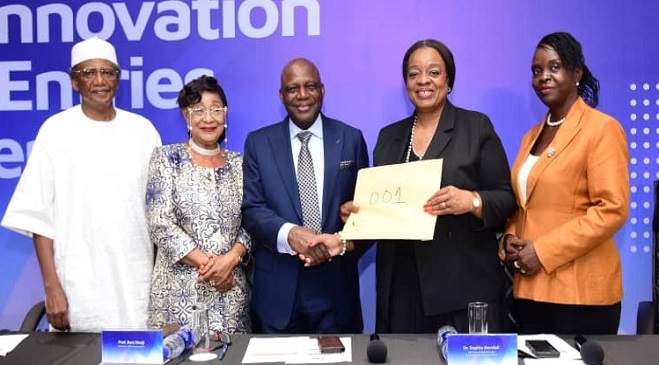
For the first time since it was established in 2004, the 2026 edition of The Nigeria Prize for Science and Innovation has recorded an historic milestone, attracting a record-breaking 237 entries.

The submissions were formally handed over to the Prize’s Advisory Board at a press conference in Lagos on Thursday, marking the start of the adjudication process.
The handover marks the beginning of the search for Nigeria’s most innovative scientific mind, under the theme “Innovations in ICT, Artificial Intelligence (AI), and Digital Technologies for Development.” The theme was a deliberate retention from the 2025 edition, which concluded without a winner after no entry met the required standard for selection.
Speaking at the press conference, Sophia Horsfall, NLNG’s General Manager, External Relations and Sustainable Development, said the continued focus on digital technologies reflects both global trends and Nigeria’s development priorities. She noted that the Prize remains a platform for identifying solutions with real-world relevance.
“In this fourth revolution, digital infrastructure is as foundational to our survival as electricity or water. For Nigeria, our economic sustainability depends on our ability to move beyond promising research and into undeniable innovation that delivers,” she said.
She added that global recognition for Nigerian innovation must be earned through stringent standards. “We believe that if a Nigerian discovery is to command global respect, it must withstand the highest levels of scrutiny. It is this conviction that guided the difficult decision seven months ago”.
While acknowledging the level of interest the theme continues to attract, Horsfall maintained that expectations remain uncompromising, noting that only solutions demonstrating real impact and scalability will be considered. She added that the decision not to award a winner in 2025 reflects this commitment and sets the benchmark for the current adjudication process.
Receiving the entries, Chairman of the Advisory Board, Barth Nnaji, described the handover as a decisive stage in the Prize’s selection process, emphasising that its credibility is anchored on strict standards of excellence. He reaffirmed that the Prize remains focused on identifying innovations that translate scientific insight into tangible socio-economic outcomes.
“Our refusal to award the prize in 2025 was not a dismissal of the hard work of Nigerian innovators; rather, it reinforces that The Nigeria Prize for Science and Innovation holds a gold standard of excellence,” he stated.
He further clarified that the outcome of the 2025 edition, in which no winner was declared, should be viewed within the context of the Prize’s rigorous evaluation framework, which demands novelty, depth, relevance, and demonstrable impact. He emphasized that all entries will continue to be subjected to the same high level of intellectual and technical scrutiny.
Professor Nnaji added that the Prize seeks solutions that directly address Nigeria’s real-world challenges. “Our broader objective is to identify work that brings tangible impact to the challenges Nigeria faces, whether through digital health technologies that serve rural populations or the use of AI in preserving our cultural heritage and languages.”
Other members of the Board are Chief Dr. Nike Akande, a two-time former Minister of Industry, and Professor Baba Yusuf Abubakar, a professor of quantitative genetics and animal breeding.
The Nigeria Prize for Science and Innovation, now in its 22nd year, is valued at $100,000 and remains arguably Africa’s most prestigious science award. The winning entry for the 2026 edition will be unveiled at a world press conference scheduled for September.


Federal government, in partnership with the World Bank, has launched a fresh $65 million funding phase of the Sustainable Procurement, Environmental and Social Standards Enhancement (SPESSE) project aimed at benefiting more than 24,000 Nigerians through professional training and institutional capacity development.

The initiative, coordinated by the National Universities Commission (NUC), is designed to strengthen procurement systems, environmental management and social standards across public and private institutions, while promoting transparency, accountability and sustainable development practices nationwide.
Abdullahi Ribadu, executive secretary of the Commission, disclosed this in Abuja during the signing of performance contracts for the additional SPESSE financing. He explained that the intervention builds on the gains of the initial $80 million SPESSE project, which became effective in 2021.
According to Ribadu, the programme has significantly improved institutional frameworks and developed professional expertise in key governance sectors. He noted that the initiative was introduced to address the shortage of qualified professionals in procurement, environmental management and social standards within both public and private institutions.
He said: “With the support of the World Bank and under the coordination of the NUC, six centres of excellence were established across the six geopolitical zones to provide sustainable capacity building in these critical sectors”.
Ribadu stated that the participating universities were selected through a transparent and competitive process based on institutional readiness, quality assurance and sustainability.
He added that the institutions have continued to produce skilled manpower capable of advancing transparency, environmental responsibility and inclusive national development.
He described the contract signing ceremony as a renewed commitment to accountability, sustainability and institutional excellence, noting that the centres have recorded major achievements, including the introduction of specialised academic programmes ranging from short courses to undergraduate and postgraduate degrees.
The NUC boss further disclosed that three of the six centres have already commenced PhD programmes, while the remaining centres are expected to begin by July 2026.
He added that under the new funding phase, the Commission targets at least 60 PhD graduates, enrolment of 60 foreign students, staff internships and expanded student exchange programmes with international institutions.
Also speaking, Adebowale Adedokun, director-general, Bureau of Public Procurement (BPP), said the project has so far trained more than 2,700 officers from both the public and private sectors to improve procurement competence nationwide.
He said the next phase would support the rollout of Nigeria’s electronic procurement system and expand online capacity-building programmes for policymakers and small and medium-scale enterprises involved in managing public funds.
On his part, Ishtiak Siddique, World Bank Task Team Leader for SPESSE, revealed that more than 40,000 participants had benefited from training under the original project, with over 4,000 certified in procurement, environmental and social standards.
Siddique said the additional funding would focus on strengthening the capacity of federal, state and local government agencies to improve development outcomes and service delivery, stressing that sustainability remained central to ensuring continuity beyond donor support.
For her part, Prof. Folasade Ogunsola, Vice-Chancellor, University of Lagos, reaffirmed the institution’s commitment to advancing professional capacity development under the SPESSE framework through postgraduate training, institutional ownership and international collaborations.

Kaspersky has expanded its Kaspersky Interactive Protection Simulation (KIPS) with new advanced cyberattack scenarios tailored specifically for IT organisations.

The update introduces realistic simulations of deepfake-enabled fraud, supply chain compromise, trusted relationship attacks and destructive wiper malware, helping businesses test their preparedness against today’s complex threat landscape.
IT companies remain one of the most attractive targets for cybercriminals. As attackers increasingly combine social engineering, supply chain manipulation and ransomware tactics, organisations require hands-on, strategic training that reflects real-world attack dynamics.
Kaspersky Interactive Protection Simulation is designed to bridge the communication gap between CISOs, IT teams and top management. By immersing participants in realistic cyber crisis scenarios, KIPS demonstrates the operational and business impact of attacks in an accessible, engaging format.
Real-world attacks in a realistic simulation environment
The updated IT-focused scenario in KIPS exposes participants to modern attack techniques observed by Kaspersky experts in active malicious campaigns targeting the IT sector.
Participants may face:
Binary Backdoor in the Build – a supply chain attack that compromises software during signing, packaging or distribution stages. Once deployed, the tampered product enables data theft, persistent remote access and the compromise of trusted customers downstream.
DeepFake Boss – a social engineering campaign leveraging AI-generated video and voice impersonations of corporate executives to manipulate finance teams into initiating unauthorised payments.
Trusted Relationship Attack (VPN) – exploitation of third-party access and remote connectivity tools to infiltrate corporate environments through contractors or service providers.
Wiper Attack (Babuk) – a destructive malware scenario based on leaked Babuk ransomware code. This scenario tests resilience against irreversible data corruption combined with ransomware deployment. In the simulation, if players fail to contain the attack in time, data becomes encrypted, forcing a complete rebuild from scratch.
IT companies can now choose between two dedicated attack scenarios, testing coordination, crisis management and decision-making under pressure. KIPS is available in both live (up to 100 participants) and online (up to 1,000 trainees) formats and provides detailed analytics on participants’ decisions, team coordination and benchmarking against previous sessions.
“To stay secure, organisations need a layered defence strategy that combines technology, processes and people. But investing in tools alone is not enough. Cyber resilience depends on awareness, coordination and the ability to respond effectively under pressure,” comments Svetlana Kalashnikova, Security Awareness expert at Kaspersky.
“Kaspersky Interactive Protection Simulation, a part of a comprehensive Security Awareness offering, helps organisations experience real-world attack scenarios in a controlled environment, strengthening decision-making, cross-team collaboration and executive understanding of cybersecurity risks. By transforming complex threats into practical learning experiences, we empower companies to build stronger, more resilient security cultures.”

Gozi-Anyaokei, Bank MD Arraigned over Alleged N19m, $30,000 Fraud

NDIC Drags Wema Bank to Court over N125.38Bn Banana Island Assets

Chamber Raises Alarm over Increasing Telecoms Infrastructure Vandalism

UK Reaffirms Development Partnership with Kano, Jigawa States

The Nigeria Prize for Science & Innovation Records New Height as 2026 Edition Attracts 237 Entries

Vitel Wireless Partners Fintechs to Expand Access to Services

MTN, VDT, Zoracom, Digital Realty Back 2026 Girls in ICT Campaign

Kaspersky Discovers Vulnerability in Qualcomm Snapdragon Chips that can Lead to Data Loss & Device Compromise

MTN Suspends Data, Airtime Borrowing Service over New FCCPC Lending Rules

Bank Customers to Pay N1,500 for ATM Card Issuance, Replacement – CBN




 General News2 days ago
PalmPay, LASUBEB Deepen Efforts to Keep More Children in School

 News2 days ago
National Assembly to Review National Data Protection Act

 E-Financial2 days ago
CBN Warns Non-Interest Banks against Governance, Compliance Risks

 E-Business2 days ago
Firm Shares Insights into Ransomware Trends and Tactics @ International Anti-Ransomware Day-2026

 E-Financial2 days ago
FG Seeks Fresh $1.25Bn Loan from World Bank to Create Jobs, Others

 E-Financial2 days ago
Fidelity Bank Hits N1trn Milestone as Earnings Surge 45%

 Telecom2 days ago
ATCON Says Telecom Network Under Threat, Urges Stronger Efforts to Protect Infrastructure

 E-Financial2 days ago
Ecobank Group Announces $3b Trade Finance Commitment to Boost Intra African Trade