

/home/kenneth/web/nigeriacommunicationsweek.com.ng/public_html/wp-content/themes/zox-news/parts/post-single.php on line 153
">
Warning: Undefined array key 0 in /home/kenneth/web/nigeriacommunicationsweek.com.ng/public_html/wp-content/themes/zox-news/parts/post-single.php on line 153
Warning: Attempt to read property "cat_name" on null in /home/kenneth/web/nigeriacommunicationsweek.com.ng/public_html/wp-content/themes/zox-news/parts/post-single.php on line 153
Broadband Must Be Recognized As a Vital Development Enabler

UN Broadband Commission for Digital Development which met in Dublin this weekend has said that access to broadband could be the universal catalyst that lifts developing countries out of poverty and puts access to health care education and basic social services within reach of all.
The Commission reiterated its call to International community to recognize the transformational potential of high-speed networks and ensure broadband penetration targets are specifically included in the UN post-2015 Sustainable Development Goals.
It also urged governments and international financing bodies to work to remove current barriers to investment.
Globally, as much as 95% of telecommunications infrastructure is private sector-funded, but better incentives are urgently needed if investment is to expand in line with the coming exponential growth of connected users and so-called ‘Internet of Things’ data streams.
In the world’s 200 biggest cities, the number of connected devices is forecast to increase from an average of 400 devices per square kilometre to over 13,000 devices per square kilometre by 2016.

The Commission, which includes some of the world’s most prominent leaders from the tech sector, government, academia and UN agencies. gathered in Dublin at the invitation of Denis O’Brien, Chairman of the Digicel Group and one of the founding members of the group.
Established in 2010, the Commission is a top-level advocacy body which focuses on strategies to make broadband more available and affordable worldwide, with a particular emphasis on accelerating progress towards the eight UN Millennium Development Goals.
It is chaired by President Paul Kagame of Rwanda and Mexico’s Carlos Slim Helú, with Dr Hamadoun I. Touré, ITU secretary-general; and Irina Bokova, UNESCO director-general as co-vice chairs.
“The long-sought panacea to human poverty may at last be within our reach in the form of broadband networks that empower all countries to take their place in the global economy, overcoming traditional barriers like geography, language and resource constraints,” said O’Brien, whose companies provide mobile services in some of the world’s most challenging environments and disadvantaged countries, such as Haiti and Papua New Guinea.
To drive faster broadband roll-out, O’Brien called on governments to lower spectrum license fees and advocated for the establishment of a ‘champion’s league’ index that tracks best practice in broadband investment and deployment.
In his welcoming remarks, Rwanda’s President Kagame noted that broadband and ICTs can deliver more efficiency in education, health, finance, banking and other sectors.
“In Rwanda, the broadband model we have adopted is based on effective public private partnership, guided by what works on the ground,” he said. “This has allowed broadband and ICT to continue to play an important role in the progress we have made towards the achievement of the Millennium Development Goals.” Rwanda is currently rolling out a nationwide 4G mobile broadband network through a public private partnership.
Kagame urged commissioners to go beyond infrastructure and work to ensure its use: “Our initial focus was on connectivity: to put the infrastructure and tools in place to connect citizens to the digital era. Onwards, our efforts need to focus on unleashing the smart use of broadband to help people use services in ways that will significantly improve their lives.”
Uptake of ICT is accelerating worldwide, with mobile broadband recognized as the fastest growing technology in human history.
The number of mobile phone subscriptions now roughly equals the world’s total population of around seven billion, while over 2.7 billion people are online.
Active mobile broadband subscriptions now exceed 2.1 billion – three times higher than the 700 million wireline broadband connections worldwide.
Most encouragingly, most of this progress has taken place in the developing world, which has accounted for 90% of global net additions for mobile cellular and 82% of global net additions of new Internet users since early 2010, when the Commission was set up.
“That translates to 820 million new Internet users and two billion new mobile broadband subscribers in developing countries in just four years,” said. Touré, who urged Commissioners to consider defining a Broadband for MDGs Acceleration Framework which could be presented for endorsement to the UN Secretary-General at the next meeting of the Commission in New York in September, ahead of the UN General Assembly.
“For the first time in history, broadband gives us the power to end extreme poverty and put our planet on a new, sustainable development course,” he said.
In 2011, the Commission set four ambitious broadband policy and access targets. The seventh meeting of the Commission, held in Mexico City in March 2013, added a fifth target mandating ‘gender equality in broadband access by the year 2020’, aimed at redressing gender imbalances in access to information and communication technologies.
“Broadband can be an accelerator for inclusive and sustainable growth, by opening new paths to create and share knowledge, by widening learning opportunities, by enhancing freedom of expression,” said UNESCO’s Irina Bokova.
“But this does not happen by itself, it requires will and leadership, and this is why the Commission matters.”
In addition to broadband and UN sustainable development goals, the agenda of the Dublin meeting covered the changing role of telecom operators and content providers, and innovative solutions for rolling out rural broadband.
The gathering also included a meeting of the newly-formed Working Group on Financing and Investment, held on Saturday 22 March.
At that meeting, Commissioners discussed the urgent need for new strategies to finance the massive new investment in telecoms networks needed to cope with a forecast huge surge in mobile data volumes.
“The MDGs constitute the attainment of basic human rights for billions of people around the world,” noted Carlos M. Jarque, who attended the meeting as the representative of Co-Chair Carlos Slim.
“The MDGs and emerging Sustainable Development Goals are the foundation for eliminating extreme poverty in the third decade of this new century. It is a fact that broadband can make a tremendous contribution towards their attainment. But in many countries, the telecommunication infrastructure now needs to be doubled every year. No other sector is facing a similar capex investment challenge. We need to identify viable new operating and financing models.”
Last September at the eighth meeting of the Commission in New York, the group released the second edition of its global snapshot of broadband deployment, entitled The State of Broadband 2013 Universalizing Broadband, featuring country-by-country rankings based on access and affordability.
In that report, Ireland ranked 35th out of 183 economies for fixed broadband access, 19th out of 170 economies for mobile broadband access, and 31 out of 192 economies in terms of percentage of inhabitants using the Internet (79%).


Warning: Undefined array key 0 in /home/kenneth/web/nigeriacommunicationsweek.com.ng/public_html/wp-content/themes/zox-news/parts/post-single.php on line 493
Warning: Attempt to read property "cat_ID" on null in /home/kenneth/web/nigeriacommunicationsweek.com.ng/public_html/wp-content/themes/zox-news/parts/post-single.php on line 493

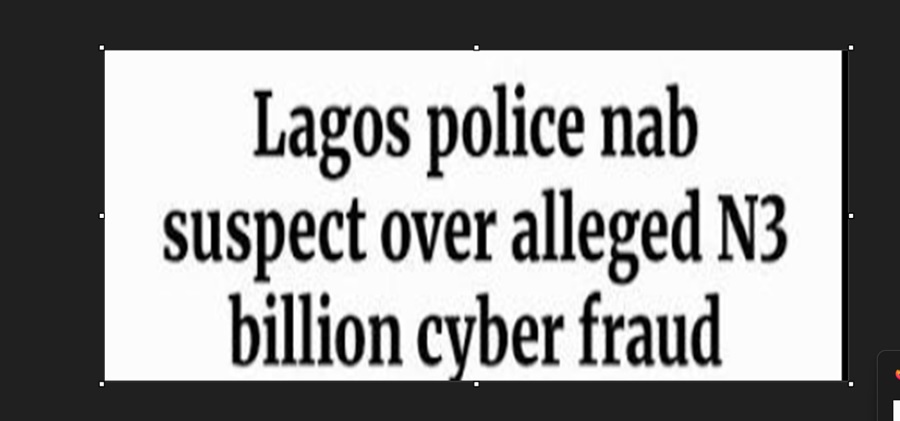
Police Special Fraud Unit (PSFU), Ikoyi, Lagos, said its operatives have busted a syndicate who used Point of Sale (POS) terminals and other technological tools to gain access to financial institution’s database to steal more than N3 billion.

Police did not name the financial institution where the money was stolen but DSP Ovie Ewhubare, spokesperson for the Unit, in a statement Friday, said that while a member of the syndicate has been arrested, other remained at large.
The PSFU spokesperson said the suspect was apprehended following an extensive investigation into a sophisticated cyber intrusion targeting a financial institution.
“The members of the syndicate allegedly used Point of Sale (POS) terminals and other technological tools to gain unauthorised access to the financial institution’s database.
“The breach enabled the suspects to initiate fraudulent transactions worth more than N3 billion,’’ he said.
According to him, investigations reveal that the proceeds of the alleged fraud are quickly laundered through multiple bank accounts in an attempt to conceal the source and movement of the funds.
The spokesperson said that the detectives deployed advanced digital forensic techniques and financial analysis to trace the transactions, identify members of the syndicate and recover key evidence to support prosecution.
Ewhubare said that Mr Eloho Okpoiakpo, commissioner of Police in charge of the PSFU, commended the investigating team for its professionalism in uncovering the alleged fraud.Law Enforcement
He said that Okpoiakpo directed the detectives to intensify efforts to apprehend other fleeing members of the syndicate, assuring that every effort would be made to bring all those involved to justice.

MTN Nigeria is accelerating investments in network expansion and modernization to address rising demand for mobile and data services across the country.

The operator is deploying additional base stations, upgrading existing infrastructure, and expanding fiber connectivity to improve network capacity, coverage, and service quality.
The investments are designed to support increasing smartphone adoption, higher data consumption, and the growing use of digital services by consumers and businesses.
MTN said the expansion aligns with its long-term strategy to enhance customer experience while strengthening Nigeria’s digital infrastructure.
The company expects the ongoing upgrades to improve connectivity, support economic growth, and enable broader access to reliable telecommunications services as demand for high-speed broadband continues to increase.

Chinonso Akujobi, former staff of Access Bank in Lagos, has been remanded in Ikoyi prison after she was arraigned on a five-count charge bordering on stealing to the tune of N294.5m.

Akujobi who is being prosecuted by the Economic and Financial Crimes Commission (EFCC) was arraigned before Justice I.O. Ijelu of the State High Court sitting in Ikeja, Lagos.
EFCC alleged that Akujobi stole the money between January and December 2025 while under the employment of Access Bank Plc.
As stated in one the charges, the defendant stole the money through unauthorized payments from the general ledger of Access Bank to her account number 0036668871 with the name Chinonso A., Uchechi A. and Florence A., thereby committing an offence of stealing, contrary to Section 280 and punishable under Section 287 of the Criminal Law of Lagos State, 2015.
The defendant pleaded “not guilty“ to the charges when they were read to her.
In view of this, S.M.Yabo, prosecution counsel, asked the court for a trial date and also prayed for the remand of the defendant in a Correctional centre.
Justice Ijelu, thereafter, adjourned the case till October 8, 2026, for the hearing of the bail application and the commencement of trial.
The Judge also ordered that the defendant be remanded in the Ikoyi correctional Centre.

Police Busts Syndicate Who Allegedly Stole N3Bn from Financial Institution

MTN Accelerates Network Expansion to Meet Surging Telecom Demand

Court Remands Akujobi, Ex Access over alleged Theft of N294.5m

TeKnowledge, Equinix Partner to Advance Nigerian Digital Infrastructure

NSIB Faults Runway Identification, Reveals Cockpit Disagreement in Asaba Jet Incident

NASENI Moves to Digitize CCB’s 5m Assets Declaration and Operations

Mobile Internet Gender Gap Widest in Africa – GSMA

Nigeria Launches FreeTV Nationwide

Lebara Nigeria Launches Lebara Play, Africa’s First Telecom-Owned Micro-Drama Platform

CANAL+ Partners Samsung to Pre-Load DStv Stream on New Samsung TVs In Nigeria, Other African Countries




 Telecom3 days ago
NCC Seeks Cost-Based Pricing Framework for Ducts

 E-Financial3 days ago
CBN Warns against Rejection of N100 Banknotes

 Telecom2 days ago
Fixed Wired Internet Market Lags as Mobile Gains Ground

 News3 days ago
Flutterwave Secures Circle Ventures Investment to Deepen USDC Payment

 Telecom3 days ago
Meta Introduces Muse Image With Advanced AI Image Editing Across WhatsApp and Instagram

 News3 days ago
How EFCC Turned Recovered Loot Into School Supplies for Thousands of Nigerian Students

 E-Financial3 days ago
BVN Enrollments Hit 69.55m- NIBSS

 News2 days ago
Study Reveals How Moniepoint is Powering Nigeria’s $11Bn Food Service Sector