

/home/kenneth/web/nigeriacommunicationsweek.com.ng/public_html/wp-content/themes/zox-news/parts/post-single.php on line 153
">
Warning: Undefined array key 0 in /home/kenneth/web/nigeriacommunicationsweek.com.ng/public_html/wp-content/themes/zox-news/parts/post-single.php on line 153
Warning: Attempt to read property "cat_name" on null in /home/kenneth/web/nigeriacommunicationsweek.com.ng/public_html/wp-content/themes/zox-news/parts/post-single.php on line 153
Nigeria Becomes 26th Largest Economy in the World

Nigeria has moved up 11 steps to number 26th largest economy globally ahead of South Africa, following the outcome of the reclassification of the based year of the Gross Domestic Product (GDP) from 1990 to 2010.
The country’s GDP increased by 75.58 per cent from $258.55 billion before the rebasing to $453.96 billion.
The new GDP places Nigeria ahead of countries like Austria with $394.7 billion; Venezuela with $381.26 billion as well as Columbia, Thailand, Denmark, Malaysia and Singapore among others which has $369.6 billion, $$365.96 billion, $$314.88 billion, $274.7 billion and $269.86 billion respectively.
On the continent, Nigeria now ranks number one ahead of South Africa which currently has a GDP of $384.3 billion.
The result of the rebasing of Nigeria’s GDP, the first in almost 25 five years, confirm that the country’s economy has grown in total value and undergone significant changes, including substantial diversification in May sectors especially in the last 10 years.
Dr Yemi Kale, statistician general of the Federation who announced the new GDP figures yesterday in Abuja, noted that the results reveal better diversification of the Nigerian economy than earlier reported.
One of the major changes identified is the noticeable shift in the share of key sectors to the country’s overall GDP.
An example is the decline in the share of agriculture sector which dropped to 24 per cent while the share of the Services sector rose to 50.2 per cent.
In the 1990 nominal series, agriculture contributed 30 per cent to the GDP while the industry contributed 46.1 per cent and services sector contributed 23.6 per cent.
According to Kale, even though agriculture is growing in terms of total value and jobs created, the rise in the contribution of services sector such as the telecommunications has led to the reduction of its contribution as a proportion of total GDP.
The implication of this, he said, is that Nigeria is moving towards a more service-oriented economy.
Speaking on the development, Dr. Ngozi Okonjo-Iweala, coordinating minister for the Economy and minister of Finance stated that with the recent exercise, “Nigeria’s estimated GDP in 2013 is N80.2 trillion or approximately $509.9 billion.”
As a result, Nigeria she said “has moved to be the largest economy by GDP size in Africa and has moved to be the 26th largest economy in the world, it notched 10 points up. On a per capita basis, Nigeria is number 121 in the world so we have the total GDP size of $2,688 per capita now and moved up from 135.”
Okonjo-Iweala however cautioned that “even though our GDP size is large in Africa and even to the world where we are number 26, if you divide it by the total number of our population we should not get carried away by the whole exercise.”
“The share of GDP of some sectors are now quite important. Manufacturing moved from 2 per cent to 7 per cent which is significant and telecommunications moved from a very low number of 1 per cent to 3 per cent. Nollywood moved from zero per cent to 1.2 per cent now and it was not being included in the GDP that was earlier measured as well as a lot of telecommunications services. A whole lot of services in the formal and informal sectors were excluded from our GDP and these have now been brought in in terms of measurement.”
This rise in services she said is not unusual for any economy and the fact that agriculture is now 22 per cent does not make it any less important. Agriculture she said is “still has a strong share of GDP and that is why we will maintain our focus.”
What this means Okonjo-Iweala added “is that what Nigerians have been wishing for, that is a more diversified economy is showing up in these numbers, with better information we can see that the economy is more diversified than before.”
She lamented that the share of oil and gas has dropped to about 15.9 per cent “but it is still an important sector of the economy as any sector with 10 per cent or more of the GDP is considered important to the economy but services is making a bigger mark.”
Government, the finance minister said “will need to continue to support diversification of the economy and push harder and we need to continue to support agriculture, manufacturing because we have seen how it has grown with policies.”


Warning: Undefined array key 0 in /home/kenneth/web/nigeriacommunicationsweek.com.ng/public_html/wp-content/themes/zox-news/parts/post-single.php on line 493
Warning: Attempt to read property "cat_ID" on null in /home/kenneth/web/nigeriacommunicationsweek.com.ng/public_html/wp-content/themes/zox-news/parts/post-single.php on line 493


Corporate Affairs Commission (CAC) has announced that it will begin enforcing statutory requirements on the contents of company business letters from August 1, 2026, warning that defaulting companies will face sanctions.

The commission disclosed this in a public notice signed by its management and posted on its X handle on Wednesday.
Recall that under the Companies and Allied Matters Act 2020, company business letters are required to clearly display key details, including the company’s registered name, registration number, directors’ present forenames or initials and surnames, any former forenames and surnames, and the nationality of every non-Nigerian director.
The requirement applies to all company business letters, including invoices, quotations, official correspondence and other business documents.
According to the CAC, the enforcement will cover the full application of Sections 304(1), 304(2) and 304(1)(c) of the Companies and Allied Matters Act 2020.
The commission said, “Commencing the 1st day of August 2026, the Commission shall enforce the full application of the requirements of sections 304(1) & (2) and (1)(c) of the Act with respect to company business letters with attendant sanctions for non-compliance.”
It reminded companies registered under the Act “to state in legible characters on its business letters, the present forename or initials and surname; any former forename and surname; and nationality of every non-Nigerian director as well as the company’s name and registration number.”
The commission urged affected companies to comply with the provisions before the enforcement date to avoid sanctions.
“The Commission remains committed to transparency, accountability and customer satisfaction as it strives to build a more resilient and responsive corporate regulatory environment,” the statement added.

Nigeria’s Bank Verification Number (BVN) database expanded to 69.55 million as of July 5 2026 from 69.32 million in June 2026, according to latest data released by the Nigeria Inter-Bank Settlement System (NIBSS).

BVN is an 11-digit biometric identification system introduced by the Central Bank of Nigeria and managed by the Nigeria Inter-Bank Settlement System (NIBSS) to secure customer accounts and reduce fraud.
This means that BVN enrolments increased by 228,947 between June and July 5 this year.
With the BVN database standing at 67.8 million as of December 31, 2025, it also means that the database grew by 1.75 million between the end of last year and July 5, 2026.
Specifically, with less than 1.8 million BVN enrolments so far recorded for this year, it is looking highly unlikely that BVN registrations at the end of 2026 will come close to the 4.3 million total registrations recorded in 2025.
Analysts note that while the expansion in the BVN database last year was largely driven by the introduction of the NonResident Bank Verification Number (NRBVN) initiative, which enables Nigerians in the diaspora to do their BVN enrolment remotely, thereby removing physical barriers and boosting cross-border financial engagement, the Central Bank of Nigeria (CBN) in March this year, announced a revised BVN regulatory framework, that saw it introducing stricter controls on suspected fraudulent transactions, BVN enrollment, and data access within the banking system.
According to the regulator, the amendments to the BVN framework, which came into effect on May 1, 2026, were aimed at strengthening fraud monitoring, improving identity management within the financial system and safeguarding the integrity of banking transactions, by strengthening identity verification and ensuring that BVN registration aligns with legally recognised age thresholds.
Thus, under the revised BVN framework, the apex bank introduced a stricter age requirement for BVN enrolment, limiting registration to 18-year-old individuals and above.
Also, under the new framework, customers will only be allowed to change the phone number associated with their BVN once. The CBN further stated: “Under the new guidelines, financial institutions are required to establish and maintain a temporary watch-list for BVNs linked to suspected fraudulent transactions reported within the banking system.
“A BVN may remain on this temporary Watch-list for a maximum period of twentyfour (24) hours, during which the BVN owner shall be contacted to provide clarification regarding the identified transaction(s).”
Launched on February 14, 2014, by the CBN in collaboration with the Bankers’ Committee, the NIBSS, and the German firm Dermalog, the BVN scheme was designed to capture the biometrics of all bank customers and provide each with a unique 11-digit identification number that can be verified across the Nigerian banking industry.
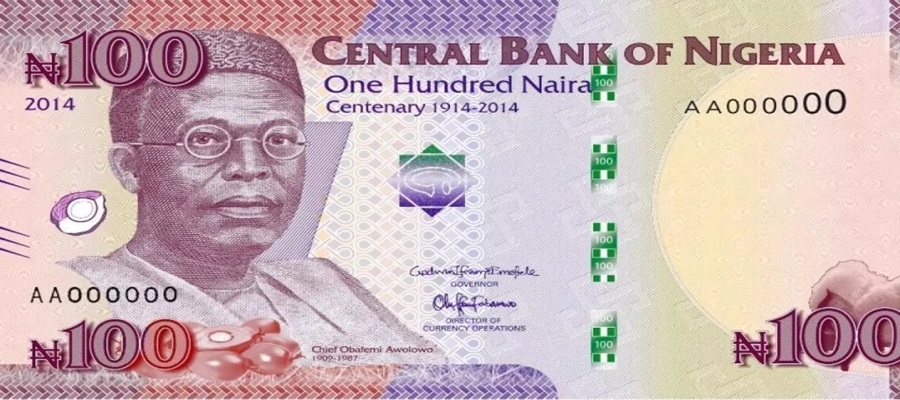
Central Bank of Nigeria (CBN) has reaffirmed that the standard N100 banknote remains legal tender across the country, warning that its rejection by individuals, businesses and institutions violates the law.

The clarification follows reports that some members of the public have refused to accept the standard N100 note over concerns about its legal tender status following the introduction of the commemorative N100 banknote issued to mark Nigeria’s centenary.
In a statement signed by Mrs. Hakama Sidi-Ali, acting director of Corporate Communications, the apex bank stressed that “both the commemorative N100 banknote and the standard N100 banknote are valid legal tender and must be accepted for all transactions nationwide.”
The CBN explained that the commemorative N100 note was introduced to celebrate Nigeria’s centenary and did not replace the existing standard N100 banknote.
The CBN cautioned individuals, businesses, financial institutions and other economic agents against rejecting the standard N100 note, noting that such action contravenes the provisions of the CBN Act and undermines public confidence in the national currency.
It warned that appropriate enforcement measures would be taken against any person or organisation found violating the law.
The apex bank reaffirmed its commitment to protecting the integrity of the naira, maintaining confidence in all duly issued banknotes and ensuring the smooth circulation of currency across the country.
The CBN also urged members of the public to continue accepting and transacting with all banknotes legally issued by the Bank and advised anyone seeking further clarification to use its official communication channels.

CAC to Sanction Companies with Incomplete Business Letters From August 1

BVN Enrollments Hit 69.55m- NIBSS

CBN Warns against Rejection of N100 Banknotes

Data Protection Industry Hits N16.3Bn in 3 Years- NDPC

NCC Seeks Cost-Based Pricing Framework for Ducts

NASENI Moves to Digitize CCB’s 5m Assets Declaration and Operations

Mobile Internet Gender Gap Widest in Africa – GSMA

Nigeria Launches FreeTV Nationwide

CANAL+ Partners Samsung to Pre-Load DStv Stream on New Samsung TVs In Nigeria, Other African Countries

CredibleVoteNG Opens Free Access to all Polling Units in Nigeria after INEC Demanded N1.Bn for Register




 General News2 days ago
IHS Nigeria, FCT-HSES Concludes Clean Cooking Energy Campaign “Project Breathe Clean Air” in Abuja

 News1 day ago
NRC, Ponzi Scheme Collapses Resulting Loss of Billions of Naira

 E-Business2 days ago
Kaspersky Transforms Threat Intelligence Reporting into an Interactive Content Hub

 News2 days ago
Microsoft to Lay Off 4,800 Workers

 Telecom2 days ago
Airtel Africa Cuts Diesel Dependence by 9.1m Litres

 Telecom2 days ago
A New Blueprint – How Strategic Collaboration is Rewriting the Narrative on Youth Drug Abuse

 Broadcasting2 days ago
NELFUND Investigates 34 Universities Over Students’ Missing Tuition Refunds

 News2 days ago
Access Bank, Fifth Chukker and UNICEF Renew Commitment to Expanding Educational Opportunities for Nigeria’s Most Vulnerable Children