

Telecom
Sophos “Pacific Rim” Report Details its Defensive and Counter-Offensive Operation with Multiple Interlinked Adversaries

Sophos, a global leader of innovative security solutions for defeating cyberattacks, today released “Pacific Rim,” a report detailing its defensive and counter-offensive operation over the last five years with multiple interlinked nation-state adversaries based in China targeting perimeter devices, including Sophos Firewalls.

The attackers used a series of campaigns with novel exploits and customized malware to embed tools to conduct surveillance, sabotage and cyberespionage as well as overlapping tactics, tools and procedures (TTPs) with well-known Chinese nation-state groups including Volt Typhoon, APT31 and APT41.
The adversaries targeted both small and large critical infrastructure and government targets, primarily located in South and South-East Asia, including nuclear energy suppliers, a national capital’s airport, a military hospital, state security apparatus, and central government ministries.
Throughout Pacific Rim, Sophos X-Ops, the company’s cybersecurity and threat intelligence unit, worked to neutralize the adversaries’ moves and continuously evolved defenses and counter-offensives.
After Sophos successfully responded to the initial attacks, the adversaries escalated their efforts and brought in more experienced operators. Sophos subsequently uncovered a vast adversarial ecosystem.
While Sophos released details starting in 2020 on the campaigns associated, including Cloud Snooper and Asnarök, the company is sharing the overall investigation analysis to raise awareness of the persistence of Chinese nation-state adversaries and their hyperfocus to compromise perimeter, unpatched and end-of-life (EOL) devices, often via zero-day exploits they are creating for those devices.
Sophos is also encouraging all organizations to urgently apply patches for vulnerabilities discovered in any of their internet-facing devices and to migrate any older unsupported devices to current models.
Sophos regularly updates all of its supported products based on new threats and indicators of compromise (IoCs) to protect customers. Sophos Firewall customers are protected via rapid hotfixes that are now turned on by default.
“The reality is that edge devices have become highly attractive targets for Chinese nation-state groups like Volt Typhoon and others as they look to build operational relay boxes (ORBs) to obfuscate and support their activity.
“This includes directly targeting an organization for espionage, or indirectly leveraging any weak points for onward attacks – essentially becoming collateral damage. Even organizations that are not targets are getting hit.
“Network devices designed for businesses are natural targets for these purposes – they are powerful, always on, and have constant connectivity,” said Ross McKerchar, CISO at Sophos.
“When a group seeking to build a global network of ORBs targeted some of our devices, we responded by applying the same detection and response techniques we use to defend our corporate endpoints and network devices.
“This allowed us to burn multiple operations and tap into a valuable stream of threat intelligence that we applied to protect our customers from both future widespread attacks and highly targeted operations.”
Highlights of the Report
● On Dec. 4, 2018, a low-privileged computer connected to an overhead display began to scan the Sophos network—seemingly on its own—at the India headquarters of Cyberoam, a company Sophos acquired in 2014. Sophos found a payload quietly listening for specialized inbound internet traffic on the computer that contained a novel type of backdoor and a complex rootkit — “Cloud Snooper.”
● In April 2020, after several organizations reported a user interface pointing to a domain with “Sophos” in its name. Sophos worked with European law enforcement, which tracked down and confiscated the server the adversaries used to deploy malicious payloads in what Sophos later dubbed Asnarök. Sophos neutralized Asnarök, which the company was able to attribute to China, by taking over the malware’s command and control (C2) channel. It also allowed Sophos to neutralize a planned wave of botnet attacks.
● After Asnarök, Sophos advanced its intelligence operations by creating an additional threat actor tracking program focused on identifying and disrupting adversaries looking to exploit Sophos devices deployed in customer environments; the program was built using a combination of open-source intelligence, web analytics, telemetry monitoring, and targeted kernel implants deployed to the attackers’ research devices.
● Next, the attackers showed an increasing level of persistence, upleveling their tactics and deploying increasingly stealthy malware. However, using its threat actor tracking program and enhanced telemetry gathering capabilities, Sophos was able to pre-empt several attacks and obtain a copy of a UEFI bootkit and custom exploits before they could be deployed broadly.
● A few months later, Sophos tracked some of the attacks to an adversary who has demonstrated links to China and Sichuan Silence Information Technology’s Double Helix Research Institute in the country’s Chengdu region.
● In March 2022, an anonymous security researcher reported a zero-day remote code execution vulnerability, designated CVE-2022-1040, to Sophos as part of the company’s bug bounty program. Further investigation revealed that this CVE was already being exploited in the wild in multiple operations—operations that Sophos was then able to stop impacting customers. After deeper analysis, Sophos determined the person reporting the exploit may have had a connection to the adversaries.
“This was the second time Sophos received a suspiciously timed “tip” about an exploit before it was used maliciously.
“Recent advisories from CISA have made it clear that Chinese nation-state groups have become a perennial threat to nations’ critical infrastructure,” McKerchar continued.
“What we tend to forget is that small- and medium-sized businesses—those that form the bulk of the supply chain for critical infrastructure—are targets since they are often the weak links in this supply chain.
“Unfortunately, these businesses often have fewer resources to defend against such sophisticated threats. Further complicating matters is the tendency for these adversaries to gain a foothold and dig in, making it hard to evict them.
“The modus operandi of China-based adversaries is creating long-term persistence and complex obfuscated attacks. They won’t stop until they’re disrupted.”
Industry Quotes About Sophos’ Pacific Rim Report
“Through the JCDC, CISA obtains and shares crucial intelligence on the cybersecurity challenges we face, including the advanced tactics and techniques used by People’s Republic of China (PRC) state-sponsored cyber actors.
“The expertise of partners like Sophos and reports like its Pacific Rim report, provides the global cyber community more insights into the PRC’s evolving behaviors.
“By working side-by-side, we are helping cyber defenders understand the scale and widespread exploitation of edge network devices and implement mitigation strategies,” said Jeff Greene, executive assistant director for cybersecurity at CISA. “CISA continues to highlight how classes of vulnerabilities, including SQL injections and memory safety vulnerabilities, continue to be exploited en masse.
“We urge software manufacturers to review our Secure by Design resources and, as Sophos has done in this case, put its principles into practice. We encourage others to take the pledge and to review our alerts on how to eliminate common classes of defects.”
“Many cybersecurity vendors conduct adversarial research operations, but few are able to successfully do so against such a challenging set of nation-state adversaries for such a long period of time,” said Eric Parizo, managing principal analyst with the cybersecurity research group at Omdia.
“Sophos made the most of a highly unique opportunity, and it should be lauded for delivering research and tactical takeaways that will help better defend its customers now and well into the future.”
“At NCSC-NL, one of our tasks is to share information and connect organisations.
“Facilitating communication and cooperation between national and international organisations is of great importance to improve cyber resilience.
“We are happy to have been able to make a contribution to this investigation with Sophos,” said Hielke Bontius, head of operations, NCSC-NL.
Advice for Defenders
Organizations should expect all internet-facing devices are prime targets for nation-state adversaries, especially those devices in critical infrastructure. Sophos encourages organizations to take the following actions to strengthen their security posture.
● Minimize internet-facing services and devices when possible
● Prioritize patching with urgency for internet-facing devices and monitor these devices
● Enable hotfixes for edge devices to be allowed and applied automatically
● Collaborate with law enforcement, public-private partners, and government to share and act on relevant IoCs
● Create a plan for how your organization deals with EOL devices
“We need to work collaboratively across the public and private sector, law enforcement and governments, and the security industry, to share what we know about these adversarial operations. Targeting the very same edge devices that are deployed to protect networks is a bold and clever tactic. Organizations, channel partners and Managed Service Providers need to understand that these devices are top targets for attackers and should ensure they are appropriately hardened, and critical patches are applied as soon as they are released.
In fact, we know that attackers are actively hunting for EOL devices. Vendors play a big part here, too. They need to help customers by supporting reliable and well-tested hot fixing, making it easy to upgrade from EOL platforms, systematically refactoring or removing legacy code that can harbor lingering vulnerabilities, continuously improving secure by default designs to offload the customer burden of hardening, and monitoring the integrity of our deployed devices,” concluded McKerchar.



OpenAI, the developer of ChatGPT, is reportedly in discussions to offer the U.S. government a five per cent equity stake in the company as part of efforts to address growing political and regulatory scrutiny surrounding artificial intelligence (AI).

According to a report by the Financial Times, the proposal is still at an early stage and would see other leading American AI companies consider similar arrangements to allow the public to benefit from the industry’s rapid growth.
OpenAI Chief Executive Officer, Sam Altman, was quoted as saying that public ownership would enable citizens to share in the economic benefits generated by AI while helping to build public trust in the technology.
Based on OpenAI’s March funding round, which valued the company at about 852 billion dollars, a five per cent stake would be worth approximately 42.6 billion dollars.
The report said the proposal comes amid increasing concerns over AI’s impact on jobs, national security and the concentration of wealth within a handful of technology companies.
Last month, U.S. President Donald Trump said his administration was exploring ways to ensure Americans benefit directly from the country’s leadership in artificial intelligence, including the possibility of government equity stakes in AI companies.
Under the reported proposal, OpenAI executives suggested that major AI firms could allocate five per cent of their equity to a public investment vehicle modelled after the Alaska Permanent Fund, which invests state oil revenues and distributes returns for public benefit.
The discussions are also taking place as OpenAI and rival AI company Anthropic prepare for potential stock market listings that would allow public investment in their businesses.
According to the report, implementation of such an arrangement could require approval by the U.S. Congress, while it remains unclear whether other AI companies would support the proposal.
OpenAI had previously advocated the creation of a “public wealth fund” that would give every citizen a stake in AI-driven economic growth, regardless of whether they participate in financial markets.
The proposal comes as the Trump administration intensifies oversight of advanced AI technologies while promoting U.S. leadership in the rapidly expanding sector.
Kashifu Inuwa, director general of the National Information Technology Development Agency (NITDA), has said the next phase of growth for Nigeria’s banking sector will be driven less by capital accumulation and more by the ability of financial institutions to build digital trust through artificial intelligence (AI), regulatory technology (RegTech) and cyber resilience.

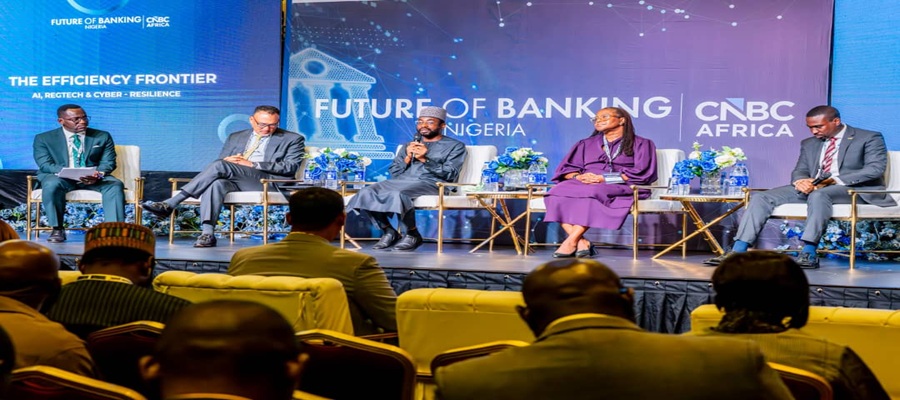
From left: Wole Famurewa, Ayotunde Coker, Managing Director, Rack Centre; the Director General of the National Information Technology Development Agency (NITDA), Kashifu Inuwa; Prof. Olayinka David West of Lagos Business School; and Femi Osinubi, Africa Advisory Leader, PwC, during the panel session, “The Efficiency Frontier – AI, RegTech and Cyber Resilience,” at the Future of Banking Nigeria Summit organised by CNBC Africa in Lagos.
Speaking during a panel session titled “The Efficiency Frontier – AI, RegTech and Cyber Resilience” at the Future of Banking Nigeria Summit organised by CNBC Africa in Lagos, Inuwa argued that while Nigeria’s banking industry has successfully weathered major reforms over the past two decades, the emerging threats confronting the sector require a different approach.
He noted that the industry has repeatedly demonstrated resilience through landmark milestones such as the 2005 banking consolidation, the 2009 banking reforms and the ongoing recapitalisation exercise. According to him, the priority has now shifted from simply raising capital to ensuring that such capital is protected and sustained in an increasingly digital economy.
“Today’s question is no longer whether we can raise capital, but whether we can protect, preserve and grow that capital in the digital era. Trust has become the foundation of modern banking, and that trust must be built on resilient digital infrastructure and effective regulation,” he said.
Inuwa observed that digital channels have become the primary point of interaction between banks and customers, making technology resilience, cybersecurity and uninterrupted service delivery essential to maintaining public confidence in the financial system.
He described artificial intelligence as a strategic tool capable of transforming banking operations by improving productivity, strengthening decision-making, boosting revenue and delivering personalised financial services that reflect the expectations of digitally connected customers.
The DG also highlighted the growing importance of regulatory technology, saying its adoption can simplify compliance, lower operational costs, improve transparency and strengthen governance across financial institutions.
According to him, effective regulation must evolve alongside innovation. He explained that NITDA combines formal regulatory instruments with collaborative, innovation-friendly approaches that allow emerging technologies to develop while regulators establish appropriate standards and safeguards.
“Technology evolves much faster than traditional regulation. Regulators must work closely with innovators to create enabling frameworks that encourage innovation while protecting consumers and maintaining market confidence,” he said.
Using Nigeria’s thriving fintech ecosystem as an example, Inuwa said technology has fundamentally changed the delivery of financial services by enabling customers to open accounts, access banking products and carry out transactions remotely without visiting physical branches.
He further called for closer collaboration among regulators to improve access to finance for Small and Medium-sized Enterprises (SMEs). He explained that AI-powered credit assessment and digital financial management tools can help financial institutions better understand business performance, reduce lending risks and expand credit to underserved enterprises.
On responsible AI adoption, Inuwa disclosed that NITDA’s National Artificial Intelligence Strategy provides a framework for deploying AI across critical sectors in partnership with sector regulators, including the Central Bank of Nigeria (CBN) for financial services.
He added that the Agency is also developing National Standards for Sovereign Cloud infrastructure and data classification to strengthen Nigeria’s digital sovereignty and ensure that sensitive national and financial data remain adequately protected.
Inuwa concluded that deeper collaboration among regulators, technology innovators and financial institutions will be critical to building a secure, resilient and globally competitive financial ecosystem that supports sustainable economic growth.

Indian government has asked Meta Platforms to suspend the rollout of WhatsApp’s proposed username feature in the country over fears that it could fuel online fraud, impersonation and phishing attacks.

The directive, issued by the Ministry of Electronics and Information Technology (MeitY), comes days after WhatsApp announced plans to introduce usernames globally, allowing users to connect without sharing their phone numbers in a move aimed at enhancing privacy.
India, WhatsApp’s largest market with more than 500 million users, expressed concern that the feature could make it easier for cybercriminals to impersonate individuals and organisations, particularly among users with limited digital literacy.
According to media reports, the ministry, in a letter to Meta, warned that the feature could increase incidents of online fraud, phishing, digital arrest scams and identity theft.
A senior government official was quoted as saying that malicious actors could claim usernames resembling those of legitimate individuals and use them to deceive unsuspecting users.
The ministry has reportedly asked Meta not to launch the feature in India until consultations with the government are concluded and the company provides satisfactory explanations on the safeguards built into the system. Authorities have also asked WhatsApp to respond to the concerns within three days.
Responding to the concerns, Meta said the username feature had not yet gone live in India and stressed that multiple security measures had been incorporated to prevent abuse.
The company said usernames for high-profile public figures and verified organisations had already been reserved to prevent impersonation.
Meta added that users would still require a phone number to register for WhatsApp and that the platform had introduced several layers of protection, including limits on messaging unknown users, restrictions on repeated attempts to guess usernames, and systems to detect and remove impersonation and scam-related activities.
The latest development comes as India intensifies efforts to combat cybercrime amid a sharp rise in digital fraud cases across the country.
Government data indicate that financial losses from cyber fraud have risen significantly in recent years, prompting closer scrutiny of digital platforms and their security features.

Court Declares Keystone Bank Staff Wanted over Alleged N35m Fraud

IMF Raises Concerns over N8.83 Trillion Unreported Spending in Nigeria’s Budgets

NOTAP to Commercialise University Research, Expands Patent Drive

FG Unveils Digital Postcode System for MDAs

BoI, NBCC Sign MoU to Deepen Bilateral Trade, Industrial Growth and Investment

Mobile Internet Gender Gap Widest in Africa – GSMA

London Strengthens Global Investment Ties with Africa @ First Ever London-Africa Business Summit

FG Targets Alleged N3tn Capital Flight, Opens Airtime Credit Market to Nigerian Fintechs

Japan, UNESCO Boost Digital Learning in 15 CoEs with Donation of ICT Equipment

Nigeria Launches FreeTV Nationwide




 News3 days ago
Verve Strengthens Global Acceptance Across Leading Digital Platforms

 News3 days ago
Army Says Terrorists Now Recruiting, Raising Funds Online

 Telecom3 days ago
Lebara Nigeria Becomes Member of GSMA Network

 E-Business3 days ago
Kaspersky Warns of The Gentlemen Ransomware Group Expanding Operations with New Malware

 Telecom3 days ago
Airtel Nigeria Deepens Focus on Data Usage Transparency @ Customer Forum

 Telecom2 days ago
MTN Foundation, Microsoft Empower Nigerian Educators with AI Integration Skills

 Telecom3 days ago
Vitel Wireless Warns Public, Says it Not Running any Investment Scheme

 E-Financial3 days ago
Bank of Industry Appoints Kuramo Capital as Manager of Dice Fund of Funds