

News
Engr. Aziz, Former NIMC DG Celebrates Prof. Iya Abubakar at 90

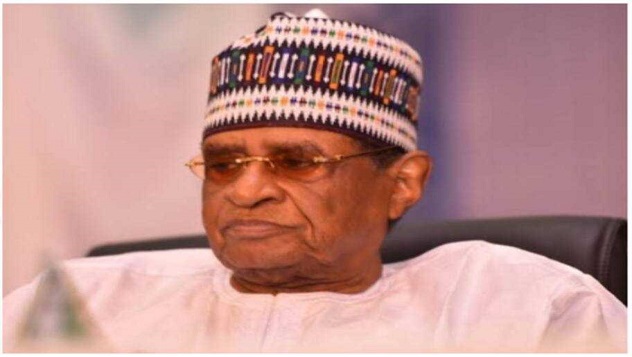
The immediate past Director-General of the National Identity Management Commission (NIMC), Engr. Aliyu Aziz, has paid glowing tributes to a former Minister of Defence, Prof. Iya Abubakar, as he clocks 90 years on December 13.

In a statement he entitled “Celebrating a Visionary at 90,” Engr. Aziz said that it was “with immense pride and gratitude that I join the celebration of an extraordinary milestone in the life of an exceptional leader and trailblazer – Senator Prof. Iya Abubakar.”
According to Engr. Aziz, himself an ID4Africa Emeritus Ambassador, at 90, Prof. Abubakar’s legacy stands tall “as a symbol of intellectual brilliance, visionary leadership, and boundless dedication to the advancement of education, technology, and nation-building.”
Recalling his encounter with Prof. Abubakar, Engr. Aziz stated: “I am particularly privileged to be one of the greatest beneficiaries of the Iya Abubakar Computer Center – an incredible institution that was far ahead of its time. It is astonishing to recall how he procured and established what was then the largest computer in Africa, a CDC Cyber 72 series with a remarkable 64 kilobytes of memory.
“This technological marvel was accompanied by a line printer capable of printing 1,200 lines per minute, a digital plotter, and a suite of high-level programming languages such as FORTRAN, COBOL, PASCAL, BASIC, and APL, among others. His foresight and determination revolutionized computational capacity in the region and inspired countless minds, including mine.”
Engr. Aziz stated further that “Senator Prof. Iya Abubakar’s contributions extend far beyond technology. As a scholar, statesman, and leader, his influence has shaped policies and institutions that continue to benefit generations.
His dedication to education, research, and national development serves as a beacon for all of us striving to make a difference in our various fields.”
Therefore, “On this momentous occasion of his 90th birthday, I salute his monumental achievements and enduring legacy. May he continue to inspire us all with his wisdom, humility, and unwavering commitment to excellence,” Engr. Aziz further stated.
Born on December 13, 1934 in Belel in the Maiha Local Government Area (LGA) of Adamawa State, Nigeria, besides serving as Minister of Defence (24 October 1979 – January 1981), Prof. Abubakar had previously served as Minister of Internal Affairs (1981–1982).
As an academic, Prof. Abubakar was appointed Vice-Chancellor of Ahmadu Bello University, Zaria, in 1975, a position he held until 1978 when he was forced to resign by the then military authorities following the ‘Ali Must Go’ student protests of 1978. Prof. Iya Abubakar had previously become the Head of the Department of Mathematics and Computer Science, ABU, Zaria, at 32.
Prof. Abubakar’s academic trajectory is sprinkled with sparkles of excellence. He achieved a first class honors degree in Mathematics at the University College, Ibadan (now University of Ibadan), before he went to England for postgraduate studies at Cambridge University in 1958.
In 1960, he conducted research at the Pasadena Seismological Laboratory in the United States for a year. And, one year later, he was awarded a Ph.D. in applied mathematics and theoretical physics from Cambridge University, becoming the first person from the Northern region of Nigeria to receive this degree.
He worked as a visiting professor at the University of Michigan from 1965–66, before being appointed as professor of mathematics at Ahmadu Bello University at the age of 28, in 1967. He held this position until 1975, as well as a visiting professorship at the City University of New York from 1971 to 1972.
As a consummate politician, Prof. Abubakar was elected Senator in 1999 for the Adamawa North senatorial district in Adamawa State covering the local government areas of Madagali, Maiha, Michika, Mubi North, and Mubi South. He was re-elected in 2003 and served in the Nigerian upper chamber of the National Assembly till 2007. As a serving senator, he was notably Chairman of the Senator Committee on Science and Technology, among other roles.



National Reading Culture (NRC), an online investment platform targeting Nigerians has collapsed, resulting in the loss of billions of Naira for investors.

The website unexpectedly shut down, blocking users from withdrawing their funds and locking in their investments.
Just like all other investment scams, victims were lured with promises of doubling their money in few weeks.
When National Reading Culture eventually crashed, the operators vanished with users’ funds, leaving investors devastated.
How the Platform WorkedTask-Based Earning:
According findings, National Reading Culture lured users with promises of making money by completing simple daily tasks like reading articles, clicking links, or inviting friends.
They also offered investment tiers to earn higher daily profits, where users had to deposit their own money into the platform.
Evidence showed the website previously operated as a Chinese job search platform before rebranding into an “earning” scheme.

The Nigeria Social Insurance Trust Fund (NSITF) has signed a memorandum of understanding (MoU) with Rand Mutual Assurance (RMA) to collaborate on digital transformation aimed at strengthening worker protection systems and support economic growth.

According to RMA, the agreement was concluded during a visit by its delegation to Abuja.
The partnership will focus on institutional capability development, modernising operating models, improving service delivery and sharing knowledge between the two organisations.
Through the partnership, RMA and NSITF will collaborate to strengthen institutional capability, modernise operating models, accelerate digital transformation and improve services for workers and employers.
The organisations will also explore opportunities for knowledge exchange and the adoption of best practices in social security administration.
RMA said the agreement forms part of its broader engagement with governments, regulators and social security institutions across Africa to support improvements in governance, operational resilience and service delivery.
“Our partnership with NSITF reflects much more than the signing of an agreement,” said Mandla Shezi, group chief executive officer of RMA. “This partnership is not simply about sharing knowledge. It is about co-creating the next generation of African social security systems.”
He added: “By combining our respective strengths, we can help build institutions that are more resilient, more responsive and better equipped to protect workers while supporting national development.”
Shezi said the future of social security depends on integrated systems where prevention, insurance, healthcare, rehabilitation, technology, investment management and institutional capability work together.

Microsoft has announced plans to cut about 4,800 jobs, representing roughly 2.1 percent of its global workforce, with Xbox, its gaming division, expected to bear the largest share of the layoffs.

The company said more than 1,600 positions at Xbox would be eliminated immediately, while another 1,600 jobs would be phased out over the next year as part of a major restructuring of the gaming business.
In a memo to employees, Amy Coleman, executive vice president, Microsoft, said the company was streamlining its operations to focus on areas that deliver greater value to customers in a rapidly changing technology industry.
Asha Sharma, chief executive officer, Xbox, described the move as “the most significant restructure in Xbox history,” saying the changes are intended to position the gaming business for long-term growth rather than downsizing.

Court Declares ARCON’s N60Bn Fine against Facebook Nigeria Illegal

NIN Enrollment Hits over 136m as New ID Law Takes Effect

NRC, Ponzi Scheme Collapses Resulting Loss of Billions of Naira

Plateau PCC Collects Nigerians’ Data without Privacy Policy – FIJ

FG Suspends New Internet Regulations to Prevent Overlapping Rules

Mobile Internet Gender Gap Widest in Africa – GSMA

NASENI Moves to Digitize CCB’s 5m Assets Declaration and Operations

Nigeria Launches FreeTV Nationwide

CANAL+ Partners Samsung to Pre-Load DStv Stream on New Samsung TVs In Nigeria, Other African Countries

UK, Nigeria Launch £15m Growth Programme to Accelerate Economic Transformation




 E-Financial2 days ago
Tokenization, Blockchain Technology will Transform Financial Institutions – IMF

 General News2 days ago
NIS Deploys Advanced Surveillance Masts, other Critical Infrastructure to Boost Border Security

 Broadcasting2 days ago
Obi, NDC Presidential Candidate Faces N50Bn Defamation Claim over Alleged Podcast Remark

 E-Business2 days ago
Weebly Websites to Shut Down for Nigeria, 66 Other Countries from September

 E-Financial2 days ago
FG Denies N8 Trillion ‘Shadow Budget’, Says IMF Quoted out of Context

 General News1 day ago
IHS Nigeria, FCT-HSES Concludes Clean Cooking Energy Campaign “Project Breathe Clean Air” in Abuja

 Telecom2 days ago
No Plans for Fresh Tariff Hike – MTN

 News2 days ago
World Bank Sounds Alarm: Low Revenue, Not Debt, Is Nigeria’s Biggest Fiscal Threat