

Telecom
Nigeria Records over 4m 5G Subscriptions after 2 Years

The total number of mobile subscriptions on Nigeria’s 5G network grew to 4.05 million in December 2024, two years after MTN Nigeria first launched the network.

This is as the total number of mobile subscriptions recovered to 164.65 million after a Nigerian Communications Commission (NCC) audit crashed subscriptions to 154.63 million in September 2024.
The audit removed 64.37 million lines from the national subscription base between March and September, and while some of these lines were lost due to the completion of the Subscriber Identification Modules (SIMs) and the National Identification Number (NIN) linkage exercise, most stopped existing because Globacom over-reported its subscriber base by as much as 40 million.
A breakdown of the 164.65 million subscriber base revealed that MTN now has a subscriber base of 84.61 million, Airtel has 56.62 million, 9mobile has 3.28 million, and Glo has recovered to 20.14 million. Most of these connections (47.20 percent) are on 4G network, with those on 5G network only comprising 2.46 percent of the total.
MTN Nigeria and Mafab Nigeria Communications Limited’s 2021 victory at the auction for two available lots of 100 MHz TDD slots of 3.5 GHz band ushered in 5G in Nigeria, with Airtel getting its license in 2022.

The network is meant to usher in faster internet speed in a country where internet consumption has been on a steady climb. Nigeria’s internet consumption rose to an all-time high of 973,455.35 terabytes in December 2024.
According to Karl Toriola, CEO, MTNN, “5G will change everything. It will allow us to connect, create, collaborate, and compete in ways we cannot imagine yet.”
GSMA, the global body for telcos, noted that growing 5G adoption will contribute $10 billion to Nigeria and other Sub-Saharan African countries’ economies by 2030, accounting for six percent of mobile’s total economic impact.
South Africa, Nigeria, and Kenya are expected to account for more than half of all 5G connections in Sub-Saharan Africa by 2030. About 30 cities now have 5G, says the NCC.
“Nigeria is still grappling with 5G. I can say that the network is still in less than 30 cities in the country. So, we still have a long way to go. But we have strategies to deploy the service in Nigeria. 4G LTE has not even covered the entire country,” said Ubale Maska, executive commissioner of Technical Standard, NCC.
Bosun Tijani, minister of Communications, Innovations, and Digital Economy, highlighted that the lack of proper infrastructure has slowed 5G growth. “The infrastructure that drives 5G is not something that is across the nation,” he said.
Despite its many promises, 5G is not expected to become the dominant network in Nigeria anytime soon. Up until 2029, 4G is expected to account for the largest portion of mobile subscriptions in the country and across Africa.
“In the pursuit of modernisation and enhanced connectivity, subscribers are constantly migrating toward 4G networks. This trajectory indicates that 4G will be the primary driver for new subscriptions up to the year 2028,” Ericsson said in its latest mobility report.


News
NITDA Communications Director Hadiza Umar Named in 2026 PR Power List, Graces Glazia Magazine Cover

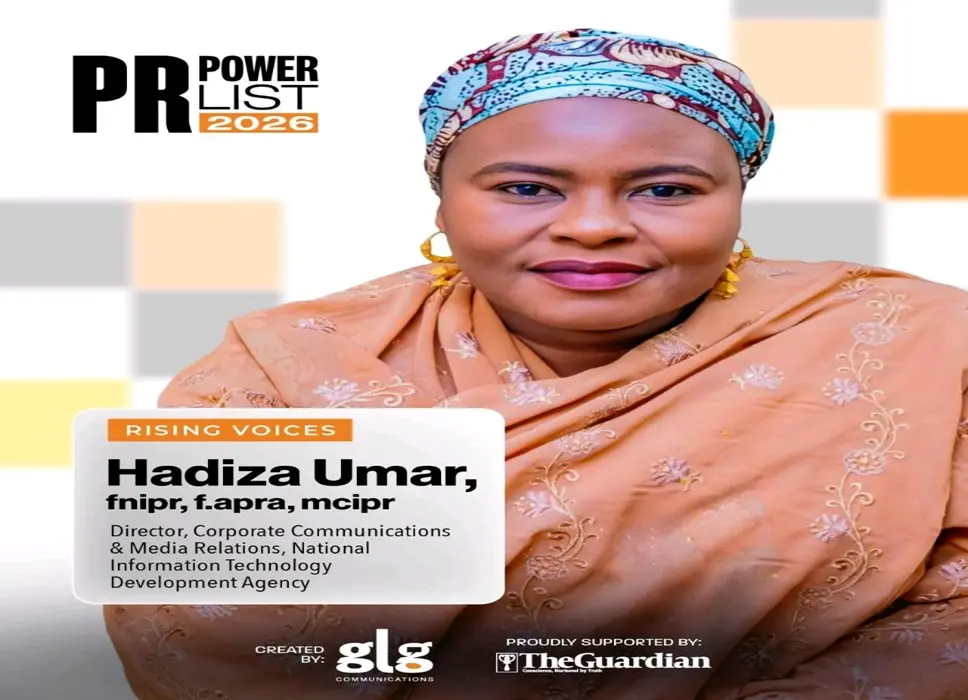
Mrs. Hadiza Umar, Director of the Corporate Communications and Media Relations Department at the National Information Technology Development Agency (NITDA), has been officially recognised as one of Nigeria’s top public relations professionals in the prestigious 2026 PR Power List.

The definitive annual list, compiled by GLG Communications in partnership with The Guardian, was unveiled to commemorate World PR Day.
It celebrates 50 outstanding professionals within Nigeria and the diaspora whose strategic communication strategies have significantly shaped organisations, influenced public discourse, and advanced the profession over the past 12 months.
Adding to the momentous milestone, Mrs. Umar was hit with a major surprise at the exclusive PR Power List Soirée and Awards ceremony held at the Alliance Française in Ikoyi, Lagos, where she was unveiled as a front-cover personality for the Glazia Magazine PR Power List Special Issue.
The double recognition highlights her exceptional distinction and impact in public sector communications and narrative management.
Speaking on the dual achievement, Mrs. Umar expressed profound gratitude for the honours, describing the magazine cover appearance as a breathtaking surprise.
“I am deeply humbled and honored to be recognized on the 2026 PR Power List and to feature on the cover of Glazia Magazine alongside other exceptional industry titans,” Umar said.
“This milestone is a testament to the enabling environment and visionary leadership of the Director General of NITDA, Kashifu Inuwa Abdullahi, CCIE, which has allowed us to strategically drive the narrative of Nigeria’s digital economy and technological innovation.”
Mrs. Umar, a highly respected corporate communications strategist, holds professional fellowships in the Nigerian Institute of Public Relations (Chartered), the African Public Relations Association (APRA), and the Institute of Corporate Administration (CICA).
Under her supervisory role, NITDA’s media relations have consistently projected national information technology frameworks, start-up support frameworks, and digital literacy initiatives, to position Nigeria competitively on the global stage.
The 2026 PR Power List selection process involved a rigorous, independent evaluation led by a distinguished international jury.
The organisers noted that the class of 2026 represents professionals raising the standard of strategic communications and introducing new ideas to the industry.
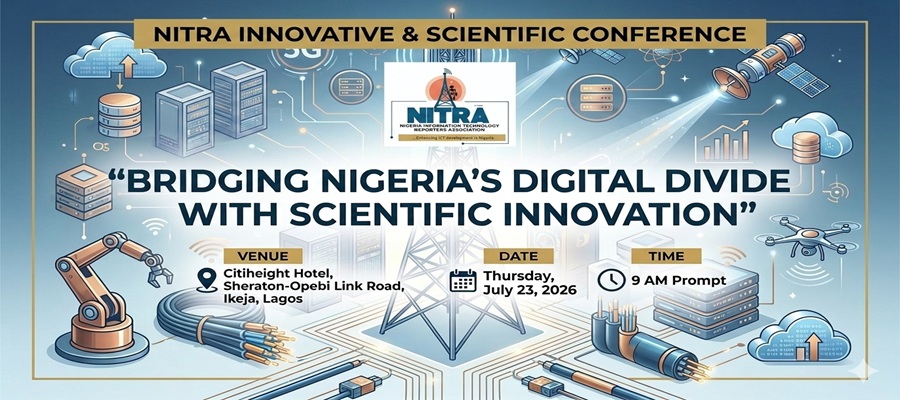
The need for Nigeria to think outside the box in its need to drive towards global relevance with innovations and scientific developments will be on the front burner at the NITRA Innovative & Scientific Conference scheduled to hold on Thursday July 23, 2026 in Ikeja, Lagos.

NITRA
The Nigerian Communications Commission (NCC) will lead other delegates to discuss and take far-reaching decisions at the event, which has its theme as “Bridging Nigeria’s Digital Divide With Scientific Innovation”.
Other companies that have indicated interest in partnering with NITRA include mobile communications company, Tecno; Africa’s premier end-to-end AI solutions company, Hyperspace; and telecommunications data infrastructure company, Digital Realty.
Speaking on the proposed event, the Chairman, Nigeria Information Technology Reporters Association (NITRA), Chike Onwuegbuchi noted that the event will seek to create a platform for government and private organisations to deliberate on policies around scientific innovations in Nigeria, challenges, place of indigenous and foreign collaboration, roles of each stakeholder, and grassroots development in that regard, among others.
According to him: “The Federal government, with series of programmes and partnerships, has established the urgent need to create an ecosystem that thrives on scientific innovation, breeding institutions and individuals with a target of placing the country at the fore-front of Next-Gen development.
It is a known fact that digital and scientific innovations are crucial, not only to the survivability of a nation, but also to the sustainability of its growth and development, with significant effect on economic strength, global image, defense and security, government capabilities to function, and public health and safety, communication and digital footprint, among others.
The federal government is actively driving scientific innovation to foster economic diversification and build a $1 trillion economy by 2030. Efforts are heavily focused on commercializing research, establishing massive research funds, and funding strategic infrastructure, particularly in technology, biotechnology, and healthcare. Core government initiatives and policies include the newly instituted National Research and Innovation Development Fund (NRIDF), which aims to mobilize about $500 million annually to support research and the commercialization of scientific outputs; and the Nigeria Genomic City, a multi-ministerial initiative aimed at transforming Nigeria into a leading hub for genomics, precision medicine, and biotechnology. It is designed to protect indigenous data, stimulate artificial intelligence in health, and develop a highly skilled scientific workforce.
According to the General Secretary of NITRA, Mr. Chidiebere Nwankwo, the forum will also be a vehicle to propagating the views of decision makers to the public, thereby furthering the cause of public awareness and information dissemination on the topic.
The focus, he said will be on how Nigeria can sustain digital innovative growth and scientific development in Nigeria

The board of global payments company, PayPal, says a 53 billion dollars takeover offer from financial technology firm, Stripe, and private equity company, Advent International, does not adequately reflect the company’s long-term value.

PayPal
According to reports, the proposed acquisition, valued at 60.50 dollars per share, remains under consideration, with the board yet to formally respond to the offer.
The directors are said to be evaluating not only the financial value of the proposal but also the structure of the financing, the timeline for completing the transaction and the likelihood of obtaining regulatory approvals.
They are also considering the possibility of competing bids emerging.
Although the offer represents a premium of about 28 per cent above PayPal’s recent share price, the board believes the company could deliver greater value to shareholders if its ongoing turnaround strategy succeeds.
Following reports of the bid, PayPal shares gained about two per cent to close at 56.73 dollars.
Sources familiar with the discussions said Stripe and Advent have secured approximately 50 billion dollars in debt financing from JPMorgan and Morgan Stanley, while both firms would jointly contribute 17 billion dollars in equity.
Under the proposal, the two companies would jointly own PayPal instead of dividing its operations.
PayPal, Stripe, Advent International, JPMorgan and Morgan Stanley have all declined to comment on the proposed transaction.
The discussions come as PayPal seeks to strengthen its business after years of increasing competition from rivals including Apple Pay, Google Pay and emerging financial technology firms.
The company, which was valued at about 360 billion dollars in 2021, now has a market capitalisation of approximately 36 billion dollars.
Since assuming office as Chief Executive Officer in March 2026, Enrique Lores has embarked on a restructuring programme aimed at improving operational efficiency and restoring growth.
The restructuring includes the creation of three business divisions comprising Checkout, Venmo and Consumer Financial Services, and Payments and Crypto.
The company is also targeting 1.5 billion dollars in cost savings through the deployment of artificial intelligence technologies.
PayPal’s latest financial results indicated signs of recovery, with first-quarter revenue rising seven per cent year-on-year to 8.35 billion dollars, while total payment volume increased by eight per cent to 464 billion dollars.
If approved, the transaction would combine two of the world’s largest digital payments companies.
The combined business would process an estimated 3.7 trillion dollars in annual payment volume, significantly strengthening its position in the global online payments market.
However, analysts expect the proposed acquisition to face intense regulatory scrutiny because of the companies’ combined market share in merchant payment services.
To address possible antitrust concerns, the bidders have reportedly considered options, including separating PayPal’s Braintree business or other assets if required by regulators.
Sources said Stripe and Advent remain interested in pursuing the acquisition despite the board’s reservations, although negotiations are expected to continue.
Market observers are also awaiting PayPal’s earnings report scheduled for July 28 for further indications of the company’s financial recovery and future growth prospects.

YEDC Warns Customers, Says 20 Percent Electricity Bonus is Scam

FG to Support 12 Tech Startups with N482m under iDICE

NBC, INEC, Plan Joint Broadcast Monitoring Framework ahead of 2027 Elections

No Going Back on July 31 Deadline for Insurance Firms’ Recapitalisation – NAICOM

Court Affirms FCCPC’s Power to Regulate Digital Lending

NRC, Ponzi Scheme Collapses Resulting Loss of Billions of Naira

NASENI Moves to Digitize CCB’s 5m Assets Declaration and Operations

Lebara Nigeria Launches Lebara Play, Africa’s First Telecom-Owned Micro-Drama Platform

CANAL+ Partners Samsung to Pre-Load DStv Stream on New Samsung TVs In Nigeria, Other African Countries

Tokenization, Blockchain Technology will Transform Financial Institutions – IMF




 News1 day ago
NIMASA Unveils Accelerator Scheme to Drive Innovation, Sustainable Growth

 E-Financial1 day ago
Access Holdings Sells 7.44% Stake in Ghana Unit

 E-Financial1 day ago
NRS Issues July 31 Deadline for e-Invoicing Compliance

 E-Business1 day ago
SERAP to Sue NASS over Bill Empowering NDPC to Regulate Social Media

 News1 day ago
ICPC Secures Final Forfeiture of N941m Linked to IPPIS Fraud

 E-Financial1 day ago
NDIC Urges Youths to Shun Ponzi Schemes, Embrace Savings

 News1 day ago
Adebutu, PDP Chieftain Accuses Nigerian Governors of Embezzling LG Allocations

 News1 day ago
eBusinessLife Advocates Greater Support for Girls in ICT as Students Showcase AI Innovations