

E-Financial
CBN Puts Accumulated Savings, Liquid Assets by Nigerians at N75.65trn

Amid mounting macroeconomic uncertainty, Nigerians are leaning heavily towards savings and low-risk financial instruments, with recent data from the Central Bank of Nigeria (CBN) showing a marked increase in quasi-money holdings.

Quasi-money are assets that are easily and quickly convertible into cash. They are considered to be close substitutes for cash in the economy.
According to the CBN’s Money and Credit Statistics for March 2025, quasi-money, comprising savings deposits, fixed-term deposits and other liquid but non-transactional assets, rose to N75.65 trillion, representing a 3.65 per cent month-on-month (m/m) increase and a 26.42 per cent rise year-on-year, up from N59.84 trillion in March 2024.
The surge highlights a growing preference for capital preservation, as households and businesses seek refuge in interest-bearing instruments amid Nigeria’s ongoing economic slowdown.
“The rising volume of quasi money reflects both a cautious approach to spending and increasing trust in formal financial institutions,” said a senior analyst at Vetiva Capital. “It’s a defensive strategy by savers who are navigating inflationary pressures and volatile market conditions.”
The CBN has maintained a tight monetary policy for over a year, with high interest rates designed to tame inflation. This stance has made fixed-income securities, such as treasury bills and term deposits, especially attractive to investors.
In January 2025, the CBN’s auction for 364-day treasury bills saw an oversubscription of N1.47 trillion, with stop rates reaching 22.6 per cent. By mid-February, total subscriptions across tenors remained strong at N2.41 trillion, underlining sustained demand for secure, high-yield instruments.
The data also reveals that broad money supply (M2) grew to N114.20 trillion in March 2025, a 23.69 per cent increase year-on-year, with quasi money continuing to dominate M2 composition. Meanwhile, demand deposits rose to N33.96 trillion, up 17.65 per cent from the same period last year, while currency outside banks jumped 26.72 per cent to N4.59 trillion.
The central bank also reported mixed trends in domestic credit: Net domestic credit rose 12.47 per cent year-on-year to N103.37 trillion, though it dipped 1.20 per cent month-on-month.
Credit to the government grew 31.99 per cent to N25.86 trillion year-on-year but fell 4.63 per cent in March, suggesting a brief pause in government borrowing whilst private sector credit growth remained modest at 7.10 per cent pointing to conservative lending practices and subdued appetite for new debt in the real economy.
Analysts say the quasi-money uptick reflects a broader trend of financial system deepening, driven by digitization and formal banking efforts. The rise in savings could, over time, translate into stronger capital pools for lending, once macroeconomic stability returns.
While the flight to safety is a rational response to uncertainty, experts warn that over-reliance on fixed-income assets could limit economic dynamism in the long term.
However, for now, Nigeria’s financial landscape suggests that stability, not speculation, is the dominant mood among savers and investors.



A Federal High Court in Abuja has affirmed the Central Bank of Nigeria’s (CBN) exclusive ownership of the “eNaira” digital currency platform and trademark.

eNaira
Justice James Omotosho, in a judgment delivered on Friday, restrained eNaira Payment Solutions Limited from presenting itself as the owner of the “eNaira” trademark.
The court also ordered the company to immediately adopt a new name that does not contain the word “Naira”.
The suit, marked FHC/ABJ/CS/113/2021, was dismissed, while the court awarded N10 million costs in favour of the CBN following its successful counterclaim.
Justice Omotosho held that although the company had been registered with the Corporate Affairs Commission (CAC) since 2004, its name was misleading because of its close association with Nigeria’s sovereign currency.
“The name chosen by the plaintiff on its incorporation is in the circumstances unregistrable due to the misleading nature of the name, which suggests government patronage,” the judge ruled.
The court further noted that the Trademark Registry had, through a letter dated Nov. 15, 2021, withdrawn approvals earlier granted to the company for applications related to the “eNaira” trademark under classes 36 and 42.
According to the judgment, the company was informed that “eNaira is a national intellectual property and constitutes a symbol and national asset of Nigeria.”
Justice Omotosho ruled that the plaintiff had no superior legal claim to the trademark and therefore could not seek injunctive relief against the CBN.
“A party that has no legal right cannot be entitled to an injunction. The purport of this is that, prima facie, the plaintiff has no valid trademark to the exclusive use of the eNaira trademark,” he held.
The judge also emphasised that under Section 852(2) of the Companies and Allied Matters Act, the CAC has powers to reject or direct changes to company names that suggest government affiliation.
“The ‘eNaira’ name is so closely linked to the legal tender of Nigeria, which is exclusively controlled by the CBN.
“An average person on the street is most likely to think that the plaintiff is an agent of the Federal Government or the CBN,” the court stated.
Justice Omotosho added that the company’s proposed activities involving digital currency operations created the impression that it had official authority to issue or manage a digital version of the naira.
“The proposed business of the plaintiff… no doubt creates the impression that the plaintiff has the authority of the Federal Government of Nigeria to issue and control a digital form of the Naira,” he said.
The judge warned that allowing a private entity to control the “eNaira” name could undermine public confidence and create confusion within the country’s financial system.
“Any digital currency with the name ‘eNaira’ will no doubt create the impression that it is an official digital form of the Naira.
“This would be disastrous for the Nigerian economy and will create skepticism among users, as it is not guaranteed by the Central Bank of Nigeria,” he added.
The court also observed that the CAC had lawfully directed the company to change its name within six weeks of its Dec. 9, 2021 directive, but the company failed to comply.
During proceedings, counsel to the plaintiff, Mr David Ityonyman, argued that the word “Naira” was not exclusive to Nigeria and should not be monopolised.
“Nothing stops India from having a Naira. Also, countries like the U.S. and Canada make use of dollars. None of them has laid claim to the name,” he submitted.
He further argued that the company had used the “Naira” branding internationally for more than two decades before the CBN launched the eNaira platform in 2021.


Central Bank of Nigeria (CBN) and commercial banks are reviewing the large number of transaction alerts sent to customers and the complaints about bank charges.

So called bank alert refers to real-time SMS or email notifications from your financial institution about transactions, balances, or security updates.
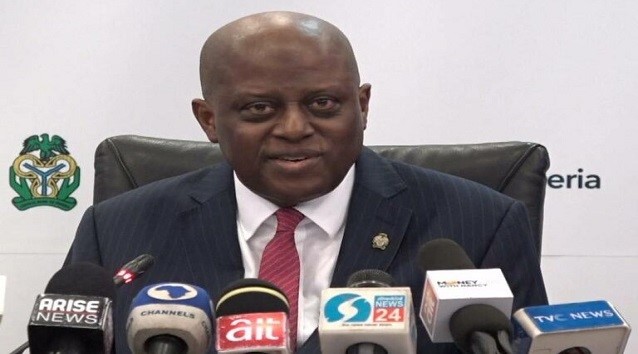
Olayemi Cardoso, governor, CBN, said this in Abuja after the 305th Monetary Policy Committee meeting.
He explained that many bank customers are confused because they receive too many debit alerts for a single transaction.
To address this, the CBN has created a quarterly meeting system involving its consumer protection team, commercial banks, and the top 10 microfinance banks. The goal is to resolve customer complaints faster and improve banking services.
Cardoso said one major issue being studied is how banks send multiple notifications for one transaction.African Politics Analysis
He said this often confuses customers and suggested that alerts should be simplified and combined so people can clearly understand what each debit is for.
He added that the issue is still being worked on and solutions will be proposed soon.
On the N50 stamp duty charge, the CBN governor explained that it is not a bank charge.
He said the charge comes from tax authorities, while banks only collect it and send it to the government.
He advised customers who notice wrong charges to first complain to their bank. If the issue is not resolved, they can escalate it to the CBN’s consumer protection department.
Cardoso also said the CBN has strengthened its monitoring system to ensure banks handle complaints properly, compensate customers when needed, and improve customer service.
The CBN is also reviewing how banks apply rules on charges and customer complaints, with the aim of improving transparency and reducing repeated issues in the banking system.
E-Financial
Griffin Capital Group Launches Integrated Financial Services Group Positioned to Strengthen Capital Formation in Nigeria, Africa
Griffin Capital Group Limited has announced its official market entry as a fully integrated financial services group, bringing together investment banking, asset management, trusteeship, lending, and insurance capabilities under a unified institutional platform.

The launch reflects a deliberate response to the evolving demands of Nigeria’s financial ecosystem, where the need for disciplined capital deployment, stronger Corporate Governance frameworks, and deeper market liquidity continues to shape the next phase of growth.
Structured as a multi-business financial services group, Griffin Capital is designed to operate across the full spectrum of capital formation, from origination through innovatively structuring complex financial transactions in a simplified manner; to execution, distribution, and investment management. This enables us to both advise on and actively participate in transactions.
The Group enters the market with a leadership team whose experience spans investment banking, Insurance brokerage, capital markets, corporate finance, development finance, and investment management across Africa and global financial centers.
Griffin Capital’s operating model reflects a clear emphasis on institutional discipline, combining advisory expertise with balance sheet strength to support more efficient capital allocation and improved transaction quality.
As Nigeria’s economic reforms continue to unlock new opportunities across infrastructure and project finance, financial advisory, and private capital markets; the Group is positioned to support both issuers and investors through a structure designed for scale, transparency, and execution.
Commenting on the launch, the Group Chief Executive Officer, Babatunde Obaniyi said: “The opportunity in Nigeria’s financial markets is significant, but unlocking it requires more than capital. It requires structure, governance, and the ability to deploy capital with discipline. Griffin Capital Group has been built to address these fundamentals. Our model allows us to operate across the full lifecycle of transactions from advisory to execution, while maintaining a strong focus on risk management and long-term value creation.
“We are entering the market with a clear sense of responsibility, particularly in how capital is structured, deployed, and preserved. Our ambition is to build an institution that contributes meaningfully to market development while maintaining the highest standards of governance and execution.”
The Chairman of the Group, Musa Bello added: “Financial institutions play a critical role in shaping economic outcomes, particularly in emerging markets where capital must be deployed with both precision and purpose. Griffin Capital Group represents a long-term commitment to building an institution that combines local market understanding with global standards of governance and execution.
“As Nigeria continues to deepen its capital markets and expand private sector participation, institutions with the capacity to structure, mobilize, and manage capital effectively will be essential. Our focus is not only on participating in this evolution, but on contributing to it in a meaningful and sustainable way.”
With a medium-to-long-term strategy focused on growth in assets under management and expanded participation across key sectors, Griffin Capital Group intends to play an active role in facilitating capital flows within Nigeria and across the African continent.
The Group’s integrated platform is expected to support a broad range of clients, including retail, corporates, institutional investors, development finance institutions, government institutions, and high-net-worth individuals, through tailored financial solutions and disciplined execution.

WHO Says Ebola Risk Now at Highest Level

Airtel Africa Launches $110m Share Buyback Programme for Capital Efficiency

NCC Drafts New Rules for Virtual Mobile Operators

LG Electronics Showcases Advanced HVAC Solutions at Mega Clima Nigeria 2026

FG Unveils AI Public Services Platform

MTN, VDT, Zoracom, Digital Realty Back 2026 Girls in ICT Campaign

Vitel Wireless Partners Fintechs to Expand Access to Services

Kaspersky Discovers Vulnerability in Qualcomm Snapdragon Chips that can Lead to Data Loss & Device Compromise

Bank Customers to Pay N1,500 for ATM Card Issuance, Replacement – CBN

FG Okays 112 as Toll-Free National Emergency Response Number




 Telecom2 days ago
MTN to Turn its African Tower Network Into a Distributed AI Compute Grid

 News2 days ago
Elon Musk to Become First World’s Trillionaire with SpaceX Historic IPO

 Telecom2 days ago
NCC Begins Review of Nigeria Telecoms Policy after 26 Years

 Broadcasting2 days ago
STBMAN Warns of “Broadcasting Crisis”, Urges Tinubu to Halt NBC’s DSO

 E-Business2 days ago
Kaspersky Warns that Scammers are Exploiting World Cup 2026 Travellers

 E-Business2 days ago
Meta Platforms Contributed $820m to Nigeria’s Economy in 2025 – Report

 E-Business2 days ago
NITDA Unveils AI-Powered Government System That Tracks Workers, Flags Delays Automatically @ICSC 2026

 News2 days ago
Moniepoint Boosts UK Payments Security