

E-Business
NITDA, CISCO Empower Youth with Digital Skills

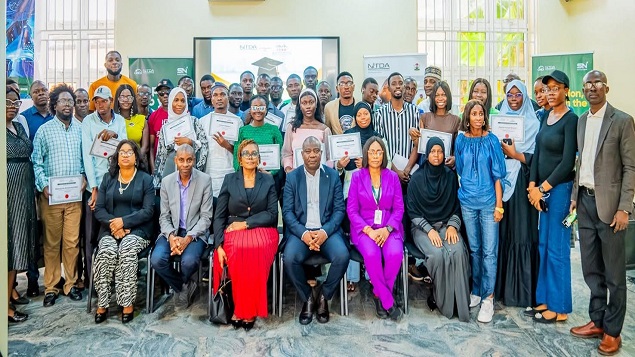
Fifty selected young unemployed Nigerians have completed a four-week intensive digital skills bootcamp under the Digital Literacy for All (DL4ALL) initiative, gaining practical training in Data Science, Artificial Intelligence (AI), and IT Essentials.

The programme, a collaborative effort between the National Information Technology Development Agency (NITDA) and Cisco, was hosted at NITDA’s South West Zonal Office in Victoria Island, Lagos.
Speaking on behalf of the Director General of NITDA, Kashifu Inuwa , the Head of the South West Zonal Office, Mrs. Chioma Okee-Agugwo, described the initiative as a vital component of Nigeria’s digital future. “This is not just a closing ceremony. It is the launchpad for new journeys—anchored in digital knowledge and powered by innovation,” she remarked.
According to the Director General, the initiative is rooted in NITDA’s Strategic Roadmap and Action Plan (SRAP 2.0) and reflects key focus areas including Digital Literacy, Emerging Technologies, and Youth Empowerment. It also aligns with President Bola Ahmed Tinubu’s Renewed Hope Agenda, which seeks to accelerate economic diversification through digitisation, innovation, and skills development.
Inuwa noted that the DL4ALL initiative forms part of Nigeria’s broader commitment to digital inclusion—ensuring that no one is left behind in the evolving digital economy. It also supports the ambitious goal of achieving 70% digital literacy by 2027, championed by the Honourable Minister of Communications, Innovation and Digital Economy, Dr. Bosun Tijani. This national vision aims to equip millions of Nigerians with the skills required to thrive in a tech-driven world.

He further emphasized the importance of empowering youth with globally relevant skills. “They are no longer just consumers of technology. They are creators, innovators, and future employers,” he said.
The NITDA boss explained that throughout the bootcamp, participants engaged in hands-on learning experiences designed to build both technical proficiency and digital leadership capabilities.
“This is only the beginning,” he stated. “Through our zonal strategy, we are bringing innovation closer to local communities. This is how we democratise access and unlock Nigeria’s full digital potential.”
Inuwa expressed appreciation to Cisco for delivering high-impact training and called on stakeholders to continue investing in partnerships, people, and platforms that drive digital inclusion.
He asserted that the newly certified participants are now equipped to contribute meaningfully to Nigeria’s digital economy—armed with the skills to build solutions, secure infrastructure, and launch tech ventures that solve real-world problems.
At the end of the bootcamp, participants demonstrated their knowledge through impressive presentations that showcased the integration of skills acquired across Data Science, AI, and IT Essentials. Many spoke passionately about how the programme had expanded their technical competence and sparked a drive to create job opportunities—not only for themselves but also for others—as entrepreneurs and digital solution providers in their communities.


E-Business
Kaspersky Reveals a New Malicious Framework Targeting Cryptocurrency Users with the Use of OkoSpyware

At its recent annual Cyber Security Weekend for the Middle East, Turkiye and Africa (META) region, Kaspersky Global Research and Analysis Team (GReAT) shared insights about the new OkoBot campaign targeting cryptocurrency users.

The new sophisticated framework employs TookPS to exfiltrate seed phrases and uses a new OkoSpyware module to monitor Chromium-based browsers and deploy various malware strains, including the Rilide stealer.
It has already targeted hundreds of victims across over 25 countries, with the highest number of affected end users recorded in Brazil, Vietnam, Canada, Mexico and Turkiye. According to Kaspersky experts, the threat remains active and primarily poses a risk to cryptocurrency users.
In January 2026, experts from the Kaspersky Global Research and Analysis Team (GReAT) identified multiple attacks involving a previously unknown malware capable of capturing the contents of cryptocurrency wallet windows. Dubbed Okobot, the new sophisticated malware framework comprises more than 20 malicious payloads and implants designed to perform a wide range of functions, including collecting local files, executing remote commands, downloading arbitrary browser extensions, stealing cryptocurrency wallets, harvesting seed phrases and credentials, recording video and carrying out other malicious activities.
One of the new implants used in the campaign is a loader that modifies browser memory to load and hide malicious extensions. OkoBot also includes a new OkoSpyware module, which captures keystrokes and the video stream of a target application’s window.
Currently available information does not allow the campaign to be attributed to any known crimeware actor with high confidence. However, the techniques and infostealer involved are widely used by Russian-speaking threat actors, and technical analysis has also revealed code artifacts in Russian.
The initial infection typically occurs through two main vectors: ClickFix attacks, in which threat actors use social engineering to trick users into running malicious code, and malware distributed via GitHub under the guise of legitimate software. During the investigation, researchers identified one such case involving a fake installer for SQL Server Management Studio (SSMS), a widely used Microsoft database management tool.
The malicious framework includes SeedHunter, a malware component that monitors active system processes and injects an implant into Trezor Suite, Ledger Wallet, and Ledger Live, – official applications used to manage cryptocurrency assets. When it detects a connected Trezor or Ledger hardware wallet, it triggers the hooked functions to display a hard-coded phishing page aimed at stealing the user’s seed phrase, using a distinct layout for each wallet type.
“The OkoBot campaign has been active for more than a year and remained ongoing as of July 2026. The observed infection vectors strongly suggest that developers are among its primary targets. Of particular concern is the malware’s continued evolution, which indicates that the framework is being actively maintained. As distribution efforts persist, the campaign has the potential to reach more users and expand into additional countries in the near term,” says Dmitry Galov, Head of the Russia and CIS unit at Kaspersky Global Research and Analysis Team.

Afri Invoice, one of Nigeria’s leading accredited e-invoicing service providers, has announced plans to recruit more than 100 professionals nationwide to strengthen support for the Nigeria Revenue Service’s (NRS) mandatory e-invoicing compliance programme.

The recruitment campaign, is aimed at expanding the company’s workforce to meet the growing demand for digital tax infrastructure and help businesses transition smoothly to the country’s evolving e-invoicing regime.
According to the company, the new positions will be spread across Nigeria’s six geopolitical zones to ensure businesses receive timely, localised support as they adapt to the new tax compliance framework.
The vacancies cut across several key departments, including Information Technology (IT), Marketing and Digital Marketing, Audit, Legal, Human Resources and multi-site office operations.
Afri Invoice said applicants are expected to possess relevant professional experience, particularly in managing operations across multiple locations and supporting organisational growth.
The company explained that the latest recruitment drive builds on a similar exercise conducted last year, which significantly expanded its operational reach and increased its capacity to onboard clients nationwide.
With the NRS intensifying the implementation of mandatory e-invoicing, Afri Invoice said it is investing in additional manpower to ensure uninterrupted service delivery, efficient client onboarding and expert technical support for businesses of all sizes.
Speaking on the expansion, the Founder and Chief Executive Officer of Afri Invoice, Mark Odenore, said the company remains committed to helping Nigerian businesses comply with the new tax regulations through innovative technology and professional support.
“As the national drive toward comprehensive e-invoicing gathers momentum under the Nigeria Revenue Service, our mission is to ensure that Nigerian businesses have a reliable, accredited partner to navigate this transition effortlessly,” Odenore said.
He added that recruiting more than 100 professionals across the country’s geopolitical zones would significantly strengthen the company’s ability to provide quality technology solutions and customer support nationwide.
Interested and qualified candidates have been encouraged to submit their applications through Afri Invoice’s official careers portal.
Afri Invoice is an accredited e-invoicing service provider that offers digital solutions designed to simplify financial processes, improve tax transparency and support businesses in complying with national tax regulations while enhancing supply chain and financial management.
E-Business
CMS T&M Launches TMO Rides to Enable a Faster & Cashless Transport Experience for CMS – Ajah Passengers


CMS Transport Management (CMS T&M), one of Lagos’ longest-standing and most trusted transport operators, officially launches a new service known as TMO Rides.

This new initiative is designed to simplify the daily commute by introducing seamless cashless payments for passengers across its bus network.
For over 58 years, CMS T&M has played a significant role in moving millions of passengers daily along the CMS – Ajah routes through its fleet of high-capacity buses popularly.
The launch of TMO Rides marks another milestone in the company’s journey toward building a smarter, more efficient transport experience.
Through the initiative, passengers will have access to TMO Cards for a seamless transport. This is more exciting because TMO launches with 2 consecutive apps.
These apps help to eliminate the need for cash transactions while reducing boarding delays and create a more convenient experience for passengers.
Beyond introducing digital fare payments, the initiative reflects CMS T&M’s broader commitment to modernize public transportation through innovation, operational efficiency and improved customer experience.
CMS T&M operates within Nigeria’s regulated transport ecosystem as a registered member of the BRT Association of Nigeria (BRTAN), where it is also an equity stakeholder, reinforcing its commitment to a cooperative-driven transport system.
The company is equally registered with the Lagos Metropolitan Area Transport Authority (LAMATA), the agency responsible for planning, regulating and franchising public transportation in Lagos State, and is also a member of the National Union of Road Transport Workers (NURTW) that promotes safe and organized road transport operations.
Speaking on the launch, Andy, Managing Director of CMS T&M, said: “For nearly six decades, our focus has remained the same, which is moving people safely and efficiently.
“As the transportation needs of Lagos continue to evolve, we must evolve with them. TMOx Rider is about making everyday commuting easier by giving our passengers a faster, more convenient way to pay while improving the overall travel experience.
“This launch represents another important step in our commitment to building a smarter, more accessible transport system for everyone.”
The launch of TMO Rides forms part of CMS T&M’s long-term vision of embracing technology to improve public transportation without compromising the trust and consistency the passengers have relied on for generations.
The cashless payment infrastructure empowering TMO Rides is enabled by Treepz, whose mobility technology supports digital fare collection and operational efficiency.
By providing the technology behind the initiative, Treepz is helping CMS T&M expand access to modern, seamless transportation while advancing a shared vision of making everyday mobility more connected, convenient and accessible across Lagos.
Visit our website: https://www.cmstaxiandmotor.com/

Dimension Data to Channel Funds to Support Nigerian Fibre Expansion

FG Commences 90,000km Fibre Optic Rollout within Weeks

Kaspersky Reveals a New Malicious Framework Targeting Cryptocurrency Users with the Use of OkoSpyware

Nigeria CommunicationsWeek Retracts Story on Pan African Towers Litigation

Firm to recruit over 100 professionals to boost NRS e-Invoicing compliance

NRC, Ponzi Scheme Collapses Resulting Loss of Billions of Naira

From Scarcity to Scale: What Africa Can Learn from India’s Agricultural Transformation

EFCC Busts NIS Visa Overstay Racket, Uncovers N700m in an Account

BON Establishes Six Ad Hoc Committees to Modernize Broadcasting

NELFUND Investigates 34 Universities Over Students’ Missing Tuition Refunds




 News3 days ago
Atte, Nigerian Develops AI Algorithm for Hair Transplants

 News3 days ago
FG to Abolish Subsidies in Power Sector in 2027 – Minister

 E-Financial3 days ago
FCT Court Awards Ex-Customers N15m against Stanbic IBTC over Data Privacy Breach

 E-Financial3 days ago
CBN Exposes over 13,000 BVNs Tied to Fraud as Banks Tighten Security

 Telecom3 days ago
Starbase Technologies Introduces Yolly, a Reward-Based Social Entertainment Platform

 General News3 days ago
Dare Tackles Onaiyekan over Criticism of Tinubu, Says Economic is Working

 E-Business2 days ago
Kaspersky Identifies Cyberespionage as a Growing Threat Across Africa, Others

 General News3 days ago
SERAP Asks Tinubu to Probe Alleged N6.79Bn Missing Police Funds, Firearms