

Telecom
MTN Nigeria Donates Medical, Digital Equipment to Lagos Primary Healthcare Centre

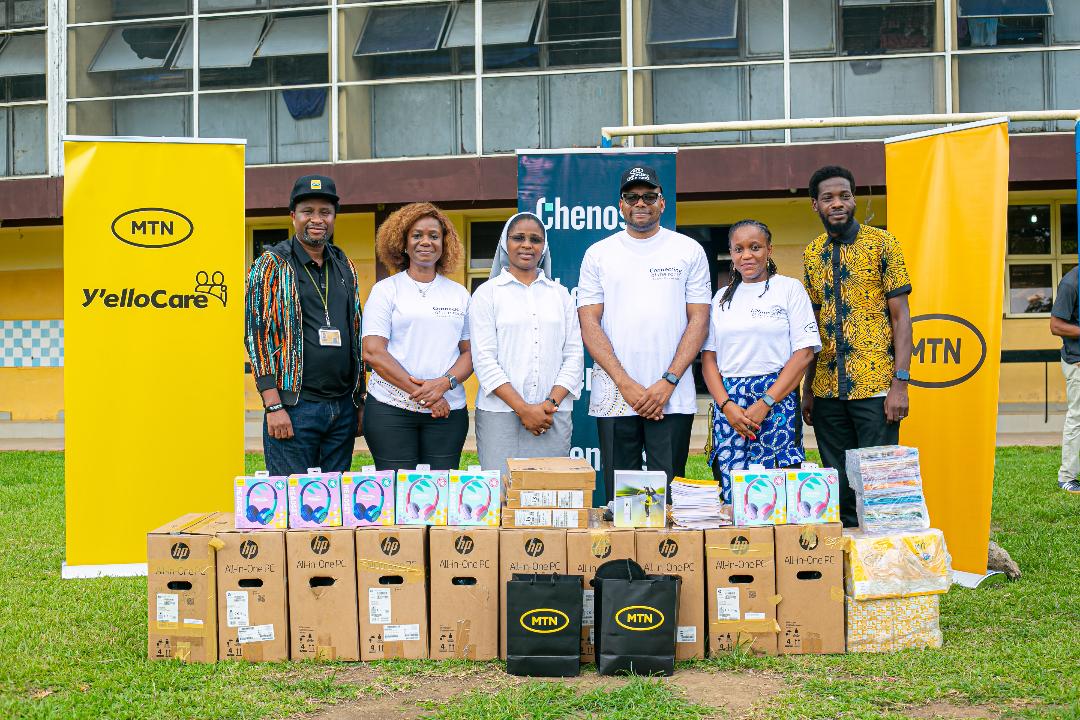
MTN Nigeria has donated a range of medical and digital equipment to the Obalende Primary Healthcare Centre in Lagos, reinforcing its commitment to enhancing grassroots healthcare through its annual Y’ello Care initiative.

The donation includes desktop computers, tablets, a 5G router, delivery beds, fans, chairs, and essential healthcare supplies, aimed at modernising the centre’s operations and improving patient care.
The initiative, now in its 18th year, mobilises MTN staff nationwide to support critical sectors via volunteering and targeted interventions, with this year’s theme focused on “Connecting at the Roots” and the staff chose to strengthen the primary healthcare centre which is closest to the vulnerable ones.
Medical Consultant at MTN Nigeria, Dr Idorenyin Oladiran, highlighted the challenges faced by primary healthcare centres, including staffing shortages, limited space, and inefficient manual record-keeping. She explained that MTN’s digital solutions are designed to transition centres from paper-based to electronic records, enhancing efficiency, data security, and seamless information sharing among healthcare providers. This digitisation also facilitates telemedicine, enabling specialists in urban areas to support colleagues in remote locations.
“Digitisation will empower healthcare workers, improve clinical decision-making, and help close the digital divide,” Dr Oladiran said. She acknowledged challenges such as limited connectivity and data privacy concerns but emphasised the importance of investing in infrastructure and training to ensure inclusive digital health transformation.
Team lead, MTN Nigeria, Sunday Ngegu, noted that the company dedicates 21 days in June, yearly, to community service, reflecting its corporate social responsibility ethos. “We are doing this in good spirit, not just as a telecommunications provider but as collaborators committed to the well-being of our communities,” he said.
Medical Official of Ikoyi/Obalende Local Council Development Area, Dr Akintayo Akintoba Adebayo, expressed profound admiration for the recent donation by MTN Nigeria to local healthcare centres, describing himself as “speechless” at the positive developments unfolding daily in the area.
He highlighted that Ikoyi/Obalende LCDA boasts two functional healthcare centres and emphasised the unpredictable nature of health issues, which require readily available resources for effective response.
Reflecting on the donated items, Dr Akintoba, who is also the Director of Health Planning, Research and Statistics for Lagos State Health District III, noted that most were essential medical supplies poised to significantly enhance healthcare delivery in the local government.
He also referenced Lagos State’s Health Information Platform, an initiative aimed at digitising healthcare processes across the state, including primary healthcare centres.
Dr Akintoba observed a shift in perception regarding technology in healthcare, stating that while computers were once considered unnecessary in primary centres, they are now recognised globally as vital, given that primary healthcare is the cornerstone of effective medical service.
Praising MTN Nigeria’s staff for their exemplary contribution, he called for collective responsibility, urging individuals to assess their environments and contribute meaningfully to societal improvement, saying government alone cannot do it all. He always underscored the universal need for healthcare. Whether for health promotion or sustaining wellbeing, and commended MTN Nigeria’s longstanding impact, particularly during the COVID-19 pandemic.
Dr Akintoba concluded by emphasising the importance of unity in addressing Nigeria’s critical health challenges, affirming that making a positive impact is a shared purpose and that MTN Nigeria’s recent intervention exemplifies this commitment.


Lebara Nigeria has become a member of the Global System for Mobile Communications Association (GSMA) as it expands operations in the West African country.

The membership places Lebara Nigeria within a global network of more than 1,000 mobile operators, device manufacturers, technology companies and digital service providers.
Through the GSMA, the company will have access to industry research, technical standards, policy engagement and industry initiatives.
Lebara Nigeria said the move reflects its participation in the wider telecommunications ecosystem as it develops its operations in Nigeria’s mobile market.
Nigeria’s telecommunications sector plays a central role in the country’s digital economy, with more than 170 million active mobile subscriptions supporting services such as digital payments, e-commerce, education and healthcare.
Industry analysts say participation in international bodies such as the GSMA supports knowledge sharing and the adoption of industry standards.
Lebara Nigeria said GSMA membership will support its engagement with industry developments and policy discussions in the telecommunications sector.
The company said it remains focused on operating in Nigeria’s mobile telecommunications market as demand for connectivity continues to grow.
GSM Association is the advocacy and lobbying organization for the mobile communications industry, representing more than 1,000 mobile operators as full members and a further 400 companies in the broader mobile ecosystem as associate members.

Management of Vitel Wireless, mobile virtual network operator (MVNO), has distanced the company from a fraudulent scheme operating under the name: “Vitel Shares Services.”

In an official statement, the management clarified that Vitel Wireless is not selling shares or running any investment schemes.
They warned that the operators of “Vitel Shares Services” are using unauthorised websites, mobile applications, social media promotions, and bank accounts falsely linked to Vitel Wireless to mislead the public.
The statement reads: “The attention of Vitel Wireless has been drawn to a fraudulent scheme operating under the name ‘Vitel Shares Services.’
“We wish to state clearly that Vitel Wireless has no affiliation with Vitel Shares Services, or any platform claiming to offer Vitel shares, investments, or financial products through unofficial channels.
“We do not solicit investments through agents, social media, websites, apps, or third parties. Any platform claiming to offer Vitel Wireless shares or investments outside our official channels is fraudulent and should be treated as such.
“We urge the general public to remain vigilant and verify all information through official Vitel Wireless communication channels before making any payments or sharing personal data.”

Airtel Nigeria has concluded its second Customer Forum in Abuja, bringing together a large section of customers including high-volume data subscribers, 5G customers, and key stakeholders in another landmark engagement aimed at addressing concerns around data usage, transparency, and customer experience.

The forum themed “Understanding Your Data and Taking Control 2.0.” aimed to strengthen trust in Nigeria’s rapidly evolving telecommunications landscape. The session also featured inputs from representatives of the Nigerian Communications Commission (NCC).
Delivering the Keynote remarks, Dinesh Balsingh, CEO of Airtel Nigeria, who was represented by Femi Adeniran, Director, Corporate Communications and CSR, emphasised that trust remains the most valuable currency in telecommunications, and Airtel remains committed to strengthening customer confidence through transparency and continuous engagement.
He explained that discussions around data consumption have become increasingly important as digital lifestyles evolve, with smartphones, cloud services, video streaming and emerging artificial intelligence applications significantly influencing data usage patterns.
According to him, Airtel recently introduced the Airtel Data Calculator, an innovative tool designed to help customers estimate their data needs based on online activities such as multimedia streaming, video calls, social media usage, and gaming.
“The purpose of the Airtel Data Calculator is to provide greater visibility, support informed decision-making and place more information directly in the hands of customers. Because transparency should never be viewed as a compliance exercise. Transparency is good business,” he stated.
He further reassured customers that Airtel has no incentive to shortchange subscribers through inaccurate billing, forced spending or unnecessary data depletion, stressing that the company’s growth depends on customer satisfaction, loyalty and trust.
Adeniran also highlighted Airtel’s continued investments in network infrastructure, fibre capacity, digital platforms, artificial intelligence capabilities, customer service systems and workforce development, noting that these investments are aimed at improving service quality and enhancing customer experiences.
Oladokun Oye, Director, Customer Experience, Airtel Nigeria, while welcoming participants to the event, said the forum was created to provide customers with an open platform for education, engagement and problem-solving, noting that the customer remains at the centre of Airtel’s business.
“Data has become central to everyday life, powering work, education, commerce, entertainment, healthcare and countless opportunities. As data usage grows, so too does the desire for greater visibility and understanding.
Today’s conversation is part of an ongoing journey. A journey toward greater transparency. A journey toward deeper understanding. And a journey toward a better customer experience for every Airtel subscriber,” he said.
The forum also featured practical demonstrations on data consumption management, device settings, and usage habits that impact data usage. It also included an interactive session by which Airtel teams provided clarifications and offered feedback to customers.
The Abuja event follows the successful maiden edition held earlier this year in Lagos and aligns with broader industry efforts led by the Nigerian Communications Commission (NCC) to improve consumer awareness, transparency, and confidence within the telecommunications sector.

UBA Surprises Thousands of Customers with Over ₦400 Million Cash Bonus

Lebara Nigeria Becomes Member of GSMA Network

FG to Abolish JSS-SSS Separation Policy after 20m Pupils Drop Out

Vitel Wireless Warns Public, Says it Not Running any Investment Scheme

Army Says Terrorists Now Recruiting, Raising Funds Online

Mobile Internet Gender Gap Widest in Africa – GSMA

London Strengthens Global Investment Ties with Africa @ First Ever London-Africa Business Summit

FG Targets Alleged N3tn Capital Flight, Opens Airtime Credit Market to Nigerian Fintechs

Japan, UNESCO Boost Digital Learning in 15 CoEs with Donation of ICT Equipment

Good News for DStv Users: Watch over 160 Channels Without Paying Extra




 E-Business3 days ago
LG Showcases AI-Powered Smart Living Innovations @ Africa Technology Expo 2026

 Telecom3 days ago
OADC Reaffirms Abundant Capacity in Data Centres in Nigeria to Host Financial Data

 E-Financial3 days ago
UBA mobilises employees across Africa for environmental clean-up, wellness campaign

 General News3 days ago
LASTMA Launches 3367 Toll-Free Hotline for Emergency Response, Traffic Management

 E-Financial3 days ago
PalmPay Calls for Trust, Infrastructure and Responsible AI to Drive Payment Ecosystem Innovation

 E-Business3 days ago
Want a Business Loan Without Interest? SMEDAN Launches N500m Fund

 Telecom3 days ago
ALTON Backs NCC’s Local Smartphone Manufacturing Drive to Widen Digital Access

 E-Financial2 days ago
Wema Bank Suspends Telegram Operations over Scams