

General News
NITDA DG says Nigeria’s Digital Economy Will Empower Citizens, Bridge Divides, and Drive Unity

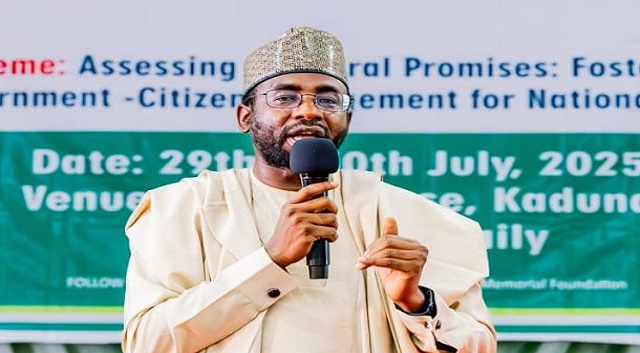
Kashifu Inuwa Abdullahi, CCIE, the Director General of the National Information Technology Development Agency (NITDA), has reiterated the Federal Government’s commitment to deepening digital literacy, accelerating innovation, and expanding technology infrastructure as key drivers of inclusive national development.

Inuwa said this while delivering an address at the 2-Day Interactive Session on Government–Citizens Engagement, organised by the Sir Ahmadu Bello Memorial Foundation at the iconic Arewa House in Kaduna.
Themed “Assessing Electoral Promises: Fostering Government Engagement for National Unity,” the forum convened high-level stakeholders in government, civil society, academia, and policymakers to reflect on the progress of the Renewed Hope Agenda of President Bola Ahmed Tinubu, particularly in the area of governance delivery and citizen inclusion.
Speaking at the event, Inuwa emphasised that digital transformation is not only central to achieving the eight priority areas outlined by President Tinubu, but also foundational to uniting the country through equitable access to opportunities.
He described the digital economy as a cross-cutting enabler capable of enhancing productivity across all sectors, from agriculture and education to healthcare and financial services.

According to him, “Digital technology is not a vertical sector, it is pervasive and foundational. It powers everything else and provides a framework for inclusive growth.”
The NITDA boss outlined the Agency’s strategic focus around three key pillars: human capital development, digital infrastructure, and innovation-driven entrepreneurship, noting that the Renewed Hope Agenda had brought renewed vision and energy to Ministries, Departments, and Agencies (MDAs), enabling them to act in concert and foster stronger trust between government and the private sector.
On human capital, he noted that Nigeria’s greatest resource is its people, and developing digital skills at scale is crucial to unlocking that potential. Through initiatives such as the 3 Million Technical Talent (3MTT) programme and the Digital Literacy for All campaign, NITDA has trained over 350,000 individuals in Northern Nigeria since 2023. He explained that the goal is to ensure that by 2027, more than 70 percent Nigerians would have attained basic digital literacy.
To achieve this, Inuwa said NITDA is working closely with the Federal Ministry of Education to embed digital skills into the formal education system from kindergarten to tertiary level. He added that partnerships with the National Universities Commission (NUC) are ongoing to ensure digital literacy becomes part of the general studies curriculum across Nigerian universities.
In addition, NITDA is collaborating with the National Youth Service Corps (NYSC) to train of corps members annually, who in turn serve as digital literacy champions, taking technology skills into rural communities and informal sectors.
Highlighting infrastructure as another critical area, Inuwa announced that the Federal Government had approved the deployment of 90,000 kilometers of fiber optic cables across the country to expand broadband penetration.
He also stated that three digital centres are currently being built in each state to ensure that underserved and unserved communities can participate meaningfully in the digital economy. Northern Nigeria, with its wide coverage and developmental needs, is expected to benefit immensely from this rollout. So far, 13 IT Community Centres, 101 Digital Economy e-learning Centres and One Cybersecurity Research Centre were established in the last two years.
He also disclosed that the conducive investment climate fostered by President Tinubu’s reforms has sparked renewed interest from global technology companies, with tech giants such as Google and Microsoft bringing significant investments in Nigeria.
Inuwa announced that Nigeria would host two major global technology events in the coming months, GITEX Nigeria in September and the United Nations’ ICT for Governance (ICEGOV) Summit in November—both of which are expected to attract global innovators and investors.



Federal government recently received a proposed protocol agreement from India that could pave the way for agricultural cooperation between the two countries.

Abishek Singh, India’s high commissioner to Nigeria, announced the proposal recently n Abuja during the India-Nigeria Business Forum on Agriculture and Allied Sectors.
New Delhi’s proposed cooperation would support Nigeria’s food security efforts, with the goal of reducing post-harvest losses by nearly 50% and expanding agricultural processing.
It would also cover technology transfers, mechanization, financing solutions and capacity building.
Abuja has opened similar discussions with China.
Only recently, Mukhtar Muhammed, permanent secretary at the Ministry of Innovation, Science and Technology, said Nigeria wanted to deepen scientific and technological cooperation with Beijing in agriculture.
The discussions with China have focused on developing low-cost, solar-powered cold storage facilities and transferring food-processing technologies.
Nigeria, also wants to work with Chinese research institutes to develop infrastructure that can improve the preservation of perishable products.
Nigeria’s outreach to its Asian partners addresses a major problem for the agricultural sector.
The Bank of Agriculture (BoA) estimates that Africa’s most populous country loses 30 million to 40 million tons of food each year before it reaches consumers.
Those losses are worth an average of about N3.5 trillion ($2.5 billion) annually, according to data the institution presented at a workshop in Kaduna in July 2026.
Perishable products are particularly vulnerable, according to local media reports, with fruits and vegetables accounting for an estimated 40% to 50% of total losses.
The government has already launched its own response to the problem.

Independent Corrupt Practices and Other Related Offences Commission (ICPC) indicted the National Information Technology Development Agency (NITDA) and other ministries over administrative lapses that allowed the fictitious Presidential Foreign Investment Promotion Council (PFIPC) to operate.

Musa Aliyu, chairman, ICPC, stated that NITDA, alongside the Office of the Secretary to the Government of the Federation (OSGF), the Budget Office, and other bodies, failed to carry out adequate due diligence and standard operating procedures.
ICPC said however, clarified that the findings pointed to severe internal control weaknesses and administrative negligence rather than active official complicity by NITDA and the other affected agencies.
The briefing followed a 30-day investigation ordered by the president on July 7 into allegations surrounding the purported presidential council.
The commission also cleared the presidency and the Central Bank of Nigeria (CBN) of any wrongdoing but blamed institutional lapses in several ministries, departments and agencies (MDAs).
Aliyu said investigators established that Adeniyi Adeyemi, the director-general, was never appointed by the federal government and that the PFIPC had no legal existence.
“As you may recall, on the 7th of July, Mr. President directed the ICPC to conduct an investigation into the fake Presidential Foreign Investment Promotion Council and submit a report within 30 days,” he said.
“Today, exactly within the stipulated period, we have submitted an interim report based on our interactions with all stakeholders involved.”
According to Aliyu, Tinubu directed the commission to make its findings public in the interest of transparency and accountability.
He said the investigation found that Adeyemi’s purported appointment letter was forged.
“It has been established that Adeniyi Adeyemi Matthew was never appointed by the Federal Government or any authority whatsoever,” he said.
“The Presidential Foreign Investment Promotion Council, which sometimes they called the Presidential Foreign Intervention Promotion Council, was never established by any law, executive order or any valid instrument of government.
“The appointment letter presented by Adeniyi Adeyemi Matthew was completely forged alongside similar documents used to perpetuate the illegal activities of the fake agency.”
Aliyu stated that a purported government gazette used to legitimise the organisation was also fabricated.
“If you recall, there was a gazette which he used to support the fake agency. That gazette is an illegal document that never passed through the processes prescribed by law,” he stated.
“Our investigation found that the office used by the fake agency was the office of the Presidential Economic Advisory Council. The office was broken into and access was gained illegally. That was how he was able to operate from there.”
Aliyu also revealed that investigators uncovered two additional fictitious government agencies allegedly created by the suspect — the FCT Investment Promotion Agency (FIPA) and the Foreign Investment Promotion Agency/Public-Private Partnership (FIPA-PPP).
According to him, fake legislative instruments were used to create the agencies and open bank accounts.
Despite the elaborate scheme, the ICPC chairman said the investigation found no evidence that federal government funds were disbursed to the fake council.
“Our investigation found that no funds of the federal government were approved or disbursed to the fake PFIPC,” he said.
“We also discovered no weaknesses in the systems of the State House or the Central Bank of Nigeria during our investigation. The fake appointment letter did not originate from the presidency.
“Our investigation found that some public officers failed to carry out due diligence and failed to comply with standard operating procedures in their ministries and departments. That gave him the opportunity to carry out these illegal acts.”

Nigeria tax system is build on taxing prosperity not poverty, according to Dr. Zacch Adedeji, executive chairman, Nigeria Revenue Service (NRS).

Dr. Zacch Adedeji, executive chairman, Nigeria Revenue Service
Adedeji, also dismissed the insinuation that the government’s tax reform is aimed at extracting money from Nigerians .
He said the essence of reform is creating an economic environment where individuals and businesses can prosper.
Dr. Adedeji made the clarifications on Sunday night while appearing on Channels Television’s Politics Today, where he defended the administration’s tax reforms and addressed concerns over rising government revenue amid the economic hardship facing Nigerians.
According to him, the government’s objective is to tax the fruits of investment rather than the investment itself.
“For us at Nigeria Tax, we are not there to extract. Our focus is not revenue. I don’t want to tax poverty. I’m to tax the fruit, not the seed, and I’m to tax the return, not investment.”
Adedeji explained that the government would generate more revenue as businesses became more profitable, without necessarily increasing the tax burden on individuals and companies.
He said a company that made N100 in profit could generate N30 in tax revenue for the government, but if its profit increased to N200 or N300, government revenue would rise accordingly.
“So, if I want to make more, I must work for you to make more. And that is why it is in the best interest of us in Nigeria Revenue Service that businesses are doing well, individuals are doing well,” he said.
He said the approach was consistent with President Bola Tinubu’s economic agenda, which seeks to remove barriers to investment and create a more conducive environment for businesses to operate and expand.
Adedeji cited reforms in the electricity sector as part of the government’s efforts to stimulate economic activity.
He noted that the Electricity Act had devolved powers to state governments to generate, transmit and distribute electricity, arguing that improved power supply would boost production and productivity across the economy.

Affordable, Flexible Streaming Platforms May Kill PAYtv – Report

FG Suspends NAICOM’s N680m Insurance Recapitalisation Fees

FG Taps Indian, Chinese Technologies to Tackle $2.5Bn in Food Losses

MTN Nigeria Clocks 25, Connects over 90m People

Subscribers to Seek Legal Redress if Poor Quality of Service Continue in September

EFCC Busts NIS Visa Overstay Racket, Uncovers N700m in an Account

Fact-Check: Elon Musk’s “Tesla Pi Phone” is Internet Rumor

NBC Tasks Broadcasting Stations over 2028 DSO Global Deadline

NBC Scraps Annual Digital Access Fee on DSO

Glo Sponsored African Voices to Feature Netflix’s “The Polygamist” Stars




 Telecom1 day ago
MTN Alerts Subscribers over Fake 25GB Anniversary MTN Data Giveaway

 E-Business1 day ago
X Replaces Revenue Sharing wit New Creator Rewards Programme

 E-Financial1 day ago
Interswitch, Temenos Commit to Advancing Nigeria’s Digital Banking Technology

 General News1 day ago
Fake Agency: ICPC Indicts NITDA, Others over Inadequate Due Diligence

 E-Financial1 day ago
FG Spent N3.1 Trillion on Domestic Debt Servicing in Q1- DMO

 General News1 day ago
UNESCO Taps Oguamanam,Nigerian Scholar to Advisory Body on Science, Tech Ethics

 General News1 day ago
Tax Reform Built on Taxing Prosperity, Not Poverty– Adedeji

 Broadcasting1 day ago
Awba-Ofemili Unveils 2026 Health Campaign, Offers Free Medical Screening