

General News
NITDA DG Urges Stronger Collaboration to Drive Nigeria’s Digital Economy

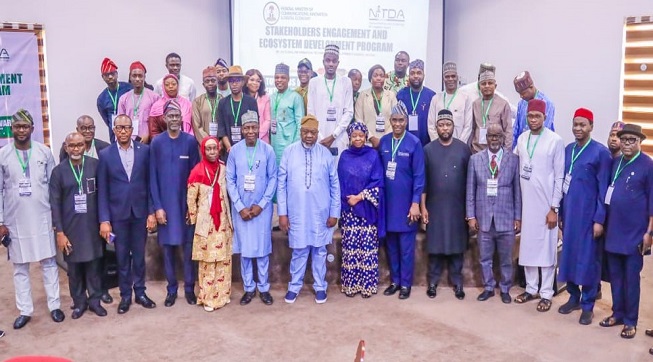
The Director General of the National Information Technology Development Agency (NITDA), Kashifu Inuwa, has called for stronger collaboration among stakeholders to unlock opportunities in Nigeria’s digital economy and accelerate national development.

Inuwa made the call at a NITDA-States IT Stakeholders’ Engagement and Ecosystem Development programme themed “Creating Opportunities, Breaking Boundaries: Towards Digitalization and Entrepreneurial Evolution.” in Abuja
Speaking at the event, the NITDA boss, represented by Mr Ajayi Babajide, Director Zonal Office Coordination, said Nigeria’s economy Africa’s largest by Gross Domestic Product (GDP) is at a critical juncture that requires urgent diversification, noting that the digital economy presents a strategic pathway to sustainable growth, job creation, and inclusive development.
He explained that in today’s interconnected world, digitalisation has become a key driver of economic transformation, offering unprecedented access to knowledge and creating opportunities for developing nations to compete globally.
According to him, the technology sector remains one of the fastest growing and most impactful segments of the global economy, stressing the need for Nigeria to position itself to fully harness its potential.
Inuwa reaffirmed NITDA’s mandate to drive and coordinate digital innovation across the country, adding that the agency is focused on creating an enabling environment that empowers all sectors, including underserved communities, to contribute meaningfully to the economy.
He highlighted the implementation of the agency’s Strategic Roadmap and Action Plan (SRAP 2.0), designed to deliver life-transforming opportunities and strengthen Nigeria’s digital ecosystem. He also pointed to the National Digital Literacy Framework (NDLF), which aims to equip citizens across various sectors with the digital skills required to thrive in a rapidly evolving economy.
The DG disclosed that NITDA has established over 100 IT centres nationwide and provided infrastructure to support digital learning and skills acquisition. However, he emphasised that sustaining and expanding these initiatives would require deeper collaboration with stakeholders.
He called for stronger partnerships among government at all levels, the private sector, academia, and civil society, noting that innovation thrives in an ecosystem supported by effective policies, access to funding, and enabling regulations.
Inuwa also stressed the importance of investing in innovation hubs and incubators to nurture startups from ideation to market readiness, enabling them to compete favourably on the global stage.
On entrepreneurship, he noted that NITDA has continued to support innovation through its special purpose vehicles, including the Office for Nigerian Digital Innovation (ONDI) and the National Centre for Artificial Intelligence and Robotics (NCAIR), which provide incubation, acceleration, and training programmes for startups and young innovators.
He observed that Nigeria’s innovation ecosystem has attracted significant investments and produced globally recognised startups, including unicorns, but said more efforts are needed to sustain the momentum.
Inuwa further noted that digitalisation holds immense potential for economic diversification, job creation, and inclusive growth, but warned that these opportunities must be deliberately harnessed through robust policies, legal frameworks, and strong institutional support.
He said the engagement provided a platform for stakeholders to exchange ideas, co-create solutions, and align strategies for the effective rollout of digital initiatives across states in line with SRAP 2.0.
The NITDA boss reiterated the agency’s commitment to fostering partnerships and providing the necessary support to drive Nigeria’s digital transformation, expressing confidence that collective efforts would deliver lasting impact.
He urged participants to remain committed to building a future where innovation thrives, opportunities are accessible, and Nigeria’s digital economy reaches its full potential.
In his earlier keynote address, the Permanent Secretary, Ministry of Innovation, Science and Technology Kogi State, Pharm. Eric Monday, explained that the state’s digital strategy is focused on applying technology to critical sectors, particularly healthcare, where efforts are underway to improve data management and expand service coverage. He added that similar interventions are being extended to works and environmental management.
He noted that outcomes from previous stakeholder engagements had helped shape actionable plans, stressing the importance of collaboration in achieving sustainable progress.
“Our goal is to learn from others while also sharing our experiences. The knowledge gained from engagements like this will help us strengthen our systems, create opportunities for our youth, and support skills development,” he said.
Highlighting ongoing projects, he disclosed that a skills acquisition centre, supported by development partners, is nearing completion and will soon be equipped to train young people in relevant digital skills.
Monday further revealed that the state is expanding its partnerships beyond Nigeria, including collaborations with Chinese organisations, to build a robust innovation ecosystem and open up new economic opportunities.
Describing Kogi as a “land of opportunity,” the official said the government is committed to leveraging its strategic position as the Confluence State to attract investment and promote growth.
Other dignitaries who delivered remarks at the event included the Permanent Secretary, Ministry of Science and Technology, Nasarawa State, Mr. Damina John, as well as the Executive Director, Commercial and Industry Development at the North Central Development Commission (NCDC), Mrs. Aisha Rufai.



Federal government has signed a concession agreement for the deployment of a contactless biometric passenger verification system across Nigeria’s domestic airports.

The initiative, known as VPASS, is designed to strengthen aviation security, improve data integrity and boost revenue generation.
Festus Keyamo, minister of Aviation and Aerospace Development, said the agreement followed the concurrence of the Infrastructure Concession Regulatory Commission, the Attorney-General of the Federation and approval by the Federal Executive Council.
Keyamo said the system will eliminate discrepancies in passenger records, curb unauthorized boarding and ensure all domestic air travellers are properly identified, closing existing gaps in standard identification procedures.

Association of Licensed Set-Top Box Manufacturers of Nigeria (STBMAN) has waxed worriedly over the National Broadcasting Commission’s (NBC) repeated violations of due process in managing the country’s Digital Switch Over (DSO) project.

In a statement released in Abuja, Sir Godfrey Ohuabunwa, chairman, STBMAN, stated that the NBC’s actions are slowing down Nigeria’s transition from analogue to digital broadcasting and discouraging local investors who have committed resources to the project.
Ohuabunwa noted that Nigeria began serious discussions on DSO in 2008, yet 17 years later, the country has made little progress, while nations that once sought Nigeria’s assistance have completed their own transitions.
“STBMAN has repeatedly called for the protection of local manufacturers, strict compliance with the federal government’s White Paper on DSO, and full respect for the rule of law, but these calls have been ignored,” Ohuabunwa said.
The NBC’s alleged plan to import hybrid set-top boxes from China has been criticized by STBMAN, which says this move disregards the heavy investments already made by licensed Nigerian manufacturers and contradicts the President’s directive to prioritize locally made products.
“The manufacturers have invested in equipment, technology upgrades, and workforce training, expecting government support and policy stability,”he added.

PowerLabs aims to expand its platform into Nigeria’s most energy-intensive sectors with the new funding. Providing hospitals and industrial hubs with the intelligent, automated control required to ensure continuous power and operational resilience.

PowerLabs, a Nigerian energy and climate-tech startup, announced the successful close of its pre-seed funding round led by Breega, with participation from Catalyst Fund, Mercy Corps Ventures, and Kaleo Ventures.
This strategic investment will accelerate the rollout of Pai Enterprise, the company’s flagship AI-enabled energy orchestration platform across commercial and industrial enterprises in Nigeria and lay the foundation for expansion into key West African markets
For decades, Nigerian energy management has centered on basic monitoring and tracking of energy consumption. Yet for the millions of businesses dealing with unreliable power grids, diesel generators, rooftop solar, inverters, and battery banks working together to keep operations running, visibility alone delivers no real value unless it leads to resilience and continuity.
The manufacturing sector alone spent ₦1.11 trillion on alternative energy sources in 2024, which is a 42% increase from the year before. A small factory changes its work hours based on when it can get generator fuel. To keep critical care going, a hospital coordinates backup systems.
Every day, the facility team of a commercial building has to make dozens of decisions about reactive energy. Monitoring tools already in use tell you what went wrong, but they do not provide solutions or preventive measures to address the issues identified.
Pai Enterprise changes that equation. Unlike conventional dashboards, Pai Enterprise does not simply observe; it senses, communicates, and actuates across multiple distributed energy sources in real time. By continuously modelling supply, demand, and operational constraints, the platform enables organizations to run their own intelligent microgrid. As a result, the platform transforms energy from a reactive problem into a proactive, strategic resource.
This vision of a self-optimizing energy ecosystem was recently highlighted in a feature that explored how PowerLabs wants to make Nigeria’s grid think by shifting the paradigm from passive consumption to active, intelligent orchestration.
The measurable impact spans Nigeria’s most critical sectors:
- Hospitals: With intelligent monitoring across critical circuits, teams are instantly notified when there are fluctuations in supply, voltage drops, or automatic transitions to backup systems. This real-time visibility ensures that departments like intensive care, laboratories, and operating theatres remain protected, enabling faster response, reduced risk of disruption, and continued patient care.
- Data Centres: By providing continuous insight into the performance of energy assets such as solar systems and generators, operators can track efficiency, optimize usage, and reduce emissions without compromising uptime. The result is a more sustainable infrastructure that still meets the uncompromising reliability standards required for digital operations.
- Factories: Factories require more than just stable power, they need actionable intelligence to drive performance and profitability. Through detailed energy analytics, operators can identify inefficiencies, understand consumption patterns across production lines, and make informed decisions that reduce costs while maintaining output. This transforms energy from a fixed expense into a controllable lever for operational efficiency.
- Retail outlets: By analyzing consumption trends and usage behavior, retail outlets can right-size their energy assets, avoiding overinvestment while ensuring sufficient supply during peak periods. This leads to lower operating costs and improved energy efficiency across single or multi-site retail operations.
- Critical facilities: For critical facilities such as telecom towers, banks, schools etc, uninterrupted operations depend on anticipating issues before they occur. Continuous real-time monitoring enables early detection of anomalies and supports predictive maintenance strategies, reducing downtime and extending asset lifespan.
Tobe, CEO & Co-Founder, PowerLabs said: “Distributed energy resources are often seen as fragmented and chaotic, a clutter of devices that don’t speak the same language. At PowerLabs, we believe decentralization doesn’t have to mean disorder. We’re building the intelligence layer that will prove that distributed energy resources can operate as a unified source while leveraging its disaggregation to offer flexibility, cost efficiency, carbon neutrality and redundancy … more than a centralised energy system ever could. “
PowerLabs will strategically deploy the raised capital to accelerate the rollout of its flagship Pai Enterprise platform, improve its cutting-edge predictive load-management algorithms, and broaden seamless integration with distributed energy assets ranging from rooftop solar and battery storage systems to traditional grid infrastructure.
This funding round brings together a mix of global and Africa-focused investment partners with deep commitment to climate-tech and a proven track record of scaling innovation in emerging markets, all aligned on PowerLabs’ mission to solve energy resilience.
Breega is an international fund investing in digital, climatech, and deeptech companies across Europe and Africa. Mercy Corps Ventures backs market-systems solutions in fragile and frontier markets; Catalyst Fund, a leading climate-tech investor backing solutions for climate adaptation and resilience in Africa. Kaleo Ventures specializes in early-stage technology companies across high-growth African markets. With their support, PowerLabs is now positioned to scale its intelligent energy solutions, expand Pai Enterprise across sectors and geographies, and demonstrate that the era of traditional energy management is over. Personalized, decentralized, resilient, and intelligent systems are the future, and for millions of people and organizations, that future is already here.
Tosin Faniro-Dada, Partner, Breega, stated that: “We backed PowerLabs at the pre-seed stage because we believe intelligent orchestration will be essential to solving Africa’s energy reliability challenge. The team is building the software and hardware layer that enables businesses to coordinate multiple distributed energy sources in real time. We’re excited to support them as they prove the impact of this model across critical sectors over the next 12–18 months.
The closing of this investment round is therefore more than a financial milestone: it is a signal that investors, businesses recognize the need for energy systems that do not merely report, but act; that do not assume stability, but adapt in real time; and that view energy not as a static commodity, but as a platform for growth, resilience, and human potential.
“Globally, more and more businesses and critical services like data centers operate in complex energy environments where a mix of energy sources must work together. The energy users typically have to toggle between cost, quality of supply and carbon footprint. PowerLabs is starting in Africa to build the intelligence to orchestrate these systems seamlessly without sacrificing any of these critical factors.” Olúwátóyìn Emmanuel-Olúbákè, Chief Investment Officer, Catalyst Fund
Energy management alone is not enough, and for millions of users who have long struggled with outages, unreliable grids, and fragmented infrastructure, the promise of intelligent energy is not merely convenience; it is the key to unlocking their full potential and powering a new era of human progress.

FG to Gift Nigerians over 100 Free TV Channels from May 15

FG New Approves Biometric Passenger Verification System for Airports Security

STBMAN, NBC Bicker over Alleged Due Process Breaches

CBN Dismisses Polaris Bank Liquidation Claim

AfDB Okays $200m for Nigeria’s Digital Backbone, Others

Spotify’s Loud & Clear Report Reveals Over ₦60Bn Revenue for Nigerian Artists in 2025

Kuda MFB Increases Kuda for Her Business Grants to ₦10 Million

Why JustMarkets Is a Strong Choice for Gold Trading

Canal+ to Cut Jobs as Part Sweeping Restructuring

Nigeria tops global rankings for USDT, USDC ownership




 E-Financial2 days ago
See Key Changes in BVN Rule from May 1 by CBN

 E-Financial2 days ago
How Sterling Bank Is Empowering 1m Women with ₦500Bn

 E-Financial2 days ago
Paga Group Rejigs Leadership as Oviosu, Founder Becomes Group CEO

 Broadcasting2 days ago
INEC Warns Broadcasters against Misinformation ahead of 2027 Polls

 E-Financial2 days ago
Reputation: The Real Currency Powering Fintechs

 E-Business2 days ago
Jumia Expands Nationwide Footprint, Deepens Reach Across Underserved Nigerian Cities

 News2 days ago
Google, UpSkill Universe Relaunch Hustle Academy to Bring Free AI Skills to Africans

 Telecom2 days ago
Meta Unveils Muse Spark: MSL’s Groundbreaking People-First AI Model