

E-Financial
Transcorp Excites Shareholders with ₦20.3 Billion Dividend @20th AGM

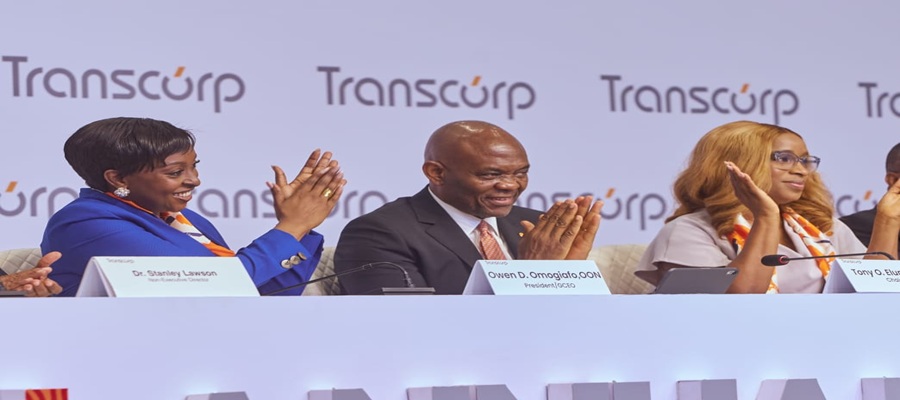
Transnational Corporation Plc (“Transcorp Group” or the “Company”) (NGX: TRANSCORP), Africa’s leading listed conglomerate with strategic investments in power, hospitality and energy, has declared a total dividend of ₦20,323,995,148, representing ₦2.00 per share to its shareholders, at its 20th Annual General Meeting (AGM), held at the new state-of-the-art Transcorp Centre Abuja.

Group Chairman, Mr Tony O. Elumelu, CFR; President/Group CEO,, Mrs. Owen D. Omogiafo, OON; and Company Secretary, Ms. Atinuke Kolade, during the 20th Annual General Meeting (AGM) of Transnational Corporation Plc( Transcorp Group) held in Abuja at the weekend
The total dividend comprises an interim dividend payment of ₦4,064,799.030, representing 40 kobo per share, paid in August 2025, together with a final dividend of ₦16,259,196,118, equivalent to ₦1.60 per share.
At the AGM, where the shareholders approved the Audited Financial Statements for the year ended December 31, 2025, the Group Chairman of Transcorp Plc, Mr Tony O. Elumelu, CFR, restated the company’s commitment to delivering sustainable long-term value creation as shareholders commended the conglomerate and its management for sustained performance.
In 2025, the Group, with a combined market capitalisation of ₦4.78 trillion ($3.52 billion) as of May 7, 2026, recorded strong year-on-year growth across all key metrics. Revenue increased by 33% to ₦544 billion (FY 2024: ₦408 billion). Profit Before Tax rose 31% to ₦179.5 billion (FY 2024: ₦136.7 billion), while Profit After Tax surged 44% to ₦135.9 billion (FY 2024: ₦94.1 billion)
Group Chairman, Mr Tony O. Elumelu, CFR; President/Group CEO,, Mrs. Owen D. Omogiafo, OON; and Company Secretary, Ms. Atinuke Kolade, during the 20th Annual General Meeting (AGM) of Transnational Corporation Plc( Transcorp Group) held in Abuja at the weekend
Mr. Tony O. Elumelu, CFR, Group Chairman, Transnational Corporation Plc said: “Transcorp Group remains firmly focused on strong corporate governance and the disciplined execution of its strategic priorities to deliver sustainable, long-term value. Despite a challenging macroeconomic environment, the Group continues to benefit from its diversified portfolio, which has underpinned resilient financial performance in 2025.

Mrs. Owen D. Omogiafo, OON, President/Group CEO, Transnational Corporation Plc said: “FY 2025 was a year defined by disciplined execution, strategic resolve, and resilient performance. Transcorp Group is committed to resolving the energy crisis in Nigeria; we have an energy situation, and the gap between the demand and supply is still very wide. Hence, we will continue to work assiduously and tirelessly towards bridging that gap, creating value for the wider country.
In our hospitality business, the 5,000-seat capacity Transcorp Centre hosting us today is a testament to our disciplined execution, and you will see more in the coming years.
While commenting on the performance, one of the shareholders, Mrs E. O. Obideyi, commended the management of Transcorp Group, saying, “I commend the management and staff of Transcorp for sustained performance year-on-year. While we appreciate the Board, I am also extending my commendation to the members of staff of Transcorp for a job well done.”
Another Shareholder, Mr Moses Igrude, commended the Board, Management and Staff of Transcorp Plc. He said: “I appreciate the vision behind Transcorp and what it has become. When I look at the history, and how far it has come under Mr Tony Elumelu’s leadership, I am proud that the aim and objectives are being achieved. That payoff line, ‘Improving lives and transforming Africa,’ is a reality we are witnessing.
Transnational Corporation Plc (Transcorp Group) is one of Africa’s leading listed conglomerates, with strategic investments in power, hospitality and energy, driven by its mission to improve lives and transform Africa.
The Group’s power businesses — Transcorp Power Plc and Transafam Power — provide over 20% of Nigeria’s installed power capacity. Transcorp is also advancing Nigeria’s domestic energy value chain through its investment in OPL281. Its hospitality subsidiary, Transcorp Hotels Plc, owns the iconic Transcorp Hilton Abuja and the landmark Transcorp Centre Abuja.


The next currency crisis could accelerate the shift of the roughly $315 billion global stablecoin market into a digital-dollar alternative for citizens in emerging economies, notably in regions like sub-Saharan Africa and Latin America.

As local fiat currencies face devaluation and high inflation, citizens and businesses are increasingly utilizing smartphone-based stablecoins (such as USDT and USDC) as hedges and primary mediums of exchange.
According to the International Monetary Fund (IMF), the rapid adoption of dollar-linked digital assets—particularly in countries heavily affected by inflation like Nigeria—poses significant risks to monetary sovereignty.
With up to 95% of surveyed individuals in some African markets preferring to receive payments in stablecoins over local fiat, the rising volume of these decentralized, cross-border channels weakens domestic currency demand and dilutes the effectiveness of local monetary policy.
IMF observed in a report titled “Stablecoins in Nigeria: A Growing Cross-Border Channel” noted that the widespread use of stablecoins poses risks to monetary sovereignty, particularly as more individuals and businesses turn to digital dollar-linked assets for savings and transactions.
Nodding in agreement is Future Investment Initiative Institute (FII Institute), a non-profit organisation run by the Public Investment Fund, Saudi Arabia’s main sovereign wealth fund.
FII Institute said that central banks face structural challenges.
And according to the institute, when citizens move savings out of national banks and into private digital wallets, conventional capital controls lose their grip.
Institutions like the Bank for International Settlements warn that interest-bearing stablecoins compete directly with domestic-currency deposits, complicating financial oversight and making smartphone-based transfers incredibly difficult for authorities to monitor.
In Nigeria, Naira depreciation has pushed users toward dollar-stablecoins, according to report by Gino Matos in cryptoslate.com.
A stablecoin is a type of cryptocurrency designed to maintain a steady value by pegging its price to a reserve asset, such as a fiat currency (e.g., the U.S. dollar) or a commodity (e.g., gold).
They act as a bridge between traditional money and the digital asset world, providing the speed of crypto without the extreme price swings of assets like Bitcoin.
Federal government has reopened three federal government of Nigeria (FGN) bond issues valued at N1.2 trillion for subscription as part of efforts to raise long-term funds from the domestic debt market.

The Debt Management Office (DMO), which announced the offer on Tuesday, said the three reopened bond issues are each valued at N400 billion.
According to the DMO, the first offer is the January 2035 FGN Bond, a 10-year reopening, carrying an interest rate of 22.60 per cent per annum.
The second is the May 2028 FGN Bond, a 15-year reopening, with a coupon rate of 15.45 per cent per annum, while the third is the June 2037 FGN Bond, a 20-year reopening, also valued at N400 billion.
The office said the bond auction is scheduled for July 20, while successful subscriptions will be settled on July 22.
It explained that the bonds are offered at N1,000 per unit, with a minimum subscription of N50 million and additional investments in multiples of N1,000.
For the reopened bonds, the DMO said successful bidders would pay a price based on the yield-to-maturity that clears the auction, in addition to any accrued interest on the instruments.
Interest on the bonds will be paid every six months, while the principal will be repaid in full on the respective maturity dates.
The DMO reaffirmed that FGN bonds are backed by the full faith and credit of the Federal Government and constitute obligations chargeable on the general assets of the federation.
It added that the bonds qualify as trustee investment securities under the Trustee Investment Act and enjoy tax exemptions for eligible investors, including pension funds, under the Company Income Tax Act and Personal Income Tax Act.
The bonds are listed on the Nigerian Exchange (NGX) and FMDQ Securities Exchange and also qualify as liquid assets for banks in computing their liquidity ratios.
FGN bonds are long-term debt instruments through which investors lend money to the Federal Government in exchange for periodic interest payments and repayment of the principal at maturity.
Gigbanc, Nigerian fintech startup, has announced it is winding down operations, after three years, citing a tough fundraising climate.

Paul Omoregie Okundaye, and Babatope Oni, co-founders of Gigbanc
The company, which set out to build cross-border financial infrastructure for African freelancers, creators, entrepreneurs and businesses, confirmed the decision in a statement signed by its co-founders.
“After careful consideration, Gigbanc’s leadership has made the difficult decision to wind down operations,” the company said, adding that the move “reflects the broader funding environment affecting early stage startups in Africa, a challenge that has been widely documented across the ecosystem.”
Since its founding, Gigbanc grew a community of more than 150,000 people across multiple countries and processed over $7.28 million (N10 billion) in payment volume, helping thousands of users receive their first international payment.
The company also ran conferences, fellowships and community events aimed at connecting entrepreneurs and creators across the continent.
`Despite the shutdown, Gigbanc said it is not walking away emptyhanded.
The company disclosed that it is in active acquisition discussions with a prominent financial infrastructure firm, with further details to be shared once the process closes.
Paul Omoregie Okundaye, co-founder and CEO, and Babatope Oni, co-founder and CTO, framed the closure as the end of a chapter rather than the erasure of Gigbanc’s impact.
“While Gigbanc is winding down operations, we don’t see this as the end of what we built together. Instead, we see it as the completion of an important chapter,” the founders said. “The relationships, lessons, community, and impact we’ve created will continue to outlive the company itself.”
The founders thanked users for their trust throughout the company’s run, citing everything from transactions and feature requests to bug reports and criticism as forces that shaped the product
“We leave this journey incredibly proud. Proud of our team, who gave everything they had.
Proud of the community that rallied behind us,” they said.
Gigbanc’s exit adds to a growing list of African startups that have shut down or scaled back operations in recent years as venture funding on the continent has tightened, with founders increasingly citing capital scarcity as the primary driver behind closures and consolidations.

Next Currency Crisis May Turn $300Bn in Stablecoins into National Currencies

NIHSA Warns States of Possible Flood within Seven Days

FG to Raise N1.2 Trillion via Fresh Bond Offer – DMO

Gigbanc Nigerian Fintech Startup Closes Shop after 3 Years

Mbunabo, Nigerian Filmmaker Accuses Ghana TV Stations of Pirating Nollywood Films

NRC, Ponzi Scheme Collapses Resulting Loss of Billions of Naira

Nigeria Launches FreeTV Nationwide

NASENI Moves to Digitize CCB’s 5m Assets Declaration and Operations

Lebara Nigeria Launches Lebara Play, Africa’s First Telecom-Owned Micro-Drama Platform

CANAL+ Partners Samsung to Pre-Load DStv Stream on New Samsung TVs In Nigeria, Other African Countries




 News2 days ago
Xora Finance, Fintech Firm Refuses to Hire Nigerians over Alleged Dishonesty

 Telecom2 days ago
NCC Advances Dig Once Policy, Engages Stakeholders on Cost-Based Framework for Duct Sharing

 Telecom2 days ago
NCC to Keynote Telecom Sector Sustainability Forum 7.0

 General News2 days ago
FG Secures Fresh $208.3m World Bank Loan for Cash Transfer
 News2 days ago
How Ponzi Scheme Victims can Seek Legal Remedies — Lawyers

 News2 days ago
PalmPay Nigeria Appoints Samuel Oluyemi as Chief Operating Officer

 Telecom1 day ago
MTN Nigeria Slashes Cost of Broadband Internet Router, Unwraps New Data Bundles for Low-Budget Users

 General News2 days ago
SERAP Sues INEC over Alleged N800Bn 2027 Tinubu Campaign Fund