

Telecom
NAIFF Returns for 2026, Expands Focus on AI-Powered Storytelling in Africa


Nigeria AI Film Festival (NAIFF) returns this September 2026 at Alliance Française Lagos to continue exploring the growing role of AI in filmmaking across Africa.

Following a strong debut, the festival founded by Obinna Okerekeocha has quickly become a gathering point for filmmakers, technologists, and creatives who are curious about what AI means for storytelling and where it’s all heading.
In its first edition last year, NAIFF recorded over 400 submissions and hosted a mix of curated screenings, panel conversations, and its AI Academy, an initiative focused on giving creatives practical tools for AI-driven production. The director of communications and panel host for the event, Chidera “Odera Collins” Okonji, described the experience as “a necessary disruption,” noting how it challenged familiar ways of telling stories and opened up new creative possibilities.
Many attendees shared similar reflections, describing the festival as immersive, eye-opening, and genuinely educational. For a lot of people, it was their first, hands-on experience seeing how AI is already shaping filmmaking within Nollywood and across Africa.

Building on that momentum, the 2026 edition is set to go even further. This year’s festival will place a stronger emphasis on experimentation, collaboration, and more grounded conversations around the ethical use of AI in film. The goal is simple: to keep pushing what’s possible while supporting the people actually doing the work.
The festival will feature:
- Screenings of selected AI-driven films
- Industry panels and conversations
- Hands-on workshops and training sessions
- Networking opportunities across creative and tech communities
NAIFF continues to position Nigeria within the global conversation on the future of filmmaking, one where technology supports, rather than replaces, human creativity.
Submissions for the 2026 edition opened on May 1 and will close on July 31. Filmmakers, artists, and digital creators are invited to submit works that explore new ways of telling stories with AI.
Speaking on this year’s call for entries, Director of Programs Chisom Ifeakandu described the current moment in filmmaking noted that African storytellers deserve to be at the centre of conversations around AI and creativity.
“We want to see films that use AI not as a gimmick, but as a real tool in service of stories that matter,” she said. “Show us something we’ve never seen before, make it feel true, and make it unmistakably yours.”
As the industry continues to evolve, NAIFF remains focused on building a space where innovation in African cinema can grow in a meaningful and sustainable way.
For submissions: https://filmfreeway.com/NaijaAIFilmFestival



Wireless Application Service Providers Association of Nigeria (WASPAN) has asked the Court of Appeal to suspend the enforcement of the Federal Competition and Consumer Protection Commission’s (FCCPC) Digital, Electronic, Online or Non-Traditional Consumer Lending Regulations, 2025 (DEON Regulations).

WASPAN warned that the implementation before the determination of its appeal could expose telecom value-added service providers to sanctions and disrupt their operations.
Millions of subscribers across the country rely on borrowed airtime to communicate.
Seun Sofoluwe, an Abeokuta, Ogun State resident, said another interruption would have severe consequences for many Nigerians who depend on airtime and data lending services for their daily communication needs.
“A lot of people depend on the services, and it will be very bad for them, especially those who are so reliant on it that they do debt-to-debt servicing,” he said.
Debt-to-debt servicing refers to the practice of repaying an outstanding airtime loan immediately to qualify for another advance, underscoring the extent to which some subscribers depend on the facility to remain connected.
Sofoluwe’s concerns echo the experience of Lagos-based employee Farouk Rabiu, who recounted the hardship caused by the six-month suspension of airtime lending services before they were restored.
“I was devastated because, after exhausting my data, I was hoping to borrow credit to access my bank account. Instead, it was a major disappointment,” Rabiu had said after the services resumed.
Adding another dimension to the debate, Gbenga Adebayo, chairman of the Association of Licensed Telecommunications Operators of Nigeria (ALTON), said the earlier disruption showed that airtime credit had evolved far beyond a conventional telecommunications offering.
“What this episode demonstrated is that airtime credit is not a financial product in the way regulators initially characterised it. It is economic infrastructure that approximately 40 million people use regularly, with the vast majority of them at the base of the economy,” Adebayo said.
WASPAN, which represents licensed value-added service providers, has asked the Court of Appeal to restrain the FCCPC from enforcing the DEON Regulations pending the hearing of its appeal against the July 20 judgment of the Federal High Court in Lagos.
The association argued that immediate enforcement would expose operators to sanctions, create regulatory uncertainty and disrupt telecom-enabled services, including airtime credit and data advances, used daily by millions of Nigerians.
The FCCPC, however, has defended the resumption of enforcement, insisting the regulations are intended to sanitise the digital lending industry, curb predatory debt recovery practices, protect consumer data and eliminate illegal digital lenders.
The Court of Appeal is expected to determine whether enforcement of the regulations should remain suspended while it considers WASPAN’s appeal, a decision that could shape the future of telecom-based digital lending services and determine whether subscribers continue to enjoy uninterrupted access to airtime and data credit.

Nigerian Communications Commission (NCC) and the Rural Electrification Agency (REA) have entered into a partnership to deploy renewable energy solutions for telecommunications infrastructure in rural and underserved communities, a move expected to reduce operators’ energy costs and improve network availability.

Abraham Oshadami, executive commissioner for Technical Services at the NCC, disclosed this during the signing of a memorandum of understanding (MoU) in Abuja.
According to Oshadami, the NCC-REA Stakeholder Forum and MoU signing ceremony will enable telecom base stations located near mini-grids to access cleaner and more affordable electricity, reducing their reliance on diesel-powered generators.
He said the agreement came at a time when telecom operators are facing rising operational costs due to increased spending on diesel to power network sites amid unreliable electricity supply from the national grid.
The partnership reflects the growing relationship between the power and telecommunications sectors, as both rely on each other to deliver essential services.
Oshadami explained that while telecom infrastructure requires a steady power supply to remain operational, digital connectivity also supports electricity services such as smart metering, electronic payments and remote customer management.
According to him, the collaboration is aimed at improving access to reliable electricity and telecommunications services, particularly in remote communities where inadequate power supply has slowed digital inclusion.
He said both agencies had identified telecom base stations located within one to two kilometres of existing mini-grids, allowing the implementation of the initiative to begin immediately.
“Where mini-grids exist, we are able to identify nearby base stations and connect them to those power sources,” Oshadami said.
He added that future mini-grid projects would be planned with telecommunications infrastructure in mind, ensuring that electricity investments also support the expansion of digital services.
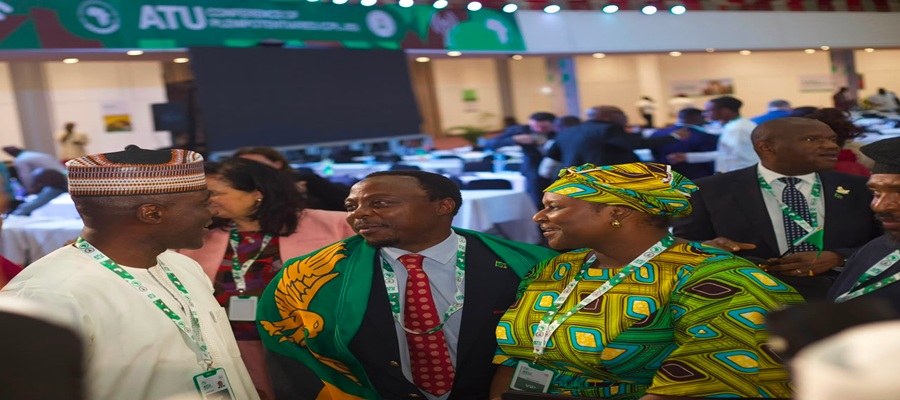

Executive Vice Chairman of the Nigerian Communications Commission, NCC, Dr Aminu Maida and the Executive Commissioner Stakeholder Management, NCC, Barr. Rimini Makama, congratulating Engr. Kezias Kazuba Mwale of Zambia (middle) as the newly elected Secretary General of the African Telecommunications Union, ATU, at the 7th Ordinary Session of the ATU Conference of Plenipotentiaries held in Abuja, Nigeria on 24th July 2026.

See Verified 20 Countries Nigerian Passport Holders Can Travel Visa-Free

NPC Opens 131 Births, Deaths Registration Centres in Anambra

Lagos Chamber Opposes 21 Percent Pension Contribution, Warns of Job Losses

Subscribers, Telcos Warn FCCPC over Airtime Lending Enforcement

NCC, REA Partner to Cut Telecom Costs with Renewable Energy

NRC, Ponzi Scheme Collapses Resulting Loss of Billions of Naira

EFCC Busts NIS Visa Overstay Racket, Uncovers N700m in an Account

Tokenization, Blockchain Technology will Transform Financial Institutions – IMF

From Scarcity to Scale: What Africa Can Learn from India’s Agricultural Transformation

Spotify partners Afro Nation Portugal to expand African music experience




 Telecom2 days ago
GSMA Supports Abuja Declaration on Meaningful Connectivity for Africa, Joins Partners to Launch ATLAS Umoja

 Telecom2 days ago
Airtel Secures Another 10-year Spectrum Renewal in Nigeria

 Telecom2 days ago
MTN Nigeria Warns Customers Against Fake ‘One Month Free Data’ Promotion

 News2 days ago
Nigeria, Israel Strengthen Research, Technology Collaboration

 Broadcasting2 days ago
Glo Sponsored African Voices to Feature Netflix’s “The Polygamist” Stars

 E-Business2 days ago
HURIWA, CLO Protests Bill Asking Social Media Firms’ to Open Shops Nigeria

 General News2 days ago
Anambra Govt Bans Graduation Ceremonies in Anambra Schools

 E-Financial2 days ago
Moniepoint as a Key Driver in Expanding Financial Access for Businesses in Nigeria