

General News
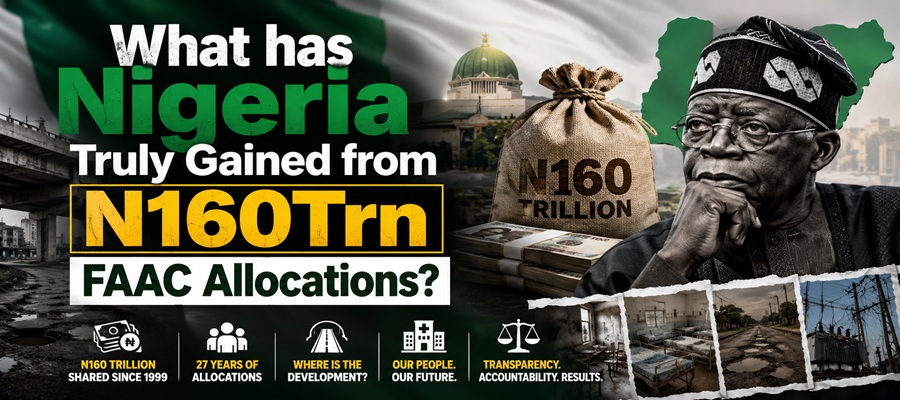
What Has Nigeria Truly Gained from N160Trn FAAC Allocations

By Blaise Udunze
Could it be said that Nigeria’s true identity today represents a country suffering and grappling with soaring inflation, mass unemployment, failing public infrastructure and multidimensional poverty despite almost three decades of enormous public revenue inflows? With the look of things, one question therefore deserves urgent national attention. Without missing any words, what exactly has government at all levels done with the trillions of naira shared through the Federation Account Allocation Committee (FAAC)?

FAAC Allocations
One obvious fact is that since the return to democratic governance in 1999, Nigeria has witnessed a remarkable expansion in federal revenue sharing since the existence of this country.
Findings based on monthly allocations reported by FAAC and the National Bureau of Statistics (NBS) showed that over the past 27 years, the FAAC has distributed an estimated N160 trillion among the Federal Government, the 36 states and the 774 local governments. The obvious here is that the figure represents one of the largest transfers of public resources in Nigeria’s history.
One would definitely assume that, since the removal of the fuel subsidy in June 2023, government revenues have risen dramatically. Not to miss out on other gains from crude oil earnings, statutory revenue, Value Added Tax (VAT), exchange-rate adjustments, electronic money transfer levies, customs collections and other federally collected revenues, resulting in unprecedented monthly FAAC allocations.
In 10 years alone, FAAC distributed approximately N25.58 trillion to the three tiers of government, with states and the FCT receiving about N13.8 trillion during the period. One would also wonder that since President Bola Tinubu assumed office in May 2023, more than N56 trillion has been distributed through FAAC.

Surprisingly, amidst it all, in just over three years, President Tinubu’s administration has presided over FAAC distributions amounting to approximately 35 percent of the estimated N160 trillion shared since the return to democracy in 1999. In other words, more than one in every three naira ever distributed through FAAC over 27 years has been shared under the current administration. But this recent figure represents only a fraction of the larger national story.
The more important question is not simply how much money has been shared. The question is what Nigeria has built with more than N160 trillion in public allocations over nearly three decades.
What is of concrete concern is that the sheer size of N160 trillion is difficult to comprehend until placed beside Nigeria’s major economic indicators.
Nigeria’s total public debt stood at approximately N149.39 trillion as of March 31, 2025. This means that the estimated FAAC allocations shared since 1999 are larger than the country’s entire current debt stock. While FAAC funds cannot directly be compared with debt because they serve different fiscal purposes, the comparison highlights a critical reality that shows that Nigeria has generated and distributed enormous financial resources, yet still carries one of Africa’s largest debt burdens.
The comparison with national budgets is equally revealing. Come to think of it, Nigeria’s proposed N58.18 trillion 2026 budget represents one of the largest annual spending plans in the country’s history, whilst the cumulative FAAC allocations since 1999 are equivalent to almost three times the size of Nigeria’s 2026 federal budget.
No doubt, the implication is profound. A country that has shared resources equivalent to several annual national budgets should reasonably demonstrate significant improvements in infrastructure, healthcare, education, electricity, industrialisation and citizens’ welfare. But the reality remains different.
One thing is obvious today and cannot be disputed by the political players, both past and present is that Nigeria continues to struggle with poor roads, unreliable electricity, inadequate healthcare facilities, overcrowded classrooms, high unemployment and widespread poverty.
The truth is that the comparison becomes even more striking when looking at specific sectors as this would provide a clearer picture. Considering that Nigeria’s recent proposed 2026 budget allocates approximately N3.52 trillion for education, N2.48 trillion for health and N3.56 trillion for infrastructure, bringing the combined allocation for these three critical sectors to about N9.56 trillion. While the estimated N160 trillion shared through FAAC since 1999 is more than 16 times the combined 2026 federal allocation for education, health and infrastructure.
This raises a fundamental question: if Nigeria has received resources sufficient to finance these strategic sectors multiple times over, why do citizens continue to experience declining social services?
The comparison with capital investment is also significant. Nigeria’s proposed 2026 capital expenditure of N26.08 trillion is only a fraction of the estimated FAAC allocations shared since 1999. Had a substantial portion of these revenues been consistently channelled into productive capital projects, Nigeria could have developed world-class transportation networks, reliable electricity systems, modern healthcare facilities, industrial clusters and globally competitive education infrastructure.
That is the scale of the opportunity Nigeria has had. Instead, millions of Nigerians continue asking a painful question: Where is the evidence?
Economic theory is straightforward. When governments receive large financial resources, citizens expect corresponding improvements in their standard of living. Public revenue exists to create public value, not merely to finance government administration. Imagine what N160 trillion could have achieved if strategically invested over 27 years.
Nigeria has an estimated housing deficit exceeding 28 million units. A sustained investment programme using only a fraction of FAAC resources could have delivered millions of affordable homes while creating massive employment opportunities across construction, cement, steel, furniture and logistics industries.
Strategic agricultural investment could have transformed Nigeria into a food-secure nation through irrigation systems, mechanised farming, storage facilities, rural roads and agro-processing industries.
Investment in healthcare could have ensured that every local government has functional primary healthcare centres equipped with trained personnel, essential medicines and modern facilities.
Education could have been completely transformed through improved teacher training, digital learning infrastructure, modern classrooms, research facilities and expanded access to quality education.
Nigeria’s electricity challenge could have received far greater attention through investments in transmission networks, renewable energy, gas-powered generation and embedded power solutions that would reduce the cost burden on businesses and households.
A significant portion of FAAC resources invested in small and medium-sized enterprises could have created millions of jobs, expanded local production and strengthened Nigeria’s private sector.
None of these ambitions were beyond Nigeria’s financial capacity. The resources existed. The challenge has been utilisation.
Across many states, FAAC has gradually become less of a development catalyst and more of a monthly survival mechanism. Salaries, recurrent expenditure, political appointments, administrative costs and government overheads consume substantial portions of public resources, while capital projects remain insufficient.
The dependence on FAAC has also discouraged many states from aggressively developing sustainable internally generated revenue. Many states still depend heavily on federal allocations, weakening fiscal innovation and reducing accountability. A system where governments wait monthly for federal transfers creates little incentive to build productive economies.
Ironically, decades of increased allocations have coincided with worsening economic realities. Food prices continue rising. Millions remain unemployed or underemployed. Hospitals struggle with inadequate equipment. Schools remain overcrowded. Roads continue deteriorating. Manufacturers battle high energy costs. Businesses continue closing. Families spend more of their income meeting basic needs.
This contradiction raises serious governance questions. In Nigeria’s case, painfully, revenue growth does not automatically create development. Development requires transparency, accountability, strategic planning and effective implementation.
Nigeria must therefore move beyond celebrating monthly FAAC figures and begin measuring the outcomes generated from those resources.
Every month Nigerians hear announcements of billions and trillions shared among governments. But rarely do they hear: How many hospitals were completed? How many schools were renovated? How many kilometres of roads were delivered? How many jobs were created? How many communities gained access to clean water? How many businesses were supported?
Revenue announcements must never replace performance reports. Every state and local government should publish transparent FAAC utilisation reports showing allocations received, projects funded, costs, locations and measurable outcomes.
Technology makes this possible. Open budgeting platforms, public expenditure dashboards and digital monitoring systems can ensure citizens know how their resources are being deployed.
Transparency should no longer be optional. The Federal Government equally has a responsibility.
Higher revenues must translate into improved national infrastructure, stronger institutions, better security, industrial growth and enhanced social protection.
Nigeria cannot continue borrowing heavily while simultaneously receiving record public revenues without demonstrating corresponding developmental outcomes.
Public finance is not simply about collecting money. It is about creating lasting value. Roads improve commerce. Electricity supports industries. Education increases productivity. Healthcare strengthens human capital. Agriculture reduces dependence on imports. Digital infrastructure enhances competitiveness. These are investments that create future prosperity.
When public revenue is consumed mainly by recurrent obligations, future generations inherit debts without corresponding assets.
Nigeria must strengthen accountability institutions, including auditors-general, public accounts committees, anti-corruption agencies and civil society organisations, to monitor how FAAC resources are utilised.
Citizens also have a responsibility. Public money belongs to the people. Communities must demand evidence of projects funded by government resources.
The tragedy of Nigeria is not simply a shortage of revenue. It is the failure to convert revenue into development. Nigeria has demonstrated remarkable ability to generate public income. What remains lacking is the political discipline and institutional capacity to transform that income into national prosperity.
The estimated N160 trillion shared through FAAC since 1999 represented a historic opportunity to rebuild Nigeria’s economy and improve citizens’ lives.
Millions of jobs could have been created. Infrastructure could have been transformed. Poverty could have been reduced. Investor confidence could have strengthened. Living standards could have improved.
Instead, many Nigerians continue to experience economic hardship despite decades of enormous public revenue distribution.
History will not judge governments by how much FAAC they received. History will judge them by what those allocations built.
The real question is no longer whether Nigeria has enough money. The question is whether Nigeria has the leadership, accountability and political will to convert public wealth into public prosperity. Not to focus on using the FAAC as an electoral tool to weaponize the opposition. Until that happens, N160 trillion in FAAC allocations will remain a symbol of missed opportunity rather than a foundation for national transformation.
Blaise, a journalist and PR professional, writes from Lagos and can be reached via: [email protected]


United States Government has said that Nigeria is not making significant progress in fiscal transparency, referencing gaps in the country’s budget disclosure, expenditure reporting, public procurement transparency and audit processes.

The assessment is contained in a report by the United States Department of State, which reviewed Nigeria’s fiscal transparency practices in its 2026 fiscal transparency report for countries published on Tuesday.
The report noted that the US government stated that Nigeria made some key fiscal documents available to the public, significant shortcomings remained in the disclosure of budgetary information and the management of public finances.
The report noted that “the government made its enacted budget and end-of-year report widely and easily accessible to the public, including online, but did not publish its executive budget proposal within a reasonable period.”
It also stated that while the Nigerian government had made information concerning the country’s debt obligations publicly available, its budget documents failed to provide a comprehensive picture of government revenues and expenditures.
“The government made information on debt obligations, including major state-owned enterprise debt, publicly available, but budget documents did not provide a substantially complete picture of the government’s revenues and expenditures, or break down expenditures to support executive offices in the budget,” the report stated.
The US government further raised concerns about discrepancies between Nigeria’s approved budget and the actual revenues and expenditures recorded during implementation.
It said, “Actual revenues and expenditures did not reasonably correspond to those in the enacted budget.”
The report also criticised the country’s supreme audit institution, stating that it did not meet international standards of independence and did not publish substantive reports, although it had access to the entire executed budget.
“The supreme audit institution did not meet international standards of independence or publish substantive reports but did have access to the entire executed budget,” it stated.
The assessment, however, acknowledged that Nigeria’s sovereign wealth fund had an adequate legal framework and disclosed information about its funding and the general approach to withdrawals.History
“The sovereign wealth fund had a sound legal framework and disclosed its source of funding and general approach to withdrawals,” the US government said.

The World Bank Group is supporting the expansion of Africa’s digital commerce infrastructure to help small businesses reach new markets, create jobs, and strengthen economic opportunities across the continent.

Through Jumia, Africa’s leading e-commerce platform, the investment is expected to enable approximately 60,000 local annual active sellers to participate more fully in the digital economy, support around 1,800 direct jobs, and create income-generating opportunities for more than 100,000 independent sales agents.
As digital commerce continues to grow across Africa, reliable access to online marketplaces, logistics networks, and digital payments are becoming increasingly important for entrepreneurs and small businesses seeking to expand beyond local markets. Strengthening this infrastructure can help firms increase sales, improve productivity, and connect consumers with a wider range of affordable goods and services.
To support this effort, the International Finance Corporation (IFC), the private sector arm of the World Bank Group, is investing US$25 million in equity in Jumia Technologies AG (Jumia), Africa’s largest public e-commerce platform. The investment will support Jumia’s next phase of growth across its core African markets, strengthening its integrated marketplace and logistics network.
By expanding access to digital commerce tools and services, the investment will help businesses grow, improve price transparency, and contribute to more inclusive and resilient private sector development across Africa.
“The support of the World Bank Group is a milestone for Jumia and for African e-commerce more broadly. It validates both the discipline we have brought to our business in recent years and the tangible impact our platform has on small businesses, jobs, and consumers across our eight markets. With partners like the IFC, we can accelerate the digital commerce infrastructure Africa needs” said Francis Dufay, CEO of Jumia.
“Jumia demonstrates how pan-African e-commerce platforms can expand economic opportunity at scale. Our investment supports the company’s next phase of growth while contributing to create jobs, digitizing supply chains and distributions channels and mobilizing private investment” said Farid Fezoua, Director for Equity, Funds, and Venture Capital at the International Finance Corporation, World Bank Group.

Nigerian Upstream Petroleum Regulatory Commission (NUPRC) has cautioned the public against fake recruitment offers and fraudulent employment letters circulating in the agency’s name.

Eniola Akinkuotu, head of Media and Corporate Communications of the Commission, stated that NUPRC has received reports of counterfeit and AI-generated appointment letters bearing names not known to the regulator.
The Commission also said fraudsters have been extorting money from jobseekers by promising placement within the agency.
NUPRC has reported the incidents to law enforcement and said investigations are underway.
The regulator reiterated that there is no ongoing recruitment exercise and warned members of the public not to make any payments for supposed job offers.
“Whenever the Commission decides to recruit, the process will be conducted strictly in accordance with extant laws and government regulations,” the statement said.
The Commission urged jobseekers to verify any purported offer and to rely only on official NUPRC communications for recruitment information.
The warning follows growing concerns about the misuse of digital tools, including artificial intelligence, to fabricate apparently authentic documents that can deceive the public.

Nigeria Not Making Progress in Fiscal Transparency –US

NCAA to Introduce RFID Technology to Tackle Missing Luggages

SEC Directs Operators to Subscribe to NigSac Alerts, Freeze Terrorists-Linked Funds

Davido Bets $1m in Hit-for-Hit Battle with Colleagues

GSMA Industry Services Unveils Circularity Services to Help Operators Reduce E-Waste and Unlock Value

EFCC Busts NIS Visa Overstay Racket, Uncovers N700m in an Account

Fact-Check: Elon Musk’s “Tesla Pi Phone” is Internet Rumor

NBC Tasks Broadcasting Stations over 2028 DSO Global Deadline

NBC Scraps Annual Digital Access Fee on DSO

Glo Sponsored African Voices to Feature Netflix’s “The Polygamist” Stars




 News2 days ago
Moove Achieves Unicorn Status With $250m Funding

 Telecom2 days ago
MTN Nigeria Clocks 25, Connects over 90m People

 E-Financial2 days ago
FG Suspends NAICOM’s N680m Insurance Recapitalisation Fees

 E-Business2 days ago
Microsoft to Unveil Next-generation AI Chip in September

 Telecom2 days ago
Subscribers to Seek Legal Redress if Poor Quality of Service Continue in September

 Broadcasting2 days ago
Affordable, Flexible Streaming Platforms May Kill PAYtv – Report

 E-Financial2 days ago
SEC Moves to Recover Unclaimed Dividends, Inherited Investments Nationwide

 Telecom2 days ago
ipNX Collaborates with ICT Stakeholders on the Future of Fibre-to-the-Home in Nigeria @ ATCON Forum