

General News
UPS Foundation Doles Out Over $2.4n for Global Volunteerism Initiatives


The UPS Foundation announced that it will award more than $2.4 million to nine nonprofit organizations focused on volunteer efforts.
This includes $1.2 million awarded to the Points of Light Foundation to support its disaster relief initiatives, its Veterans Leadership Program and its Direct-to-People Digital Strategy which will extend the organizations reach to engage and recruit more volunteers around the world. Additional initiatives that the volunteerism grants will support include leadership training programs, youth development and education, financial literacy and pro-bono counsel.
“One of UPS’s primary values is giving back to the communities in which we do business,” said Eduardo Martinez, president of The UPS Foundation.
“As volunteers are at the heart of building community resiliency, UPS believes it would be virtually impossible for non-profits and NGOs to operate without them. By supporting the efforts of our partner organizations that focus on increasing volunteerism, UPS has been able to create lasting and impactful efforts for organizations committed to leadership, youth development, financial literacy and disaster relief. As a way to reinforce our commitment, UPS has set a goal of completing 20 million hours of global volunteerism and community service by the end of the year 2020,” the president said.
Since 2011, UPS employees and their families have completed more than 5 million volunteer service hours to support disaster relief, youth leadership development and educational programming, among a wide range of initiatives.
Following UPS’s 12th annual Global Volunteer Month in October, more than 2,400 employees volunteered 315,000 hours around the world where UPS serves its local community, demonstrating the company’s commitment to reaching its 2020 goal.
In total, nine organizations will receive The UPS Foundation’s 2014 volunteerism grants, including:
BoardSource toward programs that strengthen and support nonprofit board leadership capacity and impact the overall sustainability and effectiveness of the nonprofit sector.
International Association for Volunteer Effort (IAVE) toward the continued development support of the IAVE Global Network, national and local NGO
capacity assessments, staffing capacity and National Volunteer Centers, GCVC Disaster Research Working Group and the continued development of global youth platform and volunteer centers.
Junior Achievement Worldwide toward the “Be Entrepreneurial” program, an initiative that teaches high school students entrepreneurship, financial literacy and work readiness.
National Youth Leadership Council toward initiatives that develop young leaders (K-12) and to expand current partnerships with schools in Georgia, Minnesota and Illinois from a current total of 11 schools to 27 schools.
Peace Corps toward funding four distinct initiatives, including the Gender and Development Fund (forming women’s cooperatives and youth leadership camps), the Business Development Fund (micro-finance and agribusiness projects), Environment Fund (awareness activities and projects for greener infrastructure) and the Global Fund (building classrooms, providing agricultural assistance and working with youth education projects).
Pro Bono Partnership of Atlanta to support its nonprofit legal check-up program, which pairs nonprofits with trained attorneys who conduct in-kind legal audits.
Tapfound Inc. to provide skills-based volunteerism to local organizations with needs in marketing, design, human resources, technology and strategic planning across the U.S. (Chicago, Los Angeles, New York, San Francisco and Washington, D.C.).
Toolbank USA to support of the Tool Bank Disaster Response Mobile Unit which allocates grant dollars to the launch of the organization’s disaster services and the expansion of the national ToolBank network.
UPS is a global leader in logistics, offering a broad range of solutions including the transportation of packages and freight; the facilitation of international trade, and the deployment of advanced technology to more efficiently manage the world of business.
Since its founding in 1907, UPS has built a legacy as a caring and responsible corporate citizen, supporting programs that provide long-term solutions to community needs.
Founded in 1951, The UPS Foundation is responsible for facilitating community involvement to local, national, and global communities.
In 2013, UPS and its employees, active and retired, invested more than $102 million in charitable giving around the world.


General News
NIS Deploys Advanced Surveillance Masts, other Critical Infrastructure to Boost Border Security


Nigeria Immigration Service (NIS) has said that under the first phase of its e-border solution, surveillance masts equipped with 24-hour thermal and optical monitoring capabilities have been deployed across several border locations, providing surveillance coverage of 10 to 15 kilometres during the day and up to 5 kilometres at night.

The service also assured that it will continue to modernise border security management through the deployment of advanced technology and critical infrastructure.
DCI Akinsola Akinlabi, spokesman for the NIS, who made this known during a news briefing by Spokespersons for security, defence and law enforcement agencies in Abuja, said that the phase two of the e-border solution is expected to expand coverage to additional land border points.
Akinlabi said the Service has also established an Integrated Operating Centre (IOC) to serve as a central hub for real-time intelligence gathering, surveillance, and data harmonisation relating to foreign nationals.
He said the NIS recorded significant operational successes in strengthening border security, combating transnational crime, and enhancing migration management between January and May 2026.
“During the reporting period, the Service intensified enforcement operations against irregular migration and related transnational crimes, resulting in the repatriation of 567 foreign nationals for violations of Nigeria’s immigration laws and regulations.
“In addition, six foreign natio nals were deported, comprising four individuals arrested for their involvement in a visa racketeering syndicate and two others who were deported after completing prison sentences for criminal offences.
“The Service also strengthened efforts to curb identity fraud and abuse of national documentation. Enforcement operations led to the recovery of 47 National Identification Number (NIN) cards from irregular migrants, while 21 stowaways were apprehended at various seaports as they attempted to illegally enter or exit the country through unauthorised means.”
Akinlabi said aside enforcement activities, the Service continued to invest in preventive and community-based initiatives aimed at addressing the root causes of irregular migration and cross-border crime.
“In March 2026, the Seme Border Command conducted sensitisation programmes for drivers’ associations, commercial motorcyclists, and community stakeholders to promote safe, orderly, and regular migration practices.
“Similarly, the Idi-Iroko Border Command carried out public awareness campaigns across markets, motor parks, and schools to educate border communities on the dangers and security implications of trans-border crimes.”


Mr. Emmanuel Ovaga, the Chief Executive Officer (CEO) of PufferPay Limited will deliver the keynote paper at the 3rd Business Journal Fintech & Financial Inclusion Roundtable 2026 scheduled for Friday, July 31, 2026 at Oriental Hotel, Lekki Road, Victoria Island, Lagos.

The theme of the Roundtable is: Fintech: Driving the Future of Digital Financial Ecosystem in Nigeria. Mr. Emmanuel Ovaga is a graduate of Computer Engineering from the Enugu State University of Science and Technology, Enugu State.
He is a technology entrepreneur and business leader with a strong track record in building and scaling innovative digital and enterprise solutions across Africa.
As the CEO of PufferPay, he drives the company’s vision to deliver seamless, secure and inclusive payment solutions tailored for emerging markets.
He is also the Chief Executive Officer of Pufferfish Technology Limited, a Pan-African IT and consulting firm specialising in software development, data analytics and systems integration for both public and private sector clients.
Under his leadership, the company has established strategic partnerships with globally recognised technology providers, including industry leaders in enterprise computing and analytics.
Pufferfish Technologies Limited has in a few years of its existence, birthed PufferPay, a fintech payment business created to enhance financial inclusion and payments facilitation in Africa.
PufferPay is created with best-in-class technology for transaction speed and security that guarantees top-range service delivery to its growing customers.
Reacting to the development, the Publisher/Editor-in-Chief of Business Journal Media Group, Prince Cookey said:
“Mr. Emmanuel Ovaga represents the next generation of tech leaders in the fintech space in Nigeria and Africa. His laudable accomplishments as the CEO of PufferPay Limited deserve accolades. He has positioned PufferPay as a leading player in the digital financial ecosystem in Nigeria and emerging corporate tentacles across the continent. Accordingly, stakeholders attending the 3rd Business Journal Fintech & Financial Inclusion Roundtable 2026 would be looking forward to a robust conversation on the State of the Fintech market today and tomorrow.”
The Special Guests of Honour include Dr. Aminu Maida, Executive Vice-Chairman/CEO, Nigerian Communications Commission (NCC) and Mr. Olusegun Omosehin, Commissioner for Insurance/CEO, National Insurance Commission (NAICOM) while Alhaji (Dr.) Umaru Kwairanga, Group Chairman, Nigerian Exchange Group (NGX) will Chair the event.
The Guest of Honour is Mrs. Ekeoma Ezeibe, President/Chairman of Council, NCRIB.
Distinguished members of the Panel include:
- Dr. Muda Yusuf, CEO, Centre for the Promotion of Private Enterprise (CPPE)
- Mrs. Idu Okeahialam, Group Managing Director/CEO, Royal Exchange Plc
- Mr. Jide Orimolade, Managing Director/CEO, Stanbic IBTC Insurance Limited
- Dr. Obioha Oti, President, Association of Mobile Money and Bank Agents in Nigeria (AMMBAN)
- Mr. Sarafadeen Fasasi, President, Association of Financial Inclusion Agents of Nigeria (AFIAN)
- Chidubem Emelumadu, Ecosystem Lead (Africa), Lisk
The revolutionary success story of Moniepoint, Opay, PalmPay, Flutterwave and others in the digital payment system in Nigeria represents a positive expansion of the financial services sector in the country.
With millions of Nigerians and businesses lacking access to basic financial services, the importance of Fintechs remain sacrosanct in achieving substantial level of Financial Inclusion and expanding the frontiers of the industry.
According to AI Overview, Fintechs in Nigeria have revolutionised the financial landscape by dramatically increasing access to banking services, driving, for example, a 20% increase in financial inclusion and helping to bring the banked population to roughly 63%. These firms have introduced faster, affordable digital payments, lending, and investment services, forcing traditional banks to adopt digital transformation.
On investment, AI Overview stated: “Fintechs in Nigeria dominate the tech landscape, securing 35% of total tech funding ($2 billion total) in 2024, with over 430 companies attracting roughly 36% of all African fintech investment. Despite global challenges, the sector remains highly resilient, driven by high demand, with significant deals including Moniepoint’s $110 million series C.”
In January 2026, the Central Bank of Nigeria (CBN) granted national licences to Moniepoint, Opay etc, giving them the regulatory authority to operate across the 36 States of the Federation. The decision firmly underscores the great strides by Fintechs in driving Financial Inclusion and supporting sustainable economic growth in the country.
The 3rd Business Journal Fintech & Financial Inclusion Roundtable 2026 aims to underscore the positive contribution of Fintechs in deepening Financial Inclusion, expanding access to financial services and contributing to economic growth in the country.
Expected participants at the Roundtable include regulators, operators from key sectors of the economy, media and members of the public.
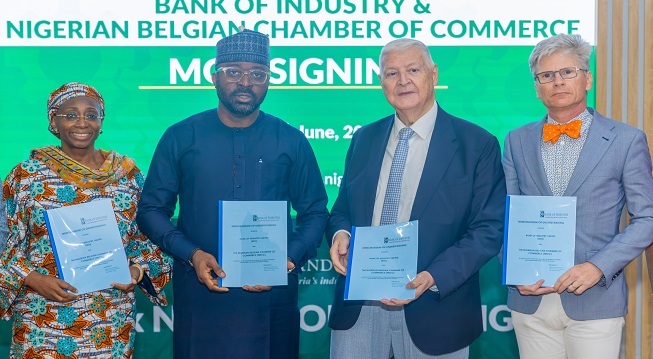
The Bank of Industry (BoI), Nigeria’s foremost Development Finance Institution (DFI), has signed a landmark Memorandum of Understanding (MoU) with the Nigerian Belgian Chamber of Commerce (NBCC), setting the stage for deeper economic cooperation, expanded investment flows, and stronger industrial partnerships between Nigeria and Belgium.

The agreement was signed during a high-level breakfast meeting jointly hosted by BoI and the NBCC under the theme, “Scaling Operations, Expanding Capacity, and Accessing Competitive Finance.” The event convened senior government officials, diplomats, business leaders, development partners, MSMEs, and private sector stakeholders committed to advancing bilateral trade and industrial development.
Speaking on behalf of the Managing Director and Chief Executive Officer of the Bank of Industry, Dr. Olasupo Olusi, the Executive Director, Corporate Finance, Sustainability and Investments, Mr. Rotimi Akinde, described the partnership as a strategic milestone in BoI’s drive to expand global collaborations that accelerate Nigeria’s industrial transformation.
“As Nigeria’s leading Development Finance Institution, the Bank of Industry has consistently recognised that sustainable industrial development is built not only on access to finance but also on enduring strategic partnerships.
“This collaboration with the Nigerian Belgian Chamber of Commerce reflects our commitment to creating stronger international business corridors that unlock investment, facilitate technology transfer, support MSMEs, and strengthen Nigeria’s industrial competitiveness,” he said.
Akinde noted that Belgium remains one of Europe’s most dynamic trading and investment destinations, making the partnership an important platform for promoting co-investment opportunities, export development, enterprise growth, and knowledge exchange between businesses in both countries.
The two-year renewable MoU establishes a framework for joint business forums, investment roadshows, trade missions, business matchmaking, enterprise capacity development, and increased promotion of BoI’s financing solutions to Belgian investors and businesses operating in Nigeria.
The collaboration is also expected to improve access to foreign direct investment, expand export-oriented industrial projects, and create stronger commercial linkages between BoI-supported enterprises and the Belgian business community.
Delivering the welcome address, His Excellency Pieter Leenknegt, Ambassador of the Kingdom of Belgium to Nigeria, commended the growing economic relationship between both countries and expressed optimism that the partnership would create new opportunities for businesses on both sides.
The General Manager of the Nigerian Belgian Chamber of Commerce, Marc Eeckhout, described the agreement as a practical platform for translating business interest into measurable economic outcomes.
“This Memorandum of Understanding represents more than an institutional partnership; it creates a structured bridge between Belgian innovation and Nigerian enterprise. By working closely with the Bank of Industry, we are opening new pathways for investment, technology exchange, and business collaboration that will enable companies from both countries to scale with confidence while contributing to sustainable industrial development,” he said.
The breakfast dialogue featured presentations on business expansion, industrial financing, and competitiveness, with contributions from industry leaders, including Engr. Vincent Adegbotolu, Managing Director/CEO of DWC Engineering, and Mudiaga Okumagba, Managing Director/Chief Executive Officer of Direct Logistics Plus.
The partnership aligns with BoI’s 2025–2027 Corporate Strategy, which prioritises industrialisation, MSME development, youth and skills, women’s economic empowerment, climate finance, digital transformation, infrastructure, and export promotion. With assets valued at over ₦6.8 trillion, the Bank continues to strengthen strategic international partnerships that support the Federal Government’s industrialisation agenda while creating jobs, enhancing productivity, and promoting sustainable economic growth.
Through the collaboration, BoI expects to attract new investment opportunities from the Belgian business ecosystem, increase financing for high-impact industrial projects, strengthen export value chains, and improve the investment readiness of Nigerian enterprises through joint advisory and capacity-building initiatives.
The Bank reaffirmed its commitment to working with global partners to unlock long-term capital, accelerate industrial growth, and position Nigeria as a competitive investment destination within Africa and beyond.

Zedvance appoints Prof. Olanrewaju as board chairman

SERAP Asks Akpabio, Abbas for Explain N1.3Bn Budgeted for ‘Fictitious’ Presidential Council

No Plans for Fresh Tariff Hike – MTN

FG Denies N8 Trillion ‘Shadow Budget’, Says IMF Quoted out of Context

Tokenization, Blockchain Technology will Transform Financial Institutions – IMF

Mobile Internet Gender Gap Widest in Africa – GSMA

Nigeria Launches FreeTV Nationwide

NASENI Moves to Digitize CCB’s 5m Assets Declaration and Operations

UK, Nigeria Launch £15m Growth Programme to Accelerate Economic Transformation

CANAL+ Partners Samsung to Pre-Load DStv Stream on New Samsung TVs In Nigeria, Other African Countries




 Broadcasting3 days ago
Why We’re Partnering With NIHOTOUR To Bring Nigerians In South Africa Home – Steve Babaeko

 News3 days ago
FG Clears N39Bn Pension Arrears for NITEL, PHCN, Other Retirees

 News3 days ago
How Fraudsters Emptied a Judge’s Account of N7.2 Million in Midnight Attack

 Telecom3 days ago
MTN Nigeria Celebrates Volunteers at Y’ello Care Impact Showcase

 E-Financial3 days ago
SEC Grants Approval to Luno, Other Crypto Firms under Regulatory Sandbox

 Telecom3 days ago
Google Play launches $1m fund to support African game developers

 Telecom3 days ago
Xenophobia: MTN Nigeria Belongs to Nigerians, Not Only South Africans — Toriola

 Telecom3 days ago
MTN Takes ‘The Gathering on 100’ Youth Empowerment Initiative to Kano