

E-Financial
CWG Earns CBN PTSP Operational Licence

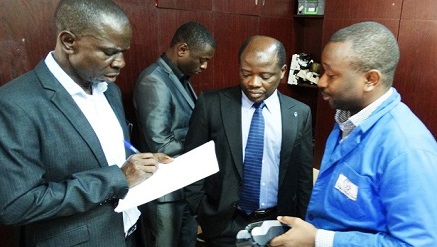
Computer Warehouse Group Plc (CWG), the leading Pan-African ICT Company has been issued the license to perform the activities of Payment Terminal Service Provider (PTSP) to Point-of-Sale terminals (PoS) in Nigeria by the Central Bank of Nigeria (CBN).
This followed a visit by a delegation of the apex bank to CWG late last year to assess the company’s preparedness and ensure that the company has fulfilled all conditions necessary and is therefore qualified to be licensed as a Payment Terminal Service Provider in the country.
In a letter, signed by Mr. Dipo Fatokun, director, Banking and Payment Systems Department, CBN noted that CWG “has successfully passed through the various stages of evaluation”.
These include an inspection of the company’s facility and processes, an allowance of a test period, during which the company’s products were carefully examined for quality and standard. CWG is “hereby licensed to perform the activities Payment Terminal Service Provider (PTSP) for Point-of-Sale terminals (POS) in Nigeria”, it concluded.
The PTSP license certifies that a company has the infrastructure to competently deploy, maintain and provide support for POS terminals in Nigeria.

According to the CBN, “A PTSP shall offer services to acquirers covering all aspects relating to terminal management support, including but not limited to purchase and replacement of spare parts, provision of connectivity, training, repairs, and development of value added services, amongst other things.”
Reacting to the development, Mr. Austin Okere, founder and chief executive officer, CWG, noted that the license is a testimony to the capability CWG Plc to competently deploy functional PoS terminals to the market at a time when CBN is vigorously pursuing the ideal of making the Nigerian business clime a cashless model.
Although the number of POS terminals increased to about 125,000 as at June last year and the value of PoS transactions increased to about N138 billion during the same period, statistics from the apex bank also indicate that about 46 percent of adult Nigerians have no access to financial services.
According to Okere, “Our track record in the financial services sector as indicated in the deployment of our Finacle core banking application to foremost banks in Nigeria, our technical platforms for Firstmonie and Diamond Yello account, are pointers to our capacity to be instrumental to the actualization of a truly cashless economy”.
On his part, Mr. James Agada, chief technology officer, observed that CWG’s quest to deploy POS terminals is an integral part of her new business module christened CWG 2.0. According to him, “The deployment of our POS terminals is inclusive of our business package for SMEs. We believe that there should be 17million terminals if there are over 17 million existing SMEs in the country. This would aid in the growth of smaller businesses and consolidate the cashless economy initiative of the government.”
“Our terminals are going to be tailored to suite the specific peculiarities of SMEs. It can work anywhere. It will also allow merchants do more since it has multiple payment option. This means that a merchant can receive payments for bills, sell Jamb pins, airtime and importantly, keep inventory of sales using the same POS terminal. This will be our quota to enabling inclusive growth in the economy.” he added.


Nigeria’s Bank Verification Number (BVN) database expanded to 69.55 million as of July 5 2026 from 69.32 million in June 2026, according to latest data released by the Nigeria Inter-Bank Settlement System (NIBSS).

BVN is an 11-digit biometric identification system introduced by the Central Bank of Nigeria and managed by the Nigeria Inter-Bank Settlement System (NIBSS) to secure customer accounts and reduce fraud.
This means that BVN enrolments increased by 228,947 between June and July 5 this year.
With the BVN database standing at 67.8 million as of December 31, 2025, it also means that the database grew by 1.75 million between the end of last year and July 5, 2026.
Specifically, with less than 1.8 million BVN enrolments so far recorded for this year, it is looking highly unlikely that BVN registrations at the end of 2026 will come close to the 4.3 million total registrations recorded in 2025.
Analysts note that while the expansion in the BVN database last year was largely driven by the introduction of the NonResident Bank Verification Number (NRBVN) initiative, which enables Nigerians in the diaspora to do their BVN enrolment remotely, thereby removing physical barriers and boosting cross-border financial engagement, the Central Bank of Nigeria (CBN) in March this year, announced a revised BVN regulatory framework, that saw it introducing stricter controls on suspected fraudulent transactions, BVN enrollment, and data access within the banking system.
According to the regulator, the amendments to the BVN framework, which came into effect on May 1, 2026, were aimed at strengthening fraud monitoring, improving identity management within the financial system and safeguarding the integrity of banking transactions, by strengthening identity verification and ensuring that BVN registration aligns with legally recognised age thresholds.
Thus, under the revised BVN framework, the apex bank introduced a stricter age requirement for BVN enrolment, limiting registration to 18-year-old individuals and above.
Also, under the new framework, customers will only be allowed to change the phone number associated with their BVN once. The CBN further stated: “Under the new guidelines, financial institutions are required to establish and maintain a temporary watch-list for BVNs linked to suspected fraudulent transactions reported within the banking system.
“A BVN may remain on this temporary Watch-list for a maximum period of twentyfour (24) hours, during which the BVN owner shall be contacted to provide clarification regarding the identified transaction(s).”
Launched on February 14, 2014, by the CBN in collaboration with the Bankers’ Committee, the NIBSS, and the German firm Dermalog, the BVN scheme was designed to capture the biometrics of all bank customers and provide each with a unique 11-digit identification number that can be verified across the Nigerian banking industry.

Central Bank of Nigeria (CBN) has reaffirmed that the standard N100 banknote remains legal tender across the country, warning that its rejection by individuals, businesses and institutions violates the law.

The clarification follows reports that some members of the public have refused to accept the standard N100 note over concerns about its legal tender status following the introduction of the commemorative N100 banknote issued to mark Nigeria’s centenary.
In a statement signed by Mrs. Hakama Sidi-Ali, acting director of Corporate Communications, the apex bank stressed that “both the commemorative N100 banknote and the standard N100 banknote are valid legal tender and must be accepted for all transactions nationwide.”
The CBN explained that the commemorative N100 note was introduced to celebrate Nigeria’s centenary and did not replace the existing standard N100 banknote.
The CBN cautioned individuals, businesses, financial institutions and other economic agents against rejecting the standard N100 note, noting that such action contravenes the provisions of the CBN Act and undermines public confidence in the national currency.
It warned that appropriate enforcement measures would be taken against any person or organisation found violating the law.
The apex bank reaffirmed its commitment to protecting the integrity of the naira, maintaining confidence in all duly issued banknotes and ensuring the smooth circulation of currency across the country.
The CBN also urged members of the public to continue accepting and transacting with all banknotes legally issued by the Bank and advised anyone seeking further clarification to use its official communication channels.

FCMB Asset Management Limited (FCMBAM), the asset management arm of FCMB Group Plc, has received an upgrade to its national scale long-term and short-term issuer ratings of A(NG) and A1(NG), from A-(NG) and A2(NG), by GCR Ratings, a leading pan-African credit rating agency.

The outlook on the ratings remains stable, said the rating agency.
The upgrade is anchored on FCMBAM’s competitive resilience and financial discipline, alongside the strengthened credit profile of FCMB Group.
GCR highlighted FCMBAM’s decade-long track record of strong performance, well-established brand franchise, diversified product suite and robust distribution network as key drivers of its standalone strength.
These are further supported by consistent earnings growth and a disciplined, unleveraged balance sheet, it said.
According to GCR, FCMBAM’s competitive position is supported by “its relatively long track record, strong brand franchise, established product and geographical distribution network and cross-selling opportunities,” with the rating agency noting that FCMBAM ranks among the top five asset managers in Nigeria, with an estimated five per cent share of a fragmented market as of 31 December.
The Company’s financial performance underpinned the upgrade, with revenue growing by 30 per cent and operating cash flow increasing by 13 per cent, enabling the business to be fully funded without recourse to debt.
Liquidity strengthened further, with liquidity sources versus uses improving to 5x as of December 2025, from 3.6x a year earlier, while the EBITDA margin edged up to over 58 per cent.
Commenting on the upgrade, the Chief Executive Officer of FCMB Asset Management, James Ilori, said: “This upgrade is an important external validation of a strategy we have pursued with discipline over many years: building an investment franchise that performs reliably, governs itself rigorously, and earns trust in every market cycle. It speaks to the strength of our membership of FCMB Group and to a culture that holds itself to local and global standards of risk management and capital stewardship.
“As Nigeria’s asset management industry enters a new era of higher capital thresholds and rising investor expectations, we intend to lead from the front – ahead of regulatory timelines, ahead in digital transformation and ahead in the outcomes we deliver for the clients who trust us to assist them in achieving their investment objectives.”

Court Adjourns Alleged Binance Tax Evasion Case over Settlement Talks

Fixed Wired Internet Market Lags as Mobile Gains Ground

Xenophobic Attacks: OYC Threatens to Picket MTN Nigeria Offices

New NIMC Act Strengthens Data Protection, Privacy – Director

BON Establishes Six Ad Hoc Committees to Modernize Broadcasting

NASENI Moves to Digitize CCB’s 5m Assets Declaration and Operations

Mobile Internet Gender Gap Widest in Africa – GSMA

Nigeria Launches FreeTV Nationwide

CANAL+ Partners Samsung to Pre-Load DStv Stream on New Samsung TVs In Nigeria, Other African Countries

Lebara Nigeria Launches Lebara Play, Africa’s First Telecom-Owned Micro-Drama Platform




 News2 days ago
NRC, Ponzi Scheme Collapses Resulting Loss of Billions of Naira

 News2 days ago
NSITF Partners South African Insurer on Digital Transformation

 General News2 days ago
KPMG Urges Africa’s Most Innovative Tech Entrepreneurs to Enter the Global Tech Innovator 2026 Competition

 E-Financial2 days ago
FCT-IRS Unveils New Digital Platform, Taxporta

 E-Business2 days ago
FG Suspends New Internet Regulations to Prevent Overlapping Rules
 E-Business2 days ago
NIN Enrollment Hits over 136m as New ID Law Takes Effect

 E-Business2 days ago
Plateau PCC Collects Nigerians’ Data without Privacy Policy – FIJ

 General News2 days ago
Court Declares ARCON’s N60Bn Fine against Facebook Nigeria Illegal