

Telecom
Airtel CEO Seeks Release of Spectrum, NBPlan Implementation for Growth


Mr. Segun Ogunsanya, managing director and chief executive officer of Airtel Nigeria, said he foresees the Nigerian telecoms market offers multiple growth opportunities, stating that with 78% mobile penetration as at December 2014, there is massive untapped market potential.
Ogunsanya also opined that broadband adoption is set to rise as demand for more stable Internet grows from the residential and business segments.
The Airtel’s Chief who was speaking on Wednesday at the Businessday CEO’s Forum held in Lagos, disclosed that 47 million subscriptions are expected between December 2014 and December, 2019, saying that this demonstrates massive untapped market potential and continued strong total telecoms revenue growth driven essentially by mobile data.
Providing insight on the theme, Nigerian Telecoms Industry: Five Years Ahead, he noted that strong growth is expected from mobile financial services over the forecasting period and operators should ensure they are able to offer products to the large unbanked population of Nigeria, whilst growing demand for mobile apps and e-commerce will have a positive knock-on effect on mobile operators.
According to the him, Nigeria offers exciting opportunities for telecoms investors as a large population with rising incomes positions the country as one of the most attractive destinations for investment on the African continent. `

Ogunsanya further opines that Nigeria has massive bandwidth capacity from the four undersea cables that has yet to be exploited and this will provide opportunities to domestic and international investors to take advantage of the growing broadband and data industry.
He, however, noted that key issues must be urgently resolved for the Nigerian telecoms industry to reach its full market potential.
He listed these issues to include spectrum availability and adequacy, Government commitment to the National Broadband Plan (NBPlan), tackling the monster of multiple-taxation, reliable and cost-effective power supply, protection of telecoms infrastructure from vandalism and resolving restrictions on telco activity in mobile money.
Speaking on spectrum availability, the Airtel CEO stated that due to explosive growth in mobile data traffic, operators require more spectrum to support this growth. Although he commended the NCC for making inroads towards spectrum availability and adequacy, he noted that there is an urgent need to expedite the release / award of frequency to operators as this will facilitate industry development.
Ogunsanya also decried the incident of multiple-taxation, disclosing that revenue loss from idle or shut down base stations represent the main source of negative impact of multiple taxation and network vandalism for the industry.
He regretted that 2% to 3% of Nigeria’s sites are affected by arbitrary shutdown and vandalism at any given point in time.
According to him, it is estimated that increased operating costs and lost revenue costs around N9bn each year to the telecoms industry or about N20bn if most of the arbitrary fees in some key states are upheld.
He, therefore, called on the government to unify taxes under one code and also bring to book vandals who deliberately destroy telecoms infrastructure.
Commenting on the immediate implementation of the National Broadband Plan (NBP), the Airtel CEO said achieving the NBP will require possibly up to 50% more than the $3bn-$4bn Nigerian operators have been spending on CAPEX annually, an increment that would need to be justified by a material change in operating conditions that would improve investment confidence.
He also noted that for the incoming government to succeed, it must show commitment to its anti-corruption campaign by ensuring the right leadership for critical sectors are put in place; develop and implement a robust economic blueprint showing key milestones and timelines and reorganize the public sector so that it becomes more efficient, effective and productive.



Viral rumors about a “Tesla Pi Phone” a new phone, being developed by Elon Musk, CEO and largest shareholder of Tesla and SpaceX, are entirely fake.

AI Generated Tesla Pi Phone and Elon Musk
Instead, the tech giant said on Monday it has filed an application with the US Federal Communications Commission for permission to deploy the constellation by 2028.
It said the system would provide voice, messaging, data and emergency services.
A quick fact-check revealed that Tesla Inc. has never manufactured, developed, or released a smartphone.
Videos and articles claiming a release (often priced between $150 and $800 with solar charging or satellite-only connections) rely on AI-generated concept art and recycled internet hoaxes dating back to 2021.
Musk has only mentioned a phone in hypothetical remarks, stating Tesla would build one only if major app stores completely blocked or censored essential apps like X (formerly Twitter).
On Monday however, his company said that “Amazon looks forward to delivering on the promise of D2D [direct-to-device] connectivity, including to the millions of people living, travelling and working in places beyond the reach of existing networks today,”
The filing is the first step from Amazon into satellite mobile connections, which has until now been dominated by SpaceX’s Starlink service.
Musk’s group has signed partnerships with existing operators such as T-Mobile US and the UK’s Virgin Media O2 to provide phone services for customers where their conventional networks do not reach.
Starlink operates across more than 150 countries, offering high-speed internet connections through its constellation of satellites.

Association of Licensed Telecommunications Operators of Nigeria (ALTON) has attributed rising mobile data consumption to increased use of smartphone applications, cloud services and emerging digital technologies.

Mr Gbenga Adebayo, chairman, ALTON
Mr Gbenga Adebayo, chairman, ALTON, disclosed this on Tuesday at the Lagos Chamber of Commerce and Industry (LCCI) conference in Lagos.
Adebayo said smartphones had transformed access to digital services, with many applications consuming data continuously, even when users were not actively browsing the internet.
He explained that automatic software updates, cloud backups, application synchronisation, video streaming, social media autoplay and location services significantly increased data consumption.
According to him, internet usage had changed considerably from a decade ago when consumers mainly relied on direct browsing with fewer digital applications running simultaneously.
He said growing adoption of artificial intelligence, cloud computing and other emerging technologies would further increase demand for reliable connectivity and greater network capacity.
“The evolution of smartphones has fundamentally changed how consumers access digital services, with many applications now consuming data continuously,” Adebayo said.
He stressed that digital literacy had become increasingly important because consumers needed to understand how their devices and applications consumed mobile data.
He advised subscribers to monitor application activity, adjust device settings and use built-in data management tools to better control their data consumption.
Adebayo said greater understanding of digital tools would help dispel misconceptions about data usage and strengthen public confidence in Nigeria’s telecommunications industry.
Responding to allegations that operators deliberately depleted customers’ data, Adebayo dismissed the claims, insisting telecommunications companies had no commercial incentive to engage in such practices.
He said every megabyte consumed on telecom networks was recorded through internationally standardised billing systems supplied by recognised technology vendors and regulated by authorities.
“Such a practice would be unlawful, unethical, commercially self-defeating and subject to stringent regulatory oversight by the Nigerian Communications Commission,” he said.
Adebayo explained that operators’ billing systems were designed to guarantee accuracy, transparency and verification, while genuine consumer complaints were investigated through established protection channels.
He added that the Nigerian Communications Commission’s complaint resolution mechanisms and technical audits provided consumers with credible avenues for seeking redress over billing concerns.
According to him, trust remains essential to expanding Nigeria’s digital economy because telecommunications infrastructure supported banking, healthcare, education, commerce and government services.
He said the telecommunications sector had evolved beyond basic communication services into a critical driver of productivity, investment, innovation and national economic growth.
Adebayo noted that emerging technologies, including artificial intelligence, financial technology, smart manufacturing and digital agriculture, depended on resilient telecommunications infrastructure.
He said Nigeria could only maximise these opportunities through sustained collaboration among government, regulators, telecommunications operators and consumers.
Adebayo reaffirmed operators’ commitment to improving customer experience, strengthening network resilience and promoting transparency in telecommunications service delivery.
He urged stakeholders to encourage evidence-based discussions on digital services, stressing that public trust remained indispensable for the sustained growth of Nigeria’s digital economy.
(NAN)
Telecom
Galaxy Backbone Soft Launches Government Service Portal to Simplify Access to Public Services

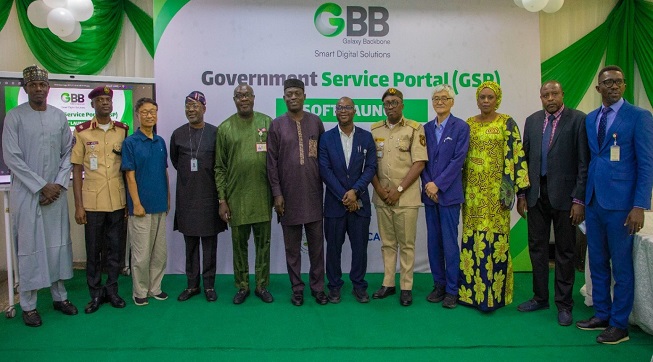
Galaxy Backbone (GBB), in partnership with the Federal Ministry of Communications, Innovation & Digital Economy (FMCIDE) and the Korea International Cooperation Agency (KOICA), officially conducted the soft launch of the Government Service Portal (GSP), a groundbreaking digital platform designed to transform how citizens, businesses and government institutions interact.

The event, held at the Galaxy Backbone National Shared Services Centre (NSSC) Headquarters in Abuja, brought together senior government officials, development partners, technology stakeholders and members of the media to unveil services.gov.ng—Nigeria’s new one-stop digital gateway for accessing government services.
The Government Service Portal is designed to provide a single, trusted platform through which Nigerians can easily discover, access and interact with digital services offered by Ministries, Departments and Agencies (MDAs). By consolidating government services into one unified portal, the initiative aims to improve accessibility, enhance service delivery and create a more seamless citizen experience.
Speaking at the event, the Managing Director/Chief Executive Officer of Galaxy Backbone. Professor Ibrahim Adeyanju, stated that the launch represents another significant milestone in Nigeria’s digital transformation journey and reflects the Federal Government’s commitment to building a more connected, efficient, transparent and citizen-centred public service.
He emphasized that the Portal is more than a website; it is the foundation of a unified digital gateway that places the needs of citizens and businesses at the centre of government service delivery.
He further noted that while the event marks the beginning of the Portal’s journey, the soft launch provides an opportunity to onboard pioneer MDAs, gather user feedback, strengthen system integrations and continuously improve the platform ahead of a wider national rollout.
Representing key stakeholder institutions at the launch were the Deputy Director of KOICA Nigeria, Mr. Ki Yun Baik; the Permanent Secretary of the Federal Ministry of Communications, Innovation & Digital Economy, represented by Mr. Joseph Bareiye, Director of e-Government; the Permanent Secretary, State House, represented by Mr. Oguntuyi Olusegun, Head of ICT; and the Executive Director, Digital Exploration and Technical Services, Galaxy Backbone, Olumbe Akinkugbe.
The Government Service Portal aligns with the Renewed Hope Agenda of President Bola Ahmed Tinubu, GCFR, and supports Nigeria’s broader Digital Public Infrastructure (DPI) agenda by creating a citizen-facing gateway that complements existing investments in digital identity, secure infrastructure, cloud services, cybersecurity and digital government platforms. It can be accessed using the link: services.gov.ng . The initiative is expected to strengthen public service delivery, increase transparency, improve operational efficiency and foster greater trust between government and citizens.
Galaxy Backbone reaffirmed its commitment to supporting all Ministries, Departments and Agencies in integrating their digital services into the Portal, noting that collaboration across government will be critical to building an inclusive, interoperable and efficient digital ecosystem that benefits every Nigerian.
The Government Service Portal is expected to evolve into Nigeria’s central digital gateway for public services, making government services simpler, faster and more accessible for citizens and businesses alike.

Fact-Check: Elon Musk’s “Tesla Pi Phone” is Internet Rumor

Dangote Plans to Donate One-Third of Wealth to Charity as Legacy

NDPC Directs DCPMIs to Register with Agency or Face Legal Consequences

Malpass, Ex World Bank Chief Raises Alarm over Nigeria’s Secretive Debt Structures

How and Why Apps Deplete Data – ALTON

NRC, Ponzi Scheme Collapses Resulting Loss of Billions of Naira

EFCC Busts NIS Visa Overstay Racket, Uncovers N700m in an Account

Tokenization, Blockchain Technology will Transform Financial Institutions – IMF

From Scarcity to Scale: What Africa Can Learn from India’s Agricultural Transformation

BON Establishes Six Ad Hoc Committees to Modernize Broadcasting




 News3 days ago
See Verified 20 Countries Nigerian Passport Holders Can Travel Visa-Free

 E-Business3 days ago
Report Says Cybercriminals Deploy Malware to Hijack Crypto Wallets, Monitor Browsers Telegram

 Telecom3 days ago
NCC, REA Partner to Cut Telecom Costs with Renewable Energy

 Telecom3 days ago
Subscribers, Telcos Warn FCCPC over Airtime Lending Enforcement

 E-Business3 days ago
NPC Opens 131 Births, Deaths Registration Centres in Anambra

 General News3 days ago
AfDB, Nigeria Urge African Control of Mineral Resources

 News2 days ago
History as Lagos Becomes First Nigerian State to Launch Greenhouse Gas Registry

 E-Business2 days ago
UNN to Partner Firm on AI, Smart Mobility Innovation Centre