

General News
Uproar as Buhari favours Northerners with Appointments


Nigerians especially those from the Southern part of the country on Friday, expressed concern over the appointments made so far by President Muhammadu Buhari, according to the Punch.
They said the appointments were lopsided and not in the best interest of the country.
President Buhari is from Katsina State, Senate President Bukola Saraki and House of Representatives Speaker, Yakubu Dogara, are from Kwara and Bauchi states respectively. The judiciary is led by Justice Mahmud Mohammed from Taraba State.
According to the Punch, of the nine appointments made by Buhari so far, eight are from the North, while one is from the South. The appointments are: Director-General of the State Services, Lawal Daura, Katsina State; Acting Chairman, the Independent National Electoral Commission, Mrs. Amina Bala Zakari, Jigawa State; Director, the Department of Petroleum Resources, Mr. Mordecai Danteni Baba Ladan; and the Accountant-General of the Federation, Alhaji Ahmed Idris, Kano State.
Others are the State Chief of Protocol, Mallam Lawal Abdullahi Kazaure; Aide De Camp, Lt.-Col. Muhammed Lawal Abubakar, Kano State; Senior Special Assistant on Media and Publicity, Mallam Garba Shehu; and Special Adviser on Media and Publicity, Mr. Femi Adesina, South-West.

The appointments, however, drew the ire of Nigerians who asked Buhari to respect the country’s principle of federal character.
Already, the Internet, particularly the social media and blogs, are agog with reactions and counter-reactions on the matter.
A commentator named Daamazing, on Nairaland, Nigeria’s largest discussion forum, accused Buhari of appointing only Northerners into key positions announced so far.
The enraged citizen said in pidgin, “After all your mumu promises, one thing you’ve not achieved, na to dey appoint all the people for your family tree, dey do tourism up and down. (After all your promises, you’ve not achieved anything. All you have done is to appoint your kinsmen and travel all around the world).”
Another commentator identified simply as Augster, said, “Buhari, don’t let those who voted for you down because your appointment of only Northerners into top positions is baffling us.”
SenseiX, another Nairaland commentator, said it was wrong for Buhari to have brought Daura, the acting DSS DG, from retirement to head the agency when there were qualified persons from other regions of the country still in service.
He said, “He ignored the entire senior cadre of the agency- from Bassey Eteng to the least- simply because they are Southerners. Even if he wanted to pick a a Northerner, he should have picked from the service rather than a 62-year-old retiree, whose only qualification is being Buhari’s kinsman, who was in the DSS. When former President Goodluck Jonathan appointed Ekpenyong, he was already a Director of Operations, same for Gadzama, who was appointed by Umaru Yar’Adua.”
As of the time of filing this report, the story- Buhari sacks DG DSS, service chiefs may go- had been read by 30,722 Nigerians on the PUNCH website, some of who expressed anger over the development.
A reader named as Ify, said, “In as much as I do not subscribe to ethnic sentiments, I am sensitive to the malaise of ethnic distrust in the country. A wise leader would therefore, thread cautiously around this landmine. We must patiently navigate our way out of ethnic bias.
“Let me also point out that Nigeria’s strength is derived from her diversity, therefore, any government that wishes to succeed must draw from our diversity, and not limit itself to the talents from one region alone.”
Another reader, Omoyooba, said, “In a multi-ethnic and multi-religious Nigeria, it is insensitive of him to be making appointments made up of Northern Muslims. What of the Christians and the Southerners? President Muhammadu Buhari should know that former President Goodluck Jonathan started with greater goodwill than this in 2011 and he ran it aground in four years. Buhari should not make the same mistake. Nigeria belongs to everybody.”
On Facebook, Fidelis Anumole-Oparaku, who was apparently disappointed with the situation, said the President’s ministerial appointments would not be much better.
He said, “Because he lacks the power to do so with ministerial appointments, he will likely give key positions to Northern Muslims, then the soft ones will be given to Northern Christians and the South.”
Like the online community, prominent groups in the South-West – Afenifere, Yoruba Unity Forum and the Movement for Oodua Republic – said this kind of lopsided appointments had never happened in the political history of the country.
While describing the President’s actions as worrisome, the YUF Secretary-General, Senator Anthony Adefuye, warned that the earlier the situation was reversed, the better, adding that the YUF would not expect the North to marginalise the South.
He said, “The fact that the President, Senate President and the Speaker of the House of Representatives are from the North is worrisome. There is no way the North can take all the principal offices and leave the deputy to us. It has never happened before and the earlier it is reverted, the better.
“There is no way that can continue because the South is not subordinate to the North. The think tank committee of the YUF will meet soon to look at the issue and see how it affects the Yoruba people. However, the development is a wrong signal that must be corrected.”
While calling on Southerners to be patient and watch events unfold, Adefuye said no region could be a subordinate of the other.
“What is more worrisome is that the immediate past INEC Chairman, Prof. Attahiru Jega, handed over to a Southerner but the Presidency changed it to a Northerner. We are watching and waiting to see what comes out of this new government.”
Adefuye added, “Southerners are always careful and concerned not to marginalise the North. Therefore, I will not expect the North to marginalise the South now that the Presidency is shifted to the region.”
The National Publicity Secretary of Afenifere, Mr. Yinka Odumakin, said the group was watching the President’s actions and taking note of them.
Odumakin, who spoke with one of our correspondents on Friday, said, “We have taken a position in Afenifere to watch the President’s actions before we begin to make comments. By the time we have a clearer picture of what is happening in the first 100 days of the President in office, we are certainly going to make a comprehensive statement.”
Also, the leader of MOR, Mr. George Akinola, said the country was heading towards total conflict should the situation continue.
He said, “The country has already been divided along religious lines. The fault lines are there and will always be there. This will continue until a time when one way or the other a conference or a referendum happens. There is no option that is not on the table but at least we will prefer the path of peace.”
Representing the interest of the South-Eastern people, the President-General of Ohanaeze Ndigbo, Chief Gary Enwo-Igariwey, asked the President to respect the principle of federal character in his appointments.
Enwo-Igariwey said, “We expect the President to recognise other nationalities that make up Nigeria. Elections are over, it is time for governance. We expect that the principle of federal character, which is constitutional, should be respected.
“It is important that in making his appointments, the President should recognise that there are six geo-political zones in the country and it is imperative that he carries all of them along in the spirit of nation building and as a statesman.”
The Igbo World Union and the Ohanaeze Youth Council described the President’s actions as a threat to the corporate existence of Nigeria.
The OYC National President, Mazi Okechukwu Isiguzoro, said, “Buhari should not abuse his privileged position as the President of Nigeria for the moment. He should not forget our federal system but reflect the federal character in his appointments.
“We are warning him to drop the Northern agenda and govern Nigeria in line with the constitution which he sworn to protect. We will hold him by his statement that ‘he is for nobody and for everybody ‘ except he now wants to tell us that he is the President of the North alone.”
According to Isiguzoro, Buhari’s actions demonstrate that he came to power to reverse the positive steps made by Jonathan, who gave consideration to Nigeria’s ethnic plurality in his appointments.
“Jonathan appointed Northerners as his National Security Adviser, Defence Minister, Inspector-General of Police, Chief of Defence Staff etc. But so far, Buhari has shown us that he has no regard for other parts of the country.”
In his reaction, the President-General of Igbo World Union, Dr. Mishak Nnanta, asked the President not to succumb to any ill- advice from individuals with parochial interest.
The National President of Njiko Igbo Forum, Reverend Okechukwu Obioha, warned Buhari against running what he described as a “Northern government.”
Obioha expressed the fear that the trend, if left unchecked, could destroy the country.
He said, “Buhari is simply running a Northern government. He is making his appointments as if he is angry with other sections of the country. The appointments are lopsided in favour of the North and that is not acceptable.”


International Trade Union Confederation, (ITUC-Africa), representing trade unions from countries in Africa, has called on Nigeria and other African governments to ensure that industrialisation translates into improved living standards for workers and ordinary citizens.

According to ITUC-Africa, economic growth must lift Nigerians and other Africans out of poverty rather than deepen inequality, frowning at Nigeria’s government plans to remove subsidy on electricity.
Delivering his opening remarks at the New Energy for Africa 11 Convening: African Workers’ Contributions to Energy Sovereignty, Green Industrialization, and a Common African for COP31, Akhator Joel Odigie, general secretary of ITUC-Africa, said, industrialisation remains central to Nigeria and Africa’s liberation and development agenda but warned that it would be meaningless if it failed to improve the welfare of the continent’s people.
He faulted the plans by the Nigerian government to remove so-called subsidy on electricity in 2027, arguing that it is aimed at satisfying the Bretton Woods institutions such as the International Monetary Fund, IMF, and the World Bank.
According to him, such removal would worsen the poverty rate in Nigeria and regress any marginal progress towards industrialisation. Subsidy removal will make electricity inaccessible to workers and the majority of the citizens.
He said, “As we speak now, Nigeria is talking of subsidy removal on electricity. The plan is not to satisfy or help Nigerians, but IMF, World Bank and other donor countries. The talk that subsidy is bad economics is a lie. All developed economies depended on public sector-driven electricity and not private sector.
“For us as Africans, industrialisation is central to our liberation and development. It is part of our aspiration to define our own identity and achieve shared prosperity through an industrialised Africa. Unfortunately, that vision has yet to be realised.
“We have also come to understand that lamenting our circumstances is not enough. Identifying the barriers to Africa’s development or pointing fingers at those who may be responsible does not move us forward. The more important question is: What next? What solutions can we pursue together?
“It is from that perspective that we confront the reality that more than 600 million Africans still lack access to electricity, while privatisation continues to deny many people affordable access to energy. This compels us to ask: What can we do differently?”
According to him, organised labour believes industrialisation can be achieved without worsening the climate crisis if governments, workers and development partners commit to energy justice.
Odigie noted that “When we speak about sustainable industrialisation, we are asking how Africa can industrialise without increasing environmental degradation or worsening the climate challenges our people already experience every day.
“We know this is possible. But it will require negotiation, compromise and genuine partnerships. It demands serious discussions on technology transfer, skills development and financing.”
He stressed that developing technical skills and mobilising investment for energy infrastructure are essential if Africa is to industrialise sustainably, saying “These are not impossible skills to acquire. With the right investment and commitment, Africa can build them. Equally important is access to finance and the resources needed to develop the infrastructure that will support sustainable industrialisation.
“An industrialised Africa has little meaning if it does not improve the lives of our people. Our vision is an Africa where prosperity is shared.
“We must reverse the growing phenomenon of the working poor. We must end the situation where women, children and older persons bear the greatest burden whenever governments attempt to balance national budgets.
“What does prosperity mean if ordinary people cannot enjoy a decent quality of life? A worker who returns home after a long day’s work should be able to switch on a fan during hot weather, watch television, listen to the news and spend meaningful time with family because electricity is available, reliable and affordable.
“If our people cannot enjoy these basic necessities, then what kind of prosperity are we really talking about?
“Energy justice means energy that is accessible, affordable and capable of improving people’s lives.”
Odigie also renewed ITUC-Africa’s campaign for stronger public participation in Africa’s energy sector, citing Finland as an example of how governments can ensure affordable electricity while working with private investors.
“Recently, we visited Finland, where we observed a successful model that combines public and private participation, with strong public leadership. Energy there is affordable. In fact, electricity costs less in Finland than it does here in Nairobi.
“Our hosts explained that this is possible because the state retains an important role in the energy sector, including the ability to influence pricing to ensure affordability for everyone.”
Ahead of the COP31 climate negotiations, he called for closer collaboration between organised labour and the African Group of Negotiators (AGN), saying trade unions are partners in governance rather than adversaries.
“Trade unions are not antagonistic to governments, even though we are sometimes misunderstood.
“Our responsibility is to strengthen accountability and help governments perform better because, from time to time, leaders can become too comfortable.”
Using a metaphor that drew applause from participants, Odigie likened the role of trade unions to keeping leaders “close to the fire.”
“Our responsibility is to keep the feet of our leaders close to the fire so that their heads do not become too cold. We want them to continue thinking clearly, making sound decisions and remaining connected to the realities faced by ordinary people.
“That is why we are not in opposition. We are not enemies.”
He said organised labour’s partnership with the AGN is intended to ensure African governments enter international climate negotiations with the full backing of workers across the continent.
Speaking, Dr Nana Amoah, chair of the African Group of Negotiators, AGN, said Africa’s energy transition presents both an urgent challenge and a historic opportunity, lamenting that “More than 600 million Africans still lack access to electricity, even though our continent possesses exceptional solar, wind, hydro and geothermal resources. Yet Africa continues to receive only a very small share of global clean-energy investment.”
Represented by Dr George Manful, AGN Senior Advisor, Amoah, said: “This imbalance must be corrected if the transition is to support Africa’s development rather than reproduce existing patterns of dependence, extraction and inequality.
“For the African Group of Negotiators, a just transition cannot be measured solely by installed megawatts, emissions reductions or new electricity connections. It must also be measured by the quality of jobs created, affordability of energy, protection of workers, participation of women and young people, development of local industries, and the capacity of African countries to retain value from their natural resources.
“Initiatives such as Mission 300 must therefore go beyond expanding access. They must strengthen public institutions, mobilise affordable and debt-sensitive finance, support local manufacturing and skills development, and guarantee that no worker, community or vulnerable group is left behind.
“Africa’s critical minerals must similarly become a foundation for green industrialisation—not another chapter of raw-material extraction. Our policies must promote local processing, technology transfer, decent work, environmental integrity and equitable participation in global value chains.”
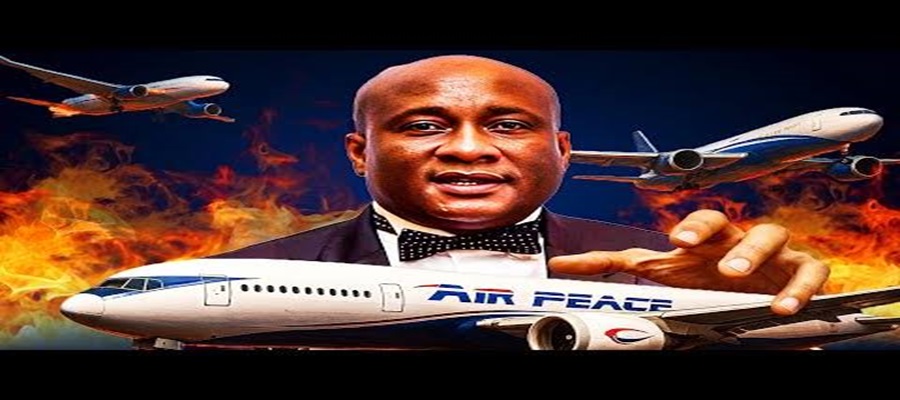
Allen Onyema, vice chairman, Airline Operators of Nigeria (AON) and chairman, Air Peace, has warned that several domestic airlines could cease operations within the next 30 days unless the federal government urgently intervenes in the challenges confronting the aviation industry.

Allen Onyema
Onyema, gave the warning on Wednesday at the launch of the book, Pathways, Pilgrimage & Destiny: The Biography of Alhaji Muneer Bankole, held in Lagos.
He described the aviation industry as capital-intensive but less rewarding, warning that airlines are facing serious threats to their survival.
“Going into aviation is not a piece of cake. It is an industry that is not very rewarding. It is capital-intensive, yet less rewarding. Today, we are facing a phase that has existential threats. Except something drastic is done very quickly within the next 30 days, a lot of airlines might go extinct,” Onyema said.
The Air Peace chairman also cautioned aviation unions against their planned picketing of airlines over the non-remittance of the five per cent Ticket Sales Charge.
He warned that if any airline is picketed, other domestic carriers would suspend operations in solidarity.
“If they picket any airline, others will go because there’s no need for that. There is nowhere in the world that government agencies use unions to talk about issues of debt,” he said.
Onyema lamented the harsh operating environment for Nigerian airlines, noting that more than 50 airlines have shut down over the years.
“Everybody pities Nigerian airlines, yet nobody wants to do anything about their situation. Over 50 airlines have come and gone. The owners of these airlines succeeded in other businesses, yet they failed in airline business,” he said.
He stressed that airlines were not opposed to helping the government generate revenue but called for a more sustainable approach.
“The airlines are not against helping government generate revenue. But no airline in the world is taxed directly for revenue. The airlines indirectly provide revenue for government,” Onyema added.
General News
QNET Denies Links to Ignite, Backs Nigeria Immigration Service Crackdown on Alleged Fraud Syndicate


QNET has denied any association with Ignite following the arrest of 12 individuals by the Nigeria Immigration Service (NIS) over alleged fraudulent recruitment, irregular migration and other unlawful activities.

QNET
In a statement issued on Tuesday, the direct-selling company described reports referring to the suspects as belonging to a “QNET/IGNITE network” as inaccurate, stressing that Ignite is an entirely separate entity with no relationship to QNET.
The company stated that Ignite is neither part of QNET nor authorised to conduct any business or activities on its behalf.
QNET urged media organisations, commentators and members of the public to avoid linking the two organisations, warning that such reports could mislead the public and unfairly associate the company with alleged criminal activities beyond its control.
According to the company, it has fully cooperated with the Nigeria Immigration Service and will continue to provide any relevant information required as investigations progress.
It reaffirmed its commitment to supporting law enforcement agencies in identifying and prosecuting individuals who misuse the QNET name to facilitate fraudulent recruitment, human trafficking, irregular migration or other criminal acts.
The company also clarified the use of the term “Model Q,” explaining that law enforcement agencies increasingly use it to describe criminal schemes in which fraudsters exploit the names of legitimate direct-selling companies and established brands to lure victims with false promises of employment, overseas travel, migration opportunities or guaranteed income.
It stressed that “Model Q” does not refer to QNET’s legitimate business operations but rather to criminal activities carried out through the unauthorised use of recognised brand names.
QNET maintained that it does not offer employment opportunities, visas, overseas travel or guaranteed financial returns through its independent distributors.
It explained that its business model is based solely on the direct sale of wellness and lifestyle products.
The company warned that anyone soliciting money for jobs, migration, travel or guaranteed investment returns in QNET’s name is acting without its authorisation.
According to the statement, criminal groups have repeatedly impersonated the company’s brand to deceive unsuspecting members of the public.
QNET said it considers itself a victim of such brand impersonation and has been working with law enforcement agencies in Nigeria and other countries to share intelligence, support investigations and protect potential victims.
The company commended the Nigeria Immigration Service for what it described as an intelligence-led operation that resulted in the rescue of victims and efforts to dismantle transnational criminal networks.
It reaffirmed its readiness to continue collaborating with the Service and other relevant authorities to ensure that those exploiting its name for criminal purposes are brought to justice.
QNET also advised members of the public to verify any claims involving the company through its official communication channels and to report suspicious offers relating to employment, travel, migration or investment made in its name.

ITUC-Africa Faults FG’s Plans to Remove Electricity Subsidy

SEC Begins Full e-Registration for Capital Market Services

NAICOM Revokes Nigeria Reinsurance’s Licence over Failure to Meet MCR

Many Nigerian Airlines May Collapse within 30 Days – Onyema

Ogbaga, Abuja Lawyer to Sue Telcos, DStv over Alleged Unfair Practices

NRC, Ponzi Scheme Collapses Resulting Loss of Billions of Naira

From Scarcity to Scale: What Africa Can Learn from India’s Agricultural Transformation

EFCC Busts NIS Visa Overstay Racket, Uncovers N700m in an Account

BON Establishes Six Ad Hoc Committees to Modernize Broadcasting

How EFCC Turned Recovered Loot Into School Supplies for Thousands of Nigerian Students




 E-Business2 days ago
Kaspersky Identifies Cyberespionage as a Growing Threat Across Africa, Others

 Broadcasting2 days ago
NBC Files Fresh Appeal against Judgment Barring it from Imposing Fines on Broadcast Stations

 News2 days ago
INTERPOL Report Shows AI Powers 55% of Cybercrimes in Africa Amid $484m Losses

 Telecom2 days ago
Why Strong Institutions Remain Africa’s True Growth Engine

 General News2 days ago
ASUS and Konga Unveil West Africa’s First Flagship Experience Store in Lagos

 E-Financial2 days ago
Nigerians Lost N25.85Bn to Digital Payment Fraud in 2025 –CBN

 News2 days ago
Nigeria Expands Deep-tech Skills Pipeline

 E-Financial2 days ago
NRS Announces 30 Percent Tax on Corporate Crypto Income