

E-Business
F2F Contact Key in Building Customer Relationships- IDC Financial Insights Study

A new IDC Financial Insights study, Branch Transformation in a Digital World, highlights that bank branches can elicit more customer retention and more cross-selling than any other method as the time to talk to customers remains the best way of understanding how to serve them better.
The study highlights some of the key drivers for branch banking:
Branch satisfaction remains high. Satisfaction with branches is generally high, and even customers who generally avoid their local branch appreciate its presence.
Transformation can entrench branches’ popularity by making sure that each customer visit is fulfilling, that customers are presented with relevant offers, and that their complaints or queries are seen to.
Face-to-face contact is key to building customer relationships. Modern data analytics can predict what products might best suit which customer but not to the level of a face-to-face meeting.
This means that branches can elicit more customer retention and more cross-selling than any other method.
Banks must protect their investments. For banks with existing, unwieldy branch networks, shutting down large numbers of branches is not realistic.
Branches are often on long-term leases, and the sunk costs in terms of previous investments are too high.
So the decline in visits must be mitigated by making the branch experience as smooth as possible, while maximizing revenue opportunities and minimizing cost.
Modern technology makes branches more affordable. A transformed branch can occupy a smaller area, employ fewer staff, and be better geared toward revenue generation — staff, equipped with the right tools, can focus on sales rather than transaction processing.
By investing in branch transformation and modern technology, a bank can therefore put its branch network on a sustainable financial footing.
“The falling overall branch number in Europe masks a brighter reality,” said Lawrence Freeborn, senior research analyst, IDC Financial Insights. “Looking at the U.K., around a fifth to a quarter of branches have been refurbished in the past couple of years, indicating that banks are investing in their shrinking stock, and continue to appreciate the importance of the branch. Taking an annual refurbishment rate across the industry of around 10%, and combining this with the recent leaps in technology available to banks and their customers alike, it can be deduced that the average European branch in 2025 will look entirely different from the one in 2015.”
“Financial institutions have done a great job reducing the cost of routing transactions by migrating them to self-service channels over the past decade,” said Andrei Charniauski, head of Europe, IDC Financial Insights. “However, they have not been able to bring the same degree of automation to the most value-adding part of branch banking — sales and customer relationships. As branch networks undergo refurbishment, it is imperative to make the most of innovative IT solutions to elevate the performance metrics of sales personnel.”
IDC Financial Insights assists financial service businesses and IT leaders, as well as the suppliers that serve them, in making more effective technology decisions by providing accurate, timely, and insightful fact-based research and consulting services.


Kaspersky experts explain which online offers travellers should be cautious of when planning their trip, to avoid spoiling their experience ahead of the upcoming games.

Thousands of fans are expected to attend the World Cup 2026, and many are already handling their travel logistics, purchasing their flights and other transport tickets, booking accommodation, and arranging everything they need to reach the host cities. As interest grows, so does the number of fraudulent schemes that exploit the fact that fans are actively preparing for their upcoming journey.
In late April 2026, Kaspersky experts detected a campaign exploiting the branding of a well-known transport app, targeting users in Mexico. The interface of a fake Spanish-language website, impersonating one of the services, prompts users to enter their phone number and password in order to “claim prizes.” In reality, the attackers are mimicking a trusted brand and attempting to steal users’ credentials from those lured by the promise of a reward.
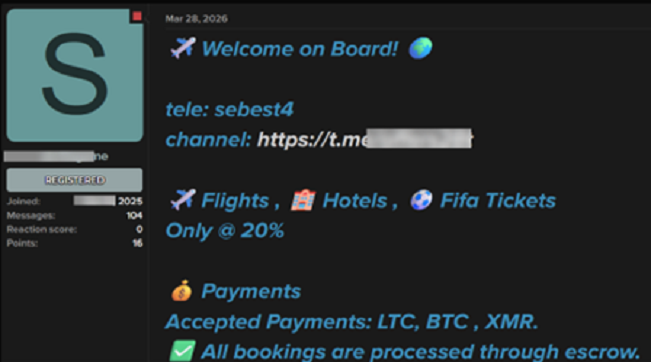
Some cybercriminals go “a level lower” and post their offers on the dark web. Kaspersky Digital Footprint Intelligence experts discovered a thread advertising such services, published on a shadow forum in March 2026.
The listings included offers for discounted airline tickets, hotel bookings, and match tickets, allegedly at 20% off the original price. These offers are designed to lure users and can be highly dangerous, ultimately resulting in victims losing both their money and any services they expected to receive.
Entrepreneurs and property owners also in the crosshairs
Cybercriminals are also targeting businesses and entrepreneurs at the intersection of the travel industry, which is also involved in the event. Given the high demand for short-term rentals during the tournament, property owners have become an attractive target for scams.
For example, a fake website was discovered requesting account credentials for a well-known platform. In this way, scammers attempt to gain access to property owner accounts, potentially resulting in unauthorised withdrawals and financial losses.
Another common scheme involves fraudsters attempting to extract money from organisations by posing as representatives of well-known airlines and offering fictitious business partnerships. In these emails, they claim to be launching new projects or business expansion initiatives and state that they are actively seeking suppliers or contractors.
If a company representative responds to such an offer, the scammers typically escalate the deception in a subsequent stage. To enhance credibility, they send forged documents for completion and signature, including supplier registration forms and non-disclosure agreements.
The ultimate objective of the fraudsters in this scheme is to induce the organisation to pay a so-called “deposit,” ostensibly required to secure a priority position in a partner selection list.
According to the claims made in the fraudulent communications, this payment would later be fully refunded once the partnership is formally established. In reality, this promise is entirely deceptive. The perpetrators simply appropriate the funds, and no reimbursement is ever made to the victim organisation.
“The travel sector, particularly when it intersects with major events, is a persistent target for a wide range of scams and fraudulent schemes. For end users, it is often difficult to distinguish at first sight between a legitimate website and a spoofed one, or between genuine marketing communications from a reputable service and scam emails.
“We therefore advise treating overly attractive offers with a high degree of caution in order to protect your personal data and financial resources,” says Anna Lazaricheva, senior spam analyst at Kaspersky.

Meta’s family of platforms, including Facebook, Instagram and WhatsApp, contributed an estimated 820 million dollars in annual economic value to Nigeria in 2025, according to a new report released on Wednesday.

Meta
The report titled “Nigeria’s Digital Economy” was conducted by independent research firm, Public First, and commissioned by Meta.
It stated that 14 million Nigerian small and medium-scale enterprises (SMEs) used Meta platforms in 2025 to start, run and grow their businesses.
According to the report, the platforms contributed about two billion dollars to Nigeria’s Gross Domestic Product (GDP) while generating an estimated 640 million dollars in productivity gains through instant messaging services.
The report noted that 81 per cent of Nigerian businesses surveyed said Meta platforms had helped them expand their customer base beyond their local areas.
It added that the digital tools had reduced customer acquisition costs and enabled businesses in different parts of the country to access wider markets.
The report also highlighted the growing role of artificial intelligence (AI) in Nigeria’s economy, projecting that AI could contribute 22 billion dollars to the country’s GDP by 2035 under favourable conditions.
It stated that 87 per cent of online Nigerians surveyed believed AI products developed within Africa would play an important role in the continent’s economic growth.
Speaking on the findings, Meta’s Director of Public Policy for Sub-Saharan Africa, Balkissa Ide Siddo, described Nigeria as one of the world’s most entrepreneurial and digitally engaged markets.
According to her, Meta platforms are helping to remove traditional barriers to business growth and enabling entrepreneurs to access broader economic opportunities.
“From a tailor in Lagos reaching customers across the country through Instagram, to a small business owner in Kano taking orders on WhatsApp, to a creator in Abuja building a global audience on Facebook, Meta’s platforms are unlocking real economic opportunity,” she said.
Siddo noted that WhatsApp had become a major gateway for AI adoption in Nigeria and across Sub-Saharan Africa.
She added that 93 per cent of Meta AI prompts in the region were made through WhatsApp, indicating that many users were engaging with AI technologies through platforms they already use daily.
The report further stated that 93 per cent of online Nigerian adults surveyed said they felt more connected to wider communities through Meta’s applications.
Also speaking, Alison Neyle, Director at Public First, said the findings reflected the increasing role of digital platforms in supporting entrepreneurship and participation in Nigeria’s growing digital economy.
“Nigeria’s digital transformation is creating new opportunities for businesses, creators and consumers alike.
“With the right combination of infrastructure, platform access and open-source AI, the upside for Nigeria is significant,” Neyle said.
The report projected that Meta’s contribution to Nigeria’s economy could rise to two billion dollars annually as digital adoption deepens and internet access improves across the country.
E-Business
NITDA Unveils AI-Powered Government System That Tracks Workers, Flags Delays Automatically @ICSC 2026


Kashifu Inuwa, director general of the National Information Technology Development Agency, has called on public institutions and organisations to embrace Artificial Intelligence (AI) responsibly while prioritising human accountability, policy frameworks, and digital skills development.

Rep of DG NITDA, the Director, SMP Department, Dr Aristotle Onumo giving insights into effective public service delivery through digital transformation at the ICSC 2026
Speaking at the International Civil Service Conference 2026, held at the Eagles Square in Abuja, the NITDA boss who was represented by the Director, Stakeholder Management and Partnership department, Dr Aristotle Onumo, disclosed that the Agency has already begun implementing a comprehensive AI Transformation Plan designed to reposition the organisation for long-term institutional efficiency, continuity, and productivity.
According to him, the three-year transformation initiative is aimed at creating a digitally driven institution where operations can continue seamlessly regardless of personnel changes.
“In NITDA as an agency, we have what we call the AI Transformation Plan. It is a kind of three-year plan which we have put in place so that even if the current staff are replaced completely, new personnel should be able to interact with the system and continue work without hindrance,” he stated.
The DG explained that the Agency has already integrated AI into its internal workflow processes, particularly in document management and task tracking.
He noted that official documents submitted at the Agency’s premises are now scanned immediately at the gate and automatically routed by AI systems to the responsible officers based on identified keywords and subject areas.
He added that the AI infrastructure also monitors timelines and flags delays where officers fail to attend to official correspondence within stipulated periods.
“All that is required now is to drop documents at the gate. AI scans and routes them to the appropriate officers. If such documents are not treated within the required timeframe, the system flags them and reports accordingly,” he explained.
While acknowledging concerns surrounding AI adoption, particularly fears about job displacement, the NITDA DG stressed that the technology should be viewed as a tool for improving productivity rather than a threat to human relevance.
“There is always this fear that AI is coming to take away jobs, especially in the public service. But I want to state clearly that the jobs of people who refuse to upskill themselves may eventually be affected. However, those willing to retrain and adapt will benefit immensely from AI,” he said.
To address workforce transition concerns, he revealed that NITDA has commenced agency-wide AI capacity building programmes for all staff members.
According to him, employees whose traditional roles are being transformed by automation are being reassigned and redesignated into emerging AI-related functions.
“We have ensured that everyone undergoes AI training. Those who previously handled manual file operations have now been redesignated as AI assistants and AI administrators. We are preparing our workforce for the future rather than replacing them,” he noted.
The DG further emphasised the importance of maintaining human oversight in AI deployment, warning against the complete removal of human intelligence and accountability from governance systems.
“You must not take away human monitoring and accountability in any AI implementation process. At the end of the day, someone must remain accountable,” he cautioned.
Speaking on governance and regulation, the NITDA boss called for all Ministries, Departments and Agencies (MDAs) to develop internal AI policies capable of defining clear operational boundaries for the technology.
According to him, government deployment of AI differs significantly from private sector usage because public institutions must bear responsibility for any AI-related failures or ethical breaches.
He stressed the need for robust governance frameworks to guide responsible AI use, protect citizens’ rights, and ensure compliance with data protection regulations.
“We must ensure that whatever we use AI for aligns with data protection regulations and responsible use principles. Without proper frameworks, data misuse could become more prevalent and destructive,” he warned.
The NITDA DG also highlighted the Agency’s broader efforts to drive national AI adoption following the development of Nigeria’s National AI Strategy, which he described as one of the country’s most forward-looking digital policy documents.
He stated that NITDA is currently using the Agency as a practical AI sandbox to test implementation models before wider deployment across the public service ecosystem.
As part of efforts to deepen digital capacity across government institutions, he disclosed that NITDA is collaborating with the Office of the Head of Civil Service of the Federation to train civil servants in digital literacy and AI-related competencies.
He reiterated that the future workforce must embrace continuous learning and adaptability to remain relevant in an increasingly AI-driven world.
“AI has not come to replace people completely. But those who refuse to develop their skills may struggle to fit into the evolving technology ecosystem,” he concluded.

NCC Begins Review of Nigeria Telecoms Policy after 26 Years

STBMAN Warns of “Broadcasting Crisis”, Urges Tinubu to Halt NBC’s DSO

MTN to Turn its African Tower Network Into a Distributed AI Compute Grid

Elon Musk to Become First World’s Trillionaire with SpaceX Historic IPO

Army Acquires New Drones to Boost Surveillance, Precision Strikes — COAS

MTN, VDT, Zoracom, Digital Realty Back 2026 Girls in ICT Campaign

Vitel Wireless Partners Fintechs to Expand Access to Services

Kaspersky Discovers Vulnerability in Qualcomm Snapdragon Chips that can Lead to Data Loss & Device Compromise

Bank Customers to Pay N1,500 for ATM Card Issuance, Replacement – CBN

FCCPC Licenses 5 Firms for Airtime, Data Lending as Telcos Step Aside




 General News3 days ago
UAE’s Exit from OPEC: Eroding Pricing Power, Saudi Arabia’s Response, and the Implications for Nigeria

 E-Financial3 days ago
Court Orders Globus Bank to Pay Firm N256m for Breach of Contract

 General News3 days ago
US to Deploy Wireless Technology in Nigeria, Others

 Telecom3 days ago
Lagos Warns against Fake Emergency Calls, Says Rising Misuse Put Lives at Risk

 E-Financial3 days ago
AFC Invests $100m in Africa-focused Technology Fund Managers

 News3 days ago
Systems, Not Skin Colour, Hold the Key to Africa’s Development, Says Evans Woherem

 Telecom2 days ago
Google unveils Gemini-powered advertising, commerce tools at Marketing Live 2026

 E-Financial2 days ago
Griffin Capital Group Launches Integrated Financial Services Group Positioned to Strengthen Capital Formation in Nigeria, Africa