

News
Williams Replaces Aladekomo at Chams

Chams Plc has announced the appointment of Olufemi Williams as the company’s new Group Managing Director and Chief Executive Officer.
Williams joined Chams about 25 years ago because he saw how clearly Chams was redefining the emerging computer hardware and maintenance sector, providing solutions hitherto sought overseas by multinational corporations.
Williams has been a key member of Chams’ executive and leadership team since 2001 and will take over from Demola Aladekomo, the founding Managing Director and Chief Executive Officer.
Aladekomo led the firm with distinction for 30 years, nurturing Chams from a computer hardware maintenance firm into Nigeria’s leading authority in identity transaction systems. Williams’ appointment takes effect September 18, 2015.
Prior to his appointment, Williams, was the Deputy Managing Director of the wholly indigenous technology firm.

Announcing Williams’ appointment, Very Reverend Ayo Richards, chairman, Chams Plc said: “Olufemi Williams is an exceptional leader. Since he joined Chams, where he has worked in various capacities, Williams has been extraordinary. His well-deserved appointment to the role of Managing Director and Chief Executive Officer affirms orderly leadership transition in the company which aligns with the board’s ratified succession plan which emphasises promoting capable internal candidates to leadership positions.”
Commenting on Williams’ appointment, outgoing CEO, Demola Aladekomo said, “Williams is a brilliant colleague who has distinguished himself over the years as a highly talented, inspiring and energetic leader with positive attitude. I am personally delighted to be handing over the reins to such an outstanding leader.”
Reflecting on his appointment, Williams said: “I am honoured and excited to have been selected to lead Chams Plc. We are a company that has evolved over the years because of our pioneering works in technology sector in the Nigerian market, with our strong capability and winning strategies enabling us to grow strongly. Consolidating on our achievement is a challenge I accept with confidence and determination. I am determined to accelerate the momentum of Chams Group in the identity transaction systems space leading the business to even greater things.”
Williams joined Chams Plc in 1990 as a Computer Engineer while undergoing the one year mandatory NYSC scheme as a corps member.
He rose to the position of General Manager in January 2001, and held same until he was seconded to SuperCard Limited, a subsidiary of the Chams group, as Managing Director in March 2004.
Williams was recalled to Chams Plc and appointed the Deputy Managing Director in 2011. He continued serving in that capacity until April 2015 when he was made the GMD/CEO designate, following the announcement of Aladekomo impending retirement from Chams Plc.
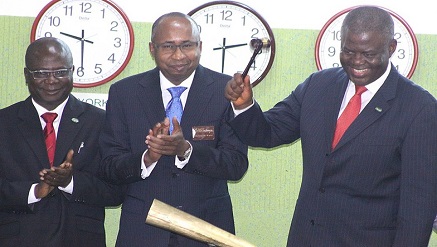
Meanwhile, in recognition of his outstanding leadership role in Chams Plc over the years, the Nigerian Stock Exchange invited Aladekomo to ring the bell at the close of business on Thursday, September 17. The privileged gesture was the NSE’s way of honouring the IT guru as he proceeds on retirement after 30 years of selfless service.
Established in 1985, Chams Plc is Nigeria’s foremost ICT firm with specialty in developing and deploying enterprise technology solutions. The company is renowned for providing innovative, qualitative products and services in the information technology sector.



Atte Ayodeji, a Nigerian computer scientist,has developed an artificial intelligence algorithm capable of detecting, counting, grouping and generating healthy hair follicles during hair transplant procedures, an innovation that earned him the Best Innovative Technology award.

Atte Ayodeji
Ayodeji also graduated with a Distinction in his Master of Science (MSc) in Computer Science from Birmingham City University on Friday, adding another milestone to an impressive academic year.
Beyond his award-winning hair transplant innovation, the Nigerian researcher developed a system and framework on Explainable Artificial Intelligence (XAI) as a professional responsibility in the diagnosis of lung cancer.
His dissertation received a silver award at the PGXPO2026 Winter, further highlighting the impact of his research in applying artificial intelligence to healthcare.
Sunday Dare, special adviser on Media and Public Communication to President Tinubu, celebrated Ayodeji’s achievements in a post on X, recalling how he first met him in 2019 during his National Youth Service.
“In 2019 when I became a Minister of the Republic, I met a young man of medium height, genteel with penetrating eyes: Atte Ayodeji. His words rarely come out and he could easily be passed by unnoticed. But I noticed him especially when my SA Kemi Areola brought him to me asking my approval for him to do his Youth Service in my office. I approved. From then on he was unstoppable. His brilliance shown and he developed skills beyond his frame.”
Highlighting Ayodeji’s recent accomplishments, Dare congratulated him saying, “Congratulations Atte. I am proud of you!”

Mr. Joseph Tegbe, minister of Power, has said that the federal government plans to end power sector subsidies from 2027 and that there are no immediate plans for tariff increases.

Mr. Joseph Tegbe, minister of Power
The minister told journalists during the media interactive session at the weekend that the government has announced plans to phase out electricity subsidy payments from 2027 as part of efforts to address mounting liabilities in the power sector.
He explained that the planned removal forms part of the broader reforms aimed at ensuring the long-term sustainability of the electricity sector, while tackling the financial challenges confronting the industry.
According to the minister, despite the planned subsidy withdrawal, there are no immediate plans to increase electricity tariffs, reassuring consumers that the government is not considering a tariff hike in the short term.

Patience Okala, the National Coordinator and Chief Executive Officer of the Nigeria AfCFTA Coordination Office has urged African countries to stop exporting raw materials and instead focus on adding value to its natural resources if it is to fully harness the opportunities offered by the African Continental Free Trade Area.

She stated this on Thursday at the Streamsowers & Köhn 20th Anniversary Business Forum, where she stressed that value addition and beneficiation are essential to Africa’s industrialisation and long-term economic growth.
According to a statement issued on Friday by the Nigeria AfCFTA Coordination Office, she said the AfCFTA goes beyond the elimination of tariffs, serving as a framework for industrialisation, value addition, and job creation across the continent.
“AfCFTA is not only about tariffs; it is also about value addition. Africa has to stop exporting raw materials. We need to add value and ensure that beneficiation is done on the continent,” she said.
Okala also said Africa’s economic transformation would depend on the effective implementation of the AfCFTA rather than on the signing of trade agreements alone.
“We have moved beyond negotiations. The success of AfCFTA will be measured by the extent to which businesses can access new markets, trade seamlessly across borders, and benefit from the opportunities created by the agreement,” she said.
She noted that Nigeria had intensified efforts to implement the agreement under the leadership of the Minister of Industry, Trade and Investment, Dr Jumoke Oduwole, including the development of simplified AfCFTA guides in six languages to help businesses understand and take advantage of opportunities under the trade pact.
Okala called for stronger collaboration among governments, regulators, and the private sector to eliminate barriers to trade and investment and build a truly integrated African market.
“As we move from policy to implementation, our collective responsibility is to ensure that the opportunities created by AfCFTA become practical realities for businesses, particularly MSMEs, women-owned enterprises, and young entrepreneurs across the continent,” she said.

SERAP Asks Tinubu to Probe Alleged N6.79Bn Missing Police Funds, Firearms

FCT Court Awards Ex-Customers N15m against Stanbic IBTC over Data Privacy Breach

CBN Exposes over 13,000 BVNs Tied to Fraud as Banks Tighten Security

Atte, Nigerian Develops AI Algorithm for Hair Transplants

Dare Tackles Onaiyekan over Criticism of Tinubu, Says Economic is Working

NRC, Ponzi Scheme Collapses Resulting Loss of Billions of Naira

EFCC Busts NIS Visa Overstay Racket, Uncovers N700m in an Account

From Scarcity to Scale: What Africa Can Learn from India’s Agricultural Transformation

Tokenization, Blockchain Technology will Transform Financial Institutions – IMF

BON Establishes Six Ad Hoc Committees to Modernize Broadcasting




 Broadcasting2 days ago
Davido Shares Past Suicidal Thoughts, Drops Oriadé Album

 E-Business2 days ago
How Temu Helped a Madagascan Vanilla Family Business Sell Direct to Consumers Across Europe

 General News2 days ago
MTN Nigeria Posts N707.5bn H1 Profit, Declares N26 Interim Dividend

 News2 days ago
Cisco Explores AI for Nigeria Farmers

 General News2 days ago
Gavi Okays $500m for Vaccines, PHCs in Nigeria

 News2 days ago
AfCFTA Urges Africa to Stop Exporting Raw Materials

 E-Business2 days ago
82% of Organizations Concerned about AI Risks Even as Adoption Accelerates – Survey Reveals

 General News2 days ago
Police Uncover Fake Diplomatic Number Plate Syndicate in Abuja