

News
Nigeria, Ghana Agree on Mutual IT Agenda

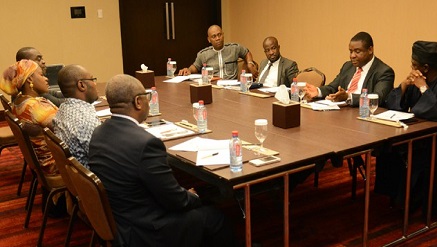
The National Information Technology Development Agency (NITDA), Nigeria’s IT clearinghouse and the National Information Technology Agency (NITA), Ghana’s agency responsible for implementing IT policies have agreed to collaborate on common grounds as it affects both countries IT sector.
The two agencies met over the weekend in Accra, Ghana to assess mutual areas of interest and how the two economic powerhouses in West Africa can leverage on ICT to better improve the economic potentials of these countries.
Both countries are to work on agreeable terms to define the nature and scope of the partnership to cover among others: human capital development, ICT startups and entrepreneurship schemes, local content, cybersecurity and smart city.
The areas of cooperation will also cover mutual support for each countries IT related events or such public sector led IT events designed to draw investments and developments to the two countries.
“The need for us as neighbours and as developing countries to identify common goals and common strategies’ within the sub-region to approach issues as relating to IT is both important and desirous now so as to raise the economic fortunes of our two countries, said Dr Vincent Olatunji, acting Director General /CEO of the NITDA.

“We welcome a partnership with Nigeria and see it as exigent to actualising our own mandate as a counterpart IT agency in Ghana. We consider partnership as an essential element of growth and look to maximising this partnership,” said CEO of the NITA, Mr. George Atta-Boatang.
According to Atta-Boatang, NITA was established in 2008 as an IT projects-based public service institution and has so far championed internet diffusion in Ghana as well as provide the framework for data warehousing for both public and private institutions in Ghana.
It is currently working to commission the 10, 000 seats BPO/Outsourcing centre in Accra, touted to be the largest in West Africa as Ghana prepares to be a major hub for BPO/Outsourcing in West Africa.
Atta-Boateng said NITA is relatively young compared to the NITDA and has had to draw on some inspiring input from the NITDA in marshalling its own current structure as a policy driven IT agency from its original orientation as a project driven one.
In response, Olatunji said that NITDA considers a working relationship with the NITA as a partnership that should thicken and inspire IT-led collaborations with other West African countries within the framework of the Economic Community of West African States (ECOWAS).
“We share a common IT destiny,” said the NITDA’s boss while elaborating on NITDA’s effort to strengthen the value of IT within Nigeria’s public and private organisations. The NITDA has invested massively in human capital in Nigeria to build an army of IT savvies. In addition to expanding the boundaries of internet usage across countries, it has provided the framework to bolster the use of the .ng domain names by Nigerian entities”, he said.
Like NITA, it is building stronger institutional bases to champion startups and ICT entrepreneurships as well as ensure achievable landmarks for Nigeria’s local content policy. “These and many more provide a strong base for collaborations between our two countries,” said the NITDA’s boss added.
Mrs. Hadiza Umar, head, Corporate Affairs at NITDA, said that the meeting was chaired by Dr. Sola Afolabi, former acting Deputy Executive Secretary of the ECOWAS, who urged the two countries to accelerate the processes for collaborations at both bilateral, country-to-country level as well as regional level within the larger ECOWAS window. In attendance at the meeting from NITDA were Head of Corporate Affairs, Mrs. Hadiza Umar and Head of Legal Services and Board Matters, Barr. Emmanuel Edet.



Oladipupo Adebutu, Peoples Democratic Party (PDP) governorship candidate in Ogun State, has alleged that all state governors in Nigeria are benefiting from and misappropriating local government allocations.

Oladipupo Adebutu
Adebutu made the remarks at the Ake Palace in Abeokuta during a meeting with the Egba Traditional Council, where he sought the support and blessings of traditional rulers for his governorship ambition.
He was accompanied by his running mate, Lateefat Sowunmi-Kolapo; the PDP senatorial candidate for Ogun Central, Iyabo Obasanjo; the Ogun State PDP Chairman, Abayomi Tella; and other party leaders and candidates.
Addressing the traditional rulers, Adebutu declared that granting full financial autonomy to local governments would be one of the defining policies of his administration.
“I will do something that will stun this nation and put us in the right direction. Local governments shall get their own money,” he said.
He added: “We must make sure we get local government autonomy. I have been reiterating to you that I, Oladipupo Olatunde, son of Adebutu, was at the National Assembly twice, and I can boast that I didn’t embezzle public funds. How many politicians can say this?”
Adebutu accused governors across party lines of diverting local government funds.
“It’s not a party thing. Both APC and PDP, all the governors are embezzling local government allocations. It’s not a secret,” he said.
He argued that local councils were able to deliver more development when they had greater control over their finances.
On infrastructure financing, Adebutu said governments must adopt new approaches rather than relying on borrowing.
“You don’t borrow money for infrastructure anymore,” he said, while promising to construct roads that would improve connectivity between Ogun State and Lagos.
In his remarks, Abayomi Tella, State Chairman of the PDP, lamented that the local government system in the state is in a state of collapse, recalling that as a former council chairman, he received N200 million as an allocation and used it to construct four roads within his local government.
He expressed concern that the current local government chairmen cannot point to any project of similar impact, attributing the situation to a lack of financial autonomy.
The PDP chairman said he strongly believes in Adebutu’s advocacy for local government autonomy, stressing that Adebutu is prepared and ready to lead the development of Ogun State.
Sowunmi-Kolapo, deputy governorship candidate, called on her kinsmen to support her political aspiration, noting that she has continued to support the development of Egbaland.
Also speaking, Iyabo Obasanjo, PDP candidate for Ogun Central Senatorial District, said that after leaving the APC following her unsuccessful governorship bid, she came to believe that Adebutu has the vision and political will to actualise her aspirations and manifesto for the people.
Obasanjo further noted that no political party has a more formidable team in Egbaland than the PDP, urging Egba monarchs to throw their weight behind the party in the interest of the people.
In his welcome address, the Alake and Paramount Ruler of Egbaland, Oba Adedotun Aremu Gbadebo, described Adebutu as “trustworthy and reliable,” declaring his support for the party’s flag bearer ahead of the 2027 governorship election.
The Alake recalled his long-standing relationship with Adebutu’s father and expressed confidence in Adebutu’s character and leadership qualities.
“The son of a lion must resemble the lion. In fact, he is an even better version of his father,” Oba Gbadebo said.

Federal high court in Abuja has ordered the final forfeiture of N941,994,079.86 linked to suspected ghost workers uncovered in the integrated payroll and personnel information system (IPPIS) to the federal government.

IPPIS is a centralised payroll system the federal government introduced to manage the salaries of federal public sector employees.
Binta Nyako, presiding judge, gave the order following an application filed by the Independent Corrupt Practices and Other Related Offences Commission (ICPC).
“That an Order is hereby made for the Final Forfeiture to the Federal Republic of Nigeria the Sum of N941,994,079.86 seized during investigation into the IPPIS Payroll scam in the year 2024,” Nyako ruled.
Okor Odey, ICPC spokesperson, announced the forfeiture in a statement issued at the weekend.
The ICPC spokesperson said investigations by the commission uncovered “large-scale payroll fraud involving hundreds of non-existent public servants, with a total sum of N941,994,079.86 traced to accounts linked to the scheme”.
Odey said a review of the IPPIS conducted in 2023 revealed the “existence of numerous “ghost workers” embedded within the payrolls of several Ministries, Departments and Agencies (MDAs)”.
According to him, following the findings, President Bola Tinubu approved a “comprehensive audit” of the IPPIS.
He added that a joint investigation between the ICPC and the office of the accountant-general of the federation in April 2025 led to the discovery of 587 suspected ghost workers on the IPPIS platform.
“Investigations revealed that fictitious IPPIS identities had been created for non-existent personnel across multiple MDAs, with salaries paid over extended periods into accounts belonging to individuals and companies,” Odey said.
“In many cases, the account names did not correspond with those of the purported employees, while some accounts received multiple salary payments simultaneously.”
The ICPC spokesperson said the agency placed post no debit (PND) restrictions on all identified accounts to freeze the funds suspected to be proceeds of fraud.
He said the affected MDAs include the Nigeria Police Force (NPF), federal ministries of defence, education, agriculture and rural development, works, water resources, and interior.
Others are National Board for Arabic and Islamic Studies, University of Benin, University of Calabar, University of Nigeria, Nsukka, University of Maiduguri, Ahmadu Bello University, Zaria, and the office of the accountant-general of the federation.
The ICPC spokesperson said 120 civil servants were cleared after their identities and employment status were confirmed following a verification exercise in 2025.
He added that 467 bank accounts remain linked to unverified individuals with holders yet to be identified.
He noted that the N941.9 million currently frozen in the 467 bank accounts has been forfeited to the federal government.
He disclosed that the agency published the names of the 910 individuals suspected to have benefited from the purported fraud in two national dailies on March 18, 2026.

The Nigerian Maritime Administration and Safety Agency (NIMASA) has introduced the Blue Economy Accelerator Programme, a strategic initiative designed to identify, nurture, and accelerate innovative startups that will contribute to the sustainable growth of Nigeria’s marine and blue economy.

The Blue Economy Accelerator Programme is aimed at attracting young, vibrant minds with innovative ideas capable of transforming Nigeria’s maritime ecosystem.
Dr. Dayo Mobereola, Director-General of NIMASA, said that through the initiative, participants will receive structured business development support, industry mentorship, and technical guidance to convert promising concepts into viable ventures that address critical challenges and opportunities within the blue economy.
“The programme reflects NIMASA’s commitment to supporting the implementation of the vision of the Federal Ministry of Marine and Blue Economy in unlocking the immense potential of the blue economy by empowering young innovators, entrepreneurs, and technology-driven enterprises. We at NIMASA want to provide a platform for investors to identify young talents and invest in them”.
Mobereola, who commended the Minister of Marine and Blue Economy, Adegboyega Oyetola for codifying the Marine and Blue Economy Policy as a clear roadmap for the sector’s development, urged young Nigerians to embrace the programme which has the potential to transform raw talents into big investments in the maritime sector.
Applications are open to startups and innovators developing solutions across several strategic sectors, including marine waste management and the blue circular economy; aquaculture and sustainable fisheries; maritime technology and logistics innovation; ocean energy including wave, tidal, and offshore renewable energy; marine tourism and coastal recreation; marine biotechnology such as, ocean data and analytics; green shipping, including vessel decarbonization; smart port solutions; autonomous marine vehicles; biofouling prevention technologies; and coastal resilience through nature-based coastal defencesolutions.
The first phase of the programme is expected to attract a minimum of 150 high-quality applications from within and outside the country provided they are Nigerian citizens.

Adebutu, PDP Chieftain Accuses Nigerian Governors of Embezzling LG Allocations

ICPC Secures Final Forfeiture of N941m Linked to IPPIS Fraud

NDIC Urges Youths to Shun Ponzi Schemes, Embrace Savings

NRS Issues July 31 Deadline for e-Invoicing Compliance

SERAP to Sue NASS over Bill Empowering NDPC to Regulate Social Media

NRC, Ponzi Scheme Collapses Resulting Loss of Billions of Naira

NASENI Moves to Digitize CCB’s 5m Assets Declaration and Operations

Lebara Nigeria Launches Lebara Play, Africa’s First Telecom-Owned Micro-Drama Platform

CANAL+ Partners Samsung to Pre-Load DStv Stream on New Samsung TVs In Nigeria, Other African Countries

Tokenization, Blockchain Technology will Transform Financial Institutions – IMF




 News2 days ago
EFCC Busts NIS Visa Overstay Racket, Uncovers N700m in an Account

 News2 days ago
NCC, NDLEA Partner to Fight Piracy and Drug Trafficking

 General News2 days ago
Dangote Refinery’s Private Placement Reportedly Hits $2.5Bn

 Telecom2 days ago
NCC Leads Tecno, Hyperspace, Digital Realty To NITRA Forum On Scientific Innovation

 E-Financial2 days ago
CBN to Monitor Every Dollar with FXBT, Forex Tracker

 E-Financial2 days ago
FG Moves to Crack Down on Crypto Fraud with Virtual Assets Executive Order

 Telecom2 days ago
Tinubu Moves to Protect Nigerians From Crypto Scams With New Executive Order

 Telecom2 days ago
PayPal Rejects $53bn Stripe-Advent Takeover Bid, Says Offer Undervalues Company