

Telecom
Checking the Influx of Counterfeit Mobile Phones

The use and sale of substandard mobile phones in the country telecommunications space have been increasing to the extent that it has become a menace as it affects quality of service among other consequence.
Simply put, counterfeiting means copying an original item, especially consumer products, with the intent of deceiving or defrauding the buyers. Unfortunately, counterfeiting has become so pervasive in Nigeria that it involves every consumer product in the marketplace, ranging from household items to automobile spare parts, telecommunications devices and so on.
The ill of counterfeiting is sometimes perceived by society as a victimless crime with ‘Fake’ simply constituting a cheap alternative purchase. At other times, consumers are constrained by ignorance, inability to detect counterfeit products and poverty. Incidentally, the case of consumers and buyers of mobile phones and their accessories is not different, as many consumers opt for substandard or counterfeit mobile handsets, often referred to as ‘China phones’, because they are seemingly cheap and look exactly like the originals.
All these are informed mainly by the advancement and sophistication of counterfeiters in recent times and compounded by the lack of zeal of producers to partner with regulators in the education of consumers and removal of fake products from the market place.
The interesting thing about the trade in counterfeit devices is that it is a buyer’s market. This means that it is the demand for the devices that encourages the supply. The easiest way to pull the plug on this business is to discourage patronage. It is believed that if the average consumer is aware of the potential hazards that he exposes himself to every time he purchases a counterfeit phones device, chances are that he would have a rethink. The need for all hands to be on deck in public enlightenment about the dangers of counterfeit phones cannot therefore be over emphasized. The more people are aware of this danger, the less vulnerable they become. The bait of cheap prizes of these counterfeit devices becomes less and less attractive. This is a fight to entrench standards in the goods and services that Nigerians consume. Indeed this is a fight against a crime that hurts us in more ways than one.
Against this backdrop that major mobile phone manufacturer, Nokia recently organized an interactive programme aimed at sensetising the country’s gate keepers and media on the need to curbing the use and sale of counterfeit mobile phones in the country.
Silvin Sinan, Head of Care, Nokia West Africa, said that as long as this illicit trade thrives, government loses revenue in the form of taxes, the economy loses potential employment opportunities, and investors are discouraged thus dealing a deadly blow at government’s efforts at encouraging foreign direct investment. As long as we allow the illicit trade in counterfeit mobile devices to thrive, we discourage creativity and innovation because the very existence of cloned counterfeit phones is an infringement on intellectual property. More importantly, counterfeit devices are hazardous to the mostly unsuspecting users. The quest to maximize returns in the illicit business relegates to the background, the need to adhere to acceptable radiation standards in the manufacture of these devices. It is therefore inhuman for us to turn a blind eye, while our economy bleeds and human lives are place at risk because of the selfish activities of a few.
Effects
According to Mrs. Ify Umenyi, director general, Consumer Protection Council (CPC),
“a part from the health hazards that consumers of counterfeit products are exposed to, since counterfeit products are usually not subjected to any regulatory authority and thereby not made in conformity to relevant standards and specifications, the country loses a lot of revenue through the activities of counterfeiters. Producers of counterfeit products evade legitimate sources of government revenues like duties and taxes. Also, employment opportunities are lost as genuine producers and employers of labour are hindered from attaining economies of scale and as a result forced to shut down on many occasions. There is also a genuine concern around the world that terrorists get their funding from illegal activities like counterfeiting smuggling, bunkering and so on”.
In view of the foregoing, the influx of fake and substandard products has been a source of concern to the federal government of Nigeria. The apex consumer protection agency of the federal government, Consumer Protection Council (CPC), she said has come up with an interventionist programme like the establishment of joint task force, in conjunction with the Standard Organization of Nigeria, National Environmental Standard Regulation and Enforcement Agency (Nesrea) and Alaba Market Association, on fake and substandard electrical and electronic products in Alaba International market, Lagos.
Said noted that CPC has also partner with some genuine manufacturers to raid some known black spots, with a view to ridding them of fake and substandard products. “In this regard, in the last one year, the council has carried out more than three different raids in GSM village, Lagos, to rid it of fake mobile phones, and carried out several other raids in Lagos metropolis and other states of the federation to remove different counterfeit and unwholesome products from the marketplace,” she added.
In spite of all these and efforts being made by other regulatory agencies to combat counterfeiting in Nigeria, the trade appears to be gaining grounds at huge costs to consumers, manufacturers and government alike.
For instance, the result of a recent research carried out by the Business Software Alliance (BSA) and the International Data Corporation (IDC) disclosed that Nigeria lost more than N19.8 million to software counterfeiting in 2009 and associated problems. Microsoft Nigeria said that, consumers and companies spend million of dollars each year on counterfeit copies, financing scammers who threaten the integrity of the software industry. But for victims of software piracy, the losses aren’t just monetary.
In the telecom market to be precise, apart from the loss of valuable income through the purchase of fake handsets and their frequent replacement by consumers, there is a growing concern that the result of highly hazardous emissions from fake mobile phones may soon begin to manifest. Counterfeit mobile devices are low in quality and do not meet standards. In some situations, the radiation from them is beyond the permissible limits and can cause serious damage to the health of consumers.
Scientific study on the levels of radio frequency emissions from mobile phone handsets indicated that several of the sophisticated looking fake and cheap phones in the market emit high levels of radiation, far higher than what is globally accepted as safe.
Ironically, manufacturers, and dealers in fake handsets are harvesting bountifully from this illegal business.
Timi Bomodi, Public Relation Officer, Nigeria Customs Service, Apapa Area 1 Command, said that the counterfeiting of intellectual property has been a source of worry to governments, and institutions the world over. He said that the behavour of certain individuals and companies in developing countries such as Nigeria has made dealing in counterfeit products very attractive. “The large domestic IT market is buoyant, and developing at an incredibly fast rate. This in an economic sense should be an asset. However, it has negative connotations,” he said.
Role of Customs
The Nigeria Custom Service is an organization set up by an act of government to regulate and control the import and export of goods to and from within its domain, in addition to regulating the domestic production of such same goods.
As part of efforts to check influx of substandard goods that the service launched ‘The ASYCUDA risk profile modules’ which are designed to target and identify importers who comply with extant import rules, and those who don’t. Risk profiling Bomodi said helps to isolate known defaulters who in the past have infringed on import laws, and applies the strictest checks on their imports, by channeling them through the deep red lane, for physical examination. The blue and green channels are automatically allocated to known genuine importers who over the years have shown integrity in their import and export dealings.
“The recently introduced Cargo tracking Note (CTN) is a web based high technology for monitoring imports and exports. It notes the cargo type, origin, quality, carrier, vessel, and other shipment information, and generates automatic information to the ports of destination. It is a useful security tool and a toll for checkmating counterfeiters, as it provides advanced information about all cargo,” he said.
Role of SON
The Standard organization of Nigeria came into being, because the federal government saw the need to regulate the quality and standards of imported and locally produced goods, seeing as Nigerians are deserving of the same quality of life as citizens elsewhere.
The organization has put in place a programme it called SONCAP, which means SON Conformity Assessment Program, designed to protect the Nigerian consumer. The aim of SONCAP is to identify those goods which pose the highest risk to consumers in Nigeria and ensure that their claims of safety are verified before they are exported to Nigeria. This helps to ensure that Nigerians are protected from unsafe and substandard goods as well as ensure that Nigerian manufacturers or brand owners are not subjected to unfair competition from such goods. The extent to which these initiatives by the country’s gate keepers have effectively performed it obligations is open to debate as in spite of these programme substandard mobile phones still find their way to Nigerian markets.
Challenges
Most persons in urban societies can easily identify a brand by its logo or its symbol. Brand visibility encourages brand acceptance. Symbols or logos alone are incapable of identifying genuine products, as counterfeiters capitalize on them to con the unsuspecting public. The different facets of a product that gives it its unique identity are usually unidentifiable by the average user. This is where the brand owners need to come in, by not only promoting the flashy exterior of its products, but by also drawing the attention of the buying public to easily identifiable marks that sets it apart from fakes.
Training and public enlightenment are major challenge in the fight against counterfeits mobile phones. Brand owners should endeavour to train the gate keepers at the various entry points. This training should be broad based and should equip the gate keepers with the technical details of their products including bar, manufacturing, and country of origin codes. This will help the officers at the ports and borders to identify, and confiscate counterfeit products. It will also help to prosecute the counterfeiters and their facilitators. They can also provide actionable intelligence from their owner sources, thereby making the job of law enforcement less difficult.
Engr. Adewumi Richard, group head, Electrical and Electronics, SON, said that tracing sellers of counterfeits mobile phones poses a challenge towards curbing the menace. According to him, the sellers don’t have a permanent location as the move from one location to the other to avoid being arrested by law enforcement when first time buyers of the counterfeit identifies that they have been con and decides to approach the police.
It is also the responsibility of brand owners to expand their sales outlets, and to make its products more accessible to consumers. Where there is a void in the supply, and demand chain, the counterfeiters are more likely to exploit it for profit.
The pricing of original products too is a factor, as research has shown that people are mainly attracted to counterfeits by their lower prices. People in the lower economic strata, are more likely to acquire counterfeits than people in the higher strata. However people with means have been fooled by the external characteristics of counterfeits too.
Brand owners should partner with government institutions like Nigeria Customs Service and Standard Organisation of Nigeria. This partnership should be in form of training, and information sharing.


Airtel Nigeria has secured a fresh 10-year renewal of its spectrum licence from the Nigerian Communications Commission (NCC), reinforcing the telecom operator’s long-term commitment to expanding broadband connectivity and improving digital access across the country.

The renewed licence covers Airtel’s spectrum holdings, which are critical to the delivery of voice and high-speed data services, providing regulatory certainty for continued investments in network expansion, capacity upgrades and improved customer experience.
According to the company, the renewal underscores confidence in Nigeria’s telecommunications sector and will support its ongoing efforts to bridge the country’s digital divide by extending quality connectivity to more underserved communities.
Sunil Taldar, chief executive officer, Airtel Africa, said the renewal provides the company with the confidence to continue investing in Nigeria’s digital infrastructure.
He said, “The spectrum renewal reaffirms our long-term commitment to Nigeria, our largest market. It gives us the certainty required to continue investing in network expansion, improve service quality and accelerate digital inclusion for millions of Nigerians.”

Taldar added that Airtel remains focused on expanding broadband access and supporting Nigeria’s digital economy agenda through sustained investments in telecommunications infrastructure.
He further said, “We appreciate the Nigerian Communications Commission and the Federal Government for their continued support in creating an enabling environment for investment. We remain committed to delivering reliable and affordable connectivity while contributing to Nigeria’s socio-economic development.”
Meanwhile, Industry observers said the licence renewal removes regulatory uncertainty and allows Airtel to pursue long-term capital investments, including the expansion of 4G and 5G networks, as demand for mobile data and digital services continues to grow across Nigeria.
The renewal comes as telecom operators continue to invest heavily in broadband infrastructure to meet rising data consumption and support government efforts to achieve Universal digital access.
Furthermore, It also aligns with the NCC’s objective of ensuring efficient spectrum management while encouraging sustained private sector investment in the country’s telecommunications industry.
Telecom
GSMA Supports Abuja Declaration on Meaningful Connectivity for Africa, Joins Partners to Launch ATLAS Umoja

The GSMA supports the Abuja Ministerial Declaration on Meaningful Connectivity for Africa by Ministers and Heads of Delegation at the African Telecommunications Union (ATU) Conference of Plenipotentiaries (CPL-2026), describing it as an important milestone in strengthening Africa’s digital future through evidence-based policy, investment and regional collaboration.

The Declaration commits African governments to advancing policies that promote meaningful connectivity, digital inclusion, technology-neutral regulation, resilient digital infrastructure and locally relevant digital services. It also reinforces the importance of collaboration between governments, industry and development partners to close the continent’s connectivity and usage gaps.
Throughout the conference, the GSMA has worked alongside governments, regulators and industry leaders to support these shared ambitions through practical policy engagement, evidence-based research and new collaborative initiatives designed to accelerate Africa’s digital transformation.
Speaking during the ATU-GSMA African ICT Regulatory Leaders’ Forum, policymakers and regulators explored how stronger evidence-based regulation, greater regulatory harmonisation and future-ready policy frameworks can create an enabling environment for investment, innovation and sustainable digital growth across Africa. Drawing insights from the GSMA’s Digital Africa Index, participants also examined future-ready approaches to satellite regulation, highlighting how technology-neutral licensing frameworks can support innovation while extending connectivity to underserved communities.
Caroline Mbugua, Senior Director, Public Policy, Africa, GSMA, said: “The Abuja Ministerial Declaration sends an important signal that African governments share a common vision for delivering meaningful connectivity through modern, evidence-based and investment-friendly policy. Its emphasis on digital inclusion, technology-neutral regulation, resilient infrastructure and stronger regional collaboration reflects the practical policy foundations needed to accelerate Africa’s digital transformation.”
Launching ATLAS Umoja AI
Supporting the ambitions set out in the Abuja Declaration, the GSMA, Nigeria’s Ministry of Communications, Innovation and Digital Economy, Togo’s Ministry of Digital Economy and Transformation, Kenya’s Ministry of information, Communications and the Digital Economy, Namibia’s Ministry of Information and Communication Technology, Benin’s Ministry of Digital Transformation and Innovation, Awarri, Zindi, Pawa AI and Mozisha today announced ATLAS Umoja AI –a new pan-African initiative to strengthen collaboration on African language AI.
Designed to complement national AI programmes, ATLAS Umoja will bring together governments, industry and researchers to share expertise, datasets and best practice, helping develop trusted, scalable AI that better reflects Africa’s languages, cultures and development priorities. The initiative aims to accelerate innovation, attract investment and scale African language AI across the continent.
The launch builds on the momentum of the newly established AI for Good Global Commission. Ministers from Nigeria, Namibia and Togo, who serve on the Commission, have committed to support Africa Umoja, demonstrating how African leaders are turning global ambitions for trusted and inclusive AI into practical regional collaboration.
Angela Wamola, Head of Africa, GSMA, said: “Africa’s AI future must reflect Africa’s own languages, communities and development priorities. ATLAS Umoja brings together governments, industry, researchers and innovators to build African language AI at scale. By making AI and digital services available in the languages people speak every day, the initiative will help tackle two of the biggest barriers to internet adoption – digital literacy and locally relevant content – supporting efforts to close Africa’s usage gap and expand meaningful connectivity across the continent.”
Dr. Bosun Tijani, Honourable Minister of Communications, Innovation and Digital Economy of Nigeria said:“Artificial Intelligence will be a defining technology for Africa’s future, but its benefits must be built on our own languages, cultures and knowledge systems. Nigeria is proud to have taken the first step through N-ATLAS and is equally proud to see that vision evolve into the continental ATLAS Umoja AI.
“By working together with governments, researchers and ecosystem partners across Africa, we can build AI that is more inclusive, locally relevant and accessible to millions of people, while strengthening Africa’s digital sovereignty and creating new opportunities for innovation, education and economic growth.”
Silas Adekunle, Founder & CEO, Awarri added: “Awarri is proud to support The ATLAS Umoja AI and contribute lessons from N-ATLAS, which has demonstrated what is possible when African language data, local technical talent and practical AI applications are brought together. This is an important opportunity to help build AI systems that work for African languages and communities.”
Celina Lee, CEO & Co-Founder, Zindi concluded: “Africa’s AI future will be built by the people who best understand its languages, cultures and communities. Through ATLAS Umoja AI, we have an opportunity to empower local researchers, data scientists and developers to solve meaningful challenges, strengthen national AI capabilities and ensure African language AI is developed by Africans, for Africans.”
Alongside the launch of ATLAS Umoja AI, the GSMA continued discussions with policymakers at the ATU Conference on future-ready regulatory frameworks, including satellite connectivity, spectrum policy and technology-neutral licensing.
Drawing on the GSMA Satellite Regulatory Playbook, discussions explored how modern regulation can encourage investment, expand meaningful connectivity and support the ambitions of the Abuja Declaration.
Together, the Abuja Declaration, ATLAS Umoja and continued collaboration between governments, regulators and industry represent an important step towards expanding meaningful connectivity, accelerating digital inclusion and supporting Africa’s digital transformation.

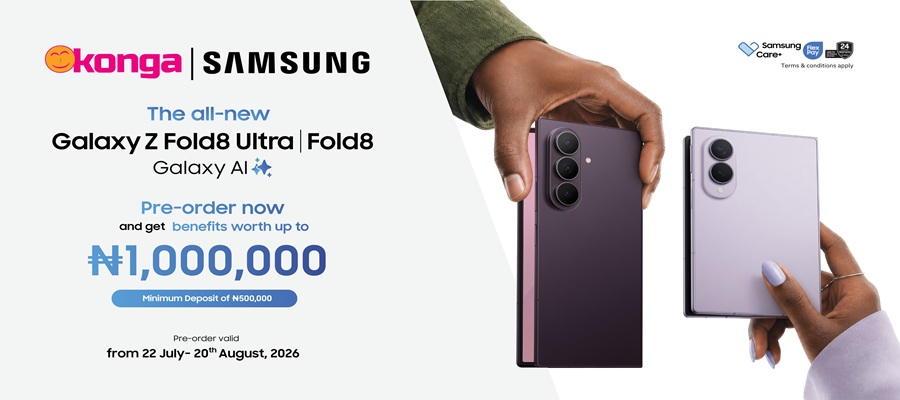
Samsung has unveiled its most advanced foldable smartphone lineup yet, the Galaxy Z Fold8 Ultra, Galaxy Z Fold8, and Galaxy Z Flip8. The tech conglomerate now sets a new benchmark for premium mobile innovation.

Konga
Nigerian customers can now pre-order the new devices on Konga, Samsung’s trusted e-commerce partner, and stand a chance to receive Samsung gift items worth up to ₦1 million, making this one of the most rewarding smartphone launches of the year.
Designed for productivity, creativity, and everyday convenience, the new Galaxy Z series introduces Samsung’s most refined foldable experience to date.
The Galaxy Z Fold8 Ultra combines an expansive display with AI-powered productivity, a powerful 200MP camera, an ultra-thin design, and enhanced durability for users who demand the very best.
The Galaxy Z Fold8 delivers immersive entertainment and seamless multitasking in a lighter, wider form factor, while the Galaxy Z Flip8 elevates self-expression with its sleek design, smarter FlexWindow, and intelligent Galaxy AI features for effortless interaction on the go. Powered by Samsung’s latest AI experiences, the new devices redefine how users create, communicate, and stay productive.
The availability of the new Galaxy Z Fold8 series on Konga further reinforces the long-standing partnership between Samsung and Konga, built on trust, authenticity, and a shared commitment to delivering genuine technology to Nigerian consumers. Through Samsung’s official store on Konga, customers are assured of authentic products, reliable after-sales support, and a seamless shopping experience.
The pre-order offer is available for a limited period. To be one of those who get to experience the new device, tech enthusiasts are encouraged to visit Konga’s Samsung Official Store to reserve their preferred Galaxy Z Fold8 or Z Flip8 device and qualify for exclusive Samsung gifts worth up to ₦1 million, while stocks last.

HURIWA, CLO Protests Bill Asking Social Media Firms’ to Open Shops Nigeria

Anambra Govt Bans Graduation Ceremonies in Anambra Schools

Airtel Secures Another 10-year Spectrum Renewal in Nigeria

Moniepoint as a Key Driver in Expanding Financial Access for Businesses in Nigeria

Nigeria, Israel Strengthen Research, Technology Collaboration

NRC, Ponzi Scheme Collapses Resulting Loss of Billions of Naira

EFCC Busts NIS Visa Overstay Racket, Uncovers N700m in an Account

Tokenization, Blockchain Technology will Transform Financial Institutions – IMF

From Scarcity to Scale: What Africa Can Learn from India’s Agricultural Transformation

Spotify partners Afro Nation Portugal to expand African music experience




 E-Business3 days ago
Kaspersky Warns Mobile‑data Buyers about Scammers Posing as Telecoms Operators

 General News3 days ago
Three Entrepreneurs Secure ₦5 Million at The Gathering on 100 Pitchathon

 E-Financial3 days ago
ChatPay Unveils Public Waitlist for WhatsApp-Based Banking Platform

 News3 days ago
African Judges Pledge Support for AfCFTA’s Success

 Telecom2 days ago
GSMA Supports Abuja Declaration on Meaningful Connectivity for Africa, Joins Partners to Launch ATLAS Umoja

 Telecom3 days ago
Airtel Africa Backs London Listing

 Telecom3 days ago
GSMA Says High Smartphone Costs Threatens Africa’s AI Future

 Telecom2 days ago
MTN Nigeria Warns Customers Against Fake ‘One Month Free Data’ Promotion