

Telecom
Concerns over Floods of Active Unregistered SIM Cards


Some mobile phone SIM card traders in Nigeria are still selling lines without registering purchasers, fuelling telecommunications violations and criminality, according to Daily Trust.
Nigerian Communications Commission (NCC) and Association of Licensed Telecommunications Operators of Nigeria (ALTON) have however put up spirited defences; but SIM cards are indeed activated on purchase, suggesting they are recognised by service providers
Deolu Ogunbanjo, president, National Association of Telecoms Subscribers (NATCOMS) said NCC and the operators should investigate their agents and sanction them.
It is unclear how the vendors secure the lines.
Daily Trust reporter who was at Wuse market in Abuja, bought a particular network’s line from a vendor who took his bio data and ‘registered’ him.
The vendor told him he could use the line for few hours pending proper registration from the network provider’s office.
Also vendors at Area 1 sell SIMs to people and get them registered for temporary use.
Our reporter bought another SIM card at this area and was able to make call with it for a few hours before he was asked by the network providers to register it or risk being barred.
A phone user, Bakare Abdulateef, told our reporter he made use of his SIM card after he purchased it from a vendor in Wuse.
Abdulateef, who said he did not know that SIM registration done by the vendors was not valid, explained that he was shocked to get a message from his network provider to register the line in its offices or risk being barred.
“But I had already made some calls and did some other things with the phone before this message came,” he told our reporter.
Another subscriber, who simply identified herself as Hajia, also said she bought a SIM and was able to make some calls with it before she got a message to register it. She said: “I don’t think this is
Reacting to the development, Mr Sonny Aragba-Akpore, NCC’s head of media said it was not true that unregistered SIM cards were sold in the open market.
He said the commission had already warned operators of severe sanctions if any of them was found contravening the SIM registration directive.
But an NCC official who asked not to be named told our reporter that “it is not impossible this is taking place but we will investigate. You know Nigerians are very difficult people, it is not impossible to see people doing it…”
Also Gbolahan Awonuga, ALTON secretary, said no one could have done that because NCC had already forbidden it.
“I don’t think so. Our vendors were doing that before, but they had since stopped. I know of some operators who even sanctioned the vendors. We have completely and collectively complied with the NCC directive now,” he said.
Elsewhere, Deolu Ogunbanjo, of NATCOMS believed the practice of allowing customers to make calls with a registered SIM card for few hours before it is barred would jeopardise the lofty aim behind the SIM registration exercise.
Recall the federal government was forced to impose a hefty fine on South African owned telecoms firm, MTN, after it was discovered that the sale of unregistered SIM cards by the company aided the terrorist group, Boko Haram, to continue to kill Nigerians.



Nigerian Communications Commission (NCC) has commenced a review of Nigeria’s 26-year-old telecommunications policy, saying the current framework no longer reflects the realities of the country’s fast-changing digital economy.

Aminu Maida, EVC, NCC
Speaking at the national telecommunications policy review workshop in Lagos, Hadiza Usman, special adviser to the president on policy and coordination, said the review had become necessary because Nigeria’s economy, technology ecosystem, and security environment had changed significantly since the national telecommunications policy was introduced in 2000.
“A policy that was fit for purpose in the year 2000 cannot simply be assumed to remain adequate in 2026,” Usman said.
She said telecommunications had evolved beyond voice connectivity and now supports financial technology, digital commerce, education, healthcare, agriculture, innovation, public service delivery, and national security operations.
“Telecommunications is no longer a standalone sector. It is an enabling platform for almost every other sector of national life,” she said.
Usman warned that outdated or poorly coordinated policies weaken implementation, discourage investment, create institutional overlaps, and reduce measurable national impact.
According to her, the revised framework must address broadband penetration, affordability of digital access, quality of service, infrastructure resilience, consumer protection, and inclusion of underserved communities.
“The revised policy must not become another document that sits on shelves. It must become a working instrument,” she said.
The presidential aide also identified fibre cuts, vandalism, multiple taxation, delayed approvals, right-of-way bottlenecks, insecurity, and energy constraints as major obstacles slowing telecommunications infrastructure expansion across the country.
She said resolving the challenges would require coordinated action among federal institutions, state governments, local authorities, regulators, operators, investors, and infrastructure providers.
Earlier, Aminu Maida, executive vice-chairman (EVC) of the NCC, said the telecommunications industry had outgrown the assumptions behind the national telecommunications policy 2000.
Maida said the policy was introduced at a time when Nigeria’s focus was on liberalisation, competition, increased access, and private sector participation in telecommunications services.
According to the EVC, the industry has since evolved into a broader digital ecosystem supporting banking, commerce, education, cloud services, entertainment, digital identity systems, and government operations.
“This is no longer a narrow telecommunications conversation. It is no longer just one sector within the economy; it is a productivity infrastructure for the entire economy,” he said.
Maida added that emerging technologies such as 5G, artificial intelligence, satellite broadband, cloud infrastructure, Internet of Things (IoT), and cybersecurity regulation have further transformed the sector.
He said the review process would also address structural issues including rural connectivity gaps, multiple taxation, vandalism, high energy costs, fibre cuts, and delays in obtaining permits.
“The commission aims to develop a modern policy framework capable of supporting innovation, protecting consumers, improving quality of experience, strengthening investment, and advancing Nigeria’s digital economy ambitions,” Maida said.
The EVC said the workshop was organised to assess implementation of the existing policy, identify gaps, engage stakeholders, and develop recommendations for a new national telecommunications policy 2026.

MTN Group plans to convert its African tower estate into a distributed AI compute fabric, installing open GPU infrastructure at base-station sites so that the same hardware can run both the cellular network and edge AI inference workloads.

The plan was set out by Charles Molapisi, group chief technology and information officer, MTN, at an event hosted by law firm Bowmans in Johannesburg recently— the company’s most detailed explanation yet of how it intends to position itself as the infrastructure layer of Africa’s AI economy.
Every cellular tower today has a baseband unit at its base — single-purpose hardware that exists only to drive the radio access network.
Molapisi said MTN will replace these with open GPU configurations capable of running the radio plus AI inference, in what the company has described as a “distributed AI grid.”
A key pay-off, he argued, is latency. AI workloads that today must be hauled back to a central data centre could instead be processed at or near the tower.
He gave the example of children playing PlayStation on an estate served by a nearby tower: with edge compute installed, the workload could be served locally rather than backhauled to a distant data centre and returned, freeing capacity and cutting round-trip time.
The edge layer sits alongside the centralized half of MTN’s AI infrastructure plan.
The group confirmed in its 2025 financial results in March that it will build two new AI-enabled data centres — one in South Africa and one in Nigeria.
Molapisi described an MTN AI strategy spanning a relatively full stack — procuring silicon, building data centres, running its own cloud platforms, curating models and co-developing applications with partners. The company is also building terrestrial fibre across multiple African markets, including some where it has no GSM licence, to plug what Molapisi called the continent’s missing “rails.”
The investments sit inside MTN’s Ambition 2030 strategy, which reorganized the group around three platforms: connectivity, fintech and digital infrastructure. The tower-to-inference push is the most concrete articulation yet of a thesis MTN has been laying out for more than a year — including an investment in March in U.S. AI-native networking start-up ORAN Development Company alongside NVIDIA, Cisco, Nokia, AT&T and Telecom Italia.
At the time, Mazen Mroué, CEO, Digital Infrastructure CEO, framed the move around “sovereign AI” — the principle that African countries should host AI compute locally rather than relying on offshore infrastructure.
Molapisi said MTN is developing the edge AI grid alongside technology partners, with the ambition for MTN to become “the biggest distributor of edge inference in the continent.”
The strategic case rests on Molapisi’s wider argument that Africa risks repeating its commodity history in the AI era.
With about 1% of global computing power on the continent today, he said, Africa stands to “export raw data” the way it has long exported raw minerals — only to import the intelligence built from it at a premium.
Molapisi conceded that chip generations are turning over quickly enough — NVIDIA’s Hopper to Blackwell inside two years, for example — that procurement decisions made today can be obsolete by deployment. He said MTN is being deliberate about its chip mix and the balance between training and inference silicon, “because if you get that wrong, you’ll get the economics terribly wrong.”

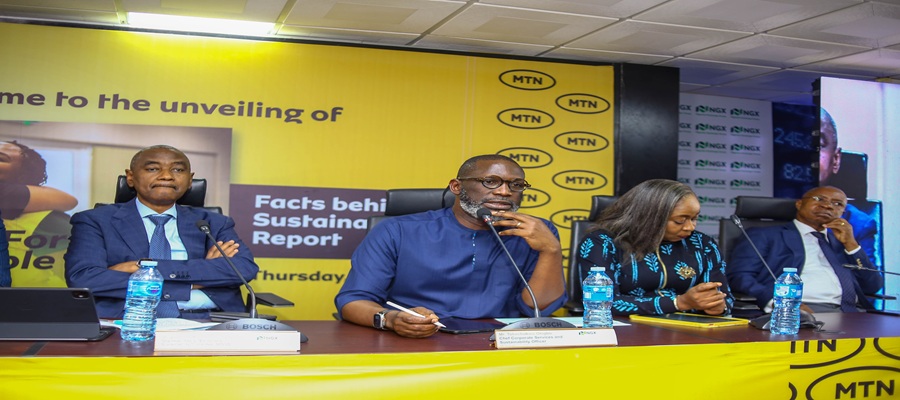
As Nigeria intensifies efforts to expand non-oil revenue and improve tax collection under its fiscal reform agenda, corporate tax contributions from major private-sector operators are becoming increasingly critical to government financing.

MTN Nigeria
Supporting that drive, MTN Nigeria paid NGN878.7 billion in taxes, levies and duties to federal and state authorities in the 2025 financial year, representing a 15% increase from the previous year, according to the company’s just-released 2025 Sustainability Report.
The trajectory tells its own story: the company paid NGN543.9 billion in taxes and levies in 2023, before that figure climbed to NGN764 billion in 2024 a cumulative rise of roughly 62% over two years, tracking the company’s recovery from deep forex-driven losses to a profit after tax of NGN1.11 trillion in 2025, with total revenue surging 54.8% to NGN5.20 trillion and operating profit climbing to NGN2.08 trillion from NGN778.2 billion.
The NGN878.7 billion remitted to government in 2025 covered corporation tax, value-added tax, spectrum fees, import duties, NCC levies and contributions under the Rural and Urban Terrestrial Infrastructure (RUTI) tax credit scheme, an initiative with deep roots in MTN Nigeria’s public-private partnership playbook.
The company has long embraced such mechanisms: it participated in the Road Infrastructure Tax Credit Scheme, under which it committed NGN202.8 billion towards reconstructing the 110-kilometre Enugu-Onitsha Expressway.
In 2025, the RUTI scheme reached 50% completion after securing approval for an additional NGN23 billion tax credit aimed at expanding fibre and telecoms infrastructure in underserved communities, a model the company argues supports infrastructure development without requiring direct public expenditure.
The report also highlighted the company’s growing domestic economic footprint, with 62% of procurement spending directed to Nigerian suppliers in 2025.
This was up from 59.6% a year earlier. MTN said the policy aligns with the Federal Government’s local-content objectives and supports sectors including civil construction, logistics, software services and power infrastructure.
The company’s operational footprint expanded to 2,087 active base stations nationwide, while active mobile subscribers stood at 85.4 million by the third quarter of 2025. Active data users rose to 51.1 million, supported by smartphone penetration of 65.1%.
During the year, MTN Nigeria renewed its 800MHz spectrum licence for another ten years to December 2034 and secured regulatory approval to lease additional spectrum from T2 Mobile, formerly 9Mobile, across 17 states and the Federal Capital Territory.

NCC Begins Review of Nigeria Telecoms Policy after 26 Years

STBMAN Warns of “Broadcasting Crisis”, Urges Tinubu to Halt NBC’s DSO

MTN to Turn its African Tower Network Into a Distributed AI Compute Grid

Elon Musk to Become First World’s Trillionaire with SpaceX Historic IPO

Army Acquires New Drones to Boost Surveillance, Precision Strikes — COAS

MTN, VDT, Zoracom, Digital Realty Back 2026 Girls in ICT Campaign

Vitel Wireless Partners Fintechs to Expand Access to Services

Kaspersky Discovers Vulnerability in Qualcomm Snapdragon Chips that can Lead to Data Loss & Device Compromise

Bank Customers to Pay N1,500 for ATM Card Issuance, Replacement – CBN

FCCPC Licenses 5 Firms for Airtime, Data Lending as Telcos Step Aside




 General News3 days ago
UAE’s Exit from OPEC: Eroding Pricing Power, Saudi Arabia’s Response, and the Implications for Nigeria

 General News3 days ago
US to Deploy Wireless Technology in Nigeria, Others

 E-Financial3 days ago
Court Orders Globus Bank to Pay Firm N256m for Breach of Contract

 Telecom3 days ago
Lagos Warns against Fake Emergency Calls, Says Rising Misuse Put Lives at Risk

 E-Financial3 days ago
AFC Invests $100m in Africa-focused Technology Fund Managers

 News3 days ago
Systems, Not Skin Colour, Hold the Key to Africa’s Development, Says Evans Woherem

 Telecom2 days ago
Google unveils Gemini-powered advertising, commerce tools at Marketing Live 2026

 General News3 days ago
Pantami, Ex Minister of Communication Withdraws from Gombe APC Governorship Primaries over Alleged Electoral Violations