

Telecom
Lagos, ALTON Agreement on Smart City Initiative Expires


The memorandum of understanding (MOU) between Lagos state government and Association of Licensed Telecommunications Operators of Nigeria (ALTON) as part of efforts to mitigate the challenges hindering the roll-out of telecommunications facilities across its domain has expired, making way for arbitrary charges by the authorities if not renewed.
The agreement expired last year December after completing its two years’ duration with provision for renewal.
It would be recalled that ALTON in 2014 signed an agreement with Lagos State Infrastructure Maintenance and Regulatory Agency (LASMIRA), and the State Ministry of Science and Technology by that MoU the approval fee for ‘right of way’ approvals was slashed by 85% to allow operators build quality network for effective service deliver for the benefit of Lagosians.
Confirming the expiration of the agreement, Engr. Gbenga Adebayo, chairman, ALTON, said that: ‘though our agreement with Lagos State government on smart city initiative expired in December 2015, but we have agreed with LASIMRA that the terms of that agreement should subsist in respect of our members seeking right of way approval till when the parties involved are able to come together to review and renew it.
On why MainOne an InfraCo operator is facing difficulty in securing Right of Way approval from the state, Adebayo, said that it is their general understanding that there should not be differential treatment between ALTON members and InfraCo operator who is not a member of ALTON.

“InfraCo operator is by extension member of ALTON, therefore should enjoy the benefit of the MoU. We don’t expect different treatment for infraCo operator,” he said.
He noted that his association is not aware of the challenges MainOne is facing with LASMIRA on ‘right of way’ issues.
When contacted, Mrs. Olasunbo, public relation officer, LASMIRA said that she will ‘get details and get back to us’ on why her agency was treating MainOne different from ALTON members.
She did not as at the time of going to press.
Also, MainOne did not respond to email by our correspondent to Adekunle Dalton-Oke, the brand and communications manager for comments on the issue.



Association of Licensed Telecommunications Operators of Nigeria (ALTON) has attributed rising mobile data consumption to increased use of smartphone applications, cloud services and emerging digital technologies.

Mr Gbenga Adebayo, chairman, ALTON
Mr Gbenga Adebayo, chairman, ALTON, disclosed this on Tuesday at the Lagos Chamber of Commerce and Industry (LCCI) conference in Lagos.
Adebayo said smartphones had transformed access to digital services, with many applications consuming data continuously, even when users were not actively browsing the internet.
He explained that automatic software updates, cloud backups, application synchronisation, video streaming, social media autoplay and location services significantly increased data consumption.
According to him, internet usage had changed considerably from a decade ago when consumers mainly relied on direct browsing with fewer digital applications running simultaneously.
He said growing adoption of artificial intelligence, cloud computing and other emerging technologies would further increase demand for reliable connectivity and greater network capacity.
“The evolution of smartphones has fundamentally changed how consumers access digital services, with many applications now consuming data continuously,” Adebayo said.
He stressed that digital literacy had become increasingly important because consumers needed to understand how their devices and applications consumed mobile data.
He advised subscribers to monitor application activity, adjust device settings and use built-in data management tools to better control their data consumption.
Adebayo said greater understanding of digital tools would help dispel misconceptions about data usage and strengthen public confidence in Nigeria’s telecommunications industry.
Responding to allegations that operators deliberately depleted customers’ data, Adebayo dismissed the claims, insisting telecommunications companies had no commercial incentive to engage in such practices.
He said every megabyte consumed on telecom networks was recorded through internationally standardised billing systems supplied by recognised technology vendors and regulated by authorities.
“Such a practice would be unlawful, unethical, commercially self-defeating and subject to stringent regulatory oversight by the Nigerian Communications Commission,” he said.
Adebayo explained that operators’ billing systems were designed to guarantee accuracy, transparency and verification, while genuine consumer complaints were investigated through established protection channels.
He added that the Nigerian Communications Commission’s complaint resolution mechanisms and technical audits provided consumers with credible avenues for seeking redress over billing concerns.
According to him, trust remains essential to expanding Nigeria’s digital economy because telecommunications infrastructure supported banking, healthcare, education, commerce and government services.
He said the telecommunications sector had evolved beyond basic communication services into a critical driver of productivity, investment, innovation and national economic growth.
Adebayo noted that emerging technologies, including artificial intelligence, financial technology, smart manufacturing and digital agriculture, depended on resilient telecommunications infrastructure.
He said Nigeria could only maximise these opportunities through sustained collaboration among government, regulators, telecommunications operators and consumers.
Adebayo reaffirmed operators’ commitment to improving customer experience, strengthening network resilience and promoting transparency in telecommunications service delivery.
He urged stakeholders to encourage evidence-based discussions on digital services, stressing that public trust remained indispensable for the sustained growth of Nigeria’s digital economy.
(NAN)
Telecom
Galaxy Backbone Soft Launches Government Service Portal to Simplify Access to Public Services

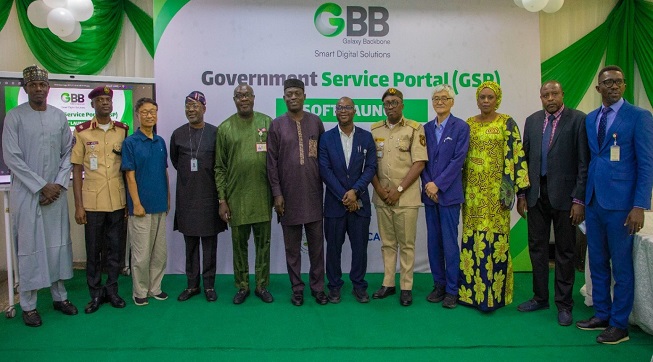
Galaxy Backbone (GBB), in partnership with the Federal Ministry of Communications, Innovation & Digital Economy (FMCIDE) and the Korea International Cooperation Agency (KOICA), officially conducted the soft launch of the Government Service Portal (GSP), a groundbreaking digital platform designed to transform how citizens, businesses and government institutions interact.

The event, held at the Galaxy Backbone National Shared Services Centre (NSSC) Headquarters in Abuja, brought together senior government officials, development partners, technology stakeholders and members of the media to unveil services.gov.ng—Nigeria’s new one-stop digital gateway for accessing government services.
The Government Service Portal is designed to provide a single, trusted platform through which Nigerians can easily discover, access and interact with digital services offered by Ministries, Departments and Agencies (MDAs). By consolidating government services into one unified portal, the initiative aims to improve accessibility, enhance service delivery and create a more seamless citizen experience.
Speaking at the event, the Managing Director/Chief Executive Officer of Galaxy Backbone. Professor Ibrahim Adeyanju, stated that the launch represents another significant milestone in Nigeria’s digital transformation journey and reflects the Federal Government’s commitment to building a more connected, efficient, transparent and citizen-centred public service.
He emphasized that the Portal is more than a website; it is the foundation of a unified digital gateway that places the needs of citizens and businesses at the centre of government service delivery.
He further noted that while the event marks the beginning of the Portal’s journey, the soft launch provides an opportunity to onboard pioneer MDAs, gather user feedback, strengthen system integrations and continuously improve the platform ahead of a wider national rollout.
Representing key stakeholder institutions at the launch were the Deputy Director of KOICA Nigeria, Mr. Ki Yun Baik; the Permanent Secretary of the Federal Ministry of Communications, Innovation & Digital Economy, represented by Mr. Joseph Bareiye, Director of e-Government; the Permanent Secretary, State House, represented by Mr. Oguntuyi Olusegun, Head of ICT; and the Executive Director, Digital Exploration and Technical Services, Galaxy Backbone, Olumbe Akinkugbe.
The Government Service Portal aligns with the Renewed Hope Agenda of President Bola Ahmed Tinubu, GCFR, and supports Nigeria’s broader Digital Public Infrastructure (DPI) agenda by creating a citizen-facing gateway that complements existing investments in digital identity, secure infrastructure, cloud services, cybersecurity and digital government platforms. It can be accessed using the link: services.gov.ng . The initiative is expected to strengthen public service delivery, increase transparency, improve operational efficiency and foster greater trust between government and citizens.
Galaxy Backbone reaffirmed its commitment to supporting all Ministries, Departments and Agencies in integrating their digital services into the Portal, noting that collaboration across government will be critical to building an inclusive, interoperable and efficient digital ecosystem that benefits every Nigerian.
The Government Service Portal is expected to evolve into Nigeria’s central digital gateway for public services, making government services simpler, faster and more accessible for citizens and businesses alike.


CMS Transport Management (CMS T&M), one of Lagos State’s oldest and most trusted transport operators, has introduced a new cashless payment service, known as TMO Rides, to improve commuting experience for passengers on its bus routes, particularly the CMS–Ajah corridor.

The initiative, which was formally launched in Lagos, is aimed at simplifying daily commuting by providing seamless, technology‑driven payment options across the CMS T&M high‑capacity bus network.
For nearly six decades, CMS T&M has played a significant role in Lagos transportation, moving thousands of passengers daily along the CMS–Ajah axis with its fleet of high‑capacity buses. The launch of TMO Rides marks another milestone in the company’s efforts to build a smarter and more efficient transport system for residents of Lagos.
Under the TMO Rides scheme, passengers will have access to TMO Cards and dedicated mobile applications that enable them to pay for bus trips digitally. The company said the service is designed to eliminate the use of cash, reduce boarding delays and create a more convenient and predictable commuting experience for its customers.
Beyond the deployment of digital fare payments, the initiative reflects CMS T&M’s broader commitment to modernising public transportation through innovation, operational efficiency and improved customer service.
CMS T&M operates within Nigeria’s regulated transport ecosystem as a registered member of the Bus Rapid Transit Association of Nigeria (BRTAN), where it is also an equity stakeholder, underscoring its commitment to a cooperative‑driven transport system. It is equally registered with the Lagos Metropolitan Area Transport Authority (LAMATA), the agency responsible for planning, regulating and franchising public transportation in Lagos State, and is a member of the National Union of Road Transport Workers (NURTW), which promotes safe and organised road transport operations.
Speaking on the launch, the Managing Director of CMS T&M, Andy, said the company was determined to keep pace with the changing transportation needs of Lagos residents.
“For nearly six decades, our focus has remained the same, which is moving people safely and efficiently. As the transportation needs of Lagos continue to evolve, we must evolve with them,” he said.
“TMO Rides is about making everyday commuting easier by giving our passengers a faster, more convenient way to pay while improving the overall travel experience. This launch represents another important step in our commitment to building a smarter, more accessible transport system for everyone,” he added.
CMS T&M explained that the cashless payment infrastructure powering TMO Rides is enabled by Treepz, a mobility technology company whose platform supports digital fare collection and operational efficiency for transport operators. By providing the technology behind the initiative, Treepz is helping CMS T&M expand access to modern, seamless transportation while advancing a shared vision of making everyday mobility more connected, convenient and accessible across Lagos.
The company said the introduction of TMO Rides forms part of its long‑term vision to embrace technology in improving public transportation without compromising the trust and consistency that passengers have relied on for generations.
CMS T&M urged commuters on the CMS–Ajah corridor and other serviced routes to take advantage of the TMO Cards and rider applications as they are rolled out, noting that more information on registration, usage and route coverage would be provided through its official channels.
More details about CMS T&M and the TMO Rides service are available on the company’s website, https://www.cmstaxiandmotor.com/.

Dangote Plans to Donate One-Third of Wealth to Charity as Legacy

NDPC Directs DCPMIs to Register with Agency or Face Legal Consequences

Malpass, Ex World Bank Chief Raises Alarm over Nigeria’s Secretive Debt Structures

How and Why Apps Deplete Data – ALTON

Galaxy Backbone Soft Launches Government Service Portal to Simplify Access to Public Services

NRC, Ponzi Scheme Collapses Resulting Loss of Billions of Naira

EFCC Busts NIS Visa Overstay Racket, Uncovers N700m in an Account

Tokenization, Blockchain Technology will Transform Financial Institutions – IMF

From Scarcity to Scale: What Africa Can Learn from India’s Agricultural Transformation

BON Establishes Six Ad Hoc Committees to Modernize Broadcasting




 News2 days ago
See Verified 20 Countries Nigerian Passport Holders Can Travel Visa-Free

 E-Business2 days ago
Report Says Cybercriminals Deploy Malware to Hijack Crypto Wallets, Monitor Browsers Telegram

 Telecom2 days ago
Subscribers, Telcos Warn FCCPC over Airtime Lending Enforcement

 Telecom2 days ago
NCC, REA Partner to Cut Telecom Costs with Renewable Energy

 E-Business2 days ago
NPC Opens 131 Births, Deaths Registration Centres in Anambra

 General News2 days ago
AfDB, Nigeria Urge African Control of Mineral Resources

 General News2 days ago
Lagos Chamber Opposes 21 Percent Pension Contribution, Warns of Job Losses

 Telecom2 days ago
Nigeria Pushes for United African Front Ahead of Global Telecoms Elections