

E-Financial
United Capital Plc, Societe Generale, Others Support African SMEs with €77m Fund


United Capital Plc, a leading African investment banking group, has partnered with global financial and corporate institutions to set up a Franco-African Investment Fund (FFA), with investible funds of 77 million euro.
The aim of the fund is to accelerate the growth of innovative and entrepreneurial African and French small and medium scale enterprises (SMEs) with development projects on both continents.
It is the first cross border investment fund dedicated to the development of African and French SMEs, and will have a lifespan of 10 years.
The agreement to set up the fund was signed in Bamako, Mali on Saturday at the sideline of the Franco African Summit which was witnessed by the Malian President Ibrahim Boubacar Keita, French President Francois Hollande amongst other global leaders in the private and public sectors. Bunmi Akinremi, The Deputy Group CEO of United Capital Plc, signed on behalf of United Capital, a limited partner on the French Africa Fund.
Other investors in the Franco-African Investment Fund apart from United Capital include: Societe Generale Orange, BpiFrance, Africinvet, Caisse Nationale de Prevoyance Sociale of CDI, Proparco (AFD), SAHAM from Morocco, Financecom, the pension fund of the Central Bank of Kenya and other private investors in Kenya. The fund is sponsored by BpiFrance and Africinvet.

Beyond financial performance, particular attention will be paid to the positive impact of the Fund’s investments in terms of governance, transparency, job creation, and respect for social and environmental values.
The participation by United Capital is considered symbolic as it portends a strategic inroad into the continent, which would see it play big in an emerging continental economy.
According to Akinremi, ‘The French government wants to explore growth markets and Africa has been identified as another area of growth. United Capital is keen to encourage the expansion of economic opportunity for Africa’. The Group Chief Executive Officer Oluwatoyin Sanni explained, “United Capital is committed to expanding its investment horizon and identifying prime opportunities to grow returns for its investors not just in Nigeria but on the African continent. The purpose of the fund aligns with what United Capital seeks to achieve in Africa”
The Fund will be split into half, with 50% to be invested in French SMEs who have interest in doing business in and with Africa and the other 50% will be invested in African SMEs.
FFA will invest primarily in African SMEs with high growth potential in order to create champions of regional and even continental statures.
Beyond capital contribution, the Fund managers will assist French companies to grow in Africa and, conversely, African companies in their growth strategy in France and Europe



Central Bank of Nigeria (CBN), has ordered banks to refund a total N19.12 billion to customers for illegal deductions and poor complaint handling.

This is coming as bank customers lodged 23,129 complaints against financial institutions in 2025, representing 11 per cent increase over the previous year.
The apex bank also imposed N1.69 billion in penalties on financial institutions for regulatory breaches, poor complaint handling and failure to comply with its directives, according to its 2025 Annual Report.
The CBN attributed the increase in complaints to growing public confidence in its consumer protection framework rather than a deterioration in banking services.
The report stated: “The Bank received a total of 23,129 complaints from consumers of financial services in 2025, a rise of 10.53 per cent above the 20,925 in 2024. The trend reflected increased awareness and improved confidence in the Bank’s consumer complaint resolution process.”
The apex bank added: “A total of 18,824 complaints were resolved, indicating a 9.36 per cent increase over the 17,213 complaints resolved in 2024.”
On the value of disputed transactions, the CBN said: “Total claims in local currency increased to N40.61 billion from N17.13 billion in 2024. Foreign currency claims also rose, reaching $344.2 million compared with $1.06 million in the preceding year.”
According to the report, “Based on the resolved complaints, the sums of N19.12 billion and $329.3 million were refunded in 2025, compared with N9.66 billion and $0.67 million in 2024.”
The CBN said it strengthened enforcement against erring financial institutions during the year.
It stated: “During the review period, the Bank imposed 11 penalties on financial institutions totalling N1.26 billion for infractions ranging from regulatory breaches and failure to respond to regulatory queries.”
The report further disclosed: “In addition, the Bank imposed 21 penalties on financial institutions to the tune of N430 million for infractions ranging from delays in resolving customer complaints to failure to comply with the Bank’s directives.”

Access Bank Plc has dismissed rumours circulating on social media that it is shutting down, describing the reports as false and malicious.

The bank, in a statement issued on Thursday, assured customers, shareholders and other stakeholders that it remains financially sound, stable and fully operational, urging the public not to be misled by the viral message.
According to the bank, the fake report falsely portrayed itself as an official communication from Access Bank with the intention of creating panic and disrupting business activities.
“We wish to reassure our customers, partners, stakeholders and the general public that Access Bank is safe, financially strong and fully operational across all our subsidiaries. Our services continue to run seamlessly, and we remain committed to serving our customers with the highest standards of excellence,” the statement read.Business Formation
The bank emphasised that there was no truth whatsoever in the claim that it was preparing to cease operations, insisting that all its branches and digital banking platforms remained fully functional.
Access Bank said it had begun working with regulatory agencies and security authorities to trace those responsible for originating and circulating the false information.
It warned that anyone found culpable would face prosecution in line with the provisions of relevant Nigerian laws.
The lender specifically noted that the creation and dissemination of false information capable of causing panic or eroding public confidence in institutions is punishable under Section 24 of the Cybercrimes (Prohibition, Prevention, etc.) (Amendment) Act, 2024.
The bank urged customers to exercise caution when consuming information online and to verify any claim through its official communication platforms before taking action.
It also appealed to the public not to forward or circulate the fake message, stressing that doing so could further spread misinformation and create unnecessary anxiety.
Reaffirming its commitment to customers, Access Bank said it would continue to provide secure, reliable and uninterrupted banking services while maintaining the confidence reposed in it by millions of customers across Nigeria and its international operations.
E-Financial
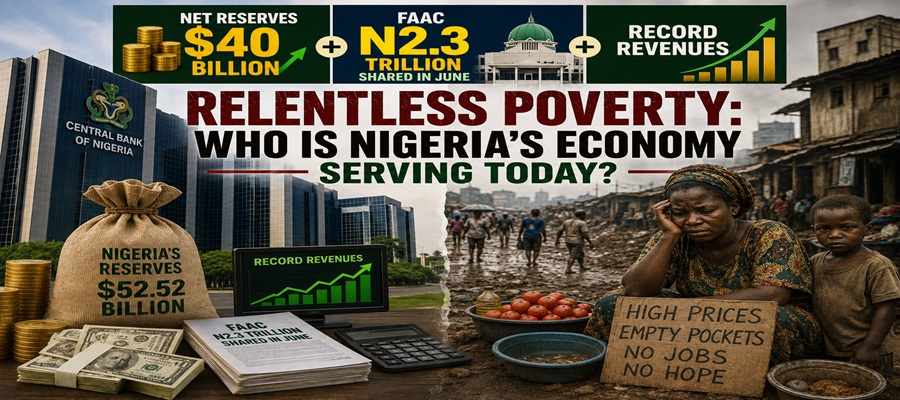
$40Bn Net Reserves, Record Wealth, Relentless Poverty: Who Is Nigeria’s Economy Serving Today?

By Blaise Udunze
No doubt, it was a welcome announcement that Nigeria’s net foreign exchange (FX) reserves have surged by an astonishing 1,233 percent from about $3 billion to over $40 billion. This would ordinarily be the kind of economic milestone that inspires optimism, coupled with gross external reserves of about $52.52 billion, which are sufficient to finance roughly 11 months of imports of goods and services. Penultimate week, the Governor of the Central Bank of Nigeria (CBN), Olayemi Cardoso, has understandably presented the development at the end of the 306th meeting of the apex bank’s Monetary Policy Committee (MPC) as evidence that its reforms are working.

It is no surprise that around the same period, one would say that another important economic event occurred with the government sharing more money than ever before with the federal, state, and local governments, as the Federation Account Allocation Committee (FAAC) distributed a record N2.55 trillion, representing an increase of N250 billion over the N2.3 trillion shared in the preceding month.
Of course, the official figures are impressive numbers. Yes, anyone would conclude that the economy is becoming stronger, more stable and better positioned for growth. While this suggests stronger public finances, it also raises the question of whether these larger allocations are producing tangible improvements in the lives of ordinary Nigerians. More interesting is that another set of figures tells a completely different story.
According to the World Bank’s newly approved Country Partnership Framework for Nigeria, 61 per cent of Nigerians now live below the poverty line, while about 79 per cent are either poor or vulnerable to falling into poverty. More than 139 million Nigerians live below the poverty line. Over 86 million people lack access to electricity, while millions of young Nigerians enter the labour market every year with little prospect of decent employment.
The contradiction could not be starker. If reserves are rising, government revenues are increasing and governments at all levels are receiving record allocations, why are the lives of ordinary Nigerians becoming more difficult?
This is the question policymakers must answer not with statistics, but with tangible improvements in the lives of citizens. If government agencies engineering these figures must know, these are not merely economic statistics; they are the lived realities by which citizens judge any government.
Foreign exchange reserves are not an economic trophy. They are a means to an end. Strong reserves are expected to stabilise the currency, reassure investors, strengthen the country’s ability to withstand external shocks and create an enabling environment for investment, production and employment.
But reserves alone do not feed families nor would they reduce their housing rents. They do not lower transport fares. They do not reduce school fees. They do not make healthcare affordable. Nor do they automatically create jobs.
Ultimately, this is to say that the success of macroeconomic reforms must be measured not by the strength of the CBN’s balance sheet but by the wellbeing of the Nigerian people.
Historically, unlike our dear country, countries that consistently build substantial foreign exchange reserves do so on the back of strong economic fundamentals. The fact is that they maintain sustained trade surpluses, export diversified products, attract large volumes of long-term foreign direct investment (FDI), develop globally competitive manufacturing industries and continuously improve productivity.
Nigeria, unfortunately, still struggles on nearly all these fronts. The country’s export earnings remain overwhelmingly dependent on crude oil. Non-oil exports remain relatively insignificant. Value-added manufacturing exports are weak. Another area that raises concern is agriculture, which continues to export mostly raw commodities rather than higher-value processed products despite being known previously as the country’s mainstay. With all these so-called developments, Nigeria still imports refined petroleum products, machinery, pharmaceuticals, industrial inputs and even food that could be produced locally.
This naturally raises an uncomfortable but legitimate question that requires an answer. Yes, it would be necessary to ask: How exactly has Nigeria grown and accumulated over $40 billion in net foreign exchange reserves without the structural fundamentals that typically support such reserve growth?
The apex bank has continued to credit exchange-rate reforms, improved transparency, stronger investor confidence and increased diaspora remittances. Well, it would be said that these achievements deserve recognition.
However, they do not completely explain the scale or more importantly, the sustainability of the reserve accumulation.
Nigeria has not consistently recorded the large trade surpluses associated with countries that rapidly accumulate reserves. Oil production remains below historical capacity. Export diversification remains limited. Ease of doing business continues to be constrained by multiple taxation, infrastructure deficits, insecurity, policy uncertainty, logistics bottlenecks and unreliable electricity.
Without addressing these structural deficiencies, reserve accumulation risks becoming more financial than productive.
Equally important is the question of foreign direct investment. Governor Cardoso has argued that improved macroeconomic stability is attracting foreign investors. That may well be true. But confidence alone does not build factories.
The real question is how much fresh FDI has actually entered Nigeria’s productive sectors? How much has gone into manufacturing? How much into agro-processing? How much into export-oriented industries capable of generating sustainable foreign exchange earnings and creating jobs?
If reserve growth is being driven largely by short-term portfolio investments attracted by high interest rates rather than long-term productive investment, then Nigeria remains vulnerable. Portfolio investors can exit as quickly as they entered whenever global financial conditions change.
The unarguable fact is that foreign direct investment, by contrast, creates factories, expands production, develops supply chains and creates lasting employment. Nigeria desperately needs more of the latter.
The CBN also points to diaspora remittances as a growing source of reserve accumulation, projecting inflows of approximately $1 billion every month before the end of the year. Again, this is encouraging.
Again, the country will not be tired of asking questions because several of these questions deserve closer examination. How much of these remittances represent genuinely new inflows rather than funds previously routed through informal channels? Come to think of it, how much of these remittances finance productive investments instead of household consumption? Can diaspora remittances realistically become a permanent substitute for export competitiveness?
No economy has ever industrialised on remittances alone. A nation cannot sustainably depend on the sacrifices of its citizens abroad while failing to create opportunities for them at home.
Beyond the reserve figures lies another troubling contradiction. This is more disturbing because every month, FAAC distributes unprecedented sums to governments across Nigeria. Yet again, with daily regret, the average Nigerian struggles with deteriorating public services.
Honestly speaking, it has become so frustrating that the majority of the people who yearn for pleasant or attractive experiences are struggling as roads remain poor, public hospitals remain overstretched, schools continue to decline, electricity remains unreliable, water infrastructure remains inadequate, youth unemployment remains widespread. Worst still, think of the cases as the nation continues to grapple with rising inflation, worsening poverty, declining purchasing power, struggling businesses and persistent insecurity.
One major contradiction is that if revenues continue rising while poverty deepens, then one unavoidable question must be asked: Where is the money going? Another pertinent question: How can the citizens be surrounded by water and still suffer from thirst or soap lather in their eyes?
This has been the predominant worry in the minds of many even as the World Bank itself acknowledges this disconnect. While praising recent macroeconomic reforms for improving fiscal stability, strengthening foreign reserves and restoring investor confidence, it concludes emphatically that the gains have not translated into meaningful improvements in living standards.
Ironically, despite the claims of declining inflation, it continues to erode purchasing power. Social protection remains weak. Most Nigerians remain trapped in low-productivity informal employment.
One contradicting and astonishing step taken recently is nowhere more evident than in the Central Bank’s monetary policy. Consider this that, despite a marginal decline in headline inflation to 15.91 percent in June 2026, the Monetary Policy Committee retained the benchmark Monetary Policy Rate (MPR) at 26.5 percent, alongside a 45 percent Cash Reserve Ratio (CRR) for commercial banks.
The decision reflects understandable caution. The CBN remains concerned that escalating geopolitical tensions in the Middle East could increase global energy prices, worsen imported inflation and reverse recent gains in price stability.
From a monetary policy perspective, this caution is defensible. But from the standpoint of businesses and households, the consequences are profound. An interest rate of 26.5 per cent inevitably translates into prohibitively expensive bank lending.
The ripple and adverse effects have led to manufacturers struggling to finance expansion. Another tough aspect is seeing the small and medium-sized enterprises, the backbone of employment generation, find access to affordable credit increasingly difficult. Entrepreneurs postpone investments. Factories delay expansion. Potential employers reduce hiring. Economic growth slows.
Ironically, while it is understandable that high interest rates may help stabilise inflation and attract foreign portfolio inflows that support reserves, it should be made known that they simultaneously suppress domestic investment, production and job creation.
In other words, the same policies helping strengthen the country’s macroeconomic indicators may also be constraining the real economy. Even the celebrated decline in inflation deserves closer scrutiny.
The national inflation rate may have eased marginally to 15.91 per cent, but this national average masks severe hardship across much of the country, which continues to create perpetual pain.
How best can this be figured out if data from the National Bureau of Statistics show that 19 states and the Federal Capital Territory recorded inflation rates exceeding 30 per cent, with Niger State above 42 percent and Kogi State exceeding 41 per cent?
Food inflation continues to rise, driven by increases in the prices of tomatoes, pepper, beef, yams, garri and other staple foods.
Businesses themselves remain unconvinced. The Organised Private Sector has welcomed the marginal moderation in inflation but insists that prices remain painfully high for both consumers and businesses.
Leaders of small business associations argue that market realities tell a different story from headline statistics. For millions of Nigerians, inflation is not measured by percentages. It is measured by empty shopping baskets. By reduced meal portions. By businesses shutting their doors. By families withdrawing children from school. By postponed medical treatments.
From a theoretical standpoint, macroeconomic stability is undoubtedly necessary. Without it, sustainable development is impossible. But it would also be agreed that macroeconomic stability alone is not sufficient. It can be argued further that economic reforms must eventually improve household incomes, reduce poverty, expand productive employment and raise living standards.
Otherwise, they risk becoming reforms that look impressive in economic reports but remain invisible in everyday life.
The truth remains that with the current situation, Nigeria therefore stands at a critical pivotal moment and the decisions taken now will determine its future.
The current reserve position should not become a destination for celebration but a foundation for deeper structural transformation. The country must diversify exports beyond crude oil. Strengthen manufacturing. Promote value-added agricultural exports. Improve electricity supply. Reduce the cost of doing business. Expand logistics infrastructure. Attract long-term productive investment.
In addition, support local industries with affordable financing. Strengthen institutions. Improve governance and ensure greater accountability for public spending. Only then will rising reserves translate into rising prosperity. Only then will record FAAC allocations produce visible development. Only then will macroeconomic stability become household stability.
The ultimate measure of economic success is not the number of dollars held in the Central Bank’s vaults. It is whether parents can afford school fees and housing rent. Whether young graduates can find decent jobs. Whether businesses can borrow, produce and expand. Whether families can afford food without sacrificing nutrition. Whether citizens feel that economic growth includes them.
Until those questions receive positive answers, one uncomfortable question will continue to linger. Who Is Nigeria’s Economy Serving Today?
Blaise, a journalist and PR professional, writes from Lagos and can be reached via: [email protected]

Police Uncover Fake Diplomatic Number Plate Syndicate in Abuja

Davido Shares Past Suicidal Thoughts, Drops Oriadé Album

Gavi Okays $500m for Vaccines, PHCs in Nigeria

82% of Organizations Concerned about AI Risks Even as Adoption Accelerates – Survey Reveals

The Journey to Financial Freedom: Priscilla, a PalmPay Agent Now Owns a Store

NRC, Ponzi Scheme Collapses Resulting Loss of Billions of Naira

EFCC Busts NIS Visa Overstay Racket, Uncovers N700m in an Account

From Scarcity to Scale: What Africa Can Learn from India’s Agricultural Transformation

Tokenization, Blockchain Technology will Transform Financial Institutions – IMF

BON Establishes Six Ad Hoc Committees to Modernize Broadcasting




 E-Financial3 days ago
Access Bank Debunks Shutdown Report, Vows Action against Perpetrators

 E-Business3 days ago
Kaspersky Uncovers Cyber Threats Defining the First Half of 2026 in Nigeria, Others

 General News3 days ago
MENXTT TECH NG Offers Affordable Dell Laptops with Flexible Payment Plans

 Telecom3 days ago
ATU Summit Ends in Abuja with Landmark Declaration to Eradicate Continental Digital Divide

 Telecom3 days ago
Hon. Minister Dr. Kingsley T. Udeh and ASUS To Unveil First of a Kind Flagship Store in West Africa

 E-Financial3 days ago
$40Bn Net Reserves, Record Wealth, Relentless Poverty: Who Is Nigeria’s Economy Serving Today?

 E-Business2 days ago
How Temu Helped a Madagascan Vanilla Family Business Sell Direct to Consumers Across Europe

 General News3 days ago
EFCC Arraigns 4 over Alleged $5.3m Fraud Scheme