

E-Business
Google Took Down 1.7Bn ‘Crooked’ Ads in 2016

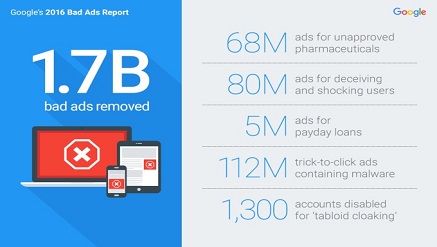
Google, the super-power in internet ad has stepped up its approach to removing nefarious ads too.
The Company on Wednesday published its latest update on how its fighting spam, bots and other problematic “ads” on its network, and said that in 2016 it took down 1.7 billion ads that violated its policies.
As a point of context, this is more than double what Google took down the year before, it said.
Google is no stranger to the issue of fake news that has swept the internet and likely influenced a lot of what people view as “fact” that may not, in fact, be true, according to the report published by TechCrunch.
In addition to accusations that its news-optimised search format elevated dodgy sites to the same level as legit news sources, the search giant was also compelled to update its policy after its ad network got used by iffy “news” sites to promote their stories and give them a lot more visibility.

The company in 2016 changed its policies in terms of how it’s been tracking ads that are misleading or predatory.
That’s included a policy introduced in July to ban payday loan ads, which led to five million ads being banned from its network.
Google said it also has been improving its tech to spot and disable dodgy ads faster. You may have noticed, for example, that “Trick to click” ads now come with system warnings before you go to the site they are linked to, as they can lead to malware links. Why these ads are not just removed altogether is another question, but in any case Google said that in 2016, its systems “detected and disabled a total of 112 million ads for ‘trick to click,’” six times as many as the year before.
Aside from tackling unethical ads such as unapproved pharmaceuticals — an issue that massively impacted Baidu in China — payday loans and counterfeit goods, and deceptive products, Google said it focused its efforts on clickbait advertising.
The company refers to clickbait as ‘tabloid cloaking,’ in other words dressing an ad up as shocking news akin to a tabloid newspaper to get attention. It really isn’t hard to find examples of that across the world.
The search giant claims it took down 1,300 accounts that were performing such scams. That doesn’t seem like a huge number, but it just takes a few bad actors to do a lot of damage. Case in point, the 22 “cloakers” it nabbed in December were responsible for serving up ads that were viewed over 20 million times online in a single week.
Bad news though, that fight is very much ongoing. Google explained that tabloid cloaking is “gaining in popularity” because it is such an effective method to grab attention online, in much the same way that some websites have risen on the back of viral/shock news.
“While we took down more bad ads in 2016 than ever before, the battle doesn’t end here,” Google said addressing the threat broadly.
“As we invest in better detection, the scammers invest in more elaborate attempts to trick our systems. Continuing to find and fight them is essential for creating a sustainable, open web from which we all enjoy.”



Kaspersky’s Global Research & Analysis Team (GReAT) reveals key cyber threat trends for the first half of 2026 at the recent Cyber Security Weekend for the Middle East, Turkiye and Africa region (META).

As the cybersecurity landscape continues to evolve, cyberthreats are becoming increasingly diverse and sophisticated. The rapid adoption of artificial intelligence (AI), coupled with ongoing geopolitical and economic instability, is contributing to the rise of cybercrime and the growing complexity of cyberattacks.
According to Kaspersky’s telemetry, online threats exploiting vulnerabilities in websites, emails and web services continued to affect millions of users across the META region during the first half of 2026.
Specifically, Kaspersky detection systems stopped 1,6M attacks from various online resources in Nigeria. Turkiye recorded the highest percentage of users affected by web-based threats at 22.8%, followed by Kenya (21.2%), Qatar (19.3%), Nigeria (18.4%) and South Africa (17.2%). In contrast, Saudi Arabia, Jordan and Pakistan registered the lowest share of users targeted by web-borne attacks in the region.
AI is transforming attacker operations
Kaspersky experts report that threat actors are increasingly integrating AI into different stages of their operations. Large language models are already being used to generate phishing emails, malicious code and supporting operational content.
AI is also beginning to play a larger role in malware development. Modern language models are capable of generating substantial portions of malicious software, from initial code scaffolding to functional modules.
Researchers have already observed AI-assisted malware development in campaigns linked to the FunkSec group, which deployed Rust-based malware capable of data theft, encryption and process manipulation. Similarly, during the RevengeHotels campaign in 2025, threat actors used large language models to generate portions of the infector and downloader code.
“We expect AI to remain one of the key factors shaping the threat landscape in 2026, as we already see how it is reshaping attacker workflows and accelerating their operations,” said Sergey Lozhkin, Head of Global Research and Analysis Team in APAC and META regions at Kaspersky. “By lowering the time and cost required to develop and adapt malicious tools, AI allows threat actors to iterate faster and scale their efforts. Defenders should be prepared for quicker shifts in tactics.”
Emerging trends shaping the cyber threat landscape
In addition to the growing use of AI by cybercriminals, Kaspersky experts identified several trends that organisations should monitor closely:
- AI-driven malware evolution: generative models can rewrite malware in different languages or architectures, making malicious code harder to detect, and faster to deploy at scale.
- Cloud-based data exfiltration: attackers increasingly route stolen data through legitimate cloud and file-sharing services to blend in with normal traffic.
- Ransomware targeting operations: some groups disrupt production and business processes, not just encrypt data, to increase pressure for payment.
- AI agents as persistence mechanisms: some AI agent solutions are granted broad or even full system access. If compromised, attackers could modify the system prompt or the agent’s configuration, for example, causing it to download a payload on every startup.
- Malicious AI skills become a new attack vector: as AI agents gain broader access to enterprise systems, attackers start to exploit compromised skills to manipulate agent behaviour, steal sensitive data, execute unauthorised actions, and establish persistent access. This creates a new layer of risk where trusted AI tools can be turned into powerful mechanisms for cyberattacks.
As cyberthreats continue to evolve alongside emerging technologies, Kaspersky recommends that organisations strengthen their cybersecurity posture through continuous vulnerability management, timely patching, employee awareness training, threat intelligence, and advanced security solutions like Kaspersky Next, capable of detecting sophisticated and AI-assisted attacks.
E-Business
Kaspersky Uncovers New Mirage Kitten Malware Used in Cyber-espionage Campaign Across Africa, Others


Kaspersky Global Research and Analysis Team (GReAT) has discovered a previously undocumented malware set used by Mirage Kitten APT. The findings were revealed at its annual Kaspersky Cyber Security Weekend for the Middle East, Turkiye and Africa (META).

The malicious tools were used in a targeted campaign aimed at maintaining long-term access to victim networks and stealing sensitive data.
The company’s researchers have identified victims of this campaign across the Middle East and Africa, including organisations in Egypt, small and medium-sized businesses and government entities in Jordan and Tanzania, aviation organisations in Pakistan, telecommunications companies in Ethiopia and financial-sector entities in Burkina Faso.
The toolset consists of three custom programs. At its core is NightLedger, a newly discovered Windows backdoor attributed to the group based on code and behavioural similarities to its previously known malware, which gives the attackers remote control over infected machines: they can run commands, explore and transfer files and capture screenshots.
It is complemented by two covert tunneling tools, ArcBridge and BridgeHead, which effectively turn a compromised computer into a relay node: the attackers run their tools on their own servers, while all the resulting traffic is quietly funneled through the victim’s machine, as if it originated from inside the victim’s network.
This lets them slip past network defences and preserve long-term access without drawing attention. The first of these tools was identified in April 2026 in activity targeting victims in the Middle East.
While the initial access vector remains unclear in most cases, Kaspersky GReAT researchers observed BridgeHead being deployed during post-compromise activity in victim environments in Egypt and at an aerospace and aviation organisation in Pakistan. In those cases, the intrusion activity followed targeted spear-phishing attempts consistent with the group’s known methods.
The lures were highly tailored including recruitment-themed messages impersonating trusted brands and hiring platforms, as well as fake videoconferencing pages that redirected victims to malicious archive files hosted on third-party file-sharing services.
“Based on our latest findings, we conclude that Mirage Kitten continues to evolve its malware arsenal in support of targeted cyber-espionage operations across the Middle East and Africa.
“Another notable aspect of the campaign is the group’s continued reliance on tunneling utilities as part of its operational toolkit: in practice this enables attackers to bypass network controls, maintain covert access to compromised environments and significantly complicate detection efforts.
“Given the persistence and sophistication of these techniques, organisations and defenders should incorporate these findings into their threat assessments and strengthen their detection and response capabilities accordingly,” says Omar Amin, senior security researcher at Kaspersky GReAT.


Nigeria Data Protection Commission (NDPC) has directed all Data Controllers and Data Processors of Major Importance (DCPMIs), yet to register with the commission to do so immediately.

This followed a Federal High Court judgment affirming NDPC statutory powers to designate and register such entities.
DCPMIs are entities operating in Nigeria that handle sensitive personal data or large volumes of information, requiring mandatory registration with the NDPC under the Nigeria Data Protection Act (NDPA).
In a statement issued on Tuesday by Babatunde Bamigboye, head of Legal, Enforcement and Regulations at the NDPC, described the judgment as a major milestone for data accountability and regulatory oversight in Nigeria.
The commission said the ruling arose from a suit filed by Emmanuel Harunna against the NDPC in Emmanuel Harunna v. NDPC (FHC/L/CS/1116/2024), in which the applicant sought a declaration that Point of Sale agents were not Data Controllers or Processors of Major Importance under the Nigeria Data Protection Act and requested a perpetual injunction restraining the commission from registering them.
According to the statement, Justice F.N. Ogazi examined the commission’s Guidance Notice on Registration alongside Sections 5(d), 6(c), 44, 45 and 65 of the Nigeria Data Protection Act before concluding that the commission acted within its statutory powers in designating entities under the Major Data Processing – Ordinary High Level category as Data Controllers and Processors of Major Importance.
Quoting the judgment, the statement read, “The Nigeria Data Protection Act was enacted to promote accountability, transparency and responsible data governance. Registration enables the Respondent to identify entities engaged in significant data processing activities, monitor compliance.”
It added that the court held that, “Far from undermining the constitutional right to privacy, the registration framework is one of the statutory mechanisms designed to safeguard that very right by subjecting data controllers and data processors to effective regulatory oversight.”
The statement further quoted the court as saying, “Looking at the recitals of the Guidance Notice, there is every indication that the Guidance Notice is also aimed at protecting the privacy and security of data subjects, thus bringing the registration requirement of the Guidance Notice within the protective shield of Section 45 of the 1999 Constitution.”
According to the commission, the court also held that, “Remarkably, Section 63 of the Data Protection Act provides that the provisions of the Act shall prevail over any other law inconsistent with its provisions on matters relating to the processing of personal data.”
Reacting to the judgment, the commission described the decision as a significant boost to Nigeria’s data protection regime.
“The Commission appreciates the ground-breaking efforts of the court towards the advancement of the jurisprudence relating to data accountability in Nigeria, as eloquently demonstrated in this case,” the statement read.
Following the ruling, Vincent Olatunji, national commissioner and chief executive officer, had directed every Data Controller and Processor of Major Importance that had yet to comply with the registration requirement to register without delay.
The commission warned that entities failing to comply with the registration requirement could face legal consequences.
“Failure to register creates serious legal liabilities under the law, while compliance with registration requirements builds public trust and safeguards the fundamental rights and freedoms of data subjects in Nigeria,” the statement added.

EFCC Arraigns 4 over Alleged $5.3m Fraud Scheme

CBN Orders N19Bn Refunds to Customers as Complaints Rise

Access Bank Debunks Shutdown Report, Vows Action against Perpetrators

Oye, AERE Raises Alarm as 8m MSMEs Collapse in 18 Months

Kaspersky Uncovers Cyber Threats Defining the First Half of 2026 in Nigeria, Others

NRC, Ponzi Scheme Collapses Resulting Loss of Billions of Naira

EFCC Busts NIS Visa Overstay Racket, Uncovers N700m in an Account

From Scarcity to Scale: What Africa Can Learn from India’s Agricultural Transformation

Tokenization, Blockchain Technology will Transform Financial Institutions – IMF

BON Establishes Six Ad Hoc Committees to Modernize Broadcasting




 Telecom2 days ago
Fact-Check: Elon Musk’s “Tesla Pi Phone” is Internet Rumor

 E-Financial2 days ago
Malpass, Ex World Bank Chief Raises Alarm over Nigeria’s Secretive Debt Structures

 Telecom2 days ago
How and Why Apps Deplete Data – ALTON

 News2 days ago
CIBN, ACAMB Push for Financial Inclusion, Women Empowerment

 E-Financial2 days ago
S&P Global Acquires Agusto & Co. to Strengthen Credit Ratings Across Africa

 Telecom2 days ago
Galaxy Backbone Soft Launches Government Service Portal to Simplify Access to Public Services

 E-Business2 days ago
NDPC Directs DCPMIs to Register with Agency or Face Legal Consequences

 Broadcasting2 days ago
Africa Prudential Posts N1.59bn Profit in H1 2026, Reaffirms Digital Growth Strategy