

News
Increasing Threats on Free Speech As Political Terrorism

“Everybody likes to get as much power as circumstances allow, and nobody will vote for a self-denying ordinance.” Lord Emerich Edward Dalberg Acton, English Catholic historian, politician, and writer.
One would have thought that the above quote attributed to Lord Acton, which has been captured in another sense as “Power tends to corrupt, and absolute power corrupts absolutely” was only relevant to the military and despotic systems of Government, but recent happenings in Nigeria and other supposedly democratic climes have proven that those words are as relevant today as they were in the worst days of military and dictatorial government across the globe.
When the Cybercrime Act 2015 was signed into Law by the erstwhile President Goodluck Ebele Jonathan at the twilight of his administration in 2015, there was a sigh of relief that Nigeria has finally been able to develop its own regulatory framework to tackle the menace of cybercrime.
The enthusiasm could not be faulted given the bad reputation the country has had to grapple with as result of the activities of the famous cybercriminals popularly known as “Yahoo boys” and lately “Yahoo Plus”.
That enthusiasm was however cut short when it became clear that this law has beyond anything else unleashed another form of terror on Nigerians even while the country grapple with conventional terrorism by Boko Haram.

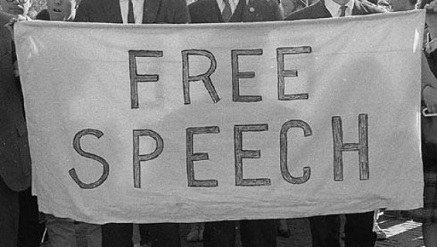
This terror however is about suppression of core values of any democratic system, which includes freedom of speech. Freedom of speech is an important tenet of any democracy and the apparent suppression of voices of dissent or whistleblowers is nothing short of terrorism in another mode.
Attack on Free Speech is a form of terror and we must curse the darkness while we can. While the Nigerian Police refuted the claims by Chidi Odinkalu and others describing the shooting at a Catholic Church in Ozubulu in Anambra State on August 6 2017 as an act of terror, the Police by inference unwittingly admitted that the trend of arrest of citizens over whistle blowing activity is an act of terror.
Abayomi Shogunle , Head of Nigeria Police Rapid response unit argued on his twitter handle which he typically uses to address issues/complaints about the Nigerian Police, that an act of terror must be politically motivated. Given this line of thought, it is clear that even the Police in Nigeria agree that the political class have now resorted to terrorizing Nigerians for expressing opinions online.
Several citizens are currently going through politically motivated prosecutions in the court. Two of those cases are highlighted here being the most recent experiences and considering the status of the actors involved in them (More cases are summarized in the image below).
It is no longer news that the Governor of Kogi state with the help of the Department of State Security services is currently prosecuting a civil servant. His offence, according to news reports, was posting the image of the Abuja residence of the Kogi State Governor, Yahaya Bello, using a drone camera.
According to the Guardian Newspaper, he was said to have posted the pictures with a caption: “This building is owned by an individual in Kogi where hunger is the people’s first name” to highlight the affluence of the Governor while Government workers groan and struggle to survive over unpaid salaries and citizens live in abject poverty.
The action, the prosecuting counsel who is also a senior legal officer with the State Ministry of Justice said, put “Governor Yahaya Bello and family into threat and harm to their property” and thereby urged the court to take cognizance of the offence of cyber stalking (relying on section 24 of the cybercrimes Act 2015) against the accused.
The action of the Kogi State Government to say the least is the most barbaric form of high-handedness by anyone in power and a total abuse of privilege by using the State Security Service funded by tax payers for an egoistic pursuit. Well, it must be noted that he has a co-traveller in Nigeria’s Senate President, Dr. Abubakar Bukola Saraki.
In an Interview with Punch Newspaper, A 37-year-old primary school teacher in Kwara State, Biodun Baba, who was arraigned before a magistrates’ court in Ilorin for allegedly insulting Senate President Bukola Saraki on Facebook, recounts his ordeal after he reacted to a Facebook post of factional Chairman of the Peoples Democratic Party in the state, Akogun Iyiola Oyedepo on the discharge and acquittal of the Senate President by the Code of Conduct Tribunal.
He commented in the comment section as follows “Somebody believes that he is above everybody, he is not above the judgment of God. If Saraki has been discharged by the CCT, has he been discharged by God?” Two officials of the DSS came and dragged him to their office in Ilorin.
They gave him a form to write an undertaking that he will never abuse the Senate President again. It didn’t stop there; he was taken to court but was lucky to be defended by a group of lawyers who worked pro-bono to defend him in Court.
The cases involving Bukola Saraki and Governor Yahaya Bello are only 2 of many of such occurrences in Nigeria lately. Paradigm Initiative documented at least 8 of such cases in 2016 alone its Digital Rights in Africa annual report for 2016 and there has been at least 10 of such cases in 2017.
If nothing else, the two cases above represent the most recent form of barbaric attacks on free speech by the Nigeria Political class but nothing of a departure from the pattern of previous documented cases.
Drafters of the Cybercrime Act 2015, their intention notwithstanding, have successfully played into the hands of agents of domination, intolerance and leaders who will rather oppress than protect the citizens that elected them.
This has been a pattern in the last 2 years and it will as a matter of fact increase as the 2019 election draws closer. I hate to opine that a law which was supposed to help curb the scourge of cybercrime in Nigeria has hardly done so but has been the tool of oppression in the hand of the powerful.
Unfortunately, this has been the case and there is no end in sight for the abuse and oppression being perpetrated by the political class and the powerful in connivance with security agencies.
This article should not be seen as an attempt to demonize certain political actors but to challenge the system and frameworks that encourage and allows the oppression of fellow citizens to be possible.
In the words of the French republican poet and politician, Alphonse Marie Louis de Prat de Lamartine, “It is not only the slave or serf who is ameliorated in becoming free… the master himself did not gain less in every point of view,… for absolute power corrupts the best natures (Translated from his original work in French)”.
Therefore we shouldn’t be looking at demonizing the actors but at correcting the system and frameworks that makes abuse possible.
Last year, Paradigm Initiative together with Media Rights Agenda and Enough is Enough went to court to challenge the constitutionality of section 24 of the Cybercrimes Act 2015, a lawsuit which has now reached the appeal stage at the Federal Appeal court.
As concerned citizens and civil society, we can only hope and urge the court to expedite the hearing and give judgment in the interest of democracy and the rule of law. Also, a member of the National Assembly Senator Buhari Abdulfatai representating Oyo state at the Nigerian Senate has sponsored a Bill to repeal and re-enact the Cybercrime Act 2015.
The Bill, SB 450: Cyber Crime (Prohibition, Prevention, etc.) Act 2015 (Repeal and Re-enactment) Bill, 2017 has only been read once on the floor of the Senate and the content is yet to be made public by the National Assembly (This represents another lacuna in the law making process in Nigeria whereby Bills being discussed by the National Assembly are not accessible to citizens).
The public hearing for this Bill whenever it happens presents an opportunity to address the sections of this Bill currently being exploited by political gladiators to oppress opposing voices.
Adeboye Adegoke @adeboyeBGO is a Digital Rights Advocate and works with Paradigm Initiative


The Chartered Institute of Bankers (CIBN) and the Association of Corporate Communication and Marketing Professionals in Banks (ACAMB) have enjoined banks to further deepen and prioritize financial inclusion, women’s empowerment and sustained growth through strategic mandates and frameworks, aimed at closing the financial gap and empowering more small, and medium enterprise (MSME) owners.

Both organisations made this call during a courtesy visit to the newly invested 24th President and Chairman of Council of the Chartered Institute of Bankers of Nigeria (CIBN), Dr. Dele Alabi, Ph.D, FCIB, as part of plans to congratulate him on his investiture as well as seek a stronger alliance between both bodies.
The visit followed Alabi’s investiture where he unveiled his “IMPACT” Vision, themed “Consolidating Our Local Impact, Enhancing Our Global Relevance.”
The vision rests on six pillars: Inclusion across geographic, gender, and generational lines; Membership growth and quality; Professionalism and ethics; Accountability; Competencies and skills development; Technology, automation, and innovation. Other areas of shared interest, include women empowerment, financial inclusion and literacy, as well as MSME clinics, all of which are top on his agenda.
Alabi explained that under him, the institute will be prioritising financial inclusion and women empowerment, because of its realisation that women are often the primary financial managers and caregivers in families. Access to savings, micro-credit, and insurance acts as a safety net during crisis and allows them to significantly improve living conditions.
He added that CIBN would be happy to drive joint knowledge sharing and exchange sessions with CBN and ACAMB across various platforms. “Educating the public through public awareness programmes, with ACAMB as the rallying point, is central to what we do,” he noted.
ACAMB President, Jide Sipe, who led the delegation, spoke in unison with the CIBN president, as he noted that, closing the inbalances in financial access help economies grow faster, reduces inequality, and encourages greater civic participation by all.


Lagos State has become the first sub-national government in Nigeria to establish a comprehensive Greenhouse Gas Registry, a move aimed at strengthening climate governance, improving emissions accountability and accelerating the state’s transition to a low-carbon economy.

The Lagos State Greenhouse Gas Registry (LGHGR) was unveiled at the Central Business District, Alausa, Ikeja, at a ceremony attended by Prof. Akin Abayomi, commissioner for Health, members of the State Executive Council, representatives of the Federal Ministry of Environment, development partners, TPHG Technologies, the diplomatic and business communities, academics, civil society organisations and the media.
Describing the initiative as a landmark achievement in the state’s environmental sustainability drive, Dr. Babatunde Ajayi, general manager of the Lagos State Environmental Protection Agency (LASEPA), said the Registry marks a defining moment in Lagos’ climate action journey and reflects Governor Babajide Sanwo-Olu’s commitment to building a resilient, climate-smart and environmentally sustainable economy.
According to Ajayi, the digital platform will enable the state to accurately measure, monitor, report and verify greenhouse gas emissions across key sectors, providing credible data to guide environmental policies and climate interventions.
He said the Registry would strengthen evidence-based decision-making, improve transparency and accountability, support national and international climate reporting obligations, unlock carbon market opportunities and boost investor confidence in Lagos’ environmental initiatives.
Ajayi also commended TPHG Technologies for providing the technical expertise that made the pioneering project possible.
Delivering the keynote address, Prof. Abayomi described the Registry as a major milestone that positions Lagos at the forefront of climate governance and emissions accountability in both Nigeria and Africa.
He noted that climate change has evolved into a significant public health and governance challenge, stressing that access to reliable emissions data would enable the state to formulate evidence-based policies, attract climate financing, strengthen resilience and accelerate its transition to a low-carbon economy.
Providing insights into the technical framework of the project, Dr. Mofoluso Fagbeja, lead consultant and chief executive officer, TPHG Technologies, explained that the Registry was developed from the greenhouse gas inventory jointly undertaken by LASEPA and TPHG Technologies in 2022, using 2019 as the baseline year for emissions assessment.
He said the platform is designed to close critical emissions data gaps, particularly within the industrial sector, while supporting effective climate policy implementation, emissions management and sustainable development.
Fagbeja also disclosed that the greenhouse gas inventory estimated that poor air quality contributes to about 35,000 premature deaths annually in Lagos, underscoring the urgent need for stronger emissions control measures and cleaner environmental practices.
In a goodwill message, Balarabe Abbas Lawal, minister of Environment, represented by Mrs. Adenaike Olunimpe Oludunni, federal controller of Environment in Lagos, commended Lagos State for pioneering the initiative, describing it as a significant contribution to Nigeria’s climate commitments.
He said the Registry aligns with the country’s Nationally Determined Contributions (NDCs) under the Paris Agreement and supports the Federal Government’s Energy Transition Plan, while reaffirming the ministry’s commitment to deeper collaboration with Lagos State on climate governance and environmental sustainability.
A recently released Henley Passport Index 2026, showed that Nigerian citizens can travel to at least 20 destinations outside the African continent where entry is allowed either visa-free, with a visa on arrival (VOA) at no extra cost, or via an e-visa.

This expanded access opens doors for Nigerian travellers to experience countries in the Caribbean, Asia, and beyond with greater ease.
Below is a comprehensive guide to countries outside Africa which Nigerian passport holders can visit without a traditional visa.
Visa-Free Countries outside Africa for Nigerian Passport Holders:
Barbados
Cambodia – Visa on arrival
Comoros Islands – Visa on arrival
Cook Islands
Dominica
Fiji
Haiti
Iran – Visa on arrival
Kiribati
Lebanon
Maldives – Visa on arrival
Micronesia
Montserrat
Niue – Visa on arrival
Palau Islands – Visa on arrival
Samoa – Visa on arrival
St. Kitts and Nevis
Timor-Leste – Visa on arrival
Tuvalu
Vanuatuul

Fact-Check: Elon Musk’s “Tesla Pi Phone” is Internet Rumor

Dangote Plans to Donate One-Third of Wealth to Charity as Legacy

NDPC Directs DCPMIs to Register with Agency or Face Legal Consequences

Malpass, Ex World Bank Chief Raises Alarm over Nigeria’s Secretive Debt Structures

How and Why Apps Deplete Data – ALTON

NRC, Ponzi Scheme Collapses Resulting Loss of Billions of Naira

EFCC Busts NIS Visa Overstay Racket, Uncovers N700m in an Account

Tokenization, Blockchain Technology will Transform Financial Institutions – IMF

From Scarcity to Scale: What Africa Can Learn from India’s Agricultural Transformation

BON Establishes Six Ad Hoc Committees to Modernize Broadcasting




 News2 days ago
See Verified 20 Countries Nigerian Passport Holders Can Travel Visa-Free

 E-Business2 days ago
Report Says Cybercriminals Deploy Malware to Hijack Crypto Wallets, Monitor Browsers Telegram

 Telecom2 days ago
NCC, REA Partner to Cut Telecom Costs with Renewable Energy

 Telecom2 days ago
Subscribers, Telcos Warn FCCPC over Airtime Lending Enforcement

 E-Business2 days ago
NPC Opens 131 Births, Deaths Registration Centres in Anambra

 General News2 days ago
AfDB, Nigeria Urge African Control of Mineral Resources

 General News2 days ago
Lagos Chamber Opposes 21 Percent Pension Contribution, Warns of Job Losses

 News1 day ago
History as Lagos Becomes First Nigerian State to Launch Greenhouse Gas Registry