

Telecom
Ericsson Expands its 5G Portfolio

Ericsson has introduced a new radio product, AIR 3246, for Massive Multiple Input Multiple Output (Massive MIMO), which is a complement to Ericsson’s global 5G radio offering.
AIR 3246 supports both 4G/LTE and 5G NR (New Radio) technologies and is Ericsson’s first 5G NR radio for frequency division duplex (FDD).
This launch will enable operators – especially in metropolitan areas – to bring 5G to subscribers using today’s mid-band spectrum and boost capacity in their LTE networks.
Ericsson’s 5G Platform includes three previously launched time division duplex (TDD) radios capable of supporting 5G and Massive MIMO, as well as core, transport, digital support and security elements. The company has the most complete 5G portfolio in the industry, serving the needs of the first movers in 5G.
Fredrik Jejdling, Head of Business Area Networks at Ericsson, said: “We now expand the 5G platform that we introduced last February. The new radio will enable operators to enhance 4G capacity for their subscribers today and be ready for 5G tomorrow, using the same hardware. We also complement the products with a set of network services, simplifying the journey to 5G for our customers.”

Bridging from 4G to 5G
People are watching, sharing and streaming video and music more than ever. As such, the demands on a sufficient speed are ever increasing.
Ericsson analyzed 4G network performance statistics from metropolitan areas around the world, and found that the probability of a smart device suffering from insufficient speed can be as high as 20 percent during peak hours.
Massive MIMO is a key technology to bridge from 4G to 5G, adding intelligent capacity and boosting user experience.
Stefan Pongratz, Senior Director at the Dell’Oro Group, said: “Just as carrier aggregation has been key to adding needed capacity to mobile broadband networks, Massive MIMO has the potential to be the primary capacity enabler in the next upgrade phase, providing a smooth transition towards 5G. With an expected 2021 installed base of 10M LTE macro radios in high traffic and metro areas, service providers are expected to capitalize on the improved spectral efficiency made possible with Massive MIMO.”
FDD Massive MIMO is part of a trial with T-Mobile US, on three sites in Baltimore, Maryland. This will be the first time that standardized Massive MIMO will be used to carry commercial LTE traffic using mid-band FDD spectrum.
Neville Ray, Chief Technology Officer for T-Mobile, said: “T-Mobile’s racing forward at breakneck pace with Ericsson’s next-gen tech that advances LTE today and paves the way for 5G tomorrow. While the carriers scramble to prop up networks caving under the weight of unlimited, the Un-carrier’s rolling out advanced technologies to massively increase network capacity and data throughput for customers. Translation – we’re making America’s best unlimited network even better!”
Massive MIMO on FDD can increase network capacity up to three times and bring up to five times better user throughput, boosting performance for the end users. Today’s global base is primarily on FDD technology and devices, which separates uplink and downlink streams on different radio frequencies.
Commercially available in the second quarter 2018, AIR 3246 will be part of Ericsson Radio System.
5G Services – preparation to launch
Complementing the 5G core transformation services introduced earlier this year, Ericsson is now launching a set of services helping operators on the road to 5G in three steps: Prepare, Mobilize and Launch.
The services entail: Prepare for the first crucial steps based on learnings from Ericsson’s trials around the world; mobilize by setting up the technical and operational resources necessary for a successful 5G launch; and launch 5G services through complete and rapid network rollout and ensure smooth operations of the services.
These new 5G services use Ericsson’s Engineered Intelligence approach, which builds on the best of human and machine capabilities and are supported by automation, machine learning and artificial intelligence tools.
Ericsson’s 5G platform comprises the 5G core, radio and transport portfolios, together with OSS, BSS, network services and security.



Dimension Data has said that the proceeds from its Series 1 corporate bond, will support the expansion of the company’s fibre infrastructure to meet Nigeria’s growing demand for digital connectivity.

This followed the successful subscription of the corporate bond.
Recall that Dimension Data Limited said that it has completed the signing ceremony for the issuance of N4.05 billion (approximately US$2.9 million).
This sum marks the first tranche of a N20 billion (US$14.7 million) bond programme announced earlier this year.
The bond programme was raised under Dimension Data SPV Funding Plc, following approval from the Securities and Exchange Commission (SEC) of Nigeria.
The company says the proceeds will support the expansion of the company’s fibre infrastructure to meet Nigeria’s growing demand for digital connectivity.
Speaking at the ceremony, Olugbenga Olabiyi, managing director of Dimension Data Limited, said the investment reflects the company’s long-term commitment to strengthening Nigeria’s digital economy.
The planned investments will fund the continued expansion of Dimension Data’s fibre network, supporting increasing demand from financial institutions, fintechs, enterprise customers and other technology-driven sectors.
Founded in 1983 and headquartered in Johannesburg, the company has grown its footprint across the Middle East and Africa.
Today Dimension Data is a member of the NTT Ltd Group, one of the world’s leading technology companies.
As cloud adoption, digital financial services and data-intensive applications continue to grow, the company believes resilient fibre infrastructure will remain a critical enabler of Nigeria’s digital economy.


The Federal Government has announced that work will commence within weeks on a 90,000-kilometre fibre optic network expected to connect every state, local government area and ward in Nigeria, marking what officials describe as one of the country’s most ambitious digital infrastructure projects.

Dr Bosun Tijani, Minister of Communications, Innovation and Digital Economy, disclosed this on Tuesday after briefing President Bola Tinubu at the State House, Abuja, on the progress of three flagship digital transformation initiatives being implemented by his ministry.
According to the minister, all resource mobilisation and contractual processes for the nationwide fibre project have been completed, paving the way for physical deployment.
“We’re now at the point where, in a few weeks’ time, we should start to lay those fibre, so people will start seeing us around the country deploying the fibre. This is going to transform Nigeria for good,” Tijani said.
He explained that the project would deliver fibre optic infrastructure to every geopolitical zone, state, local government area and ward, significantly expanding broadband access and improving the quality of internet connectivity across the country.
“This is a project where every state, every geopolitical zone, every local government and every ward in this country will be covered with fibre optic cables, which will transform the quality of connectivity,” he added.
Bosun Tijani attributed the progress in the digital economy to a series of reforms approved by President Tinubu, including the designation of digital infrastructure as Critical National Infrastructure, tariff adjustments and tax harmonisation measures sought by industry operators.
“I think our sector has been extremely fortunate. Mr. President has given us quite a number of things that the sector has been demanding for a long time. Whether it’s the Critical National Infrastructure designation for all digital infrastructure, the slight adjustment in tariff, or the tax harmonisation, these are reforms the industry has long requested.
“I think it’s probably the sector that is most appreciative of this government because when we came in, the sector was contributing between 16 and 18 per cent to our GDP, but today it is tracking close to 21 per cent. That represents significant growth,” he said.
The minister noted that the reforms had also improved the financial performance of major operators in the telecommunications sector.
On efforts to bridge the digital divide, Tijani disclosed that the government would begin deploying about 3,700 telecommunications towers from October to provide network coverage for more than 20 million Nigerians currently living in underserved communities without access to telecom services.
He said the President had approved the project after months of capital mobilisation and planning.
“Today we’re at a point where, before the end of the year, we’ll also start to deploy close to 3,700 towers. It’s taken a lot to put this project together and raise the required capital, but we are now ready to begin deployment around October,” he said.
The minister also announced that Nigeria would officially launch an alphanumeric postcode system on October 1, a move he said would place the country among a select group of nations operating an advanced digital addressing system.
“Nigeria will be amongst maybe 10 or 15 countries in the world with an alphanumeric postcode. It’s the latest design in postcode systems, where we can identify every property in this country. We’re hoping to launch that on the 1st of October,” he said.
Tijani explained that the new system would assign a unique address to every property nationwide, enhancing logistics, accelerating e-commerce, improving emergency response and strengthening public service delivery.
“Inability to locate places comes at a cost. You can imagine what this will do for e-commerce. It means goods can now be delivered in record time,” he said.
He added that integrating the postcode system with existing government identity databases would improve security and make public services more efficient.
“Our alphanumeric postcode is unique because it allows us to assign a unique address to every property. In many countries, such as the UK, postcodes cover clusters of buildings. What we are introducing will uniquely identify every building, and that will be a game changer for Nigeria in terms of security, commerce and public service delivery,” the minister stated.

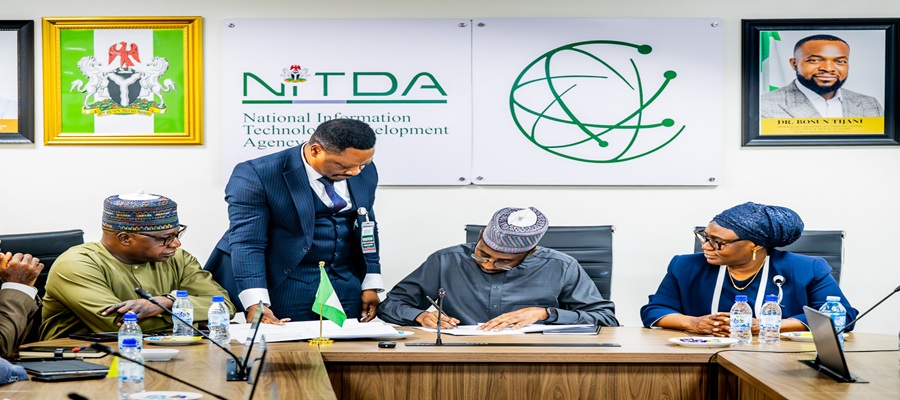
In a bold move to strengthen Nigeria’s digital sovereignty and the digital economy, the National Information Technology Development Agency (NITDA) has formally unveiled the National Sovereignty Cloud Initiative (NSCI) Regulatory Instruments, thereby setting a new benchmark for the country’s digital future.

NITDA
The NSCI is a strategic programme of the federal government coordinated by NITDA. It is designed to bolster Nigeria’s digital sovereignty and accelerate the country’s adoption of reliable cloud infrastructure. The initiative consists of the National Computing Guideline, the National Cloud Technical Guideline, the National Digital Infrastructure Assurance Framework, and the National Cloud Investment Strategy.
Speaking during the ceremony in Abuja, the Director General, Kashifu Inuwa Abdullahi CCIE, described the NSCI as a strategic move to safeguard Nigeria’s digital future. He noted that the instruments will stimulate innovation, encourage investment in local cloud services, and enhance digital resilience.
“These instruments provide the regulatory certainty, technical standards, and assurance framework required to build a trusted cloud ecosystem that safeguards Nigeria’s digital sovereignty while creating new opportunities for investment, innovation, and sustainable economic growth.
“We should position ourselves not to serve Nigeria alone, but to serve West and Central Africa. Nigeria is already the digital gateway to West Africa and can extend to every part of Africa. But we can only realise that goal when we build our infrastructure. So, today’s event is the first step in that direction,” he stated.
Abdullahi appreciated the support of relevant stakeholders and the efforts of the NSCI Technical Working Group, which culminated in the successful development of the regulatory instruments. He emphasised that collective action of regulatory agencies is necessary for a seamless implementation of the initiative.
Speaking earlier, the Permanent Secretary of the Ministry of Communications, Innovation, and Digital Economy, Engr. Nadungu Gagare, declared that the launch of the NSCI underscores the federal government’s commitment to safeguarding Nigeria’s data borders and digital economy.
“By ensuring that government data remains strictly within national jurisdiction and under local operational control, we are guaranteeing data sovereignty and regulatory compliance. It will catalyse local cloud capacity, foster local job creation, and empower indigenous investors and innovators to build solutions on a secure, locally hosted foundation,” Gagare said.
The Permanent Secretary commended the management team of NITDA, the NSCI Technical Working Group, and other stakeholders for their collaborative spirit in driving the initiative. He promised that the Ministry would ensure that the strategic objectives of the NSCI are fully realised across all ministries, departments, and agencies.
In a message, the Governor of the Central Bank of Nigeria (CBN), Dr Olayemi Cardoso, congratulated NITDA for promoting a collaborative approach, adding that modern digital regulation succeeds through coordinated regulatory actions for common national objectives.
Cardoso, who was represented by Dr. Rakiya Opemi Yusuf, the Director of the Payment System Supervision Department, acknowledged that the launch testifies to the robust collaboration existing between the apex bank and other government institutions.
“CBN regulates the financial ecosystem. NITDA provides the national framework for digital infrastructure, cloud governance and assurance. These responsibilities are complementary, not competing. Together, they create a coherent national architecture.
“Together with NITDA, and with the continued cooperation of industry, we will continue to build an ecosystem that protects Nigeria’s financial system today and positions our nation as Africa’s trusted hub for digital finance and cloud innovation.
One of the most encouraging aspects of today’s event is the strong institutional collaboration between NITDA, the CBN, and other relevant government institutions. This collaboration demonstrates an important principle.”
Cardoso reiterated that as a responsive regulator, the CBN remains committed to providing clear expectations, firm principles, proportionate implementation, and constructive engagement with all stakeholders to position Nigeria as Africa’s trusted hub for digital finance and cloud innovation.
Also, the Managing Director/CEO of Galaxy Backbone Limited, Prof. Ibrahim Adeyanju, noted that the NSCI couldn’t have come at a better time than now, especially considering CBN’s recent directive mandating banks and financial institutions to localise their data.
Adeyanju expressed confidence that the initiative would push the ecosystem to greater heights by encouraging investment, developing indigenous talent, and creating employment opportunities akin to the gains brought by the deregulation of the telecoms sector.
NITDA will constitute the Sovereign Cloud Governance Committee (SovGov) within the next two weeks to oversee the implementation of the NSCI. The committee would comprise representatives from relevant Government institutions, sector regulators, industry, and the private sector, with NITDA serving as the Secretariat

Dimension Data to Channel Funds to Support Nigerian Fibre Expansion

FG Commences 90,000km Fibre Optic Rollout within Weeks

Kaspersky Reveals a New Malicious Framework Targeting Cryptocurrency Users with the Use of OkoSpyware

PalmPay Targets Hong Kong IPO after $1Bn Valuation

NITDA Sets New Standards for Cloud Infrastructure with National Sovereignty Initiative

NRC, Ponzi Scheme Collapses Resulting Loss of Billions of Naira

From Scarcity to Scale: What Africa Can Learn from India’s Agricultural Transformation

EFCC Busts NIS Visa Overstay Racket, Uncovers N700m in an Account

BON Establishes Six Ad Hoc Committees to Modernize Broadcasting

NELFUND Investigates 34 Universities Over Students’ Missing Tuition Refunds




 News2 days ago
Atte, Nigerian Develops AI Algorithm for Hair Transplants

 News2 days ago
FG to Abolish Subsidies in Power Sector in 2027 – Minister

 E-Financial2 days ago
CBN Exposes over 13,000 BVNs Tied to Fraud as Banks Tighten Security

 E-Financial2 days ago
FCT Court Awards Ex-Customers N15m against Stanbic IBTC over Data Privacy Breach

 Telecom2 days ago
Starbase Technologies Introduces Yolly, a Reward-Based Social Entertainment Platform

 General News2 days ago
Dare Tackles Onaiyekan over Criticism of Tinubu, Says Economic is Working

 General News2 days ago
SERAP Asks Tinubu to Probe Alleged N6.79Bn Missing Police Funds, Firearms

 Telecom2 days ago
Adefolarin Ogunsanya and the Allegations of Shareholder Interference and Self-dealing @Pan African Towers