

Telecom
Mergers, Acquisition Loom in ISPs Space


There is strong indication that surviving Internet Service Providers (ISPs) are considering consolidation by way of mergers and acquisition as a fallout of the growing harsh operating environment in the country, Nigeria Communicationsweek has learnt.
Satis Kumar, chief operating officer, Direct On Data, said that traditional ISPs are presently facing unfavourable operating environment which has made the business unprofitable.
He identified the key challenges that include Network Operating Centres (NOC) expansion and power issues, bandwidth cost and base transceiver stations (BTS) issues – where tower operators they rent towers from charge them as much as N400,000 per month without efficient management of the towers.
“We have had a situation where security men attached to a tower refused to power generator because he was owed salary and our service went down. Bandwidth cost is still a challenge as some wholesale bandwidth companies that bought bulk from undersea cable operators are selling for $15,000 per Mbps if you buy direct from undersea operators you get $8,000. What we are doing now is ‘hand to mouth’ system.
The business runs to pay salaries and cost of operation nothing like profit, I see consolidation in this space through mergers and acquisition into big ISPs to be able to weather the storm of this harsh operating condition. There are some 100 licensed ISPs, today less than 20 percent are operating just to say that something is wrong and needs intervention,” he said.

Ajay Awasthi, chief executive officer, Spectranet, lamented poor service delivery by tower operators which is seriously affecting their business and urged Nigerian Communications Commission (NCC) to intervene through guideline to tower operators on the level of service delivery which if not met will attract sanction or none payment by the customer.
“Presently, the costs of delivering services aren’t coming down. This situation is not sustainable. We would like to roll out services across cities in Nigeria, but the situation at the moment does not give you the support to embark on such investments. The costs of building infrastructure are growing by 10%; that is huge costs to us. Also, some ISPs are facing the heat. They have contracted tower companies that charge for fees in dollars. I think it is very difficult this time to decide whether to go ahead and expand or stay put,” he noted.
 Engr. Olusola Teniola
Reacting on the need for policies to encourage ISPs, Engr. Olusola Teniola, president, Association of Telecommunications Companies of Nigeria (ATCON), said that ISP business is still viable if their approach is to address the niche areas of the market that are not threatening to the Mobile Network Operators (MNOs).
“There isn’t a policy in place in the world that restricts MNOs from offering a diverse set of services, especially when they are licensed to provide such services to their consumer base. What is required by NCC is a clear stance on how ‘Net neutrality’, zero rating and retail data pricing and fair usage policy of internet access should be addressed alongside the fact that voice calls are now transported in data packets, whether they are supplementary services such as being offered by OTT apps (i.e. WhatsApp, Skype or Viber etc) or Universal Access Services utilizing Voice-Over-IP (VoIP).
“The convergence of services further complicates the ability to formulate policies to define ‘garden walls’ whereby NCC attempts to define and control what and how competitors in a market are allowed to do in offering services that their consumers demand,” he said.


The Federal Government has backed moves to deregulate Nigeria’s airtime credit and data advance market, a step aimed at increasing indigenous participation, promoting competition and reducing capital flight from the country.

The move follows regulatory efforts by the Federal Competition and Consumer Protection Commission (FCCPC), which has advocated opening the market to Nigerian financial technology firms after years of dominance by foreign service providers.
Sources familiar with the development said President Bola Tinubu approved measures designed to dismantle the long-standing dominance of a South African technology firm, Optasia, in the airtime credit and data advance segment.
According to the sources, the FCCPC argued that the existing market structure had limited competition, restricted local participation and encouraged significant profit repatriation outside Nigeria.
The commission reportedly maintained that opening the sector would align with the Federal Government’s broader economic objectives of promoting local content, strengthening the digital economy, creating jobs and retaining more value within the domestic economy.
Optasia, formerly known as Channel VAS, has operated in the airtime credit and data advance market for about 12 years, providing services primarily to telecommunications operators, including MTN and some of its African affiliates.
The FCCPC is said to have raised concerns about the company’s operational structure and its contribution to Nigeria’s technology ecosystem despite its extensive activities within the country.
According to sources, the commission believes deregulation will encourage innovation, expand opportunities for indigenous fintech companies and support the implementation of the government’s Nigeria First Technology Policy.
“The commission’s position is that opening the market will promote competition, support local technology firms, create employment opportunities and reduce capital flight,” a source familiar with the matter said.
The deregulation initiative is also expected to deepen indigenous participation in Nigeria’s fast-growing fintech industry and reduce foreign exchange outflows associated with technology services.
Sources further disclosed that the FCCPC had presented the Presidency with a list of nine licensed Nigerian companies considered capable of providing airtime credit and data advance services in a competitive market environment.
The commission reportedly argued that local firms possess the technical expertise and operational capacity required to deliver the services currently dominated by foreign operators.
However, sources said Optasia had opposed the deregulation effort through legal and diplomatic channels.
According to the sources, the company has sought judicial intervention while also pursuing diplomatic engagements aimed at preserving its position in the market.
Despite those efforts, the Federal Government is said to have maintained its support for opening the sector to greater competition.
Industry stakeholders believe the move could reshape Nigeria’s digital financial services landscape by encouraging innovation, improving service delivery and creating new opportunities for indigenous technology firms.
Neither the Presidency, FCCPC nor Optasia had issued an official statement on the development as of the time of filing this report.
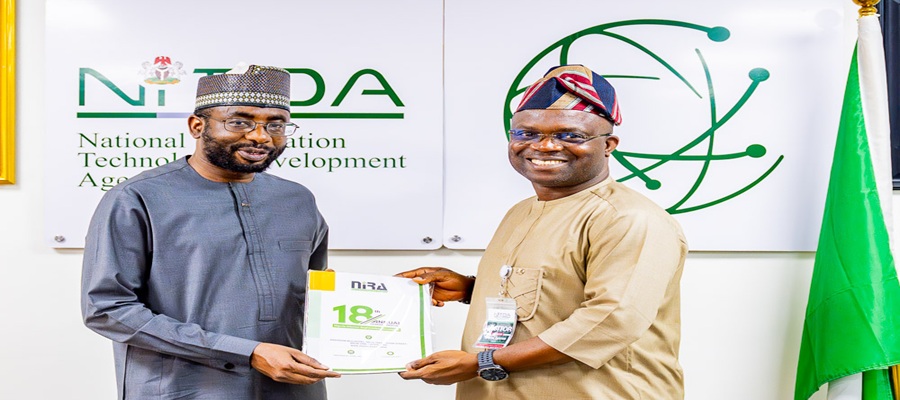
As part of its commitment to fast-track Nigeria’s digital economy, the National Information Technology Development Agency (NITDA) has officially approved the 2025 Annual Report and the 2026 Business Plan of the Nigeria Internet Registration Association (NiRA).

The Director General of NITDA, Kashifu Inuwa, receives the Nigeria Internet Registration Association (NiRA) Annual Report from its President, Adesola Akinsanya, after a briefing on the Association’s yearly activities, milestones, and ongoing efforts to strengthen Nigeria’s internet and digital landscape
The approval came during a meeting at NITDA headquarters where NiRA’s President, Mr. Adesola Akinsanya led his board members to present the association’s 2026 vision to NITDA Director General, Kashifu Inuwa, CCIE.
Following the approval, both organisations expressed the resolve to reinforce their collaborative efforts to ensure smooth, rapid execution of their shared goals of increasing the adoption of the .ng domain across
To actualise the business plan, the DG directed NiRA to work hand-in-hand with NITDA’s e-Governance and Digital Economy Department for effective implementation, daily updates, and project tracking.
“You have my full approval for these initiatives. Let us change our strategy, sync up more closely, and ensure everything we have agreed upon during this presentation is fully implemented by next year,” Inuwa declared.
Highlighting some of NiRA’s impressive achievements achievements over the past year, Akinsanya said 98,285 new registrations, 71,470 renewals, and 1,970 restorations were recorded in 2025, while there are 241,000 active domains.
Beyond the numbers, NiRA also implemented important security upgrades, including the Domain Name System Security Extensions (DNSSEC), for a more secure and resilient internet experience for local users, as well as improvements in registrar support and engagement.
Looking into the future, Akinsanya said NiRA is intensifying action to make .ng and .gov.ng domains the gold standard across the country. He expressed gratitude for NITDA’s ongoing support, calling for joint awareness campaigns and digital capacity-building to bring more state governments, local councils, and public institutions under the secure official domain.
Also, the NiRA president added that the association is updating its internal systems, introducing automation, and revising its constitution to meet globally acceptable standards to ensure sustainable growth.
“NiRA is looking into deeper stakeholder engagement and moving into areas where we see massive possibilities. We are specifically targeting startups and aligning with tech events across the country. With stronger collaboration, we can drive widespread adoption across every tier of government’’, Akinsanya said.

TikTok users in UK are being warned to keep an eye out for tax scams after two men were arrested in east London over an alleged scheme involving £153 million in fraudulent claims.

TikTok
The pair, aged 22 and 25, have been accused of luring Brits into giving away their personal tax details by offering financial rewards over the app.
Investigators believe they then used those details to lodge false claims worth tens of millions of pounds, claims which were ultimately blocked by HMRC.
The tax body is now urging social media users to be skeptical of posts that promise “risk-free” rewards in return for their tax information.
That information, HMRC warned, is then used to apply for fraudulent tax repayments. Because the criminals hide their identity, it is the person whose details were used who will owe money to HMRC as a result. Similar scams are also run on apps such as Instagram and Snapchat.
TikTokers arrested in London after ?running 153,000,000 tax scam? over app
Simon Grunwell, HMRC’s head of cybercrime investigations, told users to “protect your personal tax details in the same way you protect your bank details.”
He added: “Claims of quick, risk-free cash in return for sharing your personal information are a scam. They aim to defraud you and the taxpayer.”
The two Romanian men involved in the alleged TikTok scheme were arrested in Newham on April 23.
They were accused of offences under the Fraud Act, the Serious Crime Act, the Computer Misuse Act, and the Proceeds of Crime Act. Both have since been released on bail, and the investigation is ongoing

NITDA, Benin’s Digital Agency Strengthen Ties on Digital Transformation

IFC, NGX Group Unveil Nigeria Gender Programme

FG Targets Alleged N3tn Capital Flight, Opens Airtime Credit Market to Nigerian Fintechs

NITDA Backs NiRA’s Ambitious 2026 Plan to Drive Massive .ng Domain Adoption

TikTok Tax Scam Exposed: Two Arrested Over Alleged £153 Million Fraud Scheme

CPN Begins Crackdown on Quack IT Professionals, Vows Tougher Action against Cybercrime

FG to Launch Nationwide Free Digital TV Platform June 17

Jumia Nigeria Records Strong Q1 2026 Growth as Technology-Led Strategy Drives Market Expansion

MTN, Airtel, Glo Under Pressure as FG Demands Better Service Delivery

CBN Extends PoS Geo-Fencing Enforcement Deadline to August 2026




 Telecom2 days ago
Glo to Improve Customers’ Digital Lifestyle with “More Data, More Value” Package

 News2 days ago
London Strengthens Global Investment Ties with Africa @ First Ever London-Africa Business Summit

 Telecom2 days ago
Chinese Bank Supports Nigeria Towers Project

 E-Business2 days ago
FG Seeks Inclusive, Human-centred Artificial Intelligence Policies

 Telecom2 days ago
Moniepoint CEO Pushes New Credit Revolution for Millions of Nigerian Small Businesses

 Broadcasting2 days ago
NASENI Trains 50 Women in Kano on Renewable Energy Technologies Under She-Powers Initiative

 Telecom2 days ago
ESET Enhances Cybersecurity Awareness Among Lagos State MDAs Through Capacity-Building Programme

 Telecom2 days ago
ALTON Warns Fibre Vandalism, Multiple Taxation Threaten Telecom Service Quality and Growth