

News
Obiano Offers 2018 Technovation Challenge Winners Scholarship & N1m Each

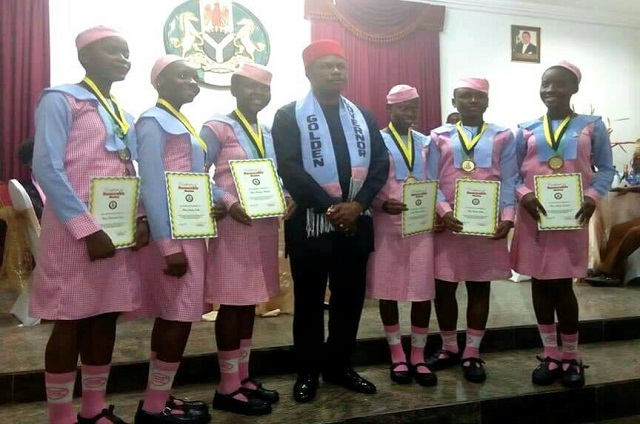
Chief Willie Obiano, Executive Governor of Anambra State, has offered scholarships to the young girls from Regina Pacis Model Secondary School Onitsha, Anambra State who won the Gold Medal at the World Technovation Challenge 2018 which took place in the Silicon Valley, San Francisco, USA.
A statement released by Mr James Eze, Special Adviser Media to the governor stated that the champions were also given a cash prize of N1m each and decorated with the Crest of Anambra State and issued a Certificate of Merit in recognition of the honour they had brought Anambra State, to Nigeria and to Africa.
Speaking at a colourful reception organised in honour of the girls at the Governor’s Lodge in Amawbia on Monday, Governor Obiano informed the parents of the Golden Girls of Nigeria that the Government of Anambra State had taken over the responsibility of their education up to the Bachelor’s Degree level.

Observing that the formal reception of the girls had fittingly coincided with the marking of the 27th anniversary of the creation of Anambra State, Governor Obiano declared that it was a double celebration for Ndi Anambra all over the world.
“Today, we celebrate our beloved state. And we celebrate our Golden Girls. Ndi Anambra, it is a double celebration for us all. We celebrate Adaeze Onuigbo, Vivian Okoye, Promise Nnalue, Nwabuaku Ossai, Jessica Osita and Miracle Igboka. And above all, we celebrate Mrs Uchenna Onwuamaegbu-Ugwu who moulded them into world-beaters. We celebrate you all,” Governor Obiano declared.
Describing them as “a group of amazing girls who recently dazzled the world with their talent,” Governor Obiano observed that “they have, therefore, turned this special day into Gold. They did it with their outstanding brilliance, their quest for knowledge and their search for a happier world. And I am immensely proud of them.”
Situating the actual significance of the feat achieved by the Golden Girls, Governor Obiano declared; “Ndi Anambra, our precious daughters have broken old stereotypes that have often shown black people as excelling mostly in football, athletics, music and the arts at the global state. Our girls have announced to the world that given the right environment and motivation, we can also contribute to science and innovation. In doing this, they have shown that Anambra is not a state with a Single Story. Indeed our stories are many and varied. Our stories are colourful!”

Speaking further, Governor Obiano maintained that any keen observer of Anambra State under his watch would have noticed the steady progress the state had recorded so far. “Our students have maintained a consistently excellent performance in all external examinations these past four years. In 2015, a group of five students that were randomly selected from public schools across Anambra State had won the Bronze Medal at the World Schools Debate Championship in Singapore.
“One year later, another set of students had also defeated the debate team of Katong Convent School in Singapore in a Mock Debate Contest. The golden performance of our girls at the World Technovation Challenge in San Francisco, USA is, therefore, a fitting climax to a narrative of excellence. It brings the relentless quest for high achievement by our children to a resounding success,” he stated.
Explaining that Anambra had stepped into a great moment in history, Governor Obiano further opined that “this moment is made special by the energy and zeal of our people and the outstanding talent that has started to find expression under my watch. My administration has resolved to reward hard-work and exceptional talent in order to encourage productivity and excellence. And we shall start with our Golden Girls today.”
He assured the girls that the State would continue to support them to ensure that they all bloom into different professions of their choice.
Also speaking, the mentor and coach of the girls, Uche Onwuamaegbu-Ugwu declared that she was not content with winning just once. Said she: “Winning for me is a vocation. When we repeat this feat next year and two years from now, that is winning for me. We cannot win just once. But we need a lot of support to keep winning. I love the celebration that has gone on across the world but in my head, I am thinking, how do we duplicate this? How do we reach other girls?
We can be champions forever. We cannot be champion today and it stops here.”
In his own words, the Senator representing Anambra Central Constituency, Senator Victor Umeh observed that the victory recorded by the girls at the 2018 World Technovation Challenge had put a seal on the claims that Governor Obiano’s campaign team made on education during the last gubernatorial election in the state.
Said he: “When news broke out on the day the girls won, it coincided with the day the governor gave out the sum of N350m again to mission schools. So, it is fair to say that the girls won because of the efforts of the governor of Anambra State.
Pointing out that Anambra was moving at a considerable speed, Senator Umeh argued that beating over 130 countries in a technological contest was not a mean achievement as it showed that in no distant time the state would be making all kinds of things.


The Chartered Institute of Bankers (CIBN) and the Association of Corporate Communication and Marketing Professionals in Banks (ACAMB) have enjoined banks to further deepen and prioritize financial inclusion, women’s empowerment and sustained growth through strategic mandates and frameworks, aimed at closing the financial gap and empowering more small, and medium enterprise (MSME) owners.

Both organisations made this call during a courtesy visit to the newly invested 24th President and Chairman of Council of the Chartered Institute of Bankers of Nigeria (CIBN), Dr. Dele Alabi, Ph.D, FCIB, as part of plans to congratulate him on his investiture as well as seek a stronger alliance between both bodies.
The visit followed Alabi’s investiture where he unveiled his “IMPACT” Vision, themed “Consolidating Our Local Impact, Enhancing Our Global Relevance.”
The vision rests on six pillars: Inclusion across geographic, gender, and generational lines; Membership growth and quality; Professionalism and ethics; Accountability; Competencies and skills development; Technology, automation, and innovation. Other areas of shared interest, include women empowerment, financial inclusion and literacy, as well as MSME clinics, all of which are top on his agenda.
Alabi explained that under him, the institute will be prioritising financial inclusion and women empowerment, because of its realisation that women are often the primary financial managers and caregivers in families. Access to savings, micro-credit, and insurance acts as a safety net during crisis and allows them to significantly improve living conditions.
He added that CIBN would be happy to drive joint knowledge sharing and exchange sessions with CBN and ACAMB across various platforms. “Educating the public through public awareness programmes, with ACAMB as the rallying point, is central to what we do,” he noted.
ACAMB President, Jide Sipe, who led the delegation, spoke in unison with the CIBN president, as he noted that, closing the inbalances in financial access help economies grow faster, reduces inequality, and encourages greater civic participation by all.


Lagos State has become the first sub-national government in Nigeria to establish a comprehensive Greenhouse Gas Registry, a move aimed at strengthening climate governance, improving emissions accountability and accelerating the state’s transition to a low-carbon economy.

The Lagos State Greenhouse Gas Registry (LGHGR) was unveiled at the Central Business District, Alausa, Ikeja, at a ceremony attended by Prof. Akin Abayomi, commissioner for Health, members of the State Executive Council, representatives of the Federal Ministry of Environment, development partners, TPHG Technologies, the diplomatic and business communities, academics, civil society organisations and the media.
Describing the initiative as a landmark achievement in the state’s environmental sustainability drive, Dr. Babatunde Ajayi, general manager of the Lagos State Environmental Protection Agency (LASEPA), said the Registry marks a defining moment in Lagos’ climate action journey and reflects Governor Babajide Sanwo-Olu’s commitment to building a resilient, climate-smart and environmentally sustainable economy.
According to Ajayi, the digital platform will enable the state to accurately measure, monitor, report and verify greenhouse gas emissions across key sectors, providing credible data to guide environmental policies and climate interventions.
He said the Registry would strengthen evidence-based decision-making, improve transparency and accountability, support national and international climate reporting obligations, unlock carbon market opportunities and boost investor confidence in Lagos’ environmental initiatives.
Ajayi also commended TPHG Technologies for providing the technical expertise that made the pioneering project possible.
Delivering the keynote address, Prof. Abayomi described the Registry as a major milestone that positions Lagos at the forefront of climate governance and emissions accountability in both Nigeria and Africa.
He noted that climate change has evolved into a significant public health and governance challenge, stressing that access to reliable emissions data would enable the state to formulate evidence-based policies, attract climate financing, strengthen resilience and accelerate its transition to a low-carbon economy.
Providing insights into the technical framework of the project, Dr. Mofoluso Fagbeja, lead consultant and chief executive officer, TPHG Technologies, explained that the Registry was developed from the greenhouse gas inventory jointly undertaken by LASEPA and TPHG Technologies in 2022, using 2019 as the baseline year for emissions assessment.
He said the platform is designed to close critical emissions data gaps, particularly within the industrial sector, while supporting effective climate policy implementation, emissions management and sustainable development.
Fagbeja also disclosed that the greenhouse gas inventory estimated that poor air quality contributes to about 35,000 premature deaths annually in Lagos, underscoring the urgent need for stronger emissions control measures and cleaner environmental practices.
In a goodwill message, Balarabe Abbas Lawal, minister of Environment, represented by Mrs. Adenaike Olunimpe Oludunni, federal controller of Environment in Lagos, commended Lagos State for pioneering the initiative, describing it as a significant contribution to Nigeria’s climate commitments.
He said the Registry aligns with the country’s Nationally Determined Contributions (NDCs) under the Paris Agreement and supports the Federal Government’s Energy Transition Plan, while reaffirming the ministry’s commitment to deeper collaboration with Lagos State on climate governance and environmental sustainability.

A recently released Henley Passport Index 2026, showed that Nigerian citizens can travel to at least 20 destinations outside the African continent where entry is allowed either visa-free, with a visa on arrival (VOA) at no extra cost, or via an e-visa.

This expanded access opens doors for Nigerian travellers to experience countries in the Caribbean, Asia, and beyond with greater ease.
Below is a comprehensive guide to countries outside Africa which Nigerian passport holders can visit without a traditional visa.
Visa-Free Countries outside Africa for Nigerian Passport Holders:
Barbados
Cambodia – Visa on arrival
Comoros Islands – Visa on arrival
Cook Islands
Dominica
Fiji
Haiti
Iran – Visa on arrival
Kiribati
Lebanon
Maldives – Visa on arrival
Micronesia
Montserrat
Niue – Visa on arrival
Palau Islands – Visa on arrival
Samoa – Visa on arrival
St. Kitts and Nevis
Timor-Leste – Visa on arrival
Tuvalu
Vanuatuul

Fact-Check: Elon Musk’s “Tesla Pi Phone” is Internet Rumor

Dangote Plans to Donate One-Third of Wealth to Charity as Legacy

NDPC Directs DCPMIs to Register with Agency or Face Legal Consequences

Malpass, Ex World Bank Chief Raises Alarm over Nigeria’s Secretive Debt Structures

How and Why Apps Deplete Data – ALTON

NRC, Ponzi Scheme Collapses Resulting Loss of Billions of Naira

EFCC Busts NIS Visa Overstay Racket, Uncovers N700m in an Account

Tokenization, Blockchain Technology will Transform Financial Institutions – IMF

From Scarcity to Scale: What Africa Can Learn from India’s Agricultural Transformation

BON Establishes Six Ad Hoc Committees to Modernize Broadcasting




 News2 days ago
See Verified 20 Countries Nigerian Passport Holders Can Travel Visa-Free

 E-Business2 days ago
Report Says Cybercriminals Deploy Malware to Hijack Crypto Wallets, Monitor Browsers Telegram

 Telecom2 days ago
NCC, REA Partner to Cut Telecom Costs with Renewable Energy

 Telecom2 days ago
Subscribers, Telcos Warn FCCPC over Airtime Lending Enforcement

 E-Business2 days ago
NPC Opens 131 Births, Deaths Registration Centres in Anambra

 General News2 days ago
AfDB, Nigeria Urge African Control of Mineral Resources

 General News2 days ago
Lagos Chamber Opposes 21 Percent Pension Contribution, Warns of Job Losses

 News1 day ago
History as Lagos Becomes First Nigerian State to Launch Greenhouse Gas Registry